当前位置:网站首页>leetcode 968. Monitoring binary tree
leetcode 968. Monitoring binary tree
2022-06-22 13:17:00 【A man of many ages】
Title Description
Given a binary tree , We put cameras on the nodes of the tree .
Each camera head on a node can monitor its parent object 、 Itself and its immediate children .
Calculate the minimum number of cameras required for all nodes of the monitoring tree .
Example 1: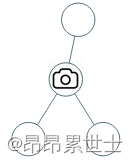
Input :[0,0,null,0,0]
Output :1
explain : As shown in the figure , One camera is enough to monitor all nodes .
Example 2:
Input :[0,0,null,0,null,0,null,null,0]
Output :2
explain : You need at least two cameras to monitor all the nodes in the tree . The image above shows one of the effective locations for the camera to be placed .
Tips :
The range of the number of nodes in a given tree is [1, 1000].
The value of each node is 0.
analysis
This topic is an interesting tree DP+ Greedy problem , And the difficulty is not small , Many people find it difficult to understand the solution . If you've done it before A dance without a boss and Strategy game These two questions , You may think this question is very similar to the strategy game , The strategy game is to see all the edges , This question is to monitor all the points , The same is true , But this question is more difficult .
Let's try the conventional idea first : Each node can choose whether to put the camera or not , If you have to put , Then place it ; Otherwise, take the minimum value of placing and not placing . in other words , For a node u Come on , If his parent node has not been covered by the camera , that u Node is to place a camera to monitor its parent node ( Here, consider whether it is really necessary to place ?), If u The parent node of is overwritten to , Just try it separately u Which of the two options is better to place or not to place . The flaw in this idea lies in , We can't determine the node u Whether the camera must be placed , Because even if its parent node is not overwritten ,u No placement , stay u Can also be monitored by placing on the sibling nodes of u Parent node ; But if we all want to let brother nodes play , As a result, both children didn't put a camera , The plan is illegal , So this kind of thinking doesn't work .
Think about linear DP problem , The state of a position , Or it can be transferred from its left position , Or it can be transferred from the right state , however The transition direction of the state must be unidirectional , This is a DP The state of having no aftereffect requirements . for instance f[2] from f[1] Roll out in turn affects f[1], This is clearly unreasonable . The reason to say this , It's because of the shape of the tree DP We can only do one-way state transition , Or only consider the state of the parent node , Or only consider the state of the child node , In this way, there can be a reasonable state transition sequence . The above idea is to consider only the state of the parent node to transfer , It turns out that it depends on the state of the sibling nodes , So it's not possible . Since it doesn't work from top to bottom , Try bottom-up . If you don't think of the irrationality of pushing the state from top to bottom , I don't understand why many people say that this problem should be calculated from the bottom up .
Get to the point . For the node u, We only deduce its state according to the state of its child node . There are three types of node states :
- 0 Means not covered by , That is, there is no camera in this position , The child node is not equipped with a camera
- 1 Means to be covered by , Explain that the child node has a camera , But it doesn't have a camera
- 2 Indicates that a camera is placed at this position , Nature is also covered
For the node u for :
If there is any child node that has not been overwritten ( Status as 0), that u A camera must be placed on the to ensure that the child is monitored , here u The state of is 2.( This is the difference between the top-down and bottom-up solutions , A node may have two children , But there is only one parent node , The parent node has no choice , Only cameras can be placed ).
If the status of its child nodes is 1, That is, it is covered by , Now? u It doesn't matter whether the child lives or dies , Just think about whether you can let it go , Choose not to place here . ** This is out of greed , because u Your child's status is 1, It means that there is no camera , The child node cannot monitor u, If in u Node placement camera , The monitoring range that can be increased is u and u Parent node ; If not u Place at , stay u Place the camera at the parent node of , The monitoring scope that may be increased is u and u Brother node of ,u The parent node of and u The grandfather node of ; Since they all add a camera , We naturally choose a wider range of options that can be increased , Such a scheme would be optimal . ** This situation u Do not place the camera , Nor can it be monitored by child nodes , State is 0. Of course, do not worry that this node will not be monitored , Because as long as u There are parent nodes , The child node cannot be monitored , There must be a camera .
If there are cameras installed in the child nodes , That is to say, the state is 2 The node of ,u The nodes are covered by , Naturally, there is no need to place a camera , It is also a greedy thought , here u The state of is 1, No camera is placed but can be covered .
u Up to two children , The state of their children is nothing more than the existence of at least one 0, All are 1, There is at least one 2 One of the three , The state division is not repeated . There is also a boundary problem to consider , That is, the state of the empty node ,NULL The node state of the is naturally not 2, Because it cannot monitor its parent node ; It's not a state 0, Because it does not need to be monitored by its parent node ; So its state is zero 1, It can be monitored but no camera is installed , This will not affect the leaf node and the degree is 1 The node state of .
The last two questions . How to conduct state transition from bottom to top ? The order of state transition is from the left and right subtrees to the root node , So the state transition can be carried out in the order of subsequent traversal . The second question is , We can define one dfs Function to find dfs(u), That is to say, return to u After the state transition for the subtree of the root u The state of , If in the end u The state of is 0 What to do with ? We move from bottom to top , Each state is only responsible for the child node , Not responsible for the parent node , So if the last root node is not overwritten , Add a camera .
One of the subtleties of this code is dfs Only return u The final state of , During traversal, if the status is 2 The number of nodes is increased , So the final count is the number of cameras .
The code of this topic is very simple , The analysis process is complex , If you can feel the subtlety of the analysis process , Believe in the tree DP The understanding of is very rewarding .
Code
/**
 * Definition for a binary tree node.
 * struct TreeNode {
 *     int val;
 *     TreeNode *left;
 *     TreeNode *right;
 *     TreeNode() : val(0), left(nullptr), right(nullptr) {}
 *     TreeNode(int x) : val(x), left(nullptr), right(nullptr) {}
 *     TreeNode(int x, TreeNode *left, TreeNode *right) : val(x), left(left), right(right) {}
 * };
 */
class Solution {
public:
    int res = 0;
    int dfs(TreeNode* root) {
        if(!root)   return 1;// Can be covered by
        int l = dfs(root->left);
        int r = dfs(root->right);
        if(l == 0 || r == 0) {
            res++;
            return 2;// Place the camera
        }
        if(l == 2 || r == 2)    return 1;// Can be covered by
        return 0;// Cannot be overwritten ,l = r = 1
    }
    int minCameraCover(TreeNode* root) {
        if(!dfs(root))   res++;
        return res;
    }
};
边栏推荐
- SAP system license viewing application and import
- AcWing 241 楼兰图腾(树状数组详解)
- MySQL_ Create and manage tables
- JAXB元素详解
- Alicloud disk performance analysis
- 310. Minimum Height Trees
- 241. Different Ways to Add Parentheses
- In June, China database industry analysis report was released! Smart wind, train storage and regeneration
- leetcode 829. 连续整数求和
- MySQL中触发器
猜你喜欢

leetcode 834. 树中距离之和

SSM based community garbage classification and transportation management system, high-quality graduation thesis example (can be used directly), source code, database script, project introduction and o

In C # development, the third-party components lambdaparser, dynamicexpresso and z.expressions are used to dynamically parse / evaluate string expressions

SAP development keys application SSCR keys application
The Chinese display of SAP client is garbled

Sap-abap- how to find a table and what related tables the fields have

Uninstall MySQL 8

Arcpy 添加图层到地图文档

Redis active / standby configuration dockercompose version
130. Surrounded Regions
随机推荐
卸载MySQL 8
基于SSM的图书馆管理系统,高质量毕业论文范例(可直接使用),项目导入视频,附送源码和数据库脚本,论文撰写教程
338. Counting Bits
MySQL 5.7 + Navicat download and installation tutorial (with installation package)
Secondary development of robotframework -- socket push real-time log
If Tiankeng majors learn IC design by themselves, will any company want it
RCE&代码执行漏洞
leetcode 829. 连续整数求和
Fluentd is easy to get started. Combined with the rainbow plug-in market, log collection is faster
SAP 开发Keys 申请SSCR Keys申请
PostGIS through St_ Dwithin retrieves elements within a certain distance
Reconstruction practice of complex C-end project of acquisition technology
Termux set up the computer to connect to the mobile phone. (knock the command quickly), mobile phone termux port 8022
Tips of setup in robotframework
leetcode 第 297 场周赛
769. Max Chunks To Make Sorted
693. Binary Number with Alternating Bits
假如,程序员面试的时候说真话
Redis active / standby configuration dockercompose version
Writing a contract testing tool from scratch -- database design