当前位置:网站首页>Mutex of thread synchronization (mutex)
Mutex of thread synchronization (mutex)
2022-06-26 04:05:00 【StudyWinter】
1 The concept of synchronization
So called synchronization , That is to start at the same time , To coordinate . Different objects , Yes “ Sync ” There is a slight difference in the way we understand it . Such as , Device synchronization , A common time reference is defined between two devices ; Database synchronization , It refers to keeping the contents of two or more databases consistent , Or keep the parts consistent as needed ; File synchronization , It refers to keeping the files in two or more folders consistent, etc .
And programming 、 The concept of synchronization in communication is slightly different from that in people's impression in life .“ Same as ” The word should mean synergy 、 assist 、 Cooperate with each other . The main idea is to coordinate the pace , Run in a predetermined order .
2 The concept of thread synchronization
Synchronization is co synchronization , Run in a predetermined order . Thread synchronization , When a thread makes a function call , Before we get results , The call does not return . At the same time, other threads to ensure data consistency , This function cannot be called .
“ Sync ” Purpose , To avoid data confusion , Resolve time related errors . actually , Not only do threads need to be synchronized , Interprocess 、 Synchronization mechanism is needed between signals . therefore , all “ Multiple flow control , Operate a shared resource together ” The situation of , All need to be synchronized .
3 Why thread synchronization

- Shared resources , Multiple threads can operate on shared resources [ It's prone to conflict ]
- The sequence of thread operations on shared resources is uncertain
- cpu Processor operations on memory are generally not atomic operations
for instance :
Both threads increase the global variable 1, This operating platform requires three instructions to complete .
Read from memory to register → Register value plus 1 → Write the value of the register to memory .
If the thread at this time A The value is not written to the memory when the register is modified , Threads B Just fetching from memory will cause two operations to be actually modified only once . In other words, what the next thread does overwrites what the previous thread did . The thread was actually executed once .
4 The mutex mutex
4.1 Basic concepts
- Linux Provides a mutex in mutex( It's also called mutex ).
- Each thread tries to lock before operating on the resource , Only when the lock is successfully applied can it be operated , End of operation unlock .
- Resources are still shared , Threads are also competing , But through “ lock ” Turn resource access into mutex operation , And then there's no more time-related mistakes .
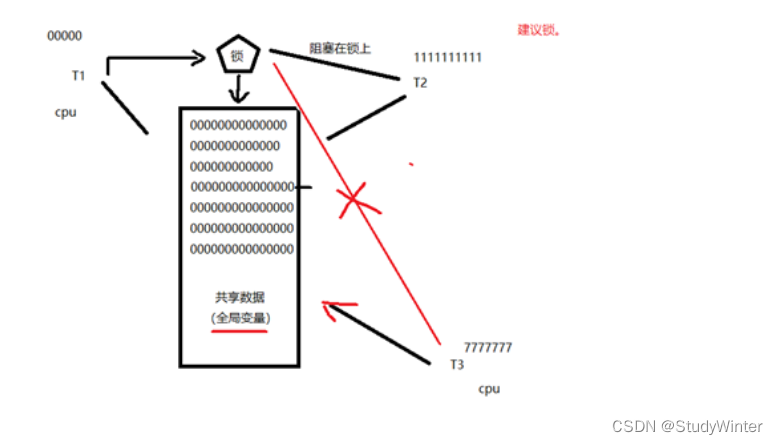
Use of locks : Recommended lock ! Protect public data . All threads 【 should 】 Take the lock before accessing public data . but , The lock itself is not mandatory .
4.2 Manage shared data to achieve synchronization with the help of mutex lock
Main application function :
pthread_mutex_init
pthread_mutex_destory
pthread_mutex_lock
pthread_mutex_trylock
pthread_mutex_unlock
above 5 The return value of each function is : Successfully returns 0, Failure returns error number .pthread_mutex_t type , Its essence is a structure . To simplify understanding , The implementation details can be ignored in application , Simply look at it as an integer .pthread_mutex_t mutex; Variable mutex There are only two values :0,1.

Use mutex( The mutex 、 The mutex ) General steps 【 a key 】
pthread_mutex_t  type .
1 pthread_mutex_t lock;  Create a lock
2 pthread_mutex_init;  initialization  1
3 pthread_mutex_lock; Lock  1-- --> 0
4  Access shared data (stdout)
5 pthrad_mutext_unlock(); Unlock  0++ --> 1
6 pthead_mutex_destroy; Destroy the lock
pthread_mutex_init function
int pthread_mutex_init(pthread_mutex_t *restrict mutex,
                       const pthread_mutexattr_t *restrict attr)
//  there restrict keyword , Indicates that the content pointed to by the pointer can only be modified through this pointer
// restrict keyword :
//  Used to limit pointer variables . The memory operation pointed to by the pointer variable qualified by this keyword , Must be done by this pointer .
Initialize mutex :
pthread_mutex_t mutex;
pthread_mutex_init(&mutex, NULL);                      //  The first 1 Kind of : dynamic initialization .
pthread_mutex_t mutex = PTHREAD_MUTEX_INITIALIZER;     //  The first 2 Kind of : initiate static
pthread_mutex_destroy function
Destroy a mutex
int pthread_mutex_destroy(pthread_mutex_t *mutex);pthread_mutex_lock function
Lock . It can be understood that mutex--( or -1), After the operation mutex The value of is 0 .
int pthread_mutex_lock(pthread_mutex_t *mutex);pthread_mutex_unlock function
Unlock . It can be understood that mutex ++( or +1), After the operation mutex The value of is 1.
int pthread_mutex_unlock(pthread_mutex_t *mutex);pthread_mutex_trylock function
Try to lock
int pthread_mutex_trylock(pthread_mutex_t *mutex);Lock and unlock
lock And unlock:
lock Try to lock , If locking fails , Thread blocking , Block until other threads holding the mutex are unlocked .
unlock Active unlocking function , At the same time, all threads blocked on the lock will be awakened , As for which thread is awakened first , It depends on the priority 、 Dispatch . Default : Block first 、 Wake up first .
for example : T1 T2 T3 T4 Use a mutex lock . T1 Locking success , Other threads are blocked , until T1 Unlock . T1 After unlocking , T2 T3 T4 All awakened , And automatically try locking again .
But imagine mutex lock init The initial value of success is 1. lock The function is to mutex--. and unlock Will mutex++.
lock And trylock:
lock Lock failure blocks , Wait for the lock to release .
trylock If the lock fails, the error number will be returned directly ( Such as : EBUSY), Don't block .
Use the lock to realize mutual exclusive access to the shared area :
#include <stdio.h>
#include <stdlib.h>
#include <string.h>
#include <unistd.h>
#include <pthread.h>

//  Define global mutexes
pthread_mutex_t mutex;

//  Initialize mutex
// mutex = PTHREAD_MUTEX_INITIALIZER;

void *tfn(void *arg)
{
    srand(time(NULL));
    int res;
    while (1)
    {
        //  Lock
        res = pthread_mutex_lock(&mutex);
        if (res != 0)
        {
            fprintf(stderr, "pthread_mutex_lock error:%s\n", strerror(res));
            exit(1);
        }
        printf("hello");
        //  Simulate long time operation, share resources
        sleep(rand() % 3);
        printf("world\n");
        //  Unlock
        res = pthread_mutex_unlock(&mutex);
        if (res != 0)
        {
            fprintf(stderr, "pthread_mutex_unlock error:%s\n", strerror(res));
            exit(1);
        }
        sleep(rand() % 3);
    }
    return NULL;
}

int main(int argc, char **argv)
{
    //  Define the thread
    pthread_t tid;
    srand(time(NULL));

    //  Initialize mutex
    int res = pthread_mutex_init(&mutex, NULL);
    if (res != 0)
    {
        fprintf(stderr, "pthread_mutex_init error:%s\n", strerror(res));
        exit(1);
    }

    //  Create thread
    res = pthread_create(&tid, NULL, tfn, NULL);
    if (res != 0)
    {
        fprintf(stderr, "pthread_create error:%s\n", strerror(res));
        exit(1);
    }

    while (1)
    {
        //  Lock
        res = pthread_mutex_lock(&mutex);
        if (res != 0)
        {
            fprintf(stderr, "pthread_mutex_lock error:%s\n", strerror(res));
            exit(1);
        }
        printf("HELLO");
        //  Simulate long time operation, share resources
        sleep(rand() % 3);
        printf("WORLD\n");
        //  Unlock
        res = pthread_mutex_unlock(&mutex);
        if (res != 0)
        {
            fprintf(stderr, "pthread_mutex_unlock error:%s\n", strerror(res));
            exit(1);
        }
        sleep(rand() % 3);
    }

    //  Recycle thread
    pthread_join(tid, NULL);

    //  Destroy mutex
    res = pthread_mutex_destroy(&mutex);
    if (res != 0)
    {
        fprintf(stderr, "pthread_mutex_unlock error:%s\n", strerror(res));
        exit(1);
    }
    return 0;
}
perform
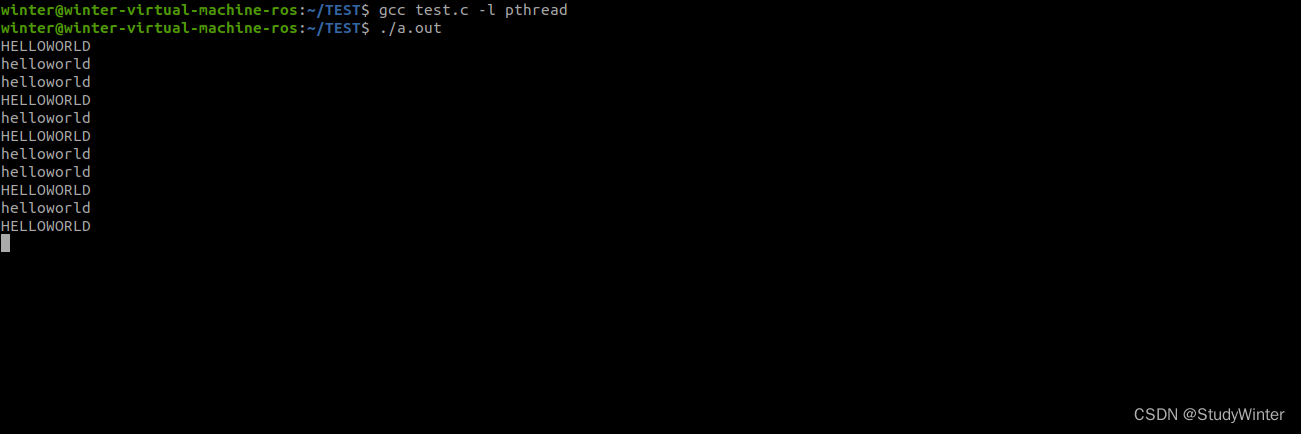
You can see , When the main thread and the sub thread access the shared area, there is no cross output .
4.3 Tips for using mutex
matters needing attention :
Try to ensure the granularity of the lock , The smaller the better. .( Before accessing shared data , Lock . Access to the end 【 immediately 】 Unlock .)
The mutex , The essence is the structure . We can think of it as an integer . The initial value is 1.(pthread_mutex_init() Function call succeeded .)
Lock : -- operation , Blocking threads .
Unlock : ++ operation , Wake up the thread blocked on the lock .
try lock : Try to lock , success --. Failure , return . Set the error number at the same time EBUSY
边栏推荐
- I/O 虚拟化技术 — VFIO
- Open camera anomaly analysis (I)
- Spark - 一文搞懂 parquet
- What's wrong with connecting MySQL database with eclipse and then the words in the figure appear
- [Flink] Flink source code analysis - creation of jobgraph in batch mode
- Question brushing record day01
- Ipvs0 network card of IPVS
- Camera memory memory leak analysis (III)
- Part 4: drawing quadrilateral
- 钉钉开放平台-小程序开发实战(钉钉小程序服务器端)
猜你喜欢

In 2022, what professional competitions can college students majoring in automation, electrical engineering and automation participate in?

用eclipse连mysql数据库出错然后出现图中的话是咋回事呀

钉钉开放平台-小程序开发实战(钉钉小程序服务器端)
![[Flink] Flink batch mode map side data aggregation normalizedkeysorter](/img/c7/611c7207730555b510505d4a8efe3d.png)
[Flink] Flink batch mode map side data aggregation normalizedkeysorter

How does virtual box virtual machine software accelerate the network speed in the virtual system?

Unity mobile game performance optimization spectrum CPU time-consuming optimization divided by engine modules

Judge the same value of two sets 𞓜 different values

使用Jsoup提取接口中的图片

Dix critères de base importants pour les essais de débogage de logiciels

線程同步之讀寫鎖
随机推荐
商城风格也可以很多变,DIY 了解一下
VHDL design
Unity mobile game performance optimization spectrum CPU time-consuming optimization divided by engine modules
Introduction Guide to the flutterplugin plug-in in the actual combat of flutter
三元损失英文版
Detailed explanation of widget construction process of fluent
asp.net网页选择身份进行登录的简单代码,asp连接数据库,使用asp:Panel、asp:DropDownList控件
How does virtual box virtual machine software accelerate the network speed in the virtual system?
钉钉开放平台-小程序开发实战(钉钉小程序服务器端)
Camera memory memory leak analysis (III)
开源!ViTAE模型再刷世界第一:COCO人体姿态估计新模型取得最高精度81.1AP
Read / write lock for thread synchronization
Dix critères de base importants pour les essais de débogage de logiciels
力扣 515. 在每个树行中找最大值
Link monitoring pinpoint
【MySQL】 MySQL 导出数据库
【掘金运营套路揭露】真心被掘金的套路....
【Flink】Flink Sort-Shuffle写流程简析
DETR3D 多2d图片3D检测框架
外包干了四年,人直接废了。。。