当前位置:网站首页>Simple demo of solving BP neural network by gradient descent method
Simple demo of solving BP neural network by gradient descent method
2022-07-03 08:21:00 【Old cake explanation BP neural network】
Original article , Reprint please indicate from 《 Old cake explains neural networks 》:bp.bbbdata.com
About 《 Old cake explains neural networks 》:
This website structurally explains the knowledge of Neural Networks , Principle and code .
repeat matlab Algorithm of neural network toolbox , It is a good assistant for learning neural networks .
Catalog
01.BP Structure and bionic thinking of
02. frequently-used BP structure
03. BP The mathematical structure of ( expression )
Two 、 The gradient descent method is used to solve the problem BP neural network
05. Test the effect of the model
The first part of this article introduces BP Model structure and mathematical expression of neural network ,
The second part introduces the gradient descent method to solve BP Specific examples and codes of Neural Networks ( Does not rely on any third party packages ).
The layout is messy , No longer adjust , If you need it, you can check it directly on the original network .
One 、BP Model is introduced
01.BP Structure and bionic thinking of
BP The idea is to imitate the working principle of human brain , Construct a mathematical model ,
Its bionic structure is as follows ( Also known as BP Neural network topology )

structure
its The structure consists of three layers , The top one is the input layer , In the middle is the hidden layer ( There can be multiple hidden layers , Each hidden layer can have multiple neurons ), Finally, the output layer .
Workflow
(1) The input layer is responsible for receiving input , After the input layer receives the input , Each input neuron will transfer the value weight to each hidden layer neuron ,
(2) Each hidden neuron receives the value transmitted by the input neuron , With its own basic threshold b Summation summation , After an activation function ( Usually the activation function is tansig function ), Then the weighting is transmitted to the output layer .
(3) The output neuron compares the value transmitted by each hidden neuron with its own threshold b Sum up ( After summation, it can also go through another layer of transformation ), That is, the output value .
Bionic principle
See symbols in your eyes “5” After , The brain will recognize that it is 5.BP It is to imitate this behavior . This behavior process is simply divided into :
(1) The eyes accept the input
(2) Transmit input signals to other brain neurons
(3) After comprehensive processing of brain neurons , The output is 5
We all know , Neurons transmit values in the mode of nerve impulse , The signal reaches the neuron , All exist in the form of electrical signals ,
When electrical signals accumulate in neurons above the threshold , Will trigger nerve impulses , Transmit electrical signals to other neurons .
According to this principle , The above neural network structure is constructed .
02. frequently-used BP structure
Above is the general structure , Number of hidden layers 、 Activation functions are undetermined .
Most commonly used , Is to set a hidden layer ,
The activation function of hidden layer neurons is set to tansig function ,
The activation function of the output layer is set to purelin
In this way , The structure is shown in the figure below :
among ,
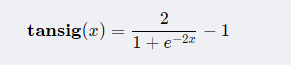
tansig Function is S Type of function :
purelin Is an identical linear mapping function :
PASS:
1、 The output layer is set to purelin, That is, there is no active function in the output layer .
2、 The hidden layer activation function can also be set to logsig :, It and tansig There are not many qualitative differences . The difference lies in ,logsig The range of phi is zero 【0,1】, and tansig yes 【-1,1】.


 , It and tansig There are not many qualitative differences . The difference lies in ,logsig The range of phi is zero 【0,1】, and tansig yes 【-1,1】.
03. BP The mathematical structure of ( expression )
ad locum , We do not provide a general mathematical structure ,
Just take a simple example , Tell about its mathematical structure , This is more specific and easy to understand .
There is one BP neural network , Its structure is as follows :
1、 An input layer , A hidden layer , An output layer , Input layer 、 Cryptic layer 、 The number of nodes in the output layer is [2 ,3,1].
2、 Transfer function settings : Cryptic layer ( tansig function ). Output layer (purelin function ).
The model topology is as follows :
The mathematical expression can be written according to the model as follows :
PASS: There are many parameters in the expression , But there are only two types of parameters : The weight w And thresholds b.Representing this weight is the... Th 2 Layer of the first 2 Nodes to 3 Layer of the first 1 Weight of nodes .
This threshold is the second 2 Layer of the first 1 Threshold of nodes .
remarks : Weight matrices w The subscript , Generally from the back layer to the front layer , This is more concise in matrix expression

 Representing this weight is the... Th 2 Layer of the first 2 Nodes to 3 Layer of the first 1 Weight of nodes .
  This threshold is the second 2 Layer of the first 1 Threshold of nodes .
 Two 、 The gradient descent method is used to solve the problem BP neural network
01 . problem
The following data are available :
y It's actually from
Generate
Now? , We need to train a neural network , Fit it , Last , We'll talk to

 Generate
 02. Modeling ideas
Set up neural network structure
Here we set it as a hidden layer ,3 Hidden neurons , The hidden layer activation function is tansig,
Then our network topology is as follows :
The mathematical expression of the corresponding model is :


Loss function and gradient
The loss function is :

Cryptic layer --> The weight of the output layer 、 The threshold gradient of the output layer is :
among ,Is the activation value of the hidden layer ,
Is the node gradient of the output layer :


 Is the activation value of the hidden layer ,
  Is the node gradient of the output layer :
Cryptic layer --> The weight of the output layer 、 The threshold gradient of the hidden layer is :
among ,Is the node gradient of the hidden layer :


 Is the node gradient of the hidden layer :
count Law flow cheng
Initialize first W,b,
(1) Calculate the gradient according to the gradient formula
(2) take W Adjust in the direction of negative gradient
Keep cycling (1) and (2), Until the termination conditions are met ( For example, the maximum number of iterations is reached , Or the error is small enough )
03. Code implementation
close all;clear all;
%----------- data ----------------------
x1 = [-3,-2.7,-2.4,-2.1,-1.8,-1.5,-1.2,-0.9,-0.6,-0.3,0,0.3,0.6,0.9,1.2,1.5,1.8];% x1:x1 = -3:0.3:2;
x2 = [-2,-1.8,-1.6,-1.4,-1.2,-1,-0.8,-0.6,-0.4,-0.2,-2.2204,0.2,0.4,0.6,0.8,1,1.2]; % x2:x2 = -2:0.2:1.2;
X  = [x1;x2];      %  take x1,x2 As input data
y  = [0.6589,0.2206,-0.1635,-0.4712,-0.6858,-0.7975,-0.8040,...
    -0.7113,-0.5326,-0.2875 ,0.9860,0.3035,0.5966,0.8553,1.0600,1.1975,1.2618];    % y: y = sin(x1)+0.2*x2.*x2;

%-------- Parameter setting and constant calculation -------------
setdemorandstream(88);
hide_num = 3;
lr = 0.05;
[in_num,sample_num] = size(X);
[out_num,~] =  size(y);

%-------- initialization w,b And forecast results -----------
w_ho = rand(out_num,hide_num);   %  Weight from hidden layer to output layer
b_o  = rand(out_num,1);          %  Output layer threshold
w_ih = rand(hide_num,in_num);    %  Input layer to hidden layer weight
b_h  = rand(hide_num,1);         %  Hidden layer threshold
simy = w_ho*tansig(w_ih*X+repmat(b_h,1,size(X,2)))+repmat(b_o,1,size(X,2)); %  Predicted results
mse_record = [sum(sum((simy - y ).^2))/(sample_num*out_num)];  %  Prediction error record

% --------- Training with gradient descent ------------------
for i = 1:5000
    % Calculate the gradient
    hide_Ac = tansig(w_ih*X+repmat(b_h,1,sample_num)); %  Hidden node activation value
    dNo     = 2*(simy - y )/(sample_num*out_num);      %  Output layer node gradient
    dw_ho   = dNo*hide_Ac';                            %  Cryptic layer - Output layer weight gradient
    db_o    = sum(dNo,2);                              %  Output layer threshold gradient

    dNh     = (w_ho'*dNo).*(1-hide_Ac.^2);             %  Hidden layer node gradient
    dw_ih   = dNh*X';                                  %  Input layer - Hidden layer weight gradient
    db_h    = sum(dNh,2);                              %  Hidden layer threshold gradient

    % Update to a negative gradient w,b
    w_ho = w_ho - lr*dw_ho;                            %  Update hidden layer - Output layer weight
    b_o  = b_o  - lr*db_o;                             %  Update the output layer threshold
    w_ih = w_ih - lr*dw_ih;                            %  Update input layer - Hidden layer weight
    b_h  = b_h  - lr*db_h;                             %  Update hidden layer threshold

    %  Calculate the network prediction results and record errors
    simy = w_ho*tansig(w_ih*X+repmat(b_h,1,size(X,2)))+repmat(b_o,1,size(X,2));
    mse_record =[mse_record, sum(sum((simy - y ).^2))/(sample_num*out_num)];
end

% ------------- Draw training results and print model parameters -----------------------------
h = figure;
subplot(1,2,1)
plot(mse_record)
subplot(1,2,2)
plot(1:sample_num,y);
hold on
plot(1:sample_num,simy,'-r');
set(h,'units','normalized','position',[0.1 0.1 0.8 0.5]);
%-- Model parameters --
w_ho   %  Weight from hidden layer to output layer
b_o    %  Output layer threshold
w_ih   %  Input layer to hidden layer weight
b_h    %  Hidden layer threshold
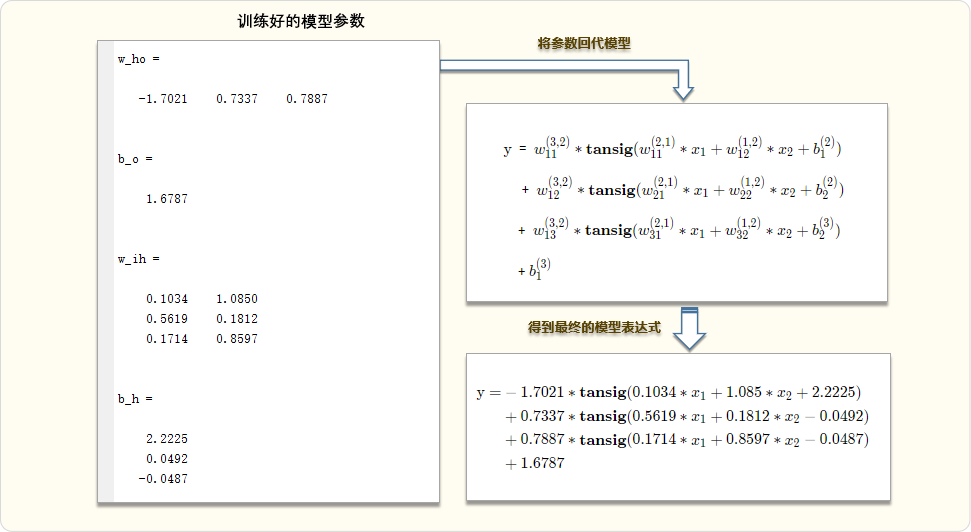
04. Running results

05. Test the effect of the model
Use x =[0.5,0.5] To test ,
Model predictions
take x =[0.5,0.5] Substitute the above network model expression , obtain 0.6241

The real result
take x =[0.5,0.5] Substitute real relationshipsGet in 0.5294 .
 Get in 0.5294 .
Analysis of prediction results
The predicted value of the network 0.6241 And the real value 0.5294 error 0.0946.
This error is not too big , But it's not small .
As a whole , Model training has certain effect , It shows that the algorithm is feasible .
PASS: Why is the training data so good , There is still such a big gap in the predicted value ? Can readers figure it out ? Can it be improved ? How can we improve ?
important clause : The realization of the whole solution process of the above gradient descent method , It's very rough , Just as a reference for getting started .
Related articles
《BP Neural network gradient derivation 》
《BP The mathematical expression extracted by neural network 》
边栏推荐
- Ue5 opencv plug-in use
- Oracle insert single quotation mark
- My touch screen production "brief history" 1
- Easy touch plug-in
- Golang json格式和结构体相互转换
- 十六进制编码简介
- 796 · 开锁
- Creation of osgearth earth files to the earth ------ osgearth rendering engine series (1)
- [set theory] order relation (the relation between elements of partial order set | comparable | strictly less than | covering | Haas diagram)
- What is BFC?
猜你喜欢
详解sizeof、strlen、指针和数组等组合题
C语言-入门-精华版-带你走进编程(一)

I want to do large screen data visualization application feature analysis

Some understandings of 3dfiles
the installer has encountered an unexpected error installing this package

C course design employee information management system
matlab神经网络所有传递函数(激活函数)公式详解
![P1596 [USACO10OCT]Lake Counting S](/img/a7/07a84c93ee476788d9443c0add808b.png)
P1596 [USACO10OCT]Lake Counting S

Redis data structure

Unity2019_ Natural ambient light_ Sky box
随机推荐
Golang json格式和结构体相互转换
How to establish rectangular coordinate system in space
KunlunBase MeetUP 等您来!
Pulitzer Prize in the field of information graphics - malofiej Award
【音视频】ijkplayer错误码
C#课程设计之学生教务管理系统
[usaco12mar]cows in a skyscraper g (state compression DP)
Exe file running window embedding QT window
CLion-Toolchains are not configured Configure Disable profile问题解决
My touch screen production "brief history" 2
Golang中删除字符串的最后一个字符
[updating] wechat applet learning notes_ three
Luaframwrok handles resource updates
Oracle insert single quotation mark
Redis data structure
Some understandings of 3dfiles
Xlua task list youyou
Chain length value
[set theory] order relation (the relation between elements of partial order set | comparable | strictly less than | covering | Haas diagram)
Shader foundation 01