since 2005 Since then , The Medical Association has always opposed the detection of bacteria in urine culture but no urinary tract infection (UTI) People who show signs regularly use antibiotics , Such as burning sensation or frequent urination . There is a great deal of evidence that , These drugs are ineffective for asymptomatic patients , Instead, it will cause diarrhea 、 vomiting 、 Side effects such as skin rash and yeast infection . In rare cases , Because there are too many harmful bacteria Clostridium difficile in the colon , Antibiotics can even cause death . The overuse of these drugs has also led to an increase in bacterial infections , Because of its resistance to antibiotics , These bacterial infections are difficult to treat , Sometimes even fatal .
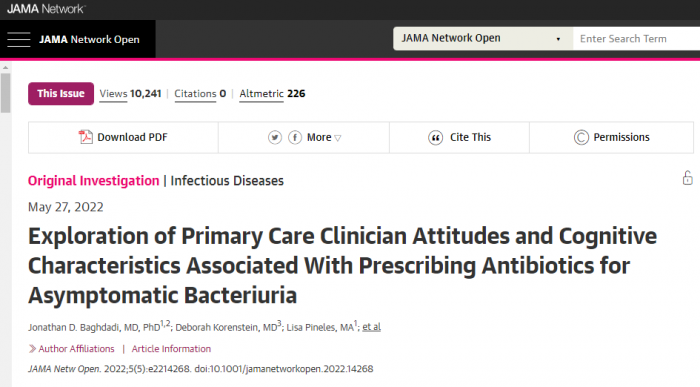
In this study , From Texas 、 Mid Atlantic and Pacific Northwest 723 Primary care professionals were asked how they would treat a fictional asymptomatic patient with bacteriuria , That is, bacteria were detected in the urine of a patient without signs of urinary tract infection . They found that , Although doing so is contrary to the recommended guidelines , But in 551 Of the doctors who responded to the study ,392 name (71%) Would choose to treat such patients with antibiotics .
“ Our research shows that , Primary care doctors do not follow widely accepted recommendations , Do not prescribe antibiotics for asymptomatic bacteriuria ,” Lead author 、UMSOM Assistant professor of epidemiology and public health Jonathan Baghdadi "Said Dr. .“ Some primary care physicians may not be aware of these recommendations , But inappropriate prescription culture may also be a contributing factor .”
Compared with other majors , Family doctors are more likely to prescribe unnecessary antibiotics . Doctors who work as residents or live in the Pacific Northwest are less likely to use antibiotics .
“ We found that other factors also play a role in the prescription , For example, whether doctors are more inclined to over treat certain diseases and fear of missing diagnosis ; Compared with those doctors who are more comfortable with the uncertainty in practicing medicine , That person is more likely to prescribe antibiotics ,” Research Director 、 Doctor of Medicine 、UMSOM Professor of epidemiology and public health Daniel Morgan say .
The researchers said in the conclusion of the article , One strategy for changing practice may be for doctors who attach great importance to treatment education plan , To make sure they don't miss out on possible infections . for example , Antibiotic “ Unnecessary treatment ” Reshaped into antibiotics “ Potentially harmful ” Treatment , It may help to curb the trend of over prescribing drugs .
UMSOM Of the faculty Lisa Pineles、Alison Lydecker、Larry Magde and Deborah Stevens Is a co-author of the study . From the University of Colorado School of medicine and memorial Sloan - Researchers at Caitlin cancer center also contributed to this study .
The study won the National Institutes of health innovator award and the University of Maryland Baltimore School of clinical and translational research / Funding of clinical and translational science awards .
Executive vice president of medical affairs, University of Baltimore 、 University of Maryland School of Medicine John Z. and Akiko K. Bowers Distinguished professor and Dean E. Albert Reece "Said Dr. :“ This is an important discovery , It points out the importance of continuing medical education , To help change the obstinate attitude towards antibiotics . Doctors are taught not to hurt , And now we know , Overuse of antibiotics can lead to real harm .”