当前位置:网站首页>100 deep learning cases | day 41: speech recognition - pytorch implementation
100 deep learning cases | day 41: speech recognition - pytorch implementation
2022-06-12 00:44:00 【Classmate K】
List of articles

My environment :
- Language environment :Python3.8
- compiler :Jupyter Lab
- Deep learning environment :
- torch==1.10.0+cu113
- torchvision==0.11.1+cu113
- Creation platform : Polar chain AI cloud
- Creating tutorials : Operation manual

In depth learning environment configuration tutorial : Introduction to Xiaobai, deep learning | Fourth articles : To configure PyTorch Environmental Science
Previous highlights
- Deep learning 100 example | The first 1 example : Cat and dog recognition - PyTorch Realization
- Deep learning 100 example | The first 2 example : Facial expression recognition - PyTorch Realization
- Deep learning 100 example | The first 3 God : Traffic sign recognition - PyTorch Realization
- Deep learning 100 example | The first 4 example : Fruit recognition - PyTorch Realization
- From column :《 Deep learning 100 example 》Pytorch edition
- Mirror column :《 Deep learning 100 example 》TensorFlow edition
Our code flow chart is as follows :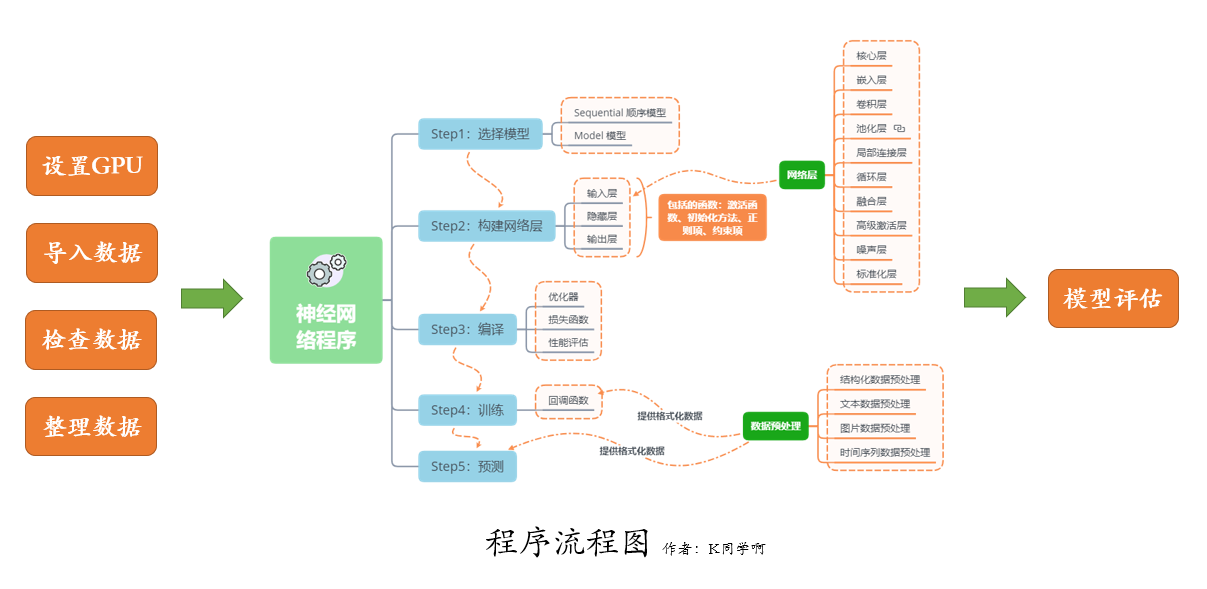

One 、 Import data
I will use torchaudio To download SpeechCommands Data sets , It was recorded by different people 35 It's a command Voice data sets . In this dataset , All the audio files are about 1 Seconds long ( about 16000 Time frame length ).
The actual loading and formatting steps occur when accessing data points ,torchaudio Responsible for converting audio files into tensors . If you want to load audio files directly , have access to torchaudio.load(). It returns a tuple , It contains the newly created tensor and the sampling frequency of the audio file (SpeechCommands by 16kHz).
import torch
import torch.nn as nn
import torch.nn.functional as F
import torch.optim as optim
import torchaudio
import matplotlib.pyplot as plt
import IPython.display as ipd
from tqdm import tqdm
Let's check CUDA GPU Is it available and choose our equipment . stay GPU Running the network on will greatly reduce training / Test run time .
device = torch.device("cuda" if torch.cuda.is_available() else "cpu")
print(device)
cuda
1. Download data
from torchaudio.datasets import SPEECHCOMMANDS
import os

class SubsetSC(SPEECHCOMMANDS):
    def __init__(self, subset: str = None):
        super().__init__("./", download=True)

        def load_list(filename):
            filepath = os.path.join(self._path, filename)
            with open(filepath) as fileobj:
                return [os.path.normpath(os.path.join(self._path, line.strip())) for line in fileobj]

        if subset == "validation":
            self._walker = load_list("validation_list.txt")
        elif subset == "testing":
            self._walker = load_list("testing_list.txt")
        elif subset == "training":
            excludes = load_list("validation_list.txt") + load_list("testing_list.txt")
            excludes = set(excludes)
            self._walker = [w for w in self._walker if w not in excludes]

#  Divide training set and test set
train_set = SubsetSC("training")
test_set  = SubsetSC("testing")

waveform, sample_rate, label, speaker_id, utterance_number = train_set[0]
2. Data presentation
SpeechCommands The data points in the data set are determined by the waveform ( sound signal )、 Sampling rate 、 word ( label )、 The speaker ID、 A tuple of words .
print("Shape of waveform: {}".format(waveform.size()))
print("Sample rate of waveform: {}".format(sample_rate))

plt.plot(waveform.t().numpy());
Shape of waveform: torch.Size([1, 16000])
Sample rate of waveform: 16000

labels = sorted(list(set(datapoint[2] for datapoint in train_set)))
print(labels)
['backward', 'bed', 'bird', 'cat', 'dog', 'down', 'eight', 'five', 'follow', 'forward', 'four', 'go', 'happy', 'house', 'learn', 'left', 'marvin', 'nine', 'no', 'off', 'on', 'one', 'right', 'seven', 'sheila', 'six', 'stop', 'three', 'tree', 'two', 'up', 'visual', 'wow', 'yes', 'zero']
35 The audio tags are commands spoken by the user
waveform_first, *_ = train_set[0]
ipd.Audio(waveform_first.numpy(), rate=sample_rate)

waveform_second, *_ = train_set[1]
ipd.Audio(waveform_second.numpy(), rate=sample_rate)

waveform_last, *_ = train_set[-1]
ipd.Audio(waveform_last.numpy(), rate=sample_rate)

Two 、 Data preparation
1. Format data
For waveforms , We down sample the audio to speed up processing , Without losing too much classification ability .
new_sample_rate = 8000

transform   = torchaudio.transforms.Resample(orig_freq=sample_rate, new_freq=new_sample_rate)
transformed = transform(waveform)

ipd.Audio(transformed.numpy(), rate=new_sample_rate)

We use the index in the tag list to encode each word .
2. Encoding and restoration of labels
def label_to_index(word):
    # Return the position of the word in labels
    return torch.tensor(labels.index(word))

def index_to_label(index):
    # Return the word corresponding to the index in labels
    # This is the inverse of label_to_index
    return labels[index]

word_start = "yes"
index = label_to_index(word_start)
word_recovered = index_to_label(index)

print(word_start, "-->", index, "-->", word_recovered)
yes --> tensor(33) --> yes
3. Build a data loader
def pad_sequence(batch):
    # Make all tensor in a batch the same length by padding with zeros
    batch = [item.t() for item in batch] #  take Tensor To transpose
    #  use 0 Fill the tensor to equal length ,.pad_sequence() For usage, please refer to :https://blog.csdn.net/qq_38251616/article/details/125222012
    batch = torch.nn.utils.rnn.pad_sequence(batch, batch_first=True, padding_value=0.)
    return batch.permute(0, 2, 1)

def collate_fn(batch):
    # A data tuple has the form:
    # waveform, sample_rate, label, speaker_id, utterance_number
    tensors, targets = [], []
    # Gather in lists, and encode labels as indices
    for waveform, _, label, *_ in batch:
        tensors += [waveform]
        targets += [label_to_index(label)]

    # Group the list of tensors into a batched tensor
    tensors = pad_sequence(tensors)
    targets = torch.stack(targets)
    return tensors, targets

batch_size = 256

if device == "cuda":
    num_workers = 1
    pin_memory = True
else:
    num_workers = 0
    pin_memory = False

#  About torch.utils.data.DataLoader() Students whose usage is not clear , You can refer to the article :
# https://blog.csdn.net/qq_38251616/article/details/125221503
train_loader = torch.utils.data.DataLoader(
    train_set,
    batch_size=batch_size,
    shuffle=True,
    collate_fn=collate_fn,
    num_workers=num_workers,
    pin_memory=pin_memory,
)
test_loader = torch.utils.data.DataLoader(
    test_set,
    batch_size=batch_size,
    shuffle=False,
    drop_last=False,
    collate_fn=collate_fn,
    num_workers=num_workers,
    pin_memory=pin_memory,
)
for X, y in test_loader:
    print("Shape of X [N, C, H, W]: ", X.shape)
    print("Shape of y: ", y.shape, y.dtype)
    break
Shape of X [N, C, H, W]:  torch.Size([256, 1, 16000])
Shape of y:  torch.Size([256]) torch.int64
3、 ... and 、 Build the model
In this tutorial , We will use convolutional neural network to process the original audio data . More advanced conversion is usually applied to audio data , but CNN It can be used to process raw data accurately . The specific architecture is modeled on the M5 Network architecture . An important aspect of the model processing the original audio data is the receptive field of the first layer filter . The first filter length of our model is 80, Therefore, in the process of 8kHz Sampled audio , The feeling field is about 10ms( stay 4kHz About 20ms). This size is similar to that often used from 20 Milliseconds to 40 MS receptive field voice processing application .
class M5(nn.Module):
    def __init__(self, n_input=1, n_output=35, stride=16, n_channel=32):
        super().__init__()
        self.conv1 = nn.Conv1d(n_input, n_channel, kernel_size=80, stride=stride)
        self.bn1 = nn.BatchNorm1d(n_channel)
        self.pool1 = nn.MaxPool1d(4)
        self.conv2 = nn.Conv1d(n_channel, n_channel, kernel_size=3)
        self.bn2 = nn.BatchNorm1d(n_channel)
        self.pool2 = nn.MaxPool1d(4)
        self.conv3 = nn.Conv1d(n_channel, 2 * n_channel, kernel_size=3)
        self.bn3 = nn.BatchNorm1d(2 * n_channel)
        self.pool3 = nn.MaxPool1d(4)
        self.conv4 = nn.Conv1d(2 * n_channel, 2 * n_channel, kernel_size=3)
        self.bn4 = nn.BatchNorm1d(2 * n_channel)
        self.pool4 = nn.MaxPool1d(4)
        self.fc1 = nn.Linear(2 * n_channel, n_output)

    def forward(self, x):
        x = self.conv1(x)
        x = F.relu(self.bn1(x))
        x = self.pool1(x)
        x = self.conv2(x)
        x = F.relu(self.bn2(x))
        x = self.pool2(x)
        x = self.conv3(x)
        x = F.relu(self.bn3(x))
        x = self.pool3(x)
        x = self.conv4(x)
        x = F.relu(self.bn4(x))
        x = self.pool4(x)
        x = F.avg_pool1d(x, x.shape[-1])
        x = x.permute(0, 2, 1)
        x = self.fc1(x)
        return F.log_softmax(x, dim=2)

model = M5(n_input=transformed.shape[0], n_output=len(labels))
model.to(device)
print(model)

def count_parameters(model):
    return sum(p.numel() for p in model.parameters() if p.requires_grad)

n = count_parameters(model)
print("Number of parameters: %s" % n)
M5(
  (conv1): Conv1d(1, 32, kernel_size=(80,), stride=(16,))
  (bn1): BatchNorm1d(32, eps=1e-05, momentum=0.1, affine=True, track_running_stats=True)
  (pool1): MaxPool1d(kernel_size=4, stride=4, padding=0, dilation=1, ceil_mode=False)
  (conv2): Conv1d(32, 32, kernel_size=(3,), stride=(1,))
  (bn2): BatchNorm1d(32, eps=1e-05, momentum=0.1, affine=True, track_running_stats=True)
  (pool2): MaxPool1d(kernel_size=4, stride=4, padding=0, dilation=1, ceil_mode=False)
  (conv3): Conv1d(32, 64, kernel_size=(3,), stride=(1,))
  (bn3): BatchNorm1d(64, eps=1e-05, momentum=0.1, affine=True, track_running_stats=True)
  (pool3): MaxPool1d(kernel_size=4, stride=4, padding=0, dilation=1, ceil_mode=False)
  (conv4): Conv1d(64, 64, kernel_size=(3,), stride=(1,))
  (bn4): BatchNorm1d(64, eps=1e-05, momentum=0.1, affine=True, track_running_stats=True)
  (pool4): MaxPool1d(kernel_size=4, stride=4, padding=0, dilation=1, ceil_mode=False)
  (fc1): Linear(in_features=64, out_features=35, bias=True)
)
Number of parameters: 26915
We will use the same optimization techniques used in this article , That is, the weight attenuation is set to 0.0001 Of Adam Optimizer . At first , We're going to 0.01 The learning rate of training , but scheduler stay 20 individual epoch After the training period , We will use a Reduce it to 0.001.
optimizer = optim.Adam(model.parameters(), lr=0.01, weight_decay=0.0001)
scheduler = optim.lr_scheduler.StepLR(optimizer, step_size=20, gamma=0.1)  # reduce the learning after 20 epochs by a factor of 10
Four 、 Training models
Now let's define a training function , It inputs our training data into the model and performs the reverse transfer and optimization steps . For training , The loss we will use is negative log likelihood . And then will be in each epoch Then test the network , To see how accuracy changes during training .
#  To speed up code running , The accuracy rate is not calculated during training .
def train(model, epoch, log_interval):
    model.train()
    for batch_idx, (data, target) in enumerate(train_loader):

        data   = data.to(device)
        target = target.to(device)

        # apply transform and model on whole batch directly on device
        data   = transform(data)
        output = model(data)

        #  Calculation  loss
        loss = F.nll_loss(output.squeeze(), target)

        optimizer.zero_grad()
        loss.backward()
        optimizer.step()

        #  Print training progress
        if batch_idx % log_interval == 0:
            print(f"Train Epoch: {
      epoch} [{
      batch_idx * len(data)}/{
      len(train_loader.dataset)} ({
      100. * batch_idx / len(train_loader):.0f}%)]\tLoss: {
      loss.item():.6f}")

        #  Record  loss
        losses.append(loss.item())
#  Calculate the correct number of predictions
def number_of_correct(pred, target):
    return pred.squeeze().eq(target).sum().item()

#  Find the most likely tag
def get_likely_index(tensor):
    return tensor.argmax(dim=-1)

def test(model, epoch):
    model.eval()
    correct = 0
    for data, target in test_loader:

        data = data.to(device)
        target = target.to(device)

        # apply transform and model on whole batch directly on device
        data = transform(data)
        output = model(data)

        pred = get_likely_index(output)
        correct += number_of_correct(pred, target)

    print(f"\nTest Epoch: {
      epoch}\tAccuracy: {
      correct}/{
      len(test_loader.dataset)} ({
      100. * correct / len(test_loader.dataset):.0f}%)\n")
Last , We can train and test the network . We will train online 10 individual epoch, Then reduce the learning rate and train again 10 individual epoch. The network will be in every epoch Then test , To see how accuracy changes during training .
log_interval = 100  #  Every time 100 individual batch Print a workout result
n_epoch = 2

losses = []

# The transform needs to live on the same device as the model and the data.
transform = transform.to(device)

for epoch in range(1, n_epoch + 1):
    train(model, epoch, log_interval)
    test(model, epoch)
    scheduler.step()
Train Epoch: 1 [0/84843 (0%)]	Loss: 3.655148
Train Epoch: 1 [25600/84843 (30%)]	Loss: 2.012523
Train Epoch: 1 [51200/84843 (60%)]	Loss: 1.584120
Train Epoch: 1 [76800/84843 (90%)]	Loss: 1.249869

Test Epoch: 1	Accuracy: 6962/11005 (63%)

Train Epoch: 2 [0/84843 (0%)]	Loss: 0.964569
Train Epoch: 2 [25600/84843 (30%)]	Loss: 1.161757
Train Epoch: 2 [51200/84843 (60%)]	Loss: 1.007113
Train Epoch: 2 [76800/84843 (90%)]	Loss: 0.843660

Test Epoch: 2	Accuracy: 7219/11005 (66%)
1. During the training loss
plt.plot(losses)
plt.xlabel("Step", fontsize=12)
plt.ylabel("Loss", fontsize=12)
plt.title("Training Loss")
plt.show()

5、 ... and 、 test model
def predict(tensor):
    tensor = tensor.to(device)
    tensor = transform(tensor)
    tensor = model(tensor.unsqueeze(0))
    tensor = get_likely_index(tensor)
    tensor = index_to_label(tensor.squeeze())
    return tensor

waveform, sample_rate, utterance, *_ = train_set[-1]
ipd.Audio(waveform.numpy(), rate=sample_rate)

print(f" True value : {
      utterance}.  Predictive value : {
      predict(waveform)}.")
True value : zero. Predictive value : zero.
for i, (waveform, sample_rate, utterance, *_) in enumerate(test_set):
    output = predict(waveform)
    if output != utterance:
        ipd.Audio(waveform.numpy(), rate=sample_rate)
        print(f"Data point #{
      i}.  True value : {
      utterance}.  Predictive value : {
      output}.")
        break
else:
    print("All examples in this dataset were correctly classified!")
    print("In this case, let's just look at the last data point")
    ipd.Audio(waveform.numpy(), rate=sample_rate)
    print(f"Data point #{
      i}.  True value : {
      utterance}.  Predictive value : {
      output}.")
Data point #1. True value : right. Predictive value : no.

边栏推荐
- 设计消息队列存储消息数据的 MySQL 表格
- wps表格怎么取消智能表格样式
- [node] common methods of path module
- Industrial control system ICs
- ironSource  New functions are released, and developers can adjust advertising strategies in real time in the same session
- 1、 Getting started with flutter learn to write a simple client
- Win jar package setting boot auto start
- QApplication a (argc, argv) and exec() in the main function of QT getting started
- How does Kingview use the wireless host link communication module to remotely collect PLC data?
- R language spline curve piecewise linear regression model piecewise regression estimation of individual stock beta value analysis of yield data
猜你喜欢

Argodb 3.2 of star ring technology was officially released to comprehensively upgrade ease of use, performance and security

How to change the font size of Apple phone WPS

MS-HGAT: 基于记忆增强序列超图注意力网络的信息扩散预测

R language spline curve piecewise linear regression model piecewise regression estimation of individual stock beta value analysis of yield data

出门带着小溪

Experiment 5 constructor and destructor

The time selector style is disordered and the middle text is blocked

手机wps如何压缩文件打包发送
How to package and send compressed files for mobile WPS

Xiaomu's interesting PWN
随机推荐
语义向量检索入门教程
Web keyboard input method application development guide (2) -- keyboard events
2022 edition of global and Chinese sodium hydrosulfide market in-depth investigation and prospect Trend Forecast Report
repeat_ L2-009 red envelope grabbing_ sort
Lambda intermediate operation sorted
Zhangxiaobai takes you to install MySQL 5.7 on Huawei cloud ECS server
MySQL basic tutorial -- MySQL transaction and storage engine
How to make scripts executable anywhere
Lambda intermediate operation filter
The time selector style is disordered and the middle text is blocked
leetcodeSQL:614. Secondary followers
C language multidimensional array and pointer - learning 24
Devops landing practice drip and pit stepping records - (1)
多年测试菜鸟对黑盒测试的理解
Lambda intermediate operation limit
关于接口测试的那些“难言之隐”
Flutter uses local pictures
Lambda快速入门
七个需要关注的测试自动化趋势
How to package and send compressed files for mobile WPS