当前位置:网站首页>10 tf. data
10 tf. data
2022-06-26 15:58:00 【X1996_】
Learn this section , The contents are arranged in a mess
tf.data Mainly tensorflow Data input inside
Data Class and related operations TFRecord File saving and reading
All code in notebook Writing in the 


Data processing


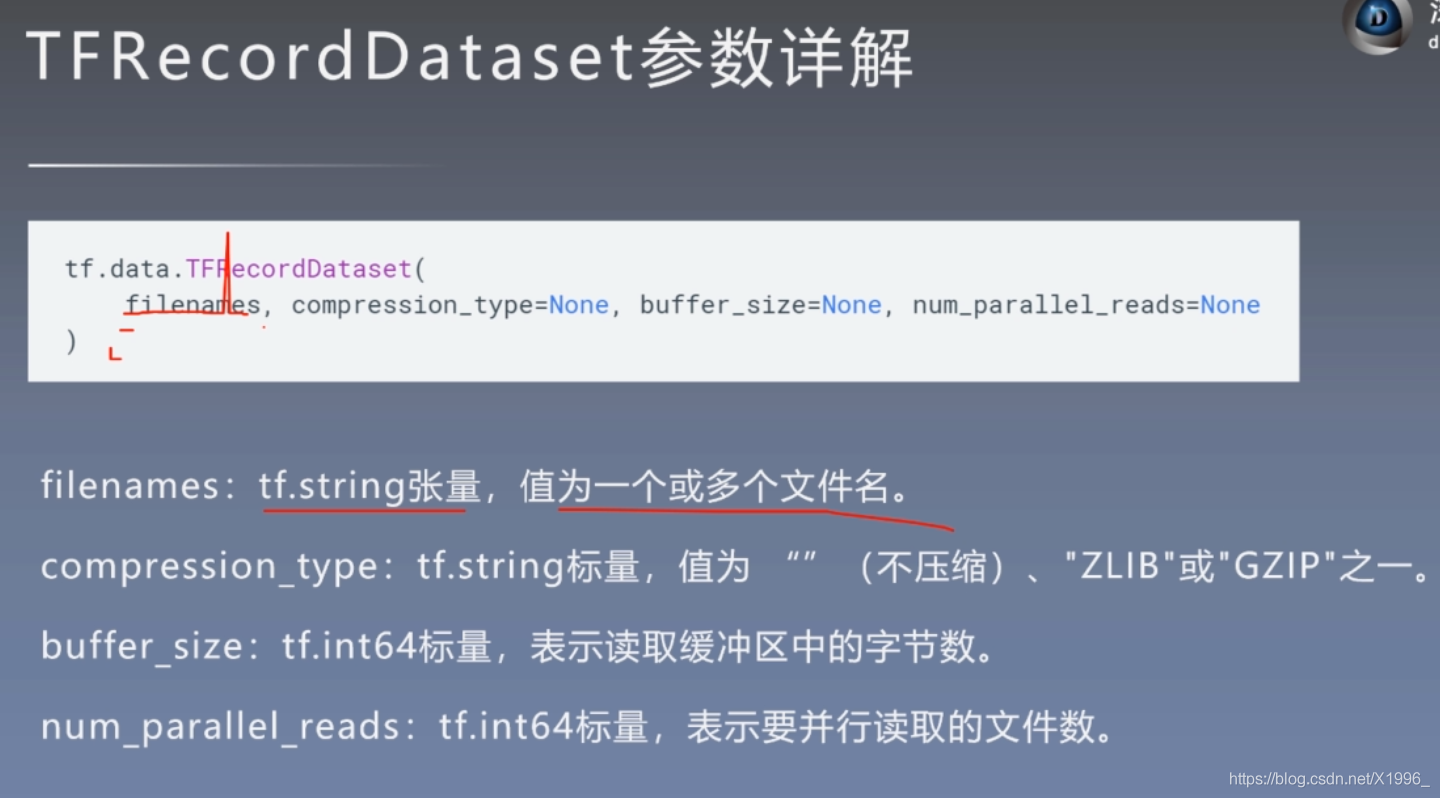


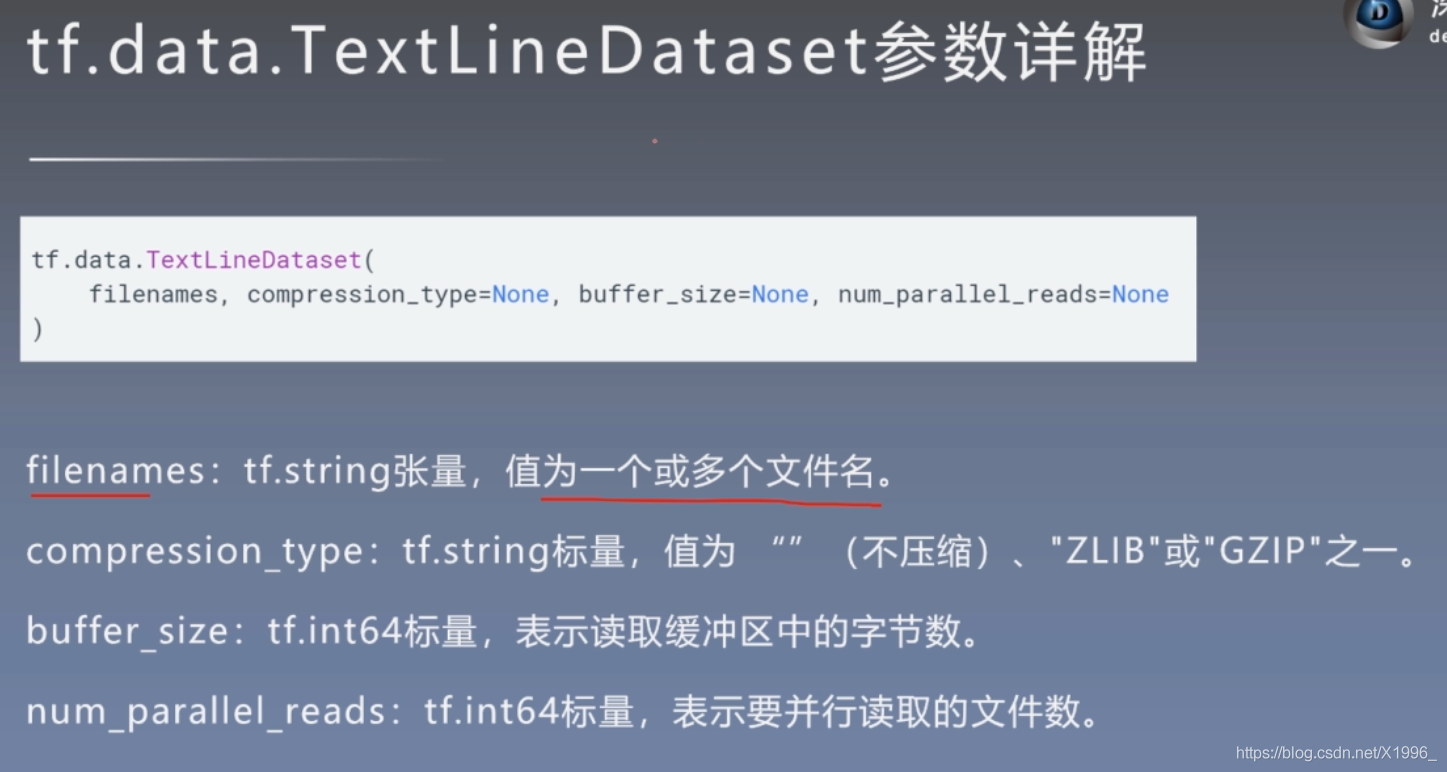
 Code
Code
Dataset class
Dataset Class read numpy data
import tensorflow as tf
import numpy as np
import matplotlib.pyplot as plt

mnist = np.load("mnist.npz")

x_train, y_train = mnist['x_train'],mnist['y_train']
#  Add one dimension at the end
x_train = np.expand_dims(x_train, axis=-1)

mnist_dataset = tf.data.Dataset.from_tensor_slices((x_train, y_train))
Pandas data fetch
import pandas as pd

df = pd.read_csv('heart.csv')
df['thal'] = pd.Categorical(df['thal'])
df['thal'] = df.thal.cat.codes
target = df.pop('target')

dataset = tf.data.Dataset.from_tensor_slices((df.values, target.values))
thal,target Is in the file , It feels like the key name
from Python generator Building data pipelines
img_gen = tf.keras.preprocessing.image.ImageDataGenerator(rescale=1./255, rotation_range=20)

flowers = './flower_photos/flower_photos/'

def Gen():
    gen = img_gen.flow_from_directory(flowers)
    for (x,y) in gen:
        yield (x,y)

ds = tf.data.Dataset.from_generator(
    Gen,
    output_types=(tf.float32, tf.float32)
# output_shapes=([32,256,256,3], [32,5])
)
TFRecordDataset class
feature_description = {
     #  Definition Feature structure , Tell the decoder everyone Feature What is the type of
    'image': tf.io.FixedLenFeature([], tf.string),
    'label': tf.io.FixedLenFeature([], tf.int64),
}

def _parse_example(example_string): #  take  TFRecord  Each serialized in the file  tf.train.Example  decode
    feature_dict = tf.io.parse_single_example(example_string, feature_description)
    feature_dict['image'] = tf.io.decode_jpeg(feature_dict['image'])    #  decode JPEG picture
    feature_dict['image'] = tf.image.resize(feature_dict['image'], [256, 256]) / 255.0
    return feature_dict['image'], feature_dict['label']

batch_size = 32

train_dataset = tf.data.TFRecordDataset("sub_train.tfrecords")    #  Read  TFRecord  file
# filename label

train_dataset = train_dataset.map(_parse_example)
TextLineDataset class
titanic_lines = tf.data.TextLineDataset(['train.csv','eval.csv'])

def data_func(line):
    line = tf.strings.split(line, sep = ",")
    return line

titanic_data = titanic_lines.skip(1).map(data_func)
Two Dataset Class related operations
flat_map
zip
concatenate


 Read from multiple files


 Code
Code
flat_map
a = tf.data.Dataset.range(1, 6)  # ==> [ 1, 2, 3, 4, 5 ]
# NOTE: New lines indicate "block" boundaries.
b=a.flat_map(lambda x: tf.data.Dataset.from_tensors(x).repeat(6))
zip
a = tf.data.Dataset.range(1, 4)  # ==> [ 1, 2, 3 ]
b = tf.data.Dataset.range(4, 7) # ==> [ 4, 5, 6 ]
ds = tf.data.Dataset.zip((a, b))
concatenate
#  Connect
a = tf.data.Dataset.range(1, 4)  # ==> [ 1, 2, 3 ]
b = tf.data.Dataset.range(4, 7) # ==> [ 4, 5, 6 ]
ds = a.concatenate(b)
performance optimization
prefetch Method
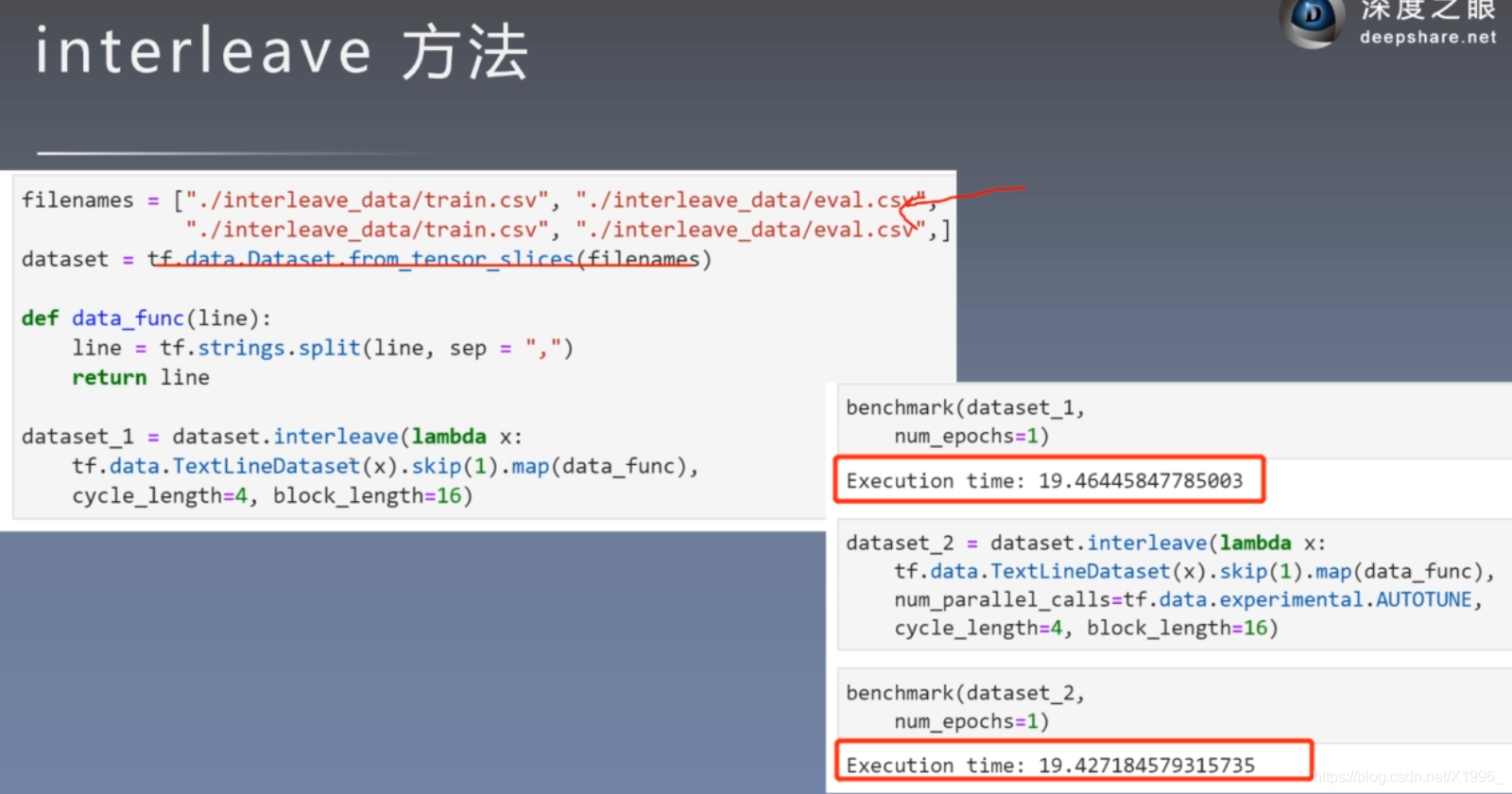
interleave Method
map Method
cache Method
Don't know much about , There is something to be used later · I'll make it up after I understand
Ah , Better than caiwenji 



An example of cat dog war
import tensorflow as tf
import os

#  Define image path
data_dir = './datasets'
train_cats_dir = data_dir + '/train/cats/'
train_dogs_dir = data_dir + '/train/dogs/'
test_cats_dir = data_dir + '/valid/cats/'
test_dogs_dir = data_dir + '/valid/dogs/'

# os.listdir(train_cats_dir)  Get all the file names in this folder
train_cat_filenames = tf.constant([train_cats_dir + filename for filename in os.listdir(train_cats_dir)])
train_dog_filenames = tf.constant([train_dogs_dir + filename for filename in os.listdir(train_dogs_dir)])
train_filenames = tf.concat([train_cat_filenames, train_dog_filenames], axis=-1)

# cat 0 dog :1
train_labels = tf.concat([
    tf.zeros(train_cat_filenames.shape, dtype=tf.int32),
    tf.ones(train_dog_filenames.shape, dtype=tf.int32)],
    axis=-1)

def _decode_and_resize(filename, label):
    image_string = tf.io.read_file(filename)            #  Read the original file
    image_decoded = tf.image.decode_jpeg(image_string)  #  decode JPEG picture
    image_resized = tf.image.resize(image_decoded, [256, 256]) / 255.0
    return image_resized, label

# Build training sets

def _decode_and_resize(filename, label):
    image_string = tf.io.read_file(filename)            #  Read the original file
    image_decoded = tf.image.decode_jpeg(image_string)  #  decode JPEG picture
    image_resized = tf.image.resize(image_decoded, [256, 256]) / 255.0
    return image_resized, label


batch_size = 32
train_dataset = tf.data.Dataset.from_tensor_slices((train_filenames, train_labels))
# name
train_dataset = train_dataset.map(
    map_func=_decode_and_resize,
    num_parallel_calls=tf.data.experimental.AUTOTUNE)

#  Before removal buffer_size Put data into buffer, And randomly sample from it , The sampled data is replaced with subsequent data
train_dataset = train_dataset.shuffle(buffer_size=23000)

train_dataset = train_dataset.repeat(count=1)

train_dataset = train_dataset.batch(batch_size)

train_dataset = train_dataset.prefetch(tf.data.experimental.AUTOTUNE)


#  Building test data sets
test_cat_filenames = tf.constant([test_cats_dir + filename for filename in os.listdir(test_cats_dir)])
test_dog_filenames = tf.constant([test_dogs_dir + filename for filename in os.listdir(test_dogs_dir)])
test_filenames = tf.concat([test_cat_filenames, test_dog_filenames], axis=-1)
test_labels = tf.concat([
    tf.zeros(test_cat_filenames.shape, dtype=tf.int32),
    tf.ones(test_dog_filenames.shape, dtype=tf.int32)],
    axis=-1)

test_dataset = tf.data.Dataset.from_tensor_slices((test_filenames, test_labels))
test_dataset = test_dataset.map(_decode_and_resize)
test_dataset = test_dataset.batch(batch_size)


class CNNModel(tf.keras.models.Model):
    def __init__(self):
        super(CNNModel, self).__init__()
        self.conv1 = tf.keras.layers.Conv2D(32, 3, activation='relu')
        self.maxpool1 = tf.keras.layers.MaxPooling2D()
        self.conv2 = tf.keras.layers.Conv2D(32, 5, activation='relu')
        self.maxpool2 = tf.keras.layers.MaxPooling2D()
        self.flatten = tf.keras.layers.Flatten()
        self.d1 = tf.keras.layers.Dense(64, activation='relu')
        self.d2 = tf.keras.layers.Dense(2, activation='softmax') #sigmoid  and softmax

    def call(self, x):
        x = self.conv1(x)
        x = self.maxpool1(x)
        x = self.conv2(x)
        x = self.maxpool2(x)
        x = self.flatten(x)
        x = self.d1(x)
        x = self.d2(x)
        return x

# softmax CategoricalCrossentropy
#sigmoid tf.keras.losses.BinaryCrossentropy


learning_rate = 0.001
model = CNNModel()

loss_object = tf.keras.losses.SparseCategoricalCrossentropy()
#label  No, one-hot


optimizer = tf.keras.optimizers.Adam(learning_rate=learning_rate)


train_loss = tf.keras.metrics.Mean(name='train_loss')
train_accuracy = tf.keras.metrics.SparseCategoricalAccuracy(name='train_accuracy')

test_loss = tf.keras.metrics.Mean(name='test_loss')
test_accuracy = tf.keras.metrics.SparseCategoricalAccuracy(name='test_accuracy')


@tf.function
def train_step(images, labels):
    with tf.GradientTape() as tape:
        predictions = model(images)
        loss = loss_object(labels, predictions)
    gradients = tape.gradient(loss, model.trainable_variables)
    optimizer.apply_gradients(zip(gradients, model.trainable_variables))

    train_loss(loss)
    train_accuracy(labels, predictions)

def test_step(images, labels):
    predictions = model(images)
    t_loss = loss_object(labels, predictions)

    test_loss(t_loss)
    test_accuracy(labels, predictions)


EPOCHS=10
for epoch in range(EPOCHS):
    #  The next epoch At the beginning of the , Reset evaluation indicator
    train_loss.reset_states()
    train_accuracy.reset_states()
    test_loss.reset_states()
    test_accuracy.reset_states()

    for images, labels in train_dataset:
        train_step(images, labels)

    for test_images, test_labels in test_dataset:
        test_step(test_images, test_labels)

    template = 'Epoch {}, Loss: {}, Accuracy: {}, Test Loss: {}, Test Accuracy: {}'
    print(template.format(epoch + 1,
                          train_loss.result(),
                          train_accuracy.result() * 100,
                          test_loss.result(),
                          test_accuracy.result() * 100
                         ))
TFRecord preservation Read


 Code
Code
import tensorflow as tf
import os

data_dir = './datasets'
train_cats_dir = data_dir + '/train/cats/'
train_dogs_dir = data_dir + '/train/dogs/'


train_tfrecord_file = data_dir + '/train/train.tfrecords'


test_cats_dir = data_dir + '/valid/cats/'
test_dogs_dir = data_dir + '/valid/dogs/'
test_tfrecord_file = data_dir + '/valid/test.tfrecords'


train_cat_filenames = [train_cats_dir + filename for filename in os.listdir(train_cats_dir)]
train_dog_filenames = [train_dogs_dir + filename for filename in os.listdir(train_dogs_dir)]
train_filenames = train_cat_filenames + train_dog_filenames

train_labels = [0] * len(train_cat_filenames) + [1] * len(train_dog_filenames)  #  take  cat  The label of the class is set to 0,dog  The label of the class is set to 1

with tf.io.TFRecordWriter(train_tfrecord_file) as writer:
    for filename, label in zip(train_filenames, train_labels):
        image = open(filename, 'rb').read()     #  Read data set picture to memory ,image  For one  Byte  String of type
        feature = {
                                 #  establish  tf.train.Feature  Dictionaries
            'image': tf.train.Feature(bytes_list=tf.train.BytesList(value=[image])),  #  The picture is a  Bytes  object
            'label': tf.train.Feature(int64_list=tf.train.Int64List(value=[label]))   #  The label is a  Int  object
        }

        example = tf.train.Example(features=tf.train.Features(feature=feature)) #  Build... Through a dictionary  Example
        writer.write(example.SerializeToString())   #  take Example Serialize and write  TFRecord  file


####  Test set
test_cat_filenames = [test_cats_dir + filename for filename in os.listdir(test_cats_dir)]
test_dog_filenames = [test_dogs_dir + filename for filename in os.listdir(test_dogs_dir)]
test_filenames = test_cat_filenames + test_dog_filenames
test_labels = [0] * len(test_cat_filenames) + [1] * len(test_dog_filenames)  #  take  cat  The label of the class is set to 0,dog  The label of the class is set to 1

with tf.io.TFRecordWriter(test_tfrecord_file) as writer:
    for filename, label in zip(test_filenames, test_labels):
        image = open(filename, 'rb').read()     #  Read data set picture to memory ,image  For one  Byte  String of type
        feature = {
                                 #  establish  tf.train.Feature  Dictionaries
            'image': tf.train.Feature(bytes_list=tf.train.BytesList(value=[image])),  #  The picture is a  Bytes  object
            'label': tf.train.Feature(int64_list=tf.train.Int64List(value=[label]))   #  The label is a  Int  object
        }
        example = tf.train.Example(features=tf.train.Features(feature=feature)) #  Build... Through a dictionary  Example
        serialized = example.SerializeToString() # take Example serialize
        writer.write(serialized)   #  write in  TFRecord  file

#  Read TFREcoed file
train_dataset = tf.data.TFRecordDataset(train_tfrecord_file)    #  Read  TFRecord  file
feature_description = {
     #  Definition Feature structure , Tell the decoder everyone Feature What is the type of
    'image': tf.io.FixedLenFeature([], tf.string),

    'label': tf.io.FixedLenFeature([], tf.int64),
}

def _parse_example(example_string): #  take  TFRecord  Each serialized in the file  tf.train.Example  decode
    feature_dict = tf.io.parse_single_example(example_string, feature_description)
    feature_dict['image'] = tf.io.decode_jpeg(feature_dict['image'])    #  decode JPEG picture
    feature_dict['image'] = tf.image.resize(feature_dict['image'], [256, 256]) / 255.0
    return feature_dict['image'], feature_dict['label']

train_dataset = train_dataset.map(_parse_example)
batch_size = 32

train_dataset = train_dataset.shuffle(buffer_size=23000)
train_dataset = train_dataset.batch(batch_size)
train_dataset = train_dataset.prefetch(tf.data.experimental.AUTOTUNE)

test_dataset = tf.data.TFRecordDataset(test_tfrecord_file)    #  Read  TFRecord  file
test_dataset = test_dataset.map(_parse_example)
test_dataset = test_dataset.batch(batch_size)

class CNNModel(tf.keras.models.Model):
    def __init__(self):
        super(CNNModel, self).__init__()
        self.conv1 = tf.keras.layers.Conv2D(32, 3, activation='relu')
        self.maxpool1 = tf.keras.layers.MaxPooling2D()
        self.conv2 = tf.keras.layers.Conv2D(32, 5, activation='relu')
        self.maxpool2 = tf.keras.layers.MaxPooling2D()
        self.flatten = tf.keras.layers.Flatten()
        self.d1 = tf.keras.layers.Dense(64, activation='relu')
        self.d2 = tf.keras.layers.Dense(2, activation='softmax')

    def call(self, x):
        x = self.conv1(x)
        x = self.maxpool1(x)
        x = self.conv2(x)
        x = self.maxpool2(x)
        x = self.flatten(x)
        x = self.d1(x)
        x = self.d2(x)
        return x

learning_rate = 0.001
model = CNNModel()

loss_object = tf.keras.losses.SparseCategoricalCrossentropy()


optimizer = tf.keras.optimizers.Adam(learning_rate=learning_rate)

train_loss = tf.keras.metrics.Mean(name='train_loss')
train_accuracy = tf.keras.metrics.SparseCategoricalAccuracy(name='train_accuracy')

test_loss = tf.keras.metrics.Mean(name='test_loss')
test_accuracy = tf.keras.metrics.SparseCategoricalAccuracy(name='test_accuracy')

#batch
@tf.function
def train_step(images, labels):
    with tf.GradientTape() as tape:
        predictions = model(images)
        loss = loss_object(labels, predictions)
    gradients = tape.gradient(loss, model.trainable_variables)
    optimizer.apply_gradients(zip(gradients, model.trainable_variables))

    train_loss(loss) #update
    train_accuracy(labels, predictions)#update

@tf.function
def test_step(images, labels):
    predictions = model(images)
    t_loss = loss_object(labels, predictions)

    test_loss(t_loss)
    test_accuracy(labels, predictions)

EPOCHS=10
for epoch in range(EPOCHS):
    #  The next epoch At the beginning of the , Reset evaluation indicator
    train_loss.reset_states()
    train_accuracy.reset_states()
    test_loss.reset_states()
    test_accuracy.reset_states()

    for images, labels in train_dataset:
        train_step(images, labels) #mini-batch  to update

    for test_images, test_labels in test_dataset:
        test_step(test_images, test_labels)

    template = 'Epoch {}, Loss: {}, Accuracy: {}, Test Loss: {}, Test Accuracy: {}'
    print(template.format(epoch + 1,
                          train_loss.result(),
                          train_accuracy.result() * 100,
                          test_loss.result(),
                          test_accuracy.result() * 100
                         ))
边栏推荐
- [CEPH] MKDIR | mksnap process source code analysis | lock state switching example
- JS text scrolling scattered animation JS special effect
- [graduation season · advanced technology Er] what is a wechat applet, which will help you open the door of the applet
- Anaconda3 installation tensorflow version 2.0 CPU and GPU installation, win10 system
- 查词翻译类应用使用数据接口api总结
- 5 模型保存与加载
- Reflection modification final
- 音视频学习(三)——sip协议
- NFT 项目的开发、部署、上线的流程(2)
- Golang temporary object pool optimization
猜你喜欢
![[file] VFS four structs: file, dentry, inode and super_ What is a block? difference? Relationship-- Editing](/img/b6/d288065747425863b9af95ec6fd554.png)
[file] VFS four structs: file, dentry, inode and super_ What is a block? difference? Relationship-- Editing

Use of abortcontroller

SQLite loads CSV files and performs data analysis

How to configure and use the new single line lidar
![[CEPH] Lock Notes of cephfs](/img/9a/b68e7b07b1187794c0dbed36eea749.png)
[CEPH] Lock Notes of cephfs

NFT transaction principle analysis (2)

How to identify contractual issues

Canvas three dot flashing animation

Stepn novice introduction and advanced
![[graduation season · advanced technology Er] what is a wechat applet, which will help you open the door of the applet](/img/c8/f3f31a8e53c5918abc719603811cc7.png)
[graduation season · advanced technology Er] what is a wechat applet, which will help you open the door of the applet
随机推荐
1 张量的简单使用
Failed to get convolution algorithm. This is probably because cuDNN failed to initialize
Keil4 opens the single-chip microcomputer project to a blank, and the problem of 100% program blocking of cpu4 is solved
效率超级加倍!pycharm十个小技巧就是这么神
Svg canvas canvas drag
音视频学习(一)——PTZ控制原理
NFT contract basic knowledge explanation
golang 1.18 go work 使用
Svg savage animation code
Evaluate:huggingface detailed introduction to the evaluation index module
(1) Keras handwritten numeral recognition and recognition of self written numbers
全面解析Discord安全问题
Reflection modification final
NFT 平台安全指南(2)
svg上升的彩色气泡动画
What is the difference between stm32f1 and gd32f1?
Transaction input data of Ethereum
Nanopi duo2 connection WiFi
JS handwritten bind, apply, call
svg野人动画代码