当前位置:网站首页>OC--包装类和处理对象
OC--包装类和处理对象
2022-07-25 09:21:00 【山河丘壑】
文章目录
前言
浅浅说一下包装类和对象的相关内容
一、包装类
1.什么是对象?
OC是面向对象的语言,但C语言所包含的基本类型(int,short,float,double)等都不是对象。
他们也没有对象的特性——没有属性,方法可以被调用。
那么什么是对象呢?
OC提供了NSValue,NSNumber来封装C语言的基本类型,这样就可以让他们具有面向对象的特征。
2.包装类
- NSInteger:大致等于long类型整数
- NSUInteger:大致等于unsigned long类型整数
- CGFloat:64位平台上相当于double,32位平台上相当于float
这三个类依然只是基本类型而不是包装类
为了更好的兼容不同的平台,建议需要定义整形变量时使用NSInteger,NSUInteger,定义浮点型变量时,使用CGFloat
二、NSValue和NSNumber
1.是什么?
NSValue和NSNumber都是包装类,NSValue是NSNumber的父类
NSValue更为通用,可以用于包装单个shorting, long, float, char,zhizhen,对象id等数据类型,通过包装该类,就可以把shorting ,long, float, char,指针等添加到NSArray,NSSet等集合(集合的元素必须是对象)。
2.怎么用?
(1)+numberWithXxx:将特定类型的值包装成为NSNumber
(2)-initWithXxx:先创建一个NSNumber对象,在用一个基本类型的值初始化NSNumber
(3)-xxxValue:返回该NSNumber对象包装的基本类型的值。
#import<Foundation/Foundation.h>
int main(int argc, char * argv[]){

    @autoreleasepool {

    	//将int类型的值包装成为NSNumber对象
        NSNumber* num = [NSNumber numberWithInt: 20];
        //将double类型的值包装成为NSNumber对象
        NSNumber* de = [NSNumber numberWithDouble: 3.4];
        NSLog(@"%d", [num intValue]);
        NSLog(@"%g", [de doubleValue]);
        //用initWithXxx执行初始化
        NSNumber* ch = [[NSNumber alloc]initWithChar: 'j'];
        //字母j的ASCLL码为106,所以输出106
        NSLog(@"%@", ch);
    }
}
运行结果如下:
三、处理对象
OC对象都是NSObject子类的实例,doily直接调用该类中定义的方法。这些方法都提供了处理OC对象的通用方法。
1.打印对象和description
Person类的接口
#import<Foundation/Foundation.h>
@interface Person: NSObject
@property (nonatomic,copy)NSString* name;
-(id)initWithName: (NSString*)namel;
-(void)info;
@end
Person类的实现
#import"heihei.h"
@implementation Person
@synthesize name = _name;
-(id) initWithName: (NSString*)name{

    if(self = [super init]){

        self.name = name;
    }
    return self;
}
-(void)info{

    NSLog(@"这个人叫:%@", self.name);
}
@end
测试
#import<Foundation/Foundation.h>
#import"heihei.h"
int main(){

    @autoreleasepool {

        Person* p = [[Person alloc]initWithName:@"yangyang"];
        NSLog(@"%@", [p description]);
    }
}
这里是代码结果
这个输出结果是怎么来的呢?NSLog()函数只能在控制台输出字符串,而Person实例是内存中存在的一个对象,怎么才能直接转换成字符串输出呢?
其实,使用NSLog()函数输出Person时,输出的是Person的对象的description方法的返回值。
即System.out.println(p )完全等于System.out.println([p description])
四、自我描述
1.是什么?
description方法一个自我描述的方法,当我们直接打印该对象时,会输出该对象的“自我描述”信息,用以告诉外界该对象具有的状态信息。description方法返回的值并不能实现“自我描述”,因此如果想让他实现自我描述,必须重写NSObject的description方法。
2.怎样实现?
Apple类的接口部分
#import<Foundation/Foundation.h>
@interface Apple: NSObject
@property(nonatomic, copy)NSString* color;
@property(nonatomic, assign)double weight;
-(id) initWithColor: (NSString*)color weight: (double)weight;
@end
Apple类的实现部分
#import"heihei.h"
@implementation Apple
@synthesize color = _color;
@synthesize weight = _weight;
-(id)initWithColor: (NSString *)color weight: (double)weight{

    if(self = [super init]){

        self.color = color;
        self.weight = weight;
    }
    return self;
}
-(NSString*)description{

    return [NSString stringWithFormat: @"Apple[_color=%@,_weight=%g]",
    self.color, self.weight];

}
@end
测试
#import<Foundation/Foundation.h>
#import"heihei.h"
int main(){

    @autoreleasepool {

        Apple* a = [[Apple alloc]initWithColor:@"红色" weight:5];
        NSLog(@"%@", a);
    }
}
代码结果如下
我们通过重写Apple类的description方法,如愿得到了我们想要的“自我描述”
五、==和isEqual
1.是什么?
OC中测试两个变量是否相等的方法
==
如果两个变量是基本类型的变量,且都是数值型(不一定要求数据类型严格相同)只要两个变量的值相等,使用==就返回1
如果是指针类型的变量,他们指向同一个对象时,==判断就返回1
==比较的是两个字符串的地址
2.怎么用?
#import<Foundation/Foundation.h>
#import"heihei.h"
int main(){

    @autoreleasepool {

        int it = 65;
        float f1 = 65.0f;
        //65和65.0是否相等? 相等
        NSLog(@"%d", (it == f1));
        char ch = 'A';
        //65和‘A'是否相等? 相等
        NSLog(@"%d", (it == ch));
        NSString* str1 = [NSString stringWithFormat: @"hello"];
        NSString* str2 = [NSString stringWithFormat: @"hello"];
        NSLog(@"%d", (str1 == str2));
        //str1 isEqual str2 相等
        NSLog(@"%d",[str1 isEqual:str2]);
        //NSDate与NSString没有继承关系,所以会报错
        NSLog(@"%d",[NSDate new] == [NSString new]);
    }
}
这里是NSDate与NSString判断时的报错
这里是代码运行结果
NSString已经重写了NSObject的isEqual方法,只要两个字符串中包含的字符序列相同,通过isEqual比较就返回真。
我们再来重新测试一下这个代码
#import<Foundation/Foundation.h>

int main(int argc, char* argv[])
{

    @autoreleasepool{

        NSString* str1 = [NSString stringWithFormat:@"娜娜"];
        NSString* str2 = [NSString stringWithFormat:@"娜娜"];
        NSLog(@"%p", str1);
        NSLog(@"%p", str2);
        NSLog(@"str1和str2是否相等?%d", (str1 == str2));
        NSLog(@"str1是否isEqual:str2?%d", [str1 isEqual: str2]);
    }
}

重写isEqual方法就是自定义的相等标准
isEqual
1,自反性:[x isEqual: x]=1
2.对称性:如果[x isEqual: y]=1,则[y isEqual: x]=1
3.传递性:如果[x isEqual: y]=1,[y isEqual: z]=1,则[x isEqual: z]=1
4.对于任何不是nil的x,[x isEqual: nil]=0
NSString不仅重写了isEqual方法,用于判断两个字符串的序列是否相等,还定义了一个isEqualToString:方法,用于判断当前字符串于另一个字符串序列是否相等。
六、==
在上面的代码中我们看到,使用NSString*str=[NSString
stringWithFormat:@“hello”];时,用==判断两个字符串是否相等时,返回了1
这里要注意,这里的字符串只能是英文模式并且长度不能超过九
当字符串含有q时,长度不能超过7
#import<Foundation/Foundation.h>

int main(int argc, char* argv[])
{

    @autoreleasepool{

        NSString* str1 = [NSString stringWithFormat: @"hellowwwww"];
        NSString* str2 = [NSString stringWithFormat: @"hellowwwww"];
        NSLog(@"%p", str1);
        NSLog(@"%p", str2);
        NSLog(@"str1和str2是否相等?%d", (str1 == str2));
    }
}
这是当字符串长度大于9时的结果
这是当字符串为中文时的结果
#import<Foundation/Foundation.h>

int main(int argc, char* argv[])
{

    @autoreleasepool{

        NSString* str1 = [NSString stringWithFormat:@"娜娜"];
        NSString* str2 = [NSString stringWithFormat:@"娜娜"];
        NSLog(@"%p", str1);
        NSLog(@"%p", str2);
        NSLog(@"str1和str2是否相等?%d",(str1 == str2));
    }
}

当我们赋值给字符串时,结果又不一样了。
这是英文的长度小于等于9的代码:
#import<Foundation/Foundation.h>

int main(int argc, char* argv[])
{

    @autoreleasepool{

        NSString* str1 = @"hello";
        NSString* str2 = @"hello";
        NSLog(@"%p", str1);
        NSLog(@"%p", str2);
        NSLog(@"str1和str2是否相等?%d", (str1 == str2));
    }
}

这里是英文的长度大于9的代码:
#import <Foundation/Foundation.h>
#import"0608.h"
int main(){

    @autoreleasepool {

        NSString* str1=@"qqqqqqqqqqq";
        NSString* str2=@"qqqqqqqqqqq";
        NSLog(@"%d",(str1 == str2));
        NSLog(@"%d",[str1 isEqual:str2]);
    }
}
结果如下: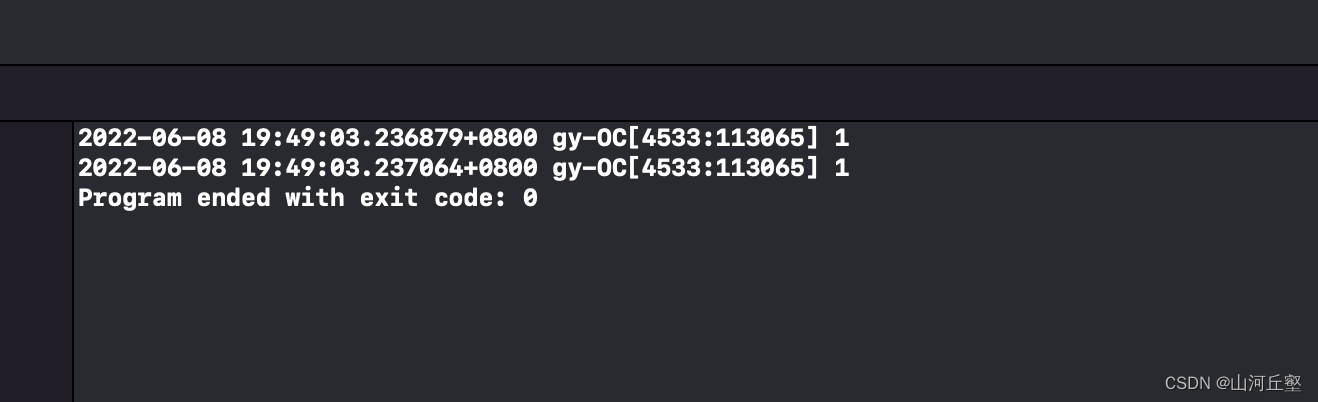
这里是含有q且长度小于9的代码
#import"0608.h"
int main(){
    @autoreleasepool {
        NSString* [email protected]"qqqqqq";
        NSString* [email protected]"qqqqqq";
        NSLog(@"%d",(str1 == str2));
        NSLog(@"%d",[str1 isEqual:str2]);
    }
}
代码结果: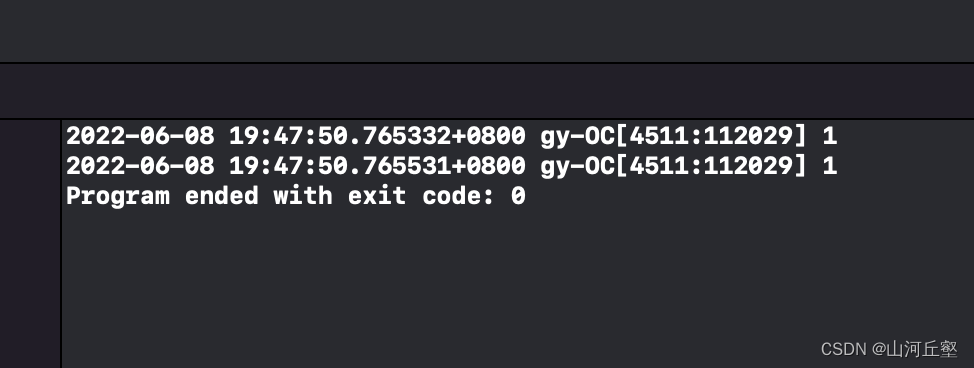
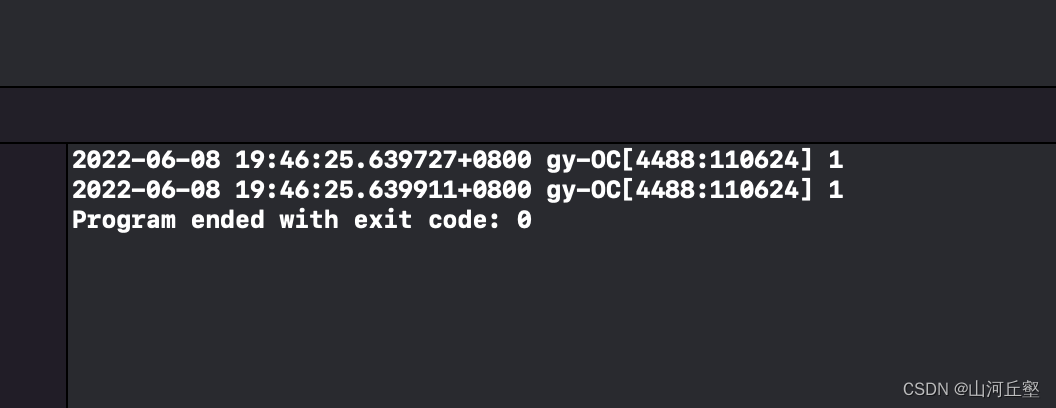
这里是当字符串为中文字符时的代码:
#import <Foundation/Foundation.h>
#import"0608.h"
int main(){

    @autoreleasepool {

        NSString* str1=@"挪挪";
        NSString* str2=@"挪挪";
        NSLog(@"%d",(str1 == str2));
        NSLog(@"%d",[str1 isEqual:str2]);
    }
}
边栏推荐
猜你喜欢
【代码源】每日一题 - 排队

文件--初识

数据预处理

@5-1 CCF 2019-12-1 报数

Publish Yum private server using nexus3 (offline intranet)

Thick willow dustpan, thin willow bucket, who hates reptile man? Asynchronous synergism, half a second to strip away a novel
OC--Foundation--字典
![[HCTF 2018]admin](/img/d7/f0155c72d3fbddf0a8c1796a179a0f.png)
[HCTF 2018]admin

【cf】Round 128 C. Binary String

初始Flask以及简单地上手应用
随机推荐
基本的网络知识
Understand the execution process of try, catch and finally (including return) (the most detailed analysis of the whole network)
Indexes, views and transactions of MySQL
浏览器访问swagger失败,显示错误ERR_UNSAFE_PORT
用kotlin怎么写Android切换界面
卷积神经网络的兴趣简单介绍
梦想启航(第一篇博客)
What is anemia model and congestion model?
Install MySQL in Ubuntu and create new users
Neural network method -- Boston house price (regression problem)
[GYCTF2020]Ez_Express
How to write Android switching interface with kotlin
Redis string 结构命令
Database operation language (DML)
Redis installation (Ubuntu)
¥1-2 例2.2 将两个集合的并集放到线性表中
CoreData存储待办事项
*6-1 CCF 2015-03-2 数字排序
*6-3 节约小能手
[GPLT] 2022 大众情人(floyd)