当前位置:网站首页>Thread pool execution process
Thread pool execution process
2022-06-24 10:24:00 【Ugly and ugly】
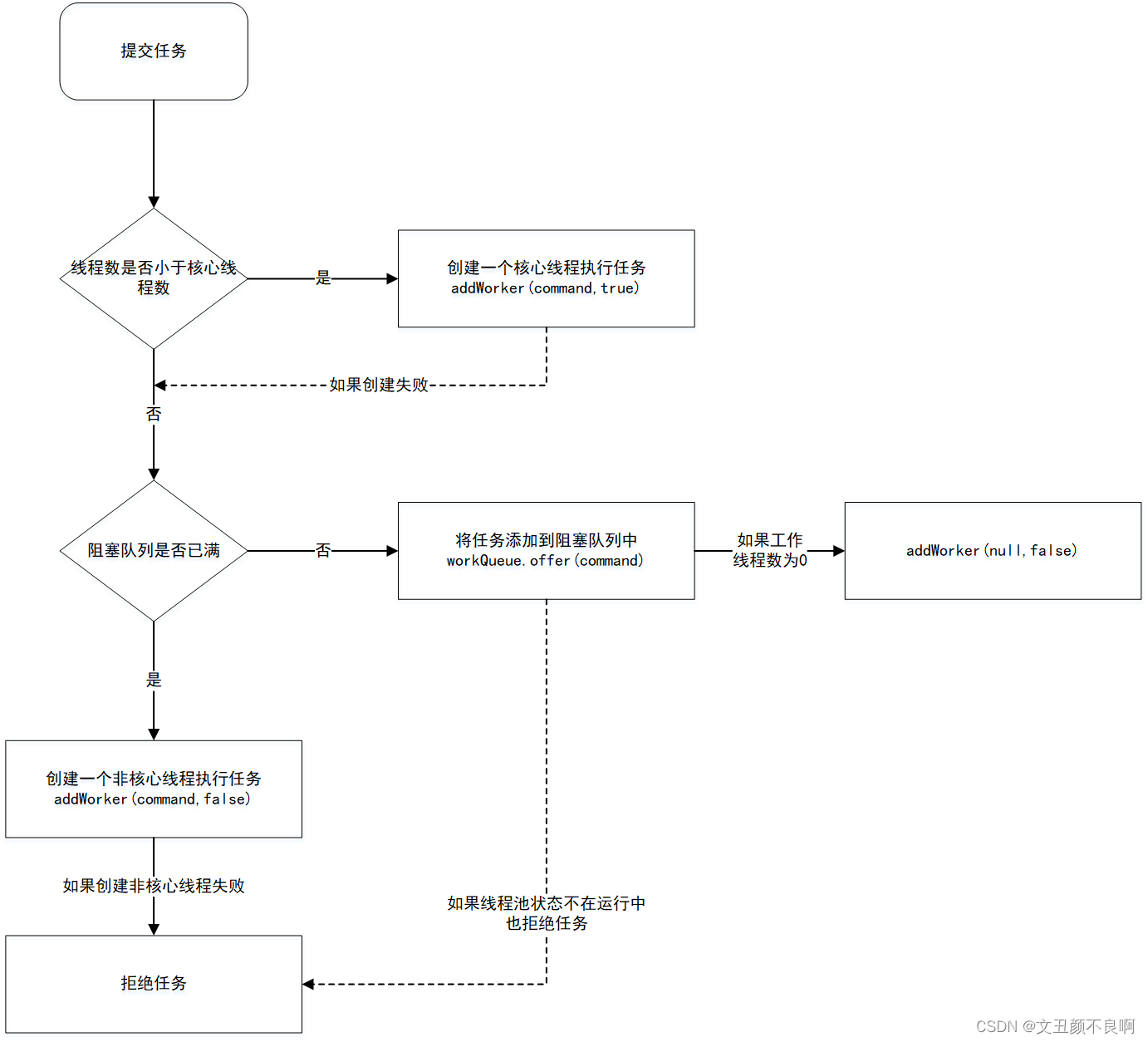
If shown in , Is the execution process of the thread pool , It can be divided into three main steps :
1. After the task is submitted, the current number of worker threads will be compared with the number of core threads , If the current number of worker threads is less than the number of core threads , Call directly addWorker() Method to create a core thread to execute tasks ;
2. If the number of worker threads is greater than the number of core threads , That is, the number of core threads in the thread pool is full , The new task will be added to the blocking queue for execution , Of course , Before adding a queue, you will also judge whether the queue is empty ;
3. If the number of surviving threads in the thread pool is equal to the number of core threads , And the blocking queue is full , Then you will judge whether the current number of threads has reached the maximum number of threads maximumPoolSize, If not , It will call addWorker() Method to create a non core thread to execute the task ;
4. If the current number of threads has reached the maximum number of threads , When a new task is submitted , Will execute a rejection strategy
In conclusion, it is Priority core threads 、 Blocking queue takes second place , Finally, non core threads .
java.util.concurrent.ThreadPoolExecutor#execute The source code of is :
 public void execute(Runnable command) {
     if (command == null)
         throw new NullPointerException();
     /*
      * Proceed in 3 steps:
      *
      * 1. If fewer than corePoolSize threads are running, try to
      * start a new thread with the given command as its first
      * task.  The call to addWorker atomically checks runState and
      * workerCount, and so prevents false alarms that would add
      * threads when it shouldn't, by returning false.
      *
      * 2. If a task can be successfully queued, then we still need
      * to double-check whether we should have added a thread
      * (because existing ones died since last checking) or that
      * the pool shut down since entry into this method. So we
      * recheck state and if necessary roll back the enqueuing if
      * stopped, or start a new thread if there are none.
      *
      * 3. If we cannot queue task, then we try to add a new
      * thread.  If it fails, we know we are shut down or saturated
      * and so reject the task.
      */
     int c = ctl.get();
     if (workerCountOf(c) < corePoolSize) {
         if (addWorker(command, true))
             return;
         c = ctl.get();
     }
     if (isRunning(c) && workQueue.offer(command)) {
         int recheck = ctl.get();
         if (! isRunning(recheck) && remove(command))
             reject(command);
         else if (workerCountOf(recheck) == 0)
             addWorker(null, false);
     }
     else if (!addWorker(command, false))
         reject(command);
 }
You can see , The comments in the source code also explain the whole excute() Method can be executed in three steps .
Variable in source code ctl It's an atomic class , The main function is to save the number of threads and the state of thread pool . Here we use high 3 Bit to save the running state , low 29 Bits to save the number of threads .
In these steps , The most important thing is addWorker() The method .
private boolean addWorker(Runnable firstTask, boolean core);The first parameter represents the task to be executed , If null, Then pull the task from the blocking queue ;
The second parameter indicates whether it is a core thread , Used to control addWorker() The process of .
addWorker() The main implementation process of the method is :

The source code is :
private boolean addWorker(Runnable firstTas
    retry:
    for (;;) {
        int c = ctl.get();
        int rs = runStateOf(c);
        // Check if queue empty only if nec
        if (rs >= SHUTDOWN &&
            ! (rs == SHUTDOWN &&
               firstTask == null &&
               ! workQueue.isEmpty()))
            return false;
        for (;;) {
            int wc = workerCountOf(c);
            if (wc >= CAPACITY ||
                wc >= (core ? corePoolSize
                return false;
            if (compareAndIncrementWorkerCo
                break retry;
            c = ctl.get();  // Re-read ctl
            if (runStateOf(c) != rs)
                continue retry;
            // else CAS failed due to worke
        }
    }
    boolean workerStarted = false;
    boolean workerAdded = false;
    Worker w = null;
    try {
        w = new Worker(firstTask);
        final Thread t = w.thread;
        if (t != null) {
            final ReentrantLock mainLock =
            mainLock.lock();
            try {
                // Recheck while holding lo
                // Back out on ThreadFactor
                // shut down before lock ac
                int rs = runStateOf(ctl.get
                if (rs < SHUTDOWN ||
                    (rs == SHUTDOWN && firs
                    if (t.isAlive()) // pre
                        throw new IllegalTh
                    workers.add(w);
                    int s = workers.size();
                    if (s > largestPoolSize
                        largestPoolSize = s
                    workerAdded = true;
                }
            } finally {
                mainLock.unlock();
            }
            if (workerAdded) {
                t.start();
                workerStarted = true;
            }
        }
    } finally {
        if (! workerStarted)
            addWorkerFailed(w);
    }
    return workerStarted;
}
addWorker() It will be used repeatedly during execution runStateOf() and workerCountOf() To get the status of the thread pool and the number of worker threads .
This article references from : Three minutes to understand the thread pool execution process - Nuggets
边栏推荐
猜你喜欢




随机推荐
leetCode-面试题 16.06: 最小差
分布式 | 如何与 DBLE 进行“秘密通话”
How can I solve the problem that the swiper animation animation fails when switching between left and right rotations of the swiper?
5.菜品管理业务开发
静态链接库和动态链接库的区别
学习使用KindEditor富文本编辑器,点击上传图片遮罩太大或白屏解决方案
Machine learning - principal component analysis (PCA)
一群骷髅在飞canvas动画js特效
学习整理在php中使用KindEditor富文本编辑器
Role of message queuing
使用swiper左右轮播切换时,Swiper Animate的动画失效,怎么解决?
Leetcode-1089: replication zero
用扫描的方法分发书稿校样
1. project environment construction
形状变化loader加载jsjs特效代码
卷妹带你学jdbc---2天冲刺Day1
canvas无限扫描js特效代码
【IEEE出版】2022年服务机器人国际研讨会(IWoSR 2022)
Uniapp implementation forbids video drag fast forward
JMeter接口测试工具基础 — Badboy工具