当前位置:网站首页>Task02: linked list
Task02: linked list
2022-06-11 01:59:00 【JxWang05】
Task02: Linked list
1. Video title
1.1 Remove linked list elements
1.1.1 describe
Give you a list of the head node head And an integer val , Please delete all the contents in the linked list Node.val == val The node of , And back to New head node .
Example 1:
Input :head = [1,2,6,3,4,5,6], val = 6
Output :[1,2,3,4,5]
Example 2:
Input :head = [], val = 1
Output :[]
Example 3:
Input :head = [7,7,7,7], val = 7
Output :[]
Tips :
The number of nodes in the list is in the range [0, 104] Inside
1 <= Node.val <= 50
0 <= val <= 50
1.1.2 Code
The given linked list is actually a linked list without head nodes , Because the value of the first node is meaningful
So for ease of operation , Here we redefine a header node , Its value is empty
This new header node is mainly used to determine whether the original header node needs to be removed
# Definition for singly-linked list.
# class ListNode:
# def __init__(self, val=0, next=None):
# self.val = val
# self.next = next
class Solution:
    def removeElements(self, head: ListNode, val: int) -> ListNode:
        new_head = ListNode()
        new_head.next = head
        prev = new_head
        while prev.next :
            if prev.next.val == val:
                prev.next = prev.next.next
            else:
                prev = prev.next
        return new_head.next
1.1.3 summary
We have created a new header node , In addition to the convenience of judging the original head node
The criteria of the cycle are also determined , namely prev.next, It is convenient to remove elements after they are found
So if you want to remove elements , It's generally used .next.val Judge
Find it this way val after , Skip the element directly , namely .next = .next.next
1.2 Rotate the list
1.2.1 describe
Give you a list of the head node head , Rotate the list , Move each node of the list to the right k A place .
Example 1:
Input :head = [1,2,3,4,5], k = 2
Output :[4,5,1,2,3]
Example 2:
Input :head = [0,1,2], k = 4
Output :[2,0,1]
Tips :
The number of nodes in the linked list is in the range [0, 500] Inside
-100 <= Node.val <= 100
0 <= k <= 2 * 109
1.2.2 Code
Rotate the list , That is to say, you need to connect the linked list end to end to form a ring , Then disconnect at the new tail node
Because each node is moved to the right k A place , So go from the end k The element reached by step is the new tail node
But the linked list is one-way , So we have to count from the beginning , That is, from the new head node length-k The node reached by step
Here's a detail , Suppose the length of the linked list is length, Then there are between the first and last nodes length-1 An interval , That's the step length
So if you start from the head node of the original linked list , It needs to be moved (length-1) - k A step
among ,length-1 Is the interval between the beginning and the end ,k Is the step size between the new tail node and the old tail node , That is to move to the right k A place
Because we have newly set an empty header node for the convenience of operation , step +1, So you need to move to the right length-k A step
# Definition for singly-linked list.
# class ListNode:
# def __init__(self, val=0, next=None):
# self.val = val
# self.next = next
class Solution:
    def rotateRight(self, head, k):

        dummy = ListNode(0)
        #  Create a new header node for easy operation
        dummy.next = head
        #  Connect the head node of the original linked list
        if head is None:
            return None
        #  If the linked list is empty, it will be returned directly
        i = head
        #  Start from the head node of the original linked list
        length = 1
        #  Start counting
        while i.next is not None:
            i = i.next
            length += 1
        #  Traversal access , Get the interval length and tail node
        k = k%length
        #  Linked lists form rings , It is possible to move more than one turn to the right
        if (k == 0) or length == 1:
            return head
        #  If it just moves right length position , That is unchanging
        #  Or the linked list has only one element , That is the same

        i.next = head
        #  end to end , Linked lists form rings

        i = dummy
        for _ in range(length - k):
            i = i.next
        #  Start with the new empty header node
        #  To the right length-k Step
        #  Find the location of the new tail node

        j = i.next
        #  New head node

        i.next = None
        #  New tail node

        return j
        #  Return to header node
1.2.3 summary
The first is the judgment of special circumstances , One is that the moving step length is exactly equal to the interval length of the linked list
It's just a circle , Back to the original position , That is, there is no change
Another is that there is only one element , No matter how it moves, it remains unchanged
And then after the ring is formed , Pay attention to the surplus , That is, to deal with the situation of moving more than one circle
Finally, the length of the main interval is different from that of the linked list , The difference between the two is 1 position
2. Assignment topic
2.1 Merge two ordered lists
2.1.1 describe
Merge two ascending linked lists into a new Ascending Link list and return . The new linked list is made up of all the nodes of the given two linked lists .
Example 1:
Input :l1 = [1,2,4], l2 = [1,3,4]
Output :[1,1,2,3,4,4]
Example 2:
Input :l1 = [], l2 = []
Output :[]
Example 3:
Input :l1 = [], l2 = [0]
Output :[0]
Tips :
The range of the number of nodes in the two linked lists is [0, 50]
-100 <= Node.val <= 100
l1 and l2 All according to Non decreasing order array
2.1.2 Code
The most intuitive idea is to compare the head nodes of two old linked lists in turn , Then add the small ones to the new linked list
Note that the two old linked lists are empty , Or if the values of the two old chain header nodes are equal
So we used it directly in both cases else To judge
# Definition for singly-linked list.
# class ListNode:
# def __init__(self, val=0, next=None):
# self.val = val
# self.next = next
class Solution:
    def mergeTwoLists(self, l1: ListNode, l2: ListNode) -> ListNode:
        head = ListNode(0)
        temp = head
        while l1 and l2:
            if l1.val < l2.val :
               temp.next = l1
               l1 = l1.next
               temp = temp.next
            else:
                temp.next = l2
                l2 = l2.next
                temp = temp.next
        if l1:
            temp.next = l1
        else:
            temp.next = l2

        return head.next
There is also a recursive solution , Running time is even longer , And the idea doesn't seem intuitive
But if we think recursively , It may be more intuitive to find this way
It seems to have a little meaning of dynamic planning , Superposition optimal sub solution , To achieve the optimal solution
It only compares the size of the current value , By default, the following values are the ordered optimal substructures
Then recursively call itself to ensure that the following values are ordered
# Definition for singly-linked list.
# class ListNode:
# def __init__(self, val=0, next=None):
# self.val = val
# self.next = next
class Solution:
    def mergeTwoLists(self, l1: ListNode, l2: ListNode) -> ListNode:
        if l1 is None:
            return l2
        elif l2 is None:
            return l1
        elif l1.val < l2.val:
            l1.next = self.mergeTwoLists(l1.next, l2)
            return l1
        else:
            l2.next = self.mergeTwoLists(l1, l2.next)
            return l2
2.1.3 summary
If the values are equal , Both operations can be handled , That is suitable for use else, direct charging else Category
2.2 Intersecting list
2.2.1 describe
Here are two head nodes of the single linked list headA and headB , Please find out and return the starting node where two single linked lists intersect . If two linked lists do not have intersecting nodes , return null .
Figure two linked lists at the node c1 Start meeting :

Subject data Guarantee There is no ring in the whole chain structure .
Be careful , Function returns the result , Linked list must Keep its original structure .
Custom profiling :
Evaluation system The input is as follows ( The program you designed Do not apply This input ):
intersectVal - The value of the starting node of the intersection . If there are no intersecting nodes , This value is 0
listA - The first list
listB - The second list
skipA - stay listA in ( Start from the beginning ) Number of nodes jumping to cross nodes
skipB - stay listB in ( Start from the beginning ) Number of nodes jumping to cross nodes
The evaluation system will create a linked data structure based on these inputs , And the two header nodes headA and headB The program passed to you . If the program returns the intersection node correctly , Then your solution will be Take it as the right answer .
Example 1: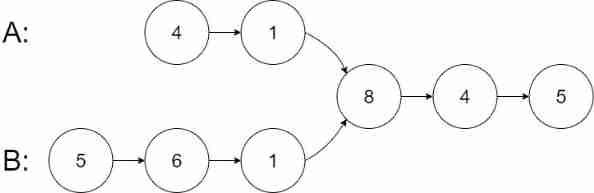
Input :intersectVal = 8, listA = [4,1,8,4,5], listB = [5,6,1,8,4,5], skipA = 2, skipB = 3
Output :Intersected at ‘8’
explain : The value of the intersection node is 8 ( Be careful , If two linked lists intersect, they cannot be 0).
Starting from the respective heads , Linked list A by [4,1,8,4,5], Linked list B by [5,6,1,8,4,5].
stay A in , There is... Before the intersection node 2 Nodes ; stay B in , There is... Before the intersection node 3 Nodes .
Example 2:
Input :intersectVal = 2, listA = [1,9,1,2,4], listB = [3,2,4], skipA = 3, skipB = 1
Output :Intersected at ‘2’
explain : The value of the intersection node is 2 ( Be careful , If two linked lists intersect, they cannot be 0).
Starting from the respective heads , Linked list A by [1,9,1,2,4], Linked list B by [3,2,4].
stay A in , There is... Before the intersection node 3 Nodes ; stay B in , There is... Before the intersection node 1 Nodes .
Example 3:
Input :intersectVal = 0, listA = [2,6,4], listB = [1,5], skipA = 3, skipB = 2
Output :null
explain : Starting from the respective heads , Linked list A by [2,6,4], Linked list B by [1,5].
Because these two linked lists don't intersect , therefore intersectVal It has to be for 0, and skipA and skipB It could be any value .
The two lists don't intersect , Therefore return null .
Tips :
listA The number of nodes in is m
listB The number of nodes in is n
1 <= m, n <= 3 * 104
1 <= Node.val <= 105
0 <= skipA <= m
0 <= skipB <= n
If listA and listB There is no point of intersection ,intersectVal by 0
If listA and listB There are intersections ,intersectVal==listA[skipA]==listB[skipB]
Advanced : Can you design a time complexity O(m + n) 、 Just use O(1) Memory solutions ?
2.2.2 Code
The simplest and most intuitive way is to type a watch , First, create a hash table for one of the linked lists
Then traverse another linked list , When encountering the same, it will jump out and return to the intersection node
# Definition for singly-linked list.
# class ListNode:
# def __init__(self, x):
# self.val = x
# self.next = None

class Solution(object):
    def getIntersectionNode(self, headA, headB):
        d = dict()
        while headA:
            d[headA] = 1
            headA = headA.next
        while headB:
            if headB in d:
                return headB
            headB = headB.next
        return None
There is also a double pointer solution , The idea is also magical and ingenious
I think it's for the pointer a, Let him run on the list B Inside the self forming ring , The pointer b On the contrary
After entering the ring , The two pointers move at the same speed , But the length of the two linked lists is different , So meet
If two linked lists have the same length , Then there is no need to enter the ring , Meet directly at the intersection
But if the pointer a and b Each of them runs in A and B Inside their respective rings , Then something goes wrong
Or it is an endless loop in which two linked lists do not intersect , Or running too long and overtime
Maybe that's not intuitive enough , We can flatten the two linked lists , Fixed pointer , Move linked list
Then we can find , When a,b After running their respective lists, they enter each other's rings , Just run the length before the intersection
hypothesis A The length before the intersection is α \alpha α,B The length before the intersection is β \beta β, The length after intersection is θ \theta θ
Flatten the list , The pointer a ran α + θ + β \alpha+\theta+\beta α+θ+β,b ran β + θ + α \beta+\theta+\alpha β+θ+α, The two meet
If the two don't intersect , set up A The length of is α \alpha α,B The length of is β \beta β, When they meet, they are None
among a ran α + β \alpha+\beta α+β, and b ran β + α \beta+\alpha β+α, The same length meets at the end
The above ideas come from blogs 1, See the explanation and drawings for details
# Definition for singly-linked list.
# class ListNode:
# def __init__(self, x):
# self.val = x
# self.next = None

class Solution(object):
    def getIntersectionNode(self, headA, headB):
        pA = headA
        pB = headB
        while pA != pB :
            pA = pA.next if pA else headB
            pB = pB.next if pB else headA

        return pA
2.2.3 summary
If you only ask to pass the title , Of course, long live the clock
From the perspective of moving the pointer in a fixed linked list , To use double pointers , There must be a difference between the two , Otherwise, we cannot meet
The ingenious part of this question is when the length of the two linked lists is the same , The pointer will meet before entering the loop
And if the title itself has no ring , We can construct rings to use double pointers
And we can change the angle of view when forming a ring , That is, the linked list is leveled and connected , Fixed pointer moves linked list
2.3 Delete duplicate elements from the sort list II
2.3.1 describe
Given the header of a sorted linked list head , Delete all nodes with duplicate numbers in the original linked list , Leave only different numbers . return Sorted linked list .
Example 1:
Input :head = [1,2,3,3,4,4,5]
Output :[1,2,5]
Example 2:

Input :head = [1,1,1,2,3]
Output :[2,3]
Tips :
The number of nodes in the linked list is in the range [0, 300] Inside
-100 <= Node.val <= 100
The title data ensures that the linked list has been in ascending order array
2.3.2 Code
Completely erase duplicate elements , So you need to record the previous element of the repeating sequence
And connect it to the first element after the repeating sequence , So it's a double pointer
A pointer is responsible for recording the previous element of the repeating sequence
The other is responsible for finding the first element after the repeated sequence
Use here next It is reduced to a pointer
# Definition for singly-linked list.
# class ListNode:
# def __init__(self, val=0, next=None):
# self.val = val
# self.next = next
class Solution:
    def deleteDuplicates(self, head: ListNode) -> ListNode:
        if not head:
            return head

        dummy = ListNode(0, head)
        #  Create a new header node , Make sure you start from the beginning

        cur = dummy

        while cur.next and cur.next.next:
        #  Loop to the end of the list
            if cur.next.val == cur.next.next.val:
            #  Once a duplicate value is found
                x = cur.next.val
                #  Get this duplicate number
                while cur.next and cur.next.val == x:
                #  Anything equal to this value is erased
                    cur.next = cur.next.next
            else:
                cur = cur.next
            #  Move to the next node
        return dummy.next
2.3.3 summary
My initial idea was to set up fast and slow Two pointers , Later, it was found that it could be merged into one
And then there's the repeated numbers , This is a sequence , So we need to use a loop to eliminate
边栏推荐
- 【音乐】基于matlab演奏《过火》【含Matlab源码 1875期】
- What if ROS lacks a package
- 基于Gin、Gorm实现的在线练习系统之项目梳理
- MATLAB数组其他常见操作笔记
- 2021-2-26 compilation of programming language knowledge points
- Task03: building an offline material system
- 1.6 Px4 initialization calibration
- 【MATLAB】图像基本运算(点运算、算术运算、缩放、旋转)
- [leetcode] notes on recursive time value transfer and reference transfer
- 卡尔曼滤波(KF)、拓展卡尔曼滤波(EKF)推导
猜你喜欢

Win11触摸键盘主题如何更换?Win11更换触摸键盘主题的方法

【音乐】基于matlab演奏《过火》【含Matlab源码 1875期】
![[leetcode] merge K ascending linked lists](/img/ff/054b7c14ce678fbdf45af780261b8c.jpg)
[leetcode] merge K ascending linked lists

A brief history of neural network

2.0 detailed explanation of ROS and Px4 communication

1.4px4 program download

1.5 Px4 vehicle selection

---Arrange numbers---

AI 狂想|来这场大会,一起盘盘 AI 的新工具!

flutter 状态管理
随机推荐
2021-2-14 gephi学习笔记
1.5 Px4 vehicle selection
---排列数字---
【MATLAB】图像复原
Leetcode 652 find duplicate subtrees (recommended by DFS)
【MATLAB】图像压缩编码(DCT、RLE)
On permutation and combination in probability and statistics
(已解决)Latex--取消正文中参考文献引用的上标显示(gbt7714-2015会导致默认上角标引用)(上角标&平齐标混合使用教程)
[matlab] image compression coding (DCT, RLE)
Byte Beijing 23K and pinduoduo Shanghai 28K, how should I choose?
[BSP video tutorial] BSP video tutorial issue 17: single chip microcomputer bootloader topic, startup, jump configuration and various usage of debugging and downloading (2022-06-10)
flutter_swiper 轮播图 插件
[QT] error: qapplication: no such file or directory solution
Derivation of Kalman filter (KF) and extended Kalman filter (EKF)
1.4px4 program download
1.2. Ros+px4 preliminary basic knowledge
中國各省份省會的坐標
关于概率统计中的排列组合
In May, the main growth ranking list (platform of station B) of the single flying melon data up was released
MATLAB数字运算函数笔记