当前位置:网站首页>Implementation of double linked list in C language
Implementation of double linked list in C language
2022-06-30 07:25:00 【Three stinky ginger】
C Language implementation of double linked list
List of articles
explain
The picture was drawn by myself , It's a little ugly , You don't mind? .
This article is from the column : data structure
It will continue in the future coding. If necessary, you can pay attention to and like the wave .
Implemented function
- Insert node
- Delete node
- Go through all the elements from beginning to end
- Get the precursor of a node and its successor nodes
The main purpose of obtaining the precursor and successor is to test whether the double linked list is written correctly , Because the double linked list can access the precursor , This is different from the single linked list .
Structure definition
typedef struct BiLinkNode
{

	ElemType data;
	struct BiLinkNode *rlink,*llink;// Represents the left pointer and the right pointer respectively , Point to the forerunner and the successor respectively , Generally also writing prior and next
}BiLink;
initialization
// Initialize double linked list ( Leading node )
bool InitBiLinkList(BiLink *B)
{

	// First apply for a header node
	BiLink *head = (BiLink *)malloc(sizeof(BiLink));
	// The left and right pointers are initially null , And the meter length is 0
	head->llink = B;
	B->rlink = head;
	head->rlink = NULL;// After the header node, there is no element at first
	return true;
}
Insert node
As shown in the figure below :

The green solid line is the structure before insertion , The dotted line is what we are going to do .S Represents the newly inserted node .
The sequence of operations here is ①②③④, Of course, you can also change the order , such as ③ and ④ The order of can be changed . The corresponding code implementation of these operations is :
①s->rlink = p->rlink;
②p->rlink->llink = s;
③p->rlink = s;
④s->llink = p;
Here I use the head interpolation method to realize , Welcome to use the tail interpolation method to try .
// Insert
bool InsertBiLinkList(BiLink *B,ElemType e)
{

	// The first interpolation
	BiLink *p = B;//

	// Apply for a new node
	BiLink *s = (BiLink *)malloc(sizeof(BiLink));

	s->data = e;// assignment

	// Modify pointer   The node s Insert to node p after
	s->rlink = p->rlink;//s Pointer to
	p->rlink->llink = s;

	p->rlink = s;
	s->llink = p;

	length++;// Number of elements plus one
	return true;
}
Delete node
Pictured :

Deleting is much simpler than inserting , We just need to modify it q->llink The right pointer of and q->rlink The left pointer of , Point them at q->rlink and q-<llink that will do .
bool DeleteBinList(BiLink *B,ElemType *e)// Delete a node according to the value
{

	BiLink *q;
	q = B->rlink;

	while(q->rlink!=NULL)// First traversal
	{

		if(q->data == e)// First find this node
		{

			q->llink->rlink = q->rlink;// modify q The following pointer in front of the node
			q->rlink->llink = q->llink;// modify q The precursor pointer behind the node
		}
		q = q->rlink;
	}
	length--;
	return true;
}
Output all elements
Just traverse from beginning to end or from end to end . Here I implement the traversal from beginning to end .
void PrintAll(BiLink *B)
{

	BiLink *q;
	q = B->rlink;

	// Print out all elements
	while(q->rlink!=NULL)
	{

		printf("%d ",q->data);
		q = q->rlink;// As long as it's not at the end , The pointer ++
	}
}
All the code
#include<stdio.h>
#include<stdlib.h>
#include<stdbool.h> // according to C99 standard ,C Language use bool Type needs to add this header file

typedef int ElemType;

typedef struct BiLinkNode
{

	ElemType data;
	struct BiLinkNode *rlink,*llink;
}BiLink;

//------------  Function declaration  ----------//
void MainMenu();
bool GetLen(BiLink *B);// Get table length , And print directly on the screen
bool InitBiLinkList(BiLink *B);// initialization
bool InsertBiLinkList(BiLink *B,ElemType e);// Insert
void PrintAll(BiLink *B);// Output all elements
bool GetPriorNode(BiLink *B,ElemType e,ElemType *ldata);// The search element is e The value of the precursor node of
bool GetNextNode(BiLink *B,ElemType e,ElemType *rdata);// The search element is e The value of the successor node of
bool DeleteBinList(BiLink *B,ElemType *e);// Delete a node according to the value
//------------  Function declaration  ----------//

int length; // Actual length in the table

int main()
{

	BiLink B;

	int ch;
	ElemType element,num,ldata,rdata;

	if(InitBiLinkList(&B))
		printf(" Successful initialization !\n");
	else
		printf(" initialization failed !\n");

	while(1)
	{

		MainMenu();
		printf(" Please enter the action you want to perform :");
		scanf("%d",&ch);

		switch(ch)
		{

			case 0:		printf(" Thank you for using , Exited !");	exit(0);	break;
			case 1:		printf(" Please enter the element you want to insert :\n");
						scanf("%d",&element);
						if(InsertBiLinkList(&B,element))
							printf(" Insert the success !\n");
						else
							printf(" Insert the failure !\n");
						break;
			case 2:		PrintAll(&B);
						break;
			case 3:		if(GetLen(&B))
							printf(" To be successful !");
						else
							printf(" Acquisition failure !");
						break;

			case 4:
						printf(" Please enter the value of the current node you want to get :\n");
						scanf("%d",&num);
						if(GetPriorNode(&B,num,&ldata))
							printf(" To be successful ,%d The value of the previous node of is :%d\n",num,ldata);
						else
							printf(" Acquisition failure !");
						break;
			case 5:
						printf(" Please enter the value of the current node you want to get :\n");
						scanf("%d",&num);
						if(GetNextNode(&B,num,&rdata))
							printf(" To be successful ,%d The value of the last node of is :%d\n",num,rdata);
						else
							printf(" Acquisition failure !");
						break;
			case 6:
						printf(" Please enter the value of the node you want to delete :\n");
						scanf("%d",&num);
						if(DeleteBinList(&B,num))
							printf(" Delete successful !\n");
						else
							printf(" Delete failed !");
						break;
			default:	printf(" The operation instruction you entered is incorrect ! Please re-enter !");
		}
	}

	return 0;
}

// The main menu , Show
void MainMenu()
{

	printf("\n\n\n");
	printf("\t *************  The realization of double linked list  ************\n\n");
	printf("\t ------- 0. sign out  \n\n");
	printf("\t ------- 1. Insert elements \n\n");
	printf("\t ------- 2. Output all elements \n\n");
	printf("\t ------- 3. Get table length \n\n");
	printf("\t ------- 4. Get the value of the precursor node of a node \n\n");
	printf("\t ------- 5. Get the value of the successor node of a node \n\n");
	printf("\t ------- 6. Delete a node \n\n");
	printf("\t *************************************\n");
}


// Initialize double linked list ( Leading node )
bool InitBiLinkList(BiLink *B)
{

	// First apply for a header node
	BiLink *head = (BiLink *)malloc(sizeof(BiLink));
	// The left and right pointers are initially null , And the meter length is 0
	head->llink = B;
	B->rlink = head;
	head->rlink = NULL;// After the header node, there is no element at first
	return true;
}

// Insert
bool InsertBiLinkList(BiLink *B,ElemType e)
{

	// The first interpolation
	BiLink *p = B;//

	// Apply for a new node
	BiLink *s = (BiLink *)malloc(sizeof(BiLink));

	s->data = e;// assignment

	// Modify pointer   The node s Insert to node p after
	s->rlink = p->rlink;//s Pointer to
	p->rlink->llink = s;

	p->rlink = s;
	s->llink = p;

	length++;// Number of elements plus one
	return true;
}


bool GetLen(BiLink *B)
{

	printf(" The watch is :%d\n",length);
	return true;
}

void PrintAll(BiLink *B)
{

	BiLink *q;
	q = B->rlink;

	// Print out all elements
	while(q->rlink!=NULL)
	{

		printf("%d ",q->data);
		q = q->rlink;
	}
}

bool GetPriorNode(BiLink *B,ElemType e,ElemType *ldata)// The search element is e The value of the precursor node of
{

	BiLink *q;
	q = B->rlink;

	while(q->rlink!=NULL)
	{

		if(q->data == e)// First find this node
			*ldata = q->llink->data;
		q = q->rlink;
	}
	return true;
}

bool GetNextNode(BiLink *B,ElemType e,ElemType *rdata)// The search element is e The value of the successor node of
{

	BiLink *q;
	q = B->rlink;

	while(q->rlink!=NULL)
	{

		if(q->data == e)// First find this node
			*rdata = q->rlink->data;
		q = q->rlink;
	}
	return true;
}

bool DeleteBinList(BiLink *B,ElemType *e)// Delete a node according to the value
{

	BiLink *q;
	q = B->rlink;

	while(q->rlink!=NULL)
	{

		if(q->data == e)// First find this node
		{

			q->llink->rlink = q->rlink;// modify q The following pointer in front of the node
			q->rlink->llink = q->llink;// modify q The precursor pointer behind the node
		}
		q = q->rlink;
	}
	length--;
	return true;
}
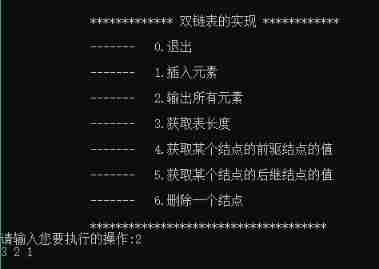
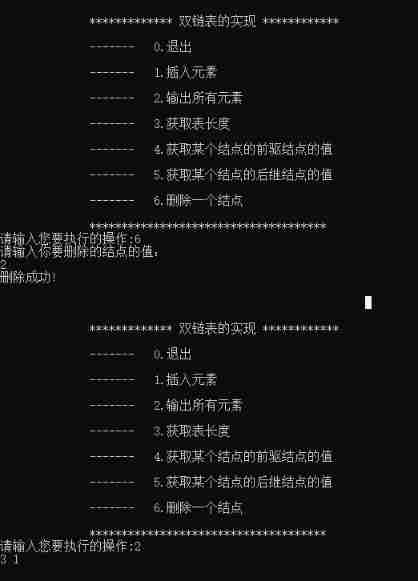
test



边栏推荐
- The most convenient serial port screen chip scheme designed at the charging pile in China
- 年轻人搞副业有多疯狂:月薪3000,副业收入3W
- failed to create symbolic link ‘/usr/bin/mysql’: File exists
- Detailed methods for copying local computer files to virtual machine system
- LabVIEW程序代码更新缓慢
- 1.someip introduction
- Write about your feelings about love and express your emotions
- The class imported by idea import clearly exists, but it is red?
- Golan common shortcut key settings
- Binary tree traversal
猜你喜欢
Connection flood attack principle
Video player (II): video decoding

The first up Master of station B paid to watch the video still came! Price "Persuading" netizens

How to use string branches for switch case

Resolution: div failed to get keyboard event

Win10 step pit - power on 0xc0000225

Network security - packet capture and IP packet header analysis
![[most complete] install MySQL on a Linux server](/img/5d/8d95033fe577c161dfaedd2accc533.png)
[most complete] install MySQL on a Linux server

Raspberry pie trivial configuration

Calculation and parameter quantity of neural network
随机推荐
[most complete] install MySQL on a Linux server
Install go language development tools
vs2019和sql
单测调用对象的私有方法
Stm32g0 and FreeRTOS learning summary
【已解决】ERROR 1290 (HY000): Unknown error 1290
app quits unexpectedly
手机开户股票开户安全吗?开户需要准备什么?
Starting MySQL ERROR! Couldn‘t find MySQL server (/usr/local/mysql/bin/mysqld_safe)
QT signal slot alarm QObject:: connect:cannot connect (null)
将本地电脑文件复制到虚拟机系统中详细方法
Resolution: div failed to get keyboard event
Keil plug-in Usage Summary
28 rounds of interviews with 10 companies in two and a half years
Halcon: read the camera and binary it
June 29, 2022 -- take the first step with C # -- add decision logic to the code using the "if", "else" and "else if" statements in C #
[semidrive source code analysis] [x9 chip startup process] 34 - RTOS side display module SDM_ display_ Init display initialization source code analysis
Go common commands
实验一、综合实验【Process on】
记录开发过程中无法使用管理员身份修改系统文件问题