当前位置:网站首页>Binary tree (serialization)
Binary tree (serialization)
2022-06-12 12:39:00 【Joey Liao】
JSON It's widely used , For example, we often sequence the structure of a language into JSON character string , It's stored in a cache or sent to a remote service over the network , Consumer acceptance JSON The string is then deserialized , You can get the raw data . This is it. 「 serialize 」 and 「 Deserialization 」 Purpose , Organize strings in some fixed format , Make data independent of programming language .
This article will use the preface 、 Middle preface 、 Post order traversal to serialize and deserialize binary trees , further , We will also use iterative hierarchical traversal to solve this problem .
List of articles
One 、 Title Description
Force to buckle 297 topic 「 Serialization and deserialization of binary trees 」
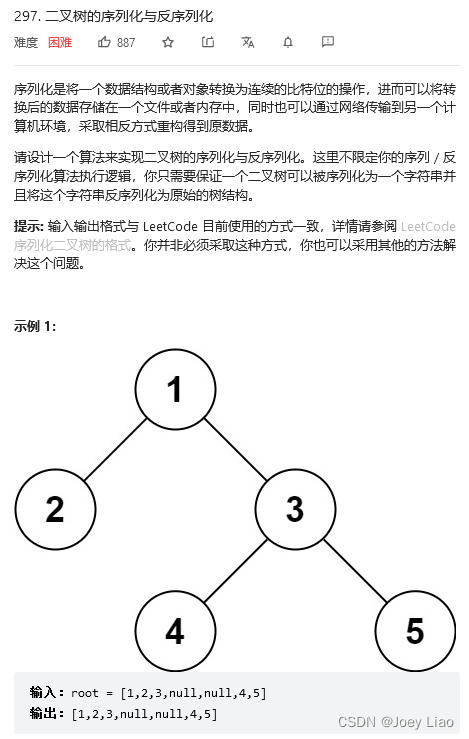
Is to input the root node of a binary tree for you root, You are required to implement the following class :
public class Codec {


    //  Sequence a binary tree into a string
    public String serialize(TreeNode root) {
    }

    //  Deserialize a string into a binary tree
    public TreeNode deserialize(String data) {
    }
}
Two 、 Preorder traversal solution
Imagine , The binary tree junction should be a two-dimensional structure in the plane , And the serialized string is a linear one-dimensional structure . The so-called serialization is just the structured data 「 Strike a level 」, In fact, it is to investigate the traversal way of binary tree .
StringBuilder Can be used to efficiently concatenate strings , So it's also a list , use , As a separator , use # Represents a null pointer null
thus , We've been able to write serialization functions serialize The code of :
String SEP = ",";
String NULL = "#";

/*  The main function , Serialize a binary tree into a string  */
String serialize(TreeNode root) {

    StringBuilder sb = new StringBuilder();
    serialize(root, sb);
    return sb.toString();
}

/*  Auxiliary function , Store the binary tree in  StringBuilder */
void serialize(TreeNode root, StringBuilder sb) {

    if (root == null) {

        sb.append(NULL).append(SEP);
        return;
    }

    /******  Preorder traversal position  ******/
    sb.append(root.val).append(SEP);
    /***********************/

    serialize(root.left, sb);
    serialize(root.right, sb);
}
Think about how to write it deserialize function , Reverse the string to construct a binary tree .
In the general context , The result of preorder traversal alone cannot restore the binary tree structure , Because of the lack of null pointer information , At least get before 、 in 、 In order to restore the binary tree, two kinds of post order traversal can be used . But here node The list contains information about null pointers , So just use node List can restore the binary tree .
that , The same is true for deserialization , First determine the root node root, Then follow the rules of preorder traversal , The left and right subtrees are generated recursively :
/*  The main function , Deserialize a string into a binary tree structure  */
TreeNode deserialize(String data) {

    //  Convert string to list
    LinkedList<String> nodes = new LinkedList<>();
    for (String s : data.split(SEP)) {

        nodes.addLast(s);
    }
    return deserialize(nodes);
}

/*  Auxiliary function , adopt  nodes  List construction binary tree  */
TreeNode deserialize(LinkedList<String> nodes) {

    if (nodes.isEmpty()) return null;

    /******  Preorder traversal position  ******/
    //  At the far left of the list is the root node
    String first = nodes.removeFirst();
    if (first.equals(NULL)) return null;
    TreeNode root = new TreeNode(Integer.parseInt(first));
    /***********************/

    root.left = deserialize(nodes);
    root.right = deserialize(nodes);

    return root;
}
3、 ... and 、 Post order ergodic solution
Understand the solution of preorder traversal , Post order traversal is easier to understand , Let's first achieve serialize Serialization method , You can just modify the method a little :
/*  Auxiliary function , Store the binary tree in  StringBuilder */
void serialize(TreeNode root, StringBuilder sb) {

    if (root == null) {

        sb.append(NULL).append(SEP);
        return;
    }

    serialize(root.left, sb);
    serialize(root.right, sb);

    /******  Postorder traversal position  ******/
    sb.append(root.val).append(SEP);
    /***********************/
}
deserialize Methods first look for root The value of the node , Then recursively calculate the left and right child nodes 
so ,root The value of is the last element of the list . We should take the list elements from back to front , Construct with the last element first root, And then recursively call to generate root Right and left subtrees . Be careful , According to the picture above , From back to front in nodes Take the elements from the list , Make sure to construct first root.right subtree , Post structure root.left subtree .
/*  The main function , Deserialize a string into a binary tree structure  */
TreeNode deserialize(String data) {

    LinkedList<String> nodes = new LinkedList<>();
    for (String s : data.split(SEP)) {

        nodes.addLast(s);
    }
    return deserialize(nodes);
}

/*  Auxiliary function , adopt  nodes  List construction binary tree  */
TreeNode deserialize(LinkedList<String> nodes) {

    if (nodes.isEmpty()) return null;
    //  Take the elements from back to front
    String last = nodes.removeLast();
    if (last.equals(NULL)) return null;
    TreeNode root = new TreeNode(Integer.parseInt(last));
    //  Restricted construction right subtree , The left subtree is constructed after
    root.right = deserialize(nodes);
    root.left = deserialize(nodes);

    return root;
}
Four 、 Middle order ergodic solution
Say first conclusion , Middle order traversal doesn't work , Because the deserialization method cannot be implemented deserialize. Middle order traversal code ,root The value of is sandwiched between two subtrees , That is to say nodes In the middle of the list , We don't know the exact index location , So we can't find root node , You can't deserialize .
5、 ... and 、 Hierarchical ergodic solution
First , First write the code framework of traversing the binary tree hierarchically :
void traverse(TreeNode root) {

    if (root == null) return;
    //  Initialize queue , take  root  Join the queue
    Queue<TreeNode> q = new LinkedList<>();
    q.offer(root);

    while (!q.isEmpty()) {

        TreeNode cur = q.poll();

        /*  Level traversal code location  */
        System.out.println(root.val);
        /*****************/

        if (cur.left != null) {

            q.offer(cur.left);
        }

        if (cur.right != null) {

            q.offer(cur.right);
        }
    }
}
The above code is a standard binary tree level traversal framework , From top to bottom , Print the values of each level of binary tree nodes from left to right , You can see , queue q There won't be null The pointer .
However, we need to record null pointer in the process of deserialization null Of , So the standard hierarchical traversal framework can be slightly modified
String SEP = ",";
String NULL = "#";

/*  Serialize a binary tree into a string  */
String serialize(TreeNode root) {

    if (root == null) return "";
    StringBuilder sb = new StringBuilder();
    //  Initialize queue , take  root  Join the queue
    Queue<TreeNode> q = new LinkedList<>();
    q.offer(root);

    while (!q.isEmpty()) {

        TreeNode cur = q.poll();

        /*  Level traversal code location  */
        if (cur == null) {

            sb.append(NULL).append(SEP);
            continue;
        }
        sb.append(cur.val).append(SEP);
        /*****************/

        q.offer(cur.left);
        q.offer(cur.right);
    }

    return sb.toString();
}

You can see , Each non empty node corresponds to two child nodes , So the idea of deserialization is to traverse hierarchically with queues , At the same time, index i Record the location of the corresponding child node :
/*  Deserialize a string into a binary tree structure  */
TreeNode deserialize(String data) {

    if (data.isEmpty()) return null;
    String[] nodes = data.split(SEP);
    //  The first element is  root  Value
    TreeNode root = new TreeNode(Integer.parseInt(nodes[0]));

    //  queue  q  Record parent , take  root  Join the queue
    Queue<TreeNode> q = new LinkedList<>();
    q.offer(root);

    for (int i = 1; i < nodes.length; ) {

        //  There are all parent nodes in the queue
        TreeNode parent = q.poll();
        //  The value of the left child node corresponding to the parent node
        String left = nodes[i++];
        if (!left.equals(NULL)) {

            parent.left = new TreeNode(Integer.parseInt(left));
            q.offer(parent.left);
        } else {

            parent.left = null;
        }
        //  The value of the right child node corresponding to the parent node
        String right = nodes[i++];
        if (!right.equals(NULL)) {

            parent.right = new TreeNode(Integer.parseInt(right));
            q.offer(parent.right);
        } else {

            parent.right = null;
        }
    }
    return root;
}
This code can test your framework thinking . Take a close look at for Loop part of the code , Found that this is not the standard level traversal code derived from it :
while (!q.isEmpty()) {

    TreeNode cur = q.poll();

    if (cur.left != null) {

        q.offer(cur.left);
    }

    if (cur.right != null) {

        q.offer(cur.right);
    }
}
It's just , The standard level traversal operates on binary tree nodes TreeNode, And our functions operate nodes[i], This is exactly the purpose of deserialization .
边栏推荐
- wx. Login and wx Getuserprofile simultaneous use problem
- Time series database - incluxdb2 docker installation
- NewOJ Week 10题解
- 牛顿法解多项式的根
- Performance comparison test of channel and condition variables of golang in single production and single consumption scenarios
- 一个ES设置操作引发的“血案”
- 二叉树(思路篇)
- sublime_text使用
- Redis的主从复制原理
- itk 多分辨率图像 itk::RecursiveMultiResolutionPyramidImageFilter
猜你喜欢

Promise knowledge

提升管道效率:你需要知道如何识别CI/CD管道中的主要障碍

配准后图像对比函数itk::CheckerBoardImageFilter

In depth anatomy of C language - key words & supplementary contents

什么时候运用二分搜索

Quantization and Training of Neural Networks for Efficient Integer-Arithmetic-Only Inference
![[JS] some handwriting functions: deep copy, bind, debounce, etc](/img/f8/cf51a24450a88abb9e68c78e0e3aa8.jpg)
[JS] some handwriting functions: deep copy, bind, debounce, etc

【数据库】navicat --oracle数据库创建

Buu question brushing record - 5

Redis的主从复制原理
随机推荐
Examples of Cartesian product and natural connection of relational algebra
Take the web page animation effects that can be used. Don't you come and have a look?
JS how to convert a string into an array object
You can't just use console Log ()?
Downloading and using SWI Prolog
Matlab install license manager error -8
This direction of ordinary function and arrow function
常数时间删除/查找数组中的任意元素
vant 标签栏+上拉加载+下拉刷新demo van-tabs+van-pull-refresh+van-list demo
Reasons for college students' leave
恭喜Splashtop 荣获2022年 IT Europa “年度垂直应用解决方案”奖
Quantization and Training of Neural Networks for Efficient Integer-Arithmetic-Only Inference
JS convert string to array object
一个ES设置操作引发的“血案”
Buu question brushing record - 4
JS method of exporting DOM as picture
二叉树(构造篇)
VGG小卷积代替大卷积 VS 深度可分离卷积
Native JS implements the copy text function
ITK Examples/RegistrationITKv4/DeformableRegistration