当前位置:网站首页>Detailed explanation of the training and prediction process of deep learning [taking lenet model and cifar10 data set as examples]
Detailed explanation of the training and prediction process of deep learning [taking lenet model and cifar10 data set as examples]
2022-07-25 13:07:00 【1 + 1= Wang】
List of articles
Introduction to models and datasets
Model :LeNet
Lenet It's a 7 Layer of neural network ( Does not include the input layer ), contain 3 Convolution layers ,2 A pool layer ,2 All connection layers .
Use pytorch The structure is as follows :
class LeNet(nn.Module):
    def __init__(self):
        super(LeNet, self).__init__()
        self.conv1 = nn.Conv2d(3, 16, 5)    # C1
        self.pool1 = nn.MaxPool2d(2, 2)     # S2
        self.conv2 = nn.Conv2d(16, 32, 5)   # C3
        self.pool2 = nn.MaxPool2d(2, 2)     # S4
        self.fc1 = nn.Linear(32*5*5, 120)   # C5( Replace with full connection )
        self.fc2 = nn.Linear(120, 84)       # F6
        self.fc3 = nn.Linear(84, 10)        # F7

    def forward(self, x):
        x = F.relu(self.conv1(x))    # input(3, 32, 32) output(16, 28, 28)
        x = self.pool1(x)            # output(16, 14, 14)
        x = F.relu(self.conv2(x))    # output(32, 10, 10)
        x = self.pool2(x)            # output(32, 5, 5)
        x = x.view(-1, 32*5*5)       # output(32*5*5)  Flattening
        x = F.relu(self.fc1(x))      # output(120)
        x = F.relu(self.fc2(x))      # output(84)
        x = self.fc3(x)              # output(10)
        return x

model = LeNet()
print(model)
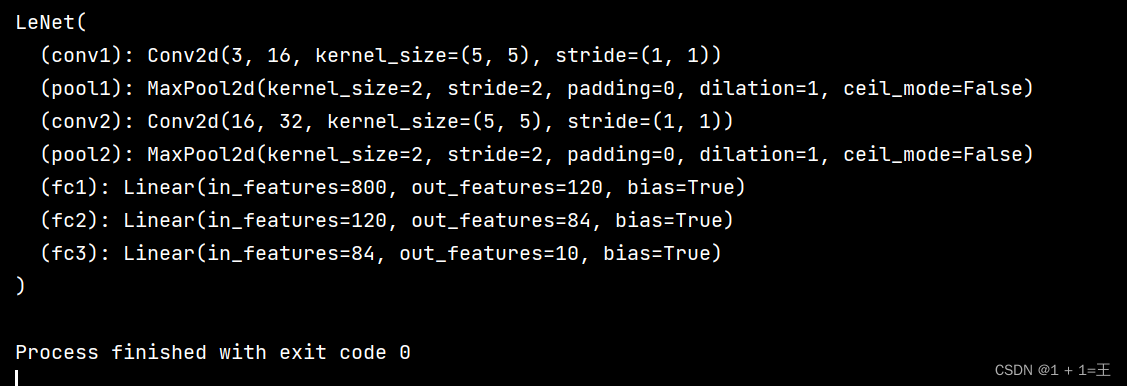
Data sets :CIFAR10
Download address :https://tensorflow.google.cn/datasets/catalog/cifar10
CIFAR10 Data set co ownership 60000 A color image , among 50000 Zhang is used for training ,5 Training batch , Every batch 10000 Pictures ;10000 Zhang for testing .
The size of the picture is 3X32X32, It is divided into 10 Categories , Each class 6000 Zhang .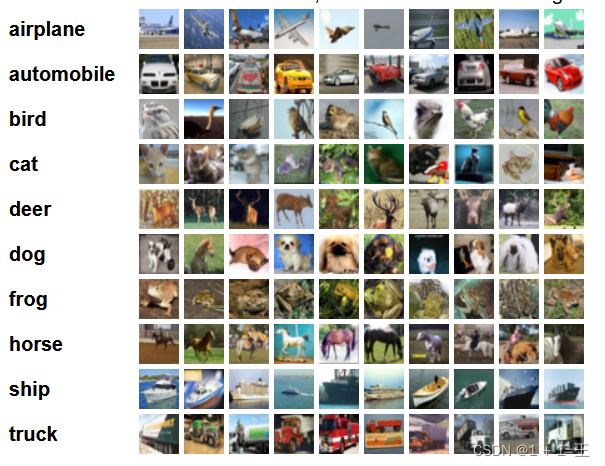
Training process
The training of the model can be divided into the following steps :
- Dataset loading
- Model loading
- Iterative training
- verification
The following is a detailed analysis combined with the code :
1. Loading data and normalization
#  Data normalization
transform = transforms.Compose(
    [transforms.ToTensor(),
     transforms.Normalize((0.5, 0.5, 0.5), (0.5, 0.5, 0.5))])

#  Load training dataset
#  Use it for the first time download Set to True To download the dataset automatically
train_set = torchvision.datasets.CIFAR10(root='./data', train=True,
                                         download=False, transform=transform)
train_loader = torch.utils.data.DataLoader(train_set, batch_size=36,
                                           shuffle=True, num_workers=0)

#  Load test validation data set
val_set = torchvision.datasets.CIFAR10(root='./data', train=False,
                                       download=False, transform=transform)
val_loader = torch.utils.data.DataLoader(val_set, batch_size=5000,
                                         shuffle=False, num_workers=0)
val_data_iter = iter(val_loader)
# val_image, val_label Respectively represent the original image and the label corresponding to the image ( Category )
#  The training set should also be split during training
val_image, val_label = val_data_iter.next()
2. Load model
#  Introducing models
net = LeNet()
#  Define the loss function
loss_function = nn.CrossEntropyLoss()
#  Define optimizer , Input model parameters and learning rate lr
optimizer = optim.Adam(net.parameters(), lr=0.001)
3. Iterative training
for epoch in range(100):  #  iteration 100 Time

    running_loss = 0.0		#  Set the initial loss to 0
    for step, data in enumerate(train_loader, start=0):
        # inputs, labels Respectively represent the original image and the label corresponding to the image ( Category )
        inputs, labels = data

        #  Every batch Set the gradient information to 0
        # ( You can have more than one batch  Call it once optimizer.zero_grad function . This is equivalent to increasing batch_size)
        optimizer.zero_grad()

        #  Transfer the original picture into the model , Get the prediction
        outputs = net(inputs)
        #  Calculate the loss with the predicted result and the original label
        loss = loss_function(outputs, labels)
        #  Back propagation
        loss.backward()
        #  Update parameters
        optimizer.step()
4. verification
for epoch in range(100):  #  iteration 100 Time

    running_loss = 0.0		#  Set the initial loss to 0
    for step, data in enumerate(train_loader, start=0):
        # inputs, labels Respectively represent the original image and the label corresponding to the image ( Category )
        inputs, labels = data
        #  Every batch Set the gradient information to 0
        # ( You can have more than one batch  Call it once optimizer.zero_grad function . This is equivalent to increasing batch_size)
        optimizer.zero_grad()
        #  Transfer the original picture into the model , Get the prediction
        outputs = net(inputs)
        #  Calculate the loss with the predicted result and the original label
        loss = loss_function(outputs, labels)
        #  Back propagation
        loss.backward()
        #  Update parameters
        optimizer.step()

		#  Calculate the total training loss
        running_loss += loss.item()

    # The above is the training process , Verify from here
	##########################################
    with torch.no_grad():		#  Verification is to stop calculating the gradient
	    #  Pass in the original image of the validation set to the model , Get the prediction
        outputs = net(val_image)
        predict_y = torch.max(outputs, dim=1)[1]
        #  Calculate the same number of predicted values and tag values , And divide by the total , Get accuracy
        accuracy = torch.eq(predict_y, val_label).sum().item() / val_label.size(0)
		#  Print training losses and accuracy
        print('[%d, %5d] train_loss: %.3f test_accuracy: %.3f' %
              (epoch + 1, step + 1, running_loss / 500, accuracy))
        #  Reset loss is 0, Start the next iteration training
        running_loss = 0.0

	print('Finished Training')
	#  End of training , Save the model
    save_path = './Lenet.pth'
    torch.save(net.state_dict(), save_path)
边栏推荐
- CONDA common commands: install, update, create, activate, close, view, uninstall, delete, clean, rename, change source, problem
- 卷积神经网络模型之——AlexNet网络结构与代码实现
- 程序员奶爸自制AI喂奶检测仪,预判宝宝饿点,不让哭声影响老婆睡眠
- Simple understanding of flow
- 跌荡的人生
- Selenium uses -- XPath and analog input and analog click collaboration
- [problem solving] ibatis.binding BindingException: Type interface xxDao is not known to the MapperRegistry.
- 程序的内存布局
- 卷积神经网络模型之——GoogLeNet网络结构与代码实现
- Shell常用脚本:获取网卡IP地址
猜你喜欢
Shell常用脚本:判断远程主机的文件是否存在

Microsoft proposed CodeT: a new SOTA for code generation, with 20 points of performance improvement

EMQX Cloud 更新:日志分析增加更多参数,监控运维更省心

基于JEECG制作一个通用的级联字典选择控件-DictCascadeUniversal

交换机链路聚合详解【华为eNSP】

Common operations for Yum and VIM
Machine learning strong foundation program 0-4: popular understanding of Occam razor and no free lunch theorem

ECCV2022 | TransGrasp类级别抓取姿态迁移

Mid 2022 review | latest progress of large model technology Lanzhou Technology

Want to go whoring in vain, right? Enough for you this time!
随机推荐
零基础学习CANoe Panel(13)—— 滑条(TrackBar )
Seven lines of code made station B crash for three hours, but "a scheming 0"
485通讯( 详解 )
Force deduction 83 biweekly T4 6131. The shortest dice sequence impossible to get, 303 weeks T4 6127. The number of high-quality pairs
Shell common script: get the IP address of the network card
[problem solving] org.apache.ibatis.exceptions PersistenceException: Error building SqlSession. 1-byte word of UTF-8 sequence
机器学习强基计划0-4:通俗理解奥卡姆剃刀与没有免费午餐定理
【OpenCV 例程 300篇】239. Harris 角点检测之精确定位(cornerSubPix)
clickhouse笔记03-- Grafana 接入ClickHouse
[300 opencv routines] 239. accurate positioning of Harris corner detection (cornersubpix)
The world is exploding, and the Google server has collapsed
Zero basic learning canoe panel (16) -- clock control/panel control/start stop control/tab control
OAuth, JWT, oidc, you mess me up
I want to ask whether DMS has the function of regularly backing up a database?
Azure Devops(十四) 使用Azure的私有Nuget仓库
How to understand metrics in keras
Shell common script: check whether a domain name and IP address are connected
吕蒙正《破窑赋》
Vim技巧:永远显示行号
“蔚来杯“2022牛客暑期多校训练营2 补题题解(G、J、K、L)