当前位置:网站首页>卷积神经网络模型之——GoogLeNet网络结构与代码实现
卷积神经网络模型之——GoogLeNet网络结构与代码实现
2022-07-25 12:43:00 【1 + 1=王】
文章目录
GoogLeNet网络简介
GoogLeNet原文地址:Going Deeper with Convolutions:https://www.cv-foundation.org/openaccess/content_cvpr_2015/papers/Szegedy_Going_Deeper_With_2015_CVPR_paper.pdf
GoogLeNet在2014年由Christian Szegedy提出,它是一种全新的深度学习结构。
GoogLeNet网络的主要创新点在于:
提出Inception结构在多个尺寸上同时进行卷积再聚合;

使用1X1的卷积进行降维以及映射处理;
添加两个辅助分类器帮助训练;
辅助分类器是将中间某一层的输出用作分类,并按一个较小的权重加到最终分类结果中。使用平均池化层代替全连接层,大大减少了参数量。
GoogLeNet网络结构
GoogLeNet的完整网络结构如下所示:
下面我们将其逐层拆分讲解并结合代码分析
Inception之前的几层结构
在进入Inception结构之前,GoogLeNet网络先堆叠了两个卷积(实则3个,有一个1X1的卷积)和两个最大池化层。

# input(3,224,224)
self.front = nn.Sequential(
    nn.Conv2d(3, 64, kernel_size=7, stride=2, padding=3),   # output(64,112,112)
    nn.ReLU(inplace=True),

    nn.MaxPool2d(kernel_size=3,stride=2,ceil_mode=True),    # output(64,56,56)

    nn.Conv2d(64,64,kernel_size=1),
    nn.Conv2d(64,192,kernel_size=3,stride=1,padding=1),     # output(192,56,56)
    nn.ReLU(inplace=True),

    nn.MaxPool2d(kernel_size=3,stride=2,ceil_mode=True),    # output(192,28,28)
)
Inception结构

Inception模块只会改变特征图的通道数,而不会改变尺寸大小。
Inception结构相对复杂,我们重新创建一个类来构建此结构,并通过参数不同的参数来控制各层的通道数。
class Inception(nn.Module):
    ''' in_channels: 输入通道数 out1x1:分支1输出通道数 in3x3:分支2的3x3卷积的输入通道数 out3x3:分支2的3x3卷积的输出通道数 in5x5:分支3的5x5卷积的输入通道数 out5x5:分支3的5x5卷积的输出通道数 pool_proj:分支4的最大池化层输出通道数 '''
    def __init__(self,in_channels,out1x1,in3x3,out3x3,in5x5,out5x5,pool_proj):
        super(Inception, self).__init__()

        self.branch1 = nn.Sequential(
            nn.Conv2d(in_channels, out1x1, kernel_size=1),
            nn.ReLU(inplace=True)
        )
        self.branch2 = nn.Sequential(
            nn.Conv2d(in_channels,in3x3,kernel_size=1),
            nn.ReLU(inplace=True),
            nn.Conv2d(in3x3,out3x3,kernel_size=3,padding=1),
            nn.ReLU(inplace=True)
        )
        self.branch3 = nn.Sequential(
            nn.Conv2d(in_channels, in5x5, kernel_size=1),
            nn.ReLU(inplace=True),
            nn.Conv2d(in5x5, out5x5, kernel_size=5, padding=2),
            nn.ReLU(inplace=True)
        )

        self.branch4 = nn.Sequential(
            nn.MaxPool2d(kernel_size=3,stride=1,padding=1),
            nn.Conv2d(in_channels,pool_proj,kernel_size=1),
            nn.ReLU(inplace=True)
        )

    def forward(self,x):
        branch1 = self.branch1(x)
        branch2 = self.branch2(x)
        branch3 = self.branch3(x)
        branch4 = self.branch4(x)

        outputs = [branch1,branch2,branch3,branch4]
        return torch.cat(outputs,1)	# 按通道数叠加
Inception3a模块

# input(192,28,28)
self.inception3a = Inception(192, 64, 96, 128, 16, 32, 32)		# output(256,28,28)
Inception3b + MaxPool

# input(256,28,28)
self.inception3b = Inception(256, 128, 128, 192, 32, 96, 64)		# output(480,28,28)
self.maxpool3 = nn.MaxPool2d(3, stride=2, ceil_mode=True)			# output(480,14,14)
Inception4a

# input(480,14,14)
self.inception4a = Inception(480, 192, 96, 208, 16, 48, 64)		# output(512,14,14)
Inception4b
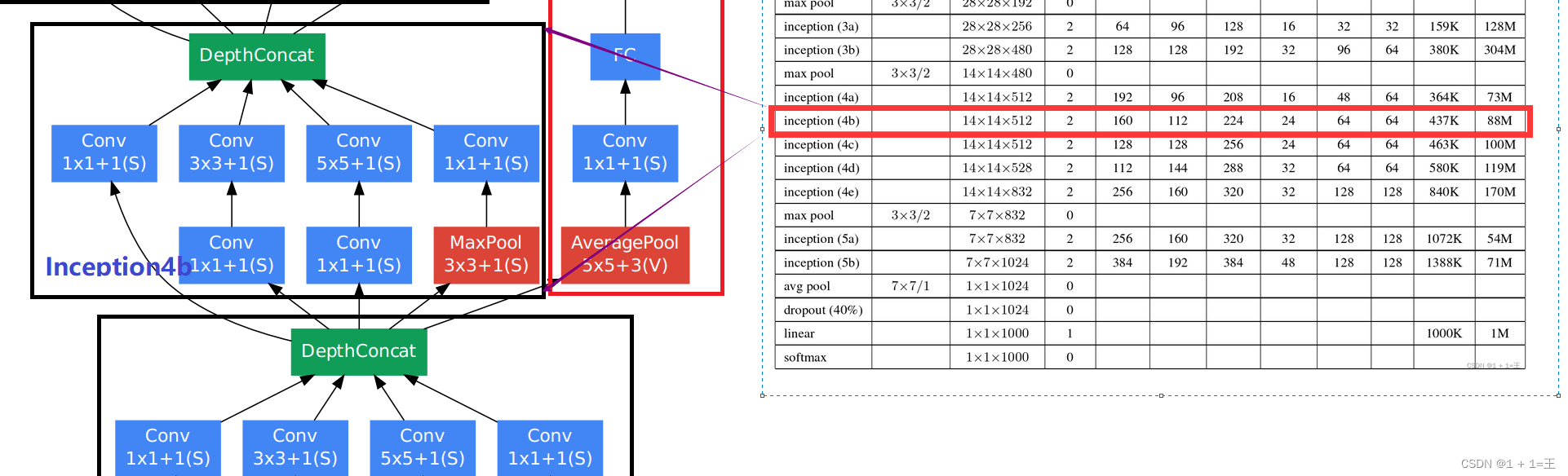
# input(512,14,14)
self.inception4b = Inception(512, 160, 112, 224, 24, 64, 64)		# output(512,14,14)
Inception4c

# input(512,14,14)
self.inception4c = Inception(512, 160, 112, 224, 24, 64, 64)		# output(512,14,14)
Inception4d

# input(512,14,14)
self.inception4d = Inception(512, 112, 144, 288, 32, 64, 64)		# output(528,14,14)
Inception4e+MaxPool
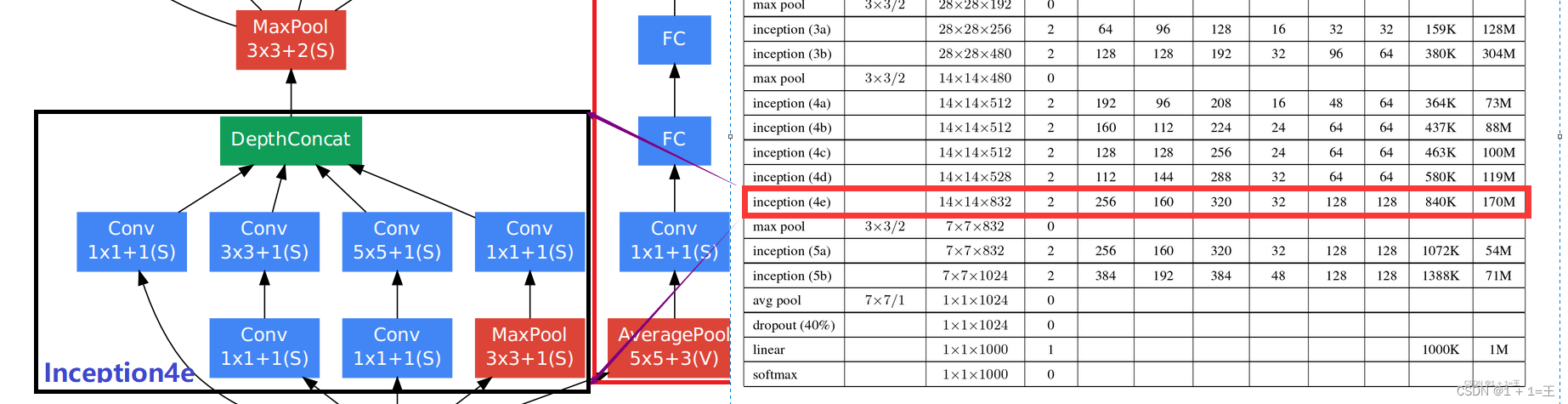
# input(528,14,14)
self.inception4e = Inception(528, 256, 160, 320, 32, 128, 128)	# output(832,14,14)
self.maxpool4 = nn.MaxPool2d(3, stride=2, ceil_mode=True)		# output(832,7,7)
Inception5a

# input(832,7,7)
self.inception5a = Inception(832, 256, 160, 320, 32, 128, 128)		# output(832,7,7)
Inception5b

# input(832,7,7)
self.inception5b = Inception(832, 384, 192, 384, 48, 128, 128)		# output(1024,7,7)
Inception之后的几层结构

辅助分类模块
除了以上主干网络结构以外,GoogLeNet还提供了两个辅助分类模块,用于将中间某一层的输出用作分类,并按一个较小的权重(0.3)加到最终分类结果。
与Inception模块一样,我们也重新创建一个类来搭建辅助分类模块结构。
class AccClassify(nn.Module):
	# in_channels: 输入通道
	# num_classes: 分类数
    def __init__(self,in_channels,num_classes):
        self.avgpool = nn.AvgPool2d(kernel_size=5, stride=3)
        self.conv = nn.MaxPool2d(in_channels, 128, kernel_size=1)  # output[batch, 128, 4, 4]
        self.relu = nn.ReLU(inplace=True)

        self.fc1 = nn.Linear(2048, 1024)
        self.fc2 = nn.Linear(1024, num_classes)

    def forward(self,x):
        x = self.avgpool(x)
        x = self.conv(x)
        x = self.relu(x)
        x = torch.flatten(x, 1)
        x = F.dropout(x, 0.5, training=self.training)
        x = F.relu(self.fc1(x), inplace=True)
        x = F.dropout(x, 0.5, training=self.training)
        x = self.fc2(x)

        return x
辅助分类模块1
第一个中间层输出位于Inception4a之后,将Inception4a的输出经过平均池化,1X1卷积和全连接后等到分类结果。
self.acc_classify1 = AccClassify(512,num_classes)
辅助分类模块2

self.acc_classify2 = AccClassify(528,num_classes)
整体网络结构
pytorch搭建完整代码
""" #-*-coding:utf-8-*- # @author: wangyu a beginner programmer, striving to be the strongest. # @date: 2022/7/5 18:37 """
import torch.nn as nn
import torch
import torch.nn.functional as F


class GoogLeNet(nn.Module):
    def __init__(self,num_classes=1000,aux_logits=True):
        super(GoogLeNet, self).__init__()
        self.aux_logits = aux_logits

        # input(3,224,224)
        self.front = nn.Sequential(
            nn.Conv2d(3, 64, kernel_size=7, stride=2, padding=3),   # output(64,112,112)
            nn.ReLU(inplace=True),

            nn.MaxPool2d(kernel_size=3,stride=2,ceil_mode=True),    # output(64,56,56)

            nn.Conv2d(64,64,kernel_size=1),
            nn.Conv2d(64,192,kernel_size=3,stride=1,padding=1),     # output(192,56,56)
            nn.ReLU(inplace=True),

            nn.MaxPool2d(kernel_size=3,stride=2,ceil_mode=True),    # output(192,28,28)
        )

        # input(192,28,28)
        self.inception3a = Inception(192, 64, 96, 128, 16, 32, 32)  # output(64+128+32+32=256,28,28)
        self.inception3b = Inception(256, 128, 128, 192, 32, 96, 64)  # output(480,28,28)
        self.maxpool3 = nn.MaxPool2d(3, stride=2, ceil_mode=True)  # output(480,14,14)

        self.inception4a = Inception(480, 192, 96, 208, 16, 48, 64)  # output(512,14,14)
        self.inception4b = Inception(512, 160, 112, 224, 24, 64, 64)  # output(512,14,14)
        self.inception4c = Inception(512, 128, 128, 256, 24, 64, 64)  # output(512,14,14)
        self.inception4d = Inception(512, 112, 144, 288, 32, 64, 64)  # output(528,14,14)
        self.inception4e = Inception(528, 256, 160, 320, 32, 128, 128)  # output(832,14,14)
        self.maxpool4 = nn.MaxPool2d(3, stride=2, ceil_mode=True)  # output(832,7,7)

        self.inception5a = Inception(832, 256, 160, 320, 32, 128, 128)  # output(832,7,7)
        self.inception5b = Inception(832, 384, 192, 384, 48, 128, 128)  # output(1024,7,7)

        if self.training and self.aux_logits:
            self.acc_classify1 = AccClassify(512,num_classes)
            self.acc_classify2 = AccClassify(528,num_classes)

        self.avgpool = nn.AdaptiveAvgPool2d((1,1))        # output(1024,1,1)
        self.dropout = nn.Dropout(0.4)
        self.fc = nn.Linear(1024,num_classes)


    def forward(self,x):
        # input(3,224,224)
        x = self.front(x)       # output(192,28,28)

        x= self.inception3a(x)  # output(256,28,28)
        x = self.inception3b(x)
        x = self.maxpool3(x)

        x = self.inception4a(x)

        if self.training and self.aux_logits:
            classify1 = self.acc_classify1(x)

        x = self.inception4b(x)
        x = self.inception4c(x)
        x = self.inception4d(x)

        if self.training and self.aux_logits:
            classify2 = self.acc_classify2(x)

        x = self.inception4e(x)
        x = self.maxpool4(x)

        x = self.inception5a(x)
        x = self.inception5b(x)

        x = self.avgpool(x)
        x = torch.flatten(x,dims=1)
        x = self.dropout(x)
        x= self.fc(x)

        if self.training and self.aux_logits:
            return x,classify1,classify2

        return x


class Inception(nn.Module):
    ''' in_channels: 输入通道数 out1x1:分支1输出通道数 in3x3:分支2的3x3卷积的输入通道数 out3x3:分支2的3x3卷积的输出通道数 in5x5:分支3的5x5卷积的输入通道数 out5x5:分支3的5x5卷积的输出通道数 pool_proj:分支4的最大池化层输出通道数 '''
    def __init__(self,in_channels,out1x1,in3x3,out3x3,in5x5,out5x5,pool_proj):
        super(Inception, self).__init__()

        # input(192,28,28)
        self.branch1 = nn.Sequential(
            nn.Conv2d(in_channels, out1x1, kernel_size=1),
            nn.ReLU(inplace=True)
        )
        self.branch2 = nn.Sequential(
            nn.Conv2d(in_channels,in3x3,kernel_size=1),
            nn.ReLU(inplace=True),
            nn.Conv2d(in3x3,out3x3,kernel_size=3,padding=1),
            nn.ReLU(inplace=True)
        )
        self.branch3 = nn.Sequential(
            nn.Conv2d(in_channels, in5x5, kernel_size=1),
            nn.ReLU(inplace=True),
            nn.Conv2d(in5x5, out5x5, kernel_size=5, padding=2),
            nn.ReLU(inplace=True)
        )

        self.branch4 = nn.Sequential(
            nn.MaxPool2d(kernel_size=3,stride=1,padding=1),
            nn.Conv2d(in_channels,pool_proj,kernel_size=1),
            nn.ReLU(inplace=True)
        )

    def forward(self,x):
        branch1 = self.branch1(x)
        branch2 = self.branch2(x)
        branch3 = self.branch3(x)
        branch4 = self.branch4(x)

        outputs = [branch1,branch2,branch3,branch4]
        return torch.cat(outputs,1)


class AccClassify(nn.Module):
    def __init__(self,in_channels,num_classes):
        self.avgpool = nn.AvgPool2d(kernel_size=5, stride=3)
        self.conv = nn.MaxPool2d(in_channels, 128, kernel_size=1)  # output[batch, 128, 4, 4]
        self.relu = nn.ReLU(inplace=True)

        self.fc1 = nn.Linear(2048, 1024)
        self.fc2 = nn.Linear(1024, num_classes)

    def forward(self,x):
        x = self.avgpool(x)
        x = self.conv(x)
        x = self.relu(x)
        x = torch.flatten(x, 1)
        x = F.dropout(x, 0.5, training=self.training)
        x = F.relu(self.fc1(x), inplace=True)
        x = F.dropout(x, 0.5, training=self.training)
        x = self.fc2(x)

        return x

# print(GoogLeNet())
结构图

边栏推荐
- AtCoder Beginner Contest 261E // 按位思考 + dp
- OAuth,JWT ,OIDC你们搞得我好乱啊
- 业务可视化-让你的流程图'Run'起来(3.分支选择&跨语言分布式运行节点)
- Zero basic learning canoe panel (13) -- trackbar
- If you want to do a good job in software testing, you can first understand ast, SCA and penetration testing
- A turbulent life
- R language uses wilcox The test function performs Wilcox signed rank test to obtain the confidence interval of the population median (the default output result includes the confidence interval of 95%
- The larger the convolution kernel, the stronger the performance? An interpretation of replknet model
- 微软提出CodeT:代码生成新SOTA,20个点的性能提升
- Oran special series-21: major players (equipment manufacturers) and their respective attitudes and areas of expertise
猜你喜欢

web安全入门-UDP测试与防御

The programmer's father made his own AI breast feeding detector to predict that the baby is hungry and not let the crying affect his wife's sleep
LeetCode 0133. 克隆图

Substance Designer 2021软件安装包下载及安装教程

Kyligence was selected into Gartner 2022 data management technology maturity curve report
Leetcode 0133. clone diagram

艰辛的旅程

卷积核越大性能越强?一文解读RepLKNet模型

Cmake learning notes (II) generation and use of Library

Zero basic learning canoe panel (13) -- trackbar
随机推荐
[problem solving] org.apache.ibatis.exceptions PersistenceException: Error building SqlSession. 1-byte word of UTF-8 sequence
B tree and b+ tree
shell基础知识(退出控制、输入输出等)
What is ci/cd?
程序员奶爸自制AI喂奶检测仪,预判宝宝饿点,不让哭声影响老婆睡眠
Use vsftpd service to transfer files (anonymous user authentication, local user authentication, virtual user authentication)
perf 性能调试
Docker学习 - Redis集群-3主3从-扩容-缩容搭建
Handwriting a blog platform ~ first day
程序的内存布局
Zero basic learning canoe panel (12) -- progress bar
Zero basic learning canoe panel (13) -- trackbar
Want to go whoring in vain, right? Enough for you this time!
【AI4Code】《Contrastive Code Representation Learning》 (EMNLP 2021)
ECCV 2022 | 登顶SemanticKITTI!基于二维先验辅助的激光雷达点云语义分割
Selenium uses -- XPath and analog input and analog click collaboration
Seven lines of code made station B crash for three hours, but "a scheming 0"
全球都热炸了,谷歌服务器已经崩掉了
JS convert pseudo array to array
Intval MD5 bypass [wustctf2020] plain