当前位置:网站首页>645. Wrong set
645. Wrong set
2022-07-27 09:16:00 【Blue cat Knight】
Topic link : 645. The wrong set
Title Description

First of all How did I do it ?
I use for Loop traversal Wrote a lot of , Repeat the test , Finally, it was written I start running ; As a result, when I run He told me
I exceeded the time limit
I giao, I really appreciate .

int* findErrorNums(int* nums, int numsSize, int* returnSize){
    int i = 0;
    int* num_s = malloc(sizeof(int)*2);
    int loss = 0;
    int loss_1 = 0;
    *returnSize = 2;
    int flag = 0;
    int j = 0;
    for(i = 0;i < numsSize;i++)
    {
        for(j = 0;j<numsSize-i-1;j++)
        {
            int tmp = 0;
            if(nums[j]>nums[j+1])
            {
                tmp = nums[j];
                nums[j] = nums[j+1];
                nums[j+1] = tmp;
            }
        }
    }
    for(i = 0;i<numsSize;i++)
    {
        for(j = 0;(j<numsSize&&i!=j);j++)
        {
           if(flag == 0)
            {
                if(nums[i] == nums[j])
                {
                    loss = nums[j];
                   flag = 1;
                }
            }

       }
    }
    int t = 0;
    for(i = 0;i<numsSize;i++)
    {
        t++;
        if(nums[0] != 1)
        {
            loss_1 = 1;
        }
        else
        {
             if(nums[i] != t)
            {
                loss_1 = t;
                if(loss>loss_1)
                {
                    break;
              }
           }
       }

  }

num_s[0] = loss;
num_s[1] = loss_1;
    return num_s;
}
The above is for entertainment only ;
Here is the positive solution ;
int* findErrorNums(int* nums, int numsSize, int* returnSize){
    int i = 0;
    int* num_s = malloc(sizeof(int)*2);
    int loss = 0;
    *returnSize = 2;
    int j = 0;
    for(i = 0;i < numsSize;i++)
    {
        for(j = 0;j<numsSize-i-1;j++)
        {
            int tmp = 0;
            if(nums[j]>nums[j+1])
            {
                tmp = nums[j];
                nums[j] = nums[j+1];
                nums[j+1] = tmp;
            }
        }
    }
    int tmp = 0;
    for(i = 0;i<numsSize;i++)
    {
        tmp = nums[i];
        if(tmp == loss)
        {
           num_s[0] = loss;
        }
        else if(tmp - loss>1)
        {
            num_s[1] = loss+1;
        }

        loss = tmp;
    }
    if(nums[numsSize-1] != numsSize)
    {
        num_s[1] = numsSize;
    }
    return num_s;
}
This is just a solution
One more Method of bit operation
Mention operators , We need to be familiar with and master Use of bitwise operators
& Bitwise AND | Press bit or ^ Bitwise XOR ( notes : Their operands must be integers .)
1. Bitwise AND
int main()
{
	int a = 3;
	int b = -5;
	int c = a & b;
	printf("c = %d\n", c);
	return 0;
}
Think about it ,C How much will it be ?

The result is C = 3
3 Original back Complement code ( The complement of positive numbers is the same )
00000000000000000000000000000011
-5 The original code of
10000000000000000000000000000101 -5 The original code of
11111111111111111111111111111010 -5 The inverse of
11111111111111111111111111111011 -5 Complement
00000000000000000000000000000011 3 Complement
& Bitwise AND Express 2 Base bit The same bit is For one Different bits ( Both are zero and zero ) zero Then the calculation results by
00000000000000000000000000000011 by 3
therefore C = 3;
2. Press bit or
int main()
{
	int a = 3;
	int b = -5;
	int c = a | b;
	printf("c = %d\n", c);
	return 0;
}
Rethinking :

11111111111111111111111111111011 -5 Complement
00000000000000000000000000000011 3 Complement
| Press bit or Express 2 Base bit One for one Just for one Both are zero It's zero ;11111111111111111111111111111011 (-5 Complement )
3. Bitwise XOR
int main()
{
	int a = 3;
	int b = -5;
	int c = a ^ b;
	printf("c = %d\n", c);
	return 0;
}
11111111111111111111111111111011 - 5 Complement
00000000000000000000000000000011 3 Complement
^ Press bit or Express 2 Base bit Same as zero Different into one ;
11111111111111111111111111111000(-8 Complement )
All of these are These are the basic rules for using bitwise operators ; Let's talk about it once Their simple nature ( Follow the law of exchange and the law of knot )
a^a = 0
0^a = a
a^b^a = b
I got it , Now we can analyze and solve the initial problem ;
Through analysis, we can know :
Duplicate numbers appear in the array 2 Time , Missing numbers appear in the array 0 Time , Each remaining number appears in the array 1 Time . thus it can be seen , The parity of occurrence times of repeated numbers and missing numbers is the same , And it is different from the parity of the number of occurrences of each other number . If in the array n After the number, add from 1 To n Every number of , obtain 2n A digital , It's in 2n Of the numbers , Repeated numbers appear 3 Time , The missing number appears 1 Time , Every other number appears 2 Time . According to the parity of the number of occurrences , You can use XOR to solve .
Code as follows
int* findErrorNums(int* nums, int numsSize, int* returnSize) {
    int* errorNums = malloc(sizeof(int) * 2);
    int xorSum = 0;
    for (int i = 1; i <= numsSize; i++)
    {
        xorSum ^= i;               // Add a group of (1->n) The data of
        xorSum ^= nums[i - 1];     //for  The loop ends   here xorSum  The result should be
                                   // Repeat the numbers  ^  Missing number
    }
    int lowbit = xorSum & (-xorSum);// We know   Negative and positive numbers   Is the difference between the
                                    // The complement of a negative number is a positive number, which is inversed by bits   Add one to get
                                    // therefore   here lowbit for xorSum The lowest point of ;
                                    // and  xorSum =  Repeat the numbers  ^  Missing number
                                    // in other words    lowbit  Namely   The lowest different bits of repeated numbers and missing numbers
   // utilize lowbit You can divide an array into two groups
   // Each number in the first group  a All satisfied with  a & lowbit==0,
   // Each number in the second group  b All satisfied with  b & lowbit!=0


    int num1 = 0, num2 = 0;
    for (int i = 0; i < numsSize; i++)
    {
        if ((nums[i] & lowbit) == 0)
    {
            num1 ^= nums[i];
        } else {
            num2 ^= nums[i];
        }
    }
    for (int i = 1; i <= numsSize; i++)
    {
        if ((i & lowbit) == 0)
    {
            num1 ^= i;
        } else {
            num2 ^= i;
        }
    }
    int* ret = malloc(sizeof(int) * 2);
    *returnSize = 2;
    for (int i = 0; i < numsSize; i++)
    {
        if (nums[i] == num1)
    {
            ret[0] = num1, ret[1] = num2;
            return ret;
        }
    }
    ret[0] = num2, ret[1] = num1;
    return ret;
}

 author :LeetCode-Solution
 link :https://leetcode.cn/problems/set-mismatch/solution/cuo-wu-de-ji-he-by-leetcode-
Now let's take a look at the standard answer

 author :LeetCode-Solution
link :https://leetcode.cn/problems/set-mismatch/solution/cuo-wu-de-ji-he-by-leetcode-solution-1ea4/
source : Power button (LeetCode)
The copyright belongs to the author . Commercial reprint please contact the author for authorization , Non-commercial reprint please indicate the source .
边栏推荐
- Programming style
- < script> detailed explanation of label content
- ES6 new - array part
- Summary of traversal methods
- Linux Installation and remote connection MySQL records
- Is the operation of assigning values to int variables atomic?
- Storage and computing engine
- Ztree custom title attribute
- npm和yarn 更新依赖包
- Music experience ceiling! Emotional design details of 14 Netease cloud music
猜你喜欢

Intel, squeezed by Samsung and TSMC, finally put down its body to customize chip technology for Chinese chips
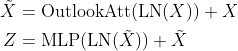
8 kinds of visual transformer finishing (Part 2)

BEVFormer: Learning Bird’s-Eye-View Representation from Multi-Camera Images via Spatiotemporal Trans

Longest string without duplicate characters

5g failed to stimulate the development of the industry, which disappointed not only operators, but also mobile phone enterprises

flex布局 (实战小米官网)

ES6 new - Operator extension

500报错

PyTorch自定义CUDA算子教程与运行时间分析

Some practical, commonly used and increasingly efficient kubernetes aliases
随机推荐
A survey of robust lidar based 3D object detection methods for autonomous driving paper notes
500报错
Cross domain and processing cross domain
Storage and computing engine
Aruba learning notes 10 security authentication portal authentication (web page configuration)
[daily algorithm 94] classic interview question: motion range of robot
Qt中发送信号时参数为结构体或者自定义的类怎么办?
B tree
How to optimize the deep learning model to improve the reasoning speed
Intel, squeezed by Samsung and TSMC, finally put down its body to customize chip technology for Chinese chips
07_ Service registration and discovery summary
ES6 new - function part
CUDA Programming -03: thread level
Antdesign a-modal user-defined instruction realizes dragging and zooming in and out
二叉树讲解
Is the operation of assigning values to int variables atomic?
[micro service ~sentinel] sentinel dashboard control panel
ArkUI框架中的两个小技巧
ES6 new - deconstruction assignment of array / object
Mangodb简单使用