当前位置:网站首页>[sort] bucket sort
[sort] bucket sort
2022-07-03 13:20:00 【Programming cheese】
brief introduction
The time complexity of bucket sorting is only O(n) A sort method of , It assumes that the input data is uniformly distributed , We put the data into n A ladle , First sort the data in the bucket , Then traverse the bucket and take out the elements in the bucket in turn to complete the sorting .
Schematic diagram
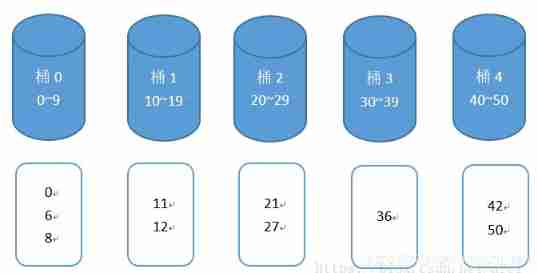
For example, input data :21,8,6,11,36,50,27,42,0,12.
Then put them into the corresponding bucket for sorting , Finally, the sorting can be completed by traversing the bucket in turn and taking out the elements .
analysis
A very important step in bucket sorting is the setting of buckets , We have to depend on the input elements , Choose an appropriate “getBucketIndex” Algorithm , So that the input elements can be correctly put into the corresponding bucket , And ensure that the input data can be put into different barrels as evenly as possible .
In the worst case , That is, all the data is put into a bucket , The self sorting algorithm in bucket is insertion sorting , Then the time complexity is O(n ^ 2) 了 .
secondly , We can find out , The finer the interval is divided , The more barrels there are , In theory, the less elements are divided into each bucket , The easier it is to sort the data in a bucket , The closer the time complexity is to linear .
In extreme cases , It's just that the range is so small that it's only 1, That is, only one element is stored in the barrel , The elements in the bucket no longer need to be sorted , Because they're all the same elements , Now bucket sort is almost the same as counting sort .
Example
Assume that the input elements are evenly distributed floating-point numbers . Counting sort is more suitable for integer cases , If we still want to sort elements in linear time , Then bucket sorting will be a good choice .
import java.util.ArrayList;
import java.util.LinkedList;
import java.util.List;
import java.util.ListIterator;

public class Main {


    public static void main(String[] args) {

        //  Input elements are in  [0, 10)  In this range
        float[] arr = new float[] {
     0.12f, 2.2f, 8.8f, 7.6f, 7.2f, 6.3f, 9.0f, 1.6f, 5.6f, 2.4f };
        bucketSort(arr);
        printArray(arr);
    }

    public static void bucketSort(float[] arr) {

        //  Create a new collection of buckets
        ArrayList<LinkedList<Float>> buckets = new ArrayList<LinkedList<Float>>();
        for (int i = 0; i < 10; i++) {

            //  Create a new bucket , And add it to the collection of buckets .
            //  Because the elements in the barrel will be inserted frequently , So choose  LinkedList  As the data structure of the bucket
            buckets.add(new LinkedList<Float>());
        }
        //  Put all the input data into the bucket and complete the sorting
        for (float data : arr) {

            int index = getBucketIndex(data);
            insertSort(buckets.get(index), data);
        }
        //  Take out all the elements in the bucket and put them in  arr  Medium output
        int index = 0;
        for (LinkedList<Float> bucket : buckets) {

            for (Float data : bucket) {

                arr[index++] = data;
            }
        }
    }

    /** *  Calculate which bucket the input element should be placed in  */
    public static int getBucketIndex(float data) {

        //  The example here is relatively simple , Only the integer part of a floating-point number is used as the index value of its bucket
        //  In the actual development, it needs to be designed according to the scene
        return (int) data;
    }

    /** *  We choose insert sort as the method to sort the elements in the bucket   Whenever a new element comes , We all call this method to insert it in the right place  */
    public static void insertSort(List<Float> bucket, float data) {

        ListIterator<Float> it = bucket.listIterator();
        boolean insertFlag = true;
        while (it.hasNext()) {

            if (data <= it.next()) {

                it.previous(); //  Shift the position of the iterator back to the previous position
                it.add(data); //  Insert data into the current position of the iterator
                insertFlag = false;
                break;
            }
        }
        if (insertFlag) {

            bucket.add(data); //  Otherwise, insert the data into the end of the list
        }
    }

    public static void printArray(float[] arr) {

        for (int i = 0; i < arr.length; i++) {

            System.out.print(arr[i] + ", ");
        }
        System.out.println();
    }

}
Link to the original text :https://blog.csdn.net/afei__/article/details/82965834
边栏推荐
- C graphical tutorial (Fourth Edition)_ Chapter 17 generic: genericsamplep315
- The difference between session and cookie
- C graphical tutorial (Fourth Edition)_ Chapter 18 enumerator and iterator: enumerator samplep340
- Solve system has not been booted with SYSTEMd as init system (PID 1) Can‘t operate.
- SSH login server sends a reminder
- 2022-02-11 heap sorting and recursion
- Logback log framework
- Kotlin - 改良装饰者模式
- Flink SQL knows why (XI): weight removal is not only count distinct, but also powerful duplication
- [Database Principle and Application Tutorial (4th Edition | wechat Edition) Chen Zhibo] [Chapter IV exercises]
猜你喜欢
Flink code is written like this. It's strange that the window can be triggered (bad programming habits)

The principle of human voice transformer

【数据库原理及应用教程(第4版|微课版)陈志泊】【第三章习题】
Smbms project
Flink SQL knows why (17): Zeppelin, a sharp tool for developing Flink SQL
DQL basic query
Servlet

刚毕业的欧洲大学生,就能拿到美国互联网大厂 Offer?

Today's sleep quality record 77 points

Finite State Machine FSM
随机推荐
Flink SQL knows why (XI): weight removal is not only count distinct, but also powerful duplication
2022-02-14 incluxdb cluster write data writetoshard parsing
正则表达式
The difference between stratifiedkfold (classification) and kfold (regression)
MySQL_ JDBC
2022-01-27 research on the minimum number of redis partitions
服务器硬盘冷迁移后网卡无法启动问题
Logback 日志框架
PowerPoint 教程,如何在 PowerPoint 中将演示文稿另存为视频?
Resolved (error in viewing data information in machine learning) attributeerror: target_ names
JSP and filter
Will Huawei be the next one to fall
刚毕业的欧洲大学生,就能拿到美国互联网大厂 Offer?
106. How to improve the readability of SAP ui5 application routing URL
MySQL
已解决TypeError: Argument ‘parser‘ has incorrect type (expected lxml.etree._BaseParser, got type)
Flink code is written like this. It's strange that the window can be triggered (bad programming habits)
In the promotion season, how to reduce the preparation time of defense materials by 50% and adjust the mentality (personal experience summary)
February 14, 2022, incluxdb survey - mind map
The difference between session and cookie