当前位置:网站首页>Viewing and modifying volume group attributes of Aix storage management (II)
Viewing and modifying volume group attributes of Aix storage management (II)
2022-07-02 00:40:00 【51CTO】
restudy old materials :
Considerations for creating volume groups
(1) The name of the volume group must be unique in the system , And the name is as meaningful as possible , For example, the volume group storing data can be named datavg.
(2) Ensure that the physical volumes you will use in the volume group are available and do not currently belong to other volume groups , This is especially important .
(3) Determine the physical partition size in the new volume group , The default value is 4MB, It is often used for 8MB. A physical volume can contain at most 1016 Physical zones , Therefore, if a volume group contains a volume larger than 4.5GB The physical volume of , The size of the physical partition in this volume group must be greater than 4MB.
(4) Whether the newly created volume group is automatically activated when the system starts .
(5) To determine the maximum number of physical volumes that can be accommodated in the new volume group .
Link to the original text : AIX Create a volume group for storage management ( One )
know sth. new :
Today I'm going to talk about AIX Viewing and modifying volume group attributes , The content is very simple , Let's start .
One 、 Volume group properties viewing
1、 Check... In the system VG

2、 View the available status in the system VG

3、 Display the properties of the volume group

4、 Show VG Information about logical volumes in
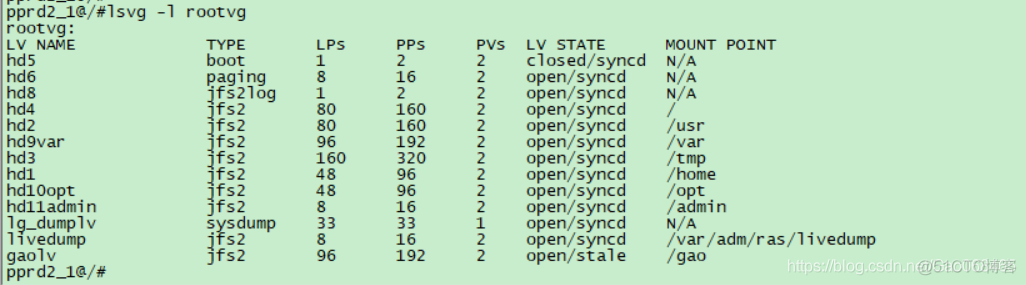
5、 Show VG Information about physical volumes in

Two 、 Volume group attribute modification
To modify the properties of a volume group, you can use the command
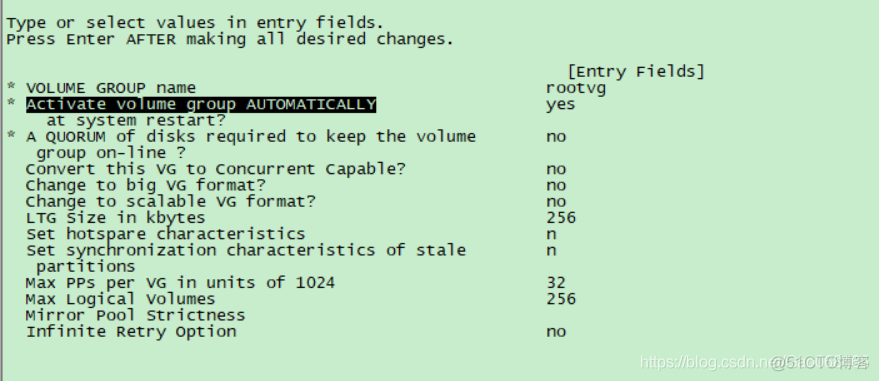
1、 If you want to set a volume group to be activated automatically when the system starts , Just put "Activate volume group AUTOMATICALLY at system restart?" The value of the column is set to yes, To enable the volume group to be activated manually later, set it to no.
2、 stay "A QUORUM of disks required to keep the volume group on-line ?" Column setting when the volume group loses disks Quorum when , Whether to force the volume group to be inactive . The default value is yes, Indicates that the volume group is missing 51% Of VGDA Then it can no longer be used .
3、 stay "Convert this VG to Concurrent Capable?" Column to set whether the volume group has the ability to be accessed concurrently , That is, the ability to be used by multiple systems at the same time ,yes Indicates that it has ,no Indicates that it does not have .
4、 stay "LTG Size in kbyte" Modify the logical record group in the column (Logical Track Group, Shorthand for LTG) Size , Unit is KB, Optional values are 128,256,512 or 1024, The default value is 128KB.
5、 stay "Set hotspare characteristics" Set the hot backup feature of the volume group in the column
3、 ... and 、 Add a physical volume to a volume group
When adding physical volumes to a volume group , Be sure to pay attention , The physical volume to be added should be available and not belong to other activated volume groups .
1、 For inactive physical volumes, you can use the following command to activate :
2、 Add physical volume
Yes, of course , You can also use smitty extendvg command

Four 、 Delete the physical volume in the volume group
1、 First delete the logical volume on the physical volume
2、 Delete the physical volume in the volume group
If you find VGDA There is also information about physical volumes in , have access to
You can also use “smitty reducevg” Delete physical volume
5、 ... and 、 Activate and deactivate volume groups
If the volume group is not automatically activated at system startup when it is created , You need to activate it manually .
1、 Activate volume group
2、 Close volume group
It can also be used smit Tools to operate .
Let's stop here for the moment about volume groups , If you want to read my next article 《 AIX Create logical volumes for storage management and view and modify attributes 》, Click the link
边栏推荐
猜你喜欢

Leetcode skimming: stack and queue 04 (delete all adjacent duplicates in the string)
Use es to realize epidemic map or take out order function (including code and data)

Qt5.12.9 migration tutorial based on Quanzhi H3

To meet the needs of consumers in technological upgrading, Angel water purifier's competitive way of "value war"

测试人进阶技能:单元测试报告应用指南

leetcode96不同的二叉搜索樹

Barbie q! How to analyze the new game app?

heketi 记录
Some understandings of graph convolution neural network r-gcn considering relations and some explanations of DGL official code
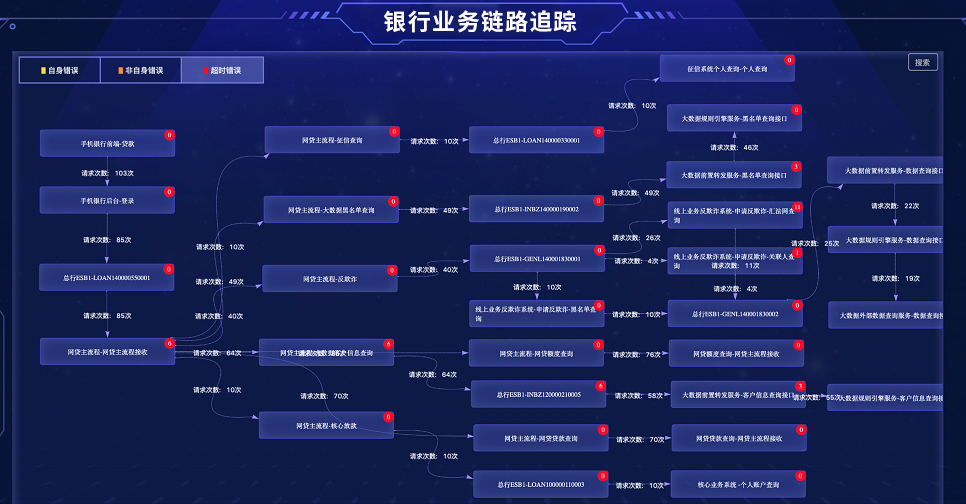
Intelligent operation and maintenance practice: banking business process and single transaction tracking
随机推荐
To meet the needs of consumers in technological upgrading, Angel water purifier's competitive way of "value war"
B tree and b+tree of MySQL
What is the purpose of ERP project implementation plan?
[wechat authorized login] the small program developed by uniapp realizes the function of obtaining wechat authorized login
Leetcode 96 différents arbres de recherche binaires
2023 Lexus ES products have been announced, which makes great progress this time
[cascade classifier training parameters] training Haar cascades
【底部弹出-选择器】uniapp Picker组件——底部弹起的滚动选择器
Barbie q! How to analyze the new game app?
Node -- egg implements the interface of uploading files
挖财学堂开户打新债安全可靠嘛?
Use es to realize epidemic map or take out order function (including code and data)
Guide d'installation du serveur SQL
@Valid参数校验不生效
UVM tutorial
创业团队如何落地敏捷测试,提升质量效能?丨声网开发者创业讲堂 Vol.03
RFID让固定资产盘点更快更准
Promise和模块块化编程
测试人进阶技能:单元测试报告应用指南
2023款雷克萨斯ES产品公布,这回进步很有感