当前位置:网站首页>Opengauss kernel: analysis of SQL parsing process
Opengauss kernel: analysis of SQL parsing process
2022-06-28 15:38:00 【InfoQ】

Lexical analysis

Syntax analysis
typedef struct SelectStmt
{
 NodeTag type;
 List  *distinctClause; /* NULL, list of DISTINCT ON exprs, or
  * lcons(NIL,NIL) for all (SELECT DISTINCT) */
 IntoClause *intoClause; /* target for SELECT INTO */
 List  *targetList; /* the target list (of ResTarget) */
 List  *fromClause; /* the FROM clause */
 Node  *whereClause; /* WHERE qualification */
 List  *groupClause; /* GROUP BY clauses */
 Node  *havingClause; /* HAVING conditional-expression */
 List  *windowClause; /* WINDOW window_name AS (...), ... */
 WithClause *withClause; /* WITH clause */
 List  *valuesLists; /* untransformed list of expression lists */
 List  *sortClause; /* sort clause (a list of SortBy's) */
 Node  *limitOffset; /* # of result tuples to skip */
 Node  *limitCount; /* # of result tuples to return */
 ……
} SelectStmt;
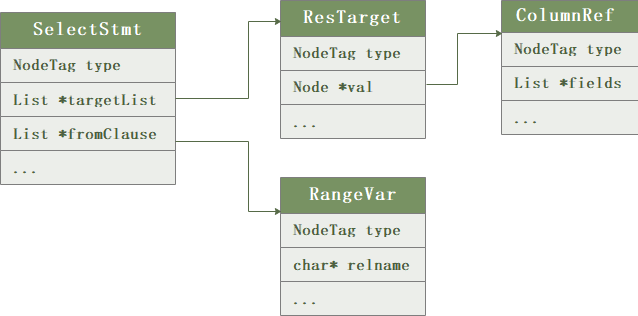

(gdb) p *parsetree_list
$47 = {type = T_List, length = 1, head = 0x7f5ff986c8f0, tail = 0x7f5ff986c8f0}(gdb) p *(Node *)(parsetree_list->head.data->ptr_value)
$45 = {type = T_SelectStmt}(gdb) set $stmt = (SelectStmt *)(parsetree_list->head.data->ptr_value)
(gdb) p *$stmt
$50 = {type = T_SelectStmt, distinctClause = 0x0, intoClause = 0x0, targetList = 0x7f5ffa43d588, fromClause = 0x7f5ff986c888, startWithClause = 0x0, whereClause = 0x0, groupClause = 0x0,
havingClause = 0x0, windowClause = 0x0, withClause = 0x0, valuesLists = 0x0, sortClause = 0x0, limitOffset = 0x0, limitCount = 0x0, lockingClause = 0x0, hintState = 0x0, op = SETOP_NONE, all = false,
larg = 0x0, rarg = 0x0, hasPlus = false}(gdb) p *($stmt->targetList)
$55 = {type = T_List, length = 2, head = 0x7f5ffa43d540, tail = 0x7f5ffa43d800}
(gdb) p *(Node *)($stmt->targetList->head.data->ptr_value)
$57 = {type = T_ResTarget}
(gdb) set $restarget1=(ResTarget *)($stmt->targetList->head.data->ptr_value)
(gdb) p *$restarget1
$60 = {type = T_ResTarget, name = 0x0, indirection = 0x0, val = 0x7f5ffa43d378, location = 7}
(gdb) p *$restarget1->val
$63 = {type = T_ColumnRef}
(gdb) p *(ColumnRef *)$restarget1->val
$64 = {type = T_ColumnRef, fields = 0x7f5ffa43d470, prior = false, indnum = 0, location = 7}
(gdb) p *((ColumnRef *)$restarget1->val)->fields
$66 = {type = T_List, length = 1, head = 0x7f5ffa43d428, tail = 0x7f5ffa43d428}
(gdb) p *(Node *)(((ColumnRef *)$restarget1->val)->fields)->head.data->ptr_value
$67 = {type = T_String}
(gdb) p *(Value *)(((ColumnRef *)$restarget1->val)->fields)->head.data->ptr_value
$77 = {type = T_String, val = {ival = 140050197369648, str = 0x7f5ffa43d330 "a"}}
(gdb) set $restarget2=(ResTarget *)($stmt->targetList->tail.data->ptr_value)
(gdb) p *$restarget2
$89 = {type = T_ResTarget, name = 0x0, indirection = 0x0, val = 0x7f5ffa43d638, location = 10}
(gdb) p *$restarget2->val
$90 = {type = T_ColumnRef}
(gdb) p *(ColumnRef *)$restarget2->val
$91 = {type = T_ColumnRef, fields = 0x7f5ffa43d730, prior = false, indnum = 0, location = 10}
(gdb) p *((ColumnRef *)$restarget2->val)->fields
$92 = {type = T_List, length = 1, head = 0x7f5ffa43d6e8, tail = 0x7f5ffa43d6e8}
(gdb) p *(Node *)(((ColumnRef *)$restarget2->val)->fields)->head.data->ptr_value
$93 = {type = T_String}
(gdb) p *(Value *)(((ColumnRef *)$restarget2->val)->fields)->head.data->ptr_value
$94 = {type = T_String, val = {ival = 140050197370352, str = 0x7f5ffa43d5f0 "b"}}(gdb) p *$stmt->fromClause
$102 = {type = T_List, length = 1, head = 0x7f5ffa43dfe0, tail = 0x7f5ffa43dfe0}
(gdb) set $fromclause=(RangeVar*)($stmt->fromClause->head.data->ptr_value)
(gdb) p *$fromclause
$103 = {type = T_RangeVar, catalogname = 0x0, schemaname = 0x0, relname = 0x7f5ffa43d848 "item", partitionname = 0x0, subpartitionname = 0x0, inhOpt = INH_DEFAULT, relpersistence = 112 'p', alias = 0x0,
location = 17, ispartition = false, issubpartition = false, partitionKeyValuesList = 0x0, isbucket = false, buckets = 0x0, length = 0, foreignOid = 0, withVerExpr = false}
Semantic analysis
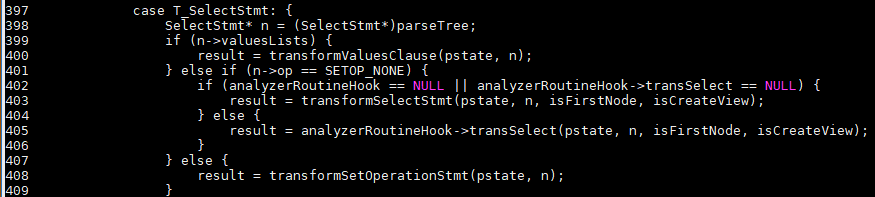
(gdb) p *result
$3 = {type = T_Query, commandType = CMD_SELECT, querySource = QSRC_ORIGINAL, queryId = 0, canSetTag = false, utilityStmt = 0x0, resultRelation = 0, hasAggs = false, hasWindowFuncs = false,
 hasSubLinks = false, hasDistinctOn = false, hasRecursive = false, hasModifyingCTE = false, hasForUpdate = false, hasRowSecurity = false, hasSynonyms = false, cteList = 0x0, rtable = 0x7f5ff5eb8c88,
 jointree = 0x7f5ff5eb9310, targetList = 0x7f5ff5eb9110,…}

(gdb) p *result->targetList
$13 = {type = T_List, length = 2, head = 0x7f5ff5eb90c8, tail = 0x7f5ff5eb92c8}

(gdb) p *(Node *)(result->targetList->head.data->ptr_value)
$8 = {type = T_TargetEntry}
(gdb) p *(TargetEntry*)(result->targetList->head.data->ptr_value)
$9 = {xpr = {type = T_TargetEntry, selec = 0}, expr = 0x7f5ff636ff48, resno = 1, resname = 0x7f5ff5caf330 "a", ressortgroupref = 0, resorigtbl = 24576, resorigcol = 1, resjunk = false}
(gdb) p *(TargetEntry*)(result->targetList->tail.data->ptr_value)
$10 = {xpr = {type = T_TargetEntry, selec = 0}, expr = 0x7f5ff5eb9178, resno = 2, resname = 0x7f5ff5caf5f0 "b", ressortgroupref = 0, resorigtbl = 24576, resorigcol = 2, resjunk = false}
(gdb)
(gdb) p *result->rtable
$14 = {type = T_List, length = 1, head = 0x7f5ff5eb8c40, tail = 0x7f5ff5eb8c40}
(gdb) p *(Node *)(result->rtable->head.data->ptr_value)
$15 = {type = T_RangeTblEntry}
(gdb) p *(RangeTblEntry*)(result->rtable->head.data->ptr_value)
$16 = {type = T_RangeTblEntry, rtekind = RTE_RELATION, relname = 0x7f5ff636efb0 "item", partAttrNum = 0x0, relid = 24576, partitionOid = 0, isContainPartition = false, subpartitionOid = 0……}
边栏推荐
- See how the interface control devaxpress WinForms creates a virtual keyboard
- Fleet |「後臺探秘」第 3 期:狀態管理
- ORACLE中dbms_output.put_line输出问题的解决过程
- The past and present life of distributed cap theorem
- 华为能成“口红一哥”,或者“带货女王”吗?
- Realization of a springboard machine
- C#/VB.NET 将PDF转为Excel
- Opengauss kernel: analysis of SQL parsing process
- Technical secrets of ByteDance data platform: implementation and optimization of complex query based on Clickhouse
- Experiment 6 8255 parallel interface experiment [microcomputer principle] [experiment]
猜你喜欢

Fleet |「后台探秘」第 3 期:状态管理

实验6 8255并行接口实验【微机原理】【实验】

Halcon basic summary (I) cutting pictures and rotating images

Grand launch of qodana: your favorite CI code quality platform

What! 一条命令搞定监控?
ORACLE中dbms_output.put_line输出问题的解决过程

信创操作系统--麒麟Kylin桌面操作系统 (项目十 安全中心)

Classmate Zhang hasn't learned to be an anchor yet

Classic model transformer

SAP mts/ato/mto/eto topic 9: front and back desk operation in m+m mode, strategy 50, preparation of raw materials and semi-finished products in advance

随机推荐
Classic model transformer
最长连续序列
R language ggplot2 visualization: use the patchwork package (directly use the plus sign +) to horizontally combine a ggplot2 visualization result and a plot function visualization result to form a fin
Go zero micro Service Practice Series (VII. How to optimize such a high demand)
Oracle11g数据库使用expdp每周进行数据备份并上传到备份服务器
C#/VB.NET 将PDF转为Excel
石油化工行业供应链系统驱动管理模式创新升级,强化企业内部管理
分布式 CAP 定理的前世今生
Leetcode 48. Rotate image (yes, resolved)
隆重推出 Qodana:您最爱的 CI 的代码质量平台
Grand launch of qodana: your favorite CI code quality platform
Leike defense: 4D millimeter wave radar products are expected to be mass produced and supplied by the end of the year
DBMS in Oracle_ output. put_ Line output problem solving process
开源大咖说 - Linus 与 Jim 对话中国开源
R语言ggplot2可视化:使用patchwork包将两个ggplot2可视化结果横向构成新的结果可视化组合图(使用|符号)
PostgreSQL 存储结构浅析
ROS21讲
ROS knowledge points - ROS create workspace
R语言ggplot2可视化:使用patchwork包将3个ggplot2可视化结果自定义组合起来构成组合图、两个子图横向组合后和另外一个图纵向组合构成最终组合图
R语言ggplot2可视化:使用patchwork包(直接使用加号+)将一个ggplot2可视化结果和数据表格横向组合起来形成最终结果图