当前位置:网站首页>深度学习实验:Softmax实现手写数字识别
深度学习实验:Softmax实现手写数字识别
2022-07-26 16:56:00 【老师我作业忘带了】
文章相关知识点:AI遮天传 DL-回归与分类_老师我作业忘带了的博客-CSDN博客
MNIST数据集
MNIST手写数字数据集是机器学习领域中广泛使用的图像分类数据集。它包含60,000个训练样本和10,000个测试样本。这些数字已进行尺寸规格化,并在固定尺寸的图像中居中。每个样本都是一个784×1的矩阵,是从原始的28×28灰度图像转换而来的。MNIST中的数字范围是0到9。下面显示了一些示例。 注意:在训练期间,切勿以任何形式使用有关测试样本的信息。

代码清单
- data/ 文件夹:存放MNIST数据集。下载数据,解压后存放于该文件夹下。下载链接:MNIST handwritten digit database, Yann LeCun, Corinna Cortes and Chris Burges
- solver.py 这个文件中实现了训练和测试的流程。;
- dataloader.py 实现了数据加载器,可用于准备数据以进行训练和测试;
- visualize.py 实现了plot_loss_and_acc函数,该函数可用于绘制损失和准确率曲线;
- optimizer.py 实现带momentum的SGD优化器,可用于执行参数更新;
- loss.py 实现softmax_cross_entropy_loss,包含loss的计算和梯度计算;
- runner.ipynb 完成所有代码后的执行文件,执行训练和测试过程。
要求
- 记录训练和测试的准确率。画出训练损失和准确率曲线;
- 比较使用和不使用momentum结果的不同,可以从训练时间,收敛性和准确率等方面讨论差异;
- 调整其他超参数,如学习率,Batchsize等,观察这些超参数如何影响分类性能。写下观察结果并将这些新结果记录在报告中。
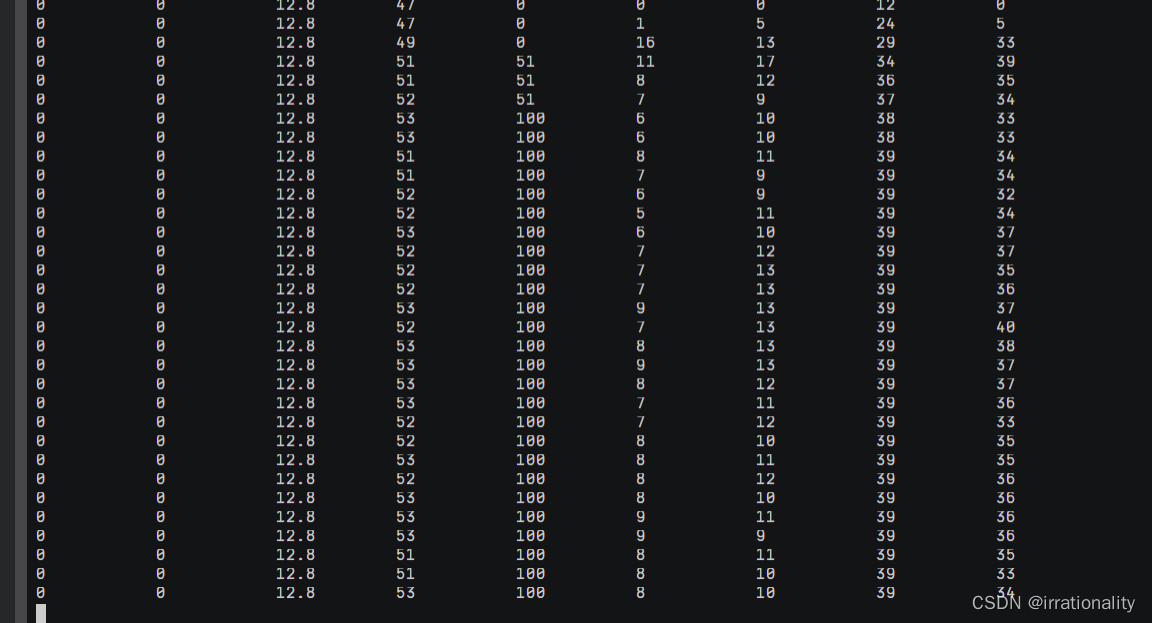
运行结果如下:


代码如下:
solver.py
import numpy as np

from layers import FCLayer

from dataloader import build_dataloader
from network import Network
from optimizer import SGD
from loss import SoftmaxCrossEntropyLoss
from visualize import plot_loss_and_acc

class Solver(object):
    def __init__(self, cfg):
        self.cfg = cfg

        # build dataloader
        train_loader, val_loader, test_loader = self.build_loader(cfg)
        self.train_loader = train_loader
        self.val_loader = val_loader
        self.test_loader = test_loader

        # build model
        self.model = self.build_model(cfg)

        # build optimizer
        self.optimizer = self.build_optimizer(self.model, cfg)

        # build evaluation criterion
        self.criterion = SoftmaxCrossEntropyLoss()

    @staticmethod
    def build_loader(cfg):
        train_loader = build_dataloader(
            cfg['data_root'], cfg['max_epoch'], cfg['batch_size'], shuffle=True, mode='train')

        val_loader = build_dataloader(
            cfg['data_root'], 1, cfg['batch_size'], shuffle=False, mode='val')

        test_loader = build_dataloader(
            cfg['data_root'], 1, cfg['batch_size'], shuffle=False, mode='test')

        return train_loader, val_loader, test_loader

    @staticmethod
    def build_model(cfg):
        model = Network()
        model.add(FCLayer(784, 10))
        return model

    @staticmethod
    def build_optimizer(model, cfg):
        return SGD(model, cfg['learning_rate'], cfg['momentum'])

    def train(self):
        max_epoch = self.cfg['max_epoch']

        epoch_train_loss, epoch_train_acc = [], []
        for epoch in range(max_epoch):

            iteration_train_loss, iteration_train_acc = [], []
            for iteration, (images, labels) in enumerate(self.train_loader):
                # forward pass
                logits = self.model.forward(images)
                loss, acc = self.criterion.forward(logits, labels)

                # backward_pass
                delta = self.criterion.backward()
                self.model.backward(delta)

                # updata the model weights
                self.optimizer.step()

                # restore loss and accuracy
                iteration_train_loss.append(loss)
                iteration_train_acc.append(acc)

                # display iteration training info
                if iteration % self.cfg['display_freq'] == 0:
                    print("Epoch [{}][{}]\t Batch [{}][{}]\t Training Loss {:.4f}\t Accuracy {:.4f}".format(
                        epoch, max_epoch, iteration, len(self.train_loader), loss, acc))

            avg_train_loss, avg_train_acc = np.mean(iteration_train_loss), np.mean(iteration_train_acc)
            epoch_train_loss.append(avg_train_loss)
            epoch_train_acc.append(avg_train_acc)

            # validate
            avg_val_loss, avg_val_acc = self.validate()

            # display epoch training info
            print('\nEpoch [{}]\t Average training loss {:.4f}\t Average training accuracy {:.4f}'.format(
                epoch, avg_train_loss, avg_train_acc))

            # display epoch valiation info
            print('Epoch [{}]\t Average validation loss {:.4f}\t Average validation accuracy {:.4f}\n'.format(
                epoch, avg_val_loss, avg_val_acc))

        return epoch_train_loss, epoch_train_acc

    def validate(self):
        logits_set, labels_set = [], []
        for images, labels in self.val_loader:
            logits = self.model.forward(images)
            logits_set.append(logits)
            labels_set.append(labels)

        logits = np.concatenate(logits_set)
        labels = np.concatenate(labels_set)
        loss, acc = self.criterion.forward(logits, labels)
        return loss, acc

    def test(self):
        logits_set, labels_set = [], []
        for images, labels in self.test_loader:
            logits = self.model.forward(images)
            logits_set.append(logits)
            labels_set.append(labels)

        logits = np.concatenate(logits_set)
        labels = np.concatenate(labels_set)
        loss, acc = self.criterion.forward(logits, labels)
        return loss, acc


if __name__ == '__main__':
    # You can modify the hyerparameters by yourself.
    relu_cfg = {
        'data_root': 'data',
        'max_epoch': 10,
        'batch_size': 100,
        'learning_rate': 0.1,
        'momentum': 0.9,
        'display_freq': 50,
        'activation_function': 'relu',
    }

    runner = Solver(relu_cfg)
    relu_loss, relu_acc = runner.train()

    test_loss, test_acc = runner.test()
    print('Final test accuracy {:.4f}\n'.format(test_acc))

    # You can modify the hyerparameters by yourself.
    sigmoid_cfg = {
        'data_root': 'data',
        'max_epoch': 10,
        'batch_size': 100,
        'learning_rate': 0.1,
        'momentum': 0.9,
        'display_freq': 50,
        'activation_function': 'sigmoid',
    }

    runner = Solver(sigmoid_cfg)
    sigmoid_loss, sigmoid_acc = runner.train()

    test_loss, test_acc = runner.test()
    print('Final test accuracy {:.4f}\n'.format(test_acc))

    plot_loss_and_acc({
        "relu": [relu_loss, relu_acc],
        "sigmoid": [sigmoid_loss, sigmoid_acc],
    })
dataloader.py
import os
import struct
import numpy as np


class Dataset(object):

    def __init__(self, data_root, mode='train', num_classes=10):
        assert mode in ['train', 'val', 'test']

        # load images and labels
        kind = {'train': 'train', 'val': 'train', 'test': 't10k'}[mode]
        labels_path = os.path.join(data_root, '{}-labels-idx1-ubyte'.format(kind))
        images_path = os.path.join(data_root, '{}-images-idx3-ubyte'.format(kind))

        with open(labels_path, 'rb') as lbpath:
            magic, n = struct.unpack('>II', lbpath.read(8))
            labels = np.fromfile(lbpath, dtype=np.uint8)

        with open(images_path, 'rb') as imgpath:
            magic, num, rows, cols = struct.unpack('>IIII', imgpath.read(16))
            images = np.fromfile(imgpath, dtype=np.uint8).reshape(len(labels), 784)

        if mode == 'train':
            # training images and labels
            self.images = images[:55000]  # shape: (55000, 784)
            self.labels = labels[:55000]  # shape: (55000,)

        elif mode == 'val':
            # validation images and labels
            self.images = images[55000:]  # shape: (5000, 784)
            self.labels = labels[55000:]  # shape: (5000, )

        else:
            # test data
            self.images = images  # shape: (10000, 784)
            self.labels = labels  # shape: (10000, )

        self.num_classes = 10

    def __len__(self):
        return len(self.images)

    def __getitem__(self, idx):
        image = self.images[idx]
        label = self.labels[idx]

        # Normalize from [0, 255.] to [0., 1.0], and then subtract by the mean value
        image = image / 255.0
        image = image - np.mean(image)

        return image, label


class IterationBatchSampler(object):

    def __init__(self, dataset, max_epoch, batch_size=2, shuffle=True):
        self.dataset = dataset
        self.batch_size = batch_size
        self.shuffle = shuffle

    def prepare_epoch_indices(self):
        indices = np.arange(len(self.dataset))

        if self.shuffle:
            np.random.shuffle(indices)

        num_iteration = len(indices) // self.batch_size + int(len(indices) % self.batch_size)
        self.batch_indices = np.split(indices, num_iteration)

    def __iter__(self):
        return iter(self.batch_indices)

    def __len__(self):
        return len(self.batch_indices)


class Dataloader(object):

    def __init__(self, dataset, sampler):
        self.dataset = dataset
        self.sampler = sampler

    def __iter__(self):
        self.sampler.prepare_epoch_indices()

        for batch_indices in self.sampler:
            batch_images = []
            batch_labels = []
            for idx in batch_indices:
                img, label = self.dataset[idx]
                batch_images.append(img)
                batch_labels.append(label)

            batch_images = np.stack(batch_images)
            batch_labels = np.stack(batch_labels)

            yield batch_images, batch_labels

    def __len__(self):
        return len(self.sampler)


def build_dataloader(data_root, max_epoch, batch_size, shuffle=False, mode='train'):
    dataset = Dataset(data_root, mode)
    sampler = IterationBatchSampler(dataset, max_epoch, batch_size, shuffle)
    data_lodaer = Dataloader(dataset, sampler)
    return data_lodaer
loss.py
import numpy as np

# a small number to prevent dividing by zero, maybe useful for you
EPS = 1e-11

class SoftmaxCrossEntropyLoss(object):

    def forward(self, logits, labels):
        """
          Inputs: (minibatch)
          - logits: forward results from the last FCLayer, shape (batch_size, 10)
          - labels: the ground truth label, shape (batch_size, )
        """

        ############################################################################
        # TODO: Put your code here
        # Calculate the average accuracy and loss over the minibatch
        # Return the loss and acc, which will be used in solver.py
        # Hint: Maybe you need to save some arrays for backward

        self.one_hot_labels = np.zeros_like(logits)
        self.one_hot_labels[np.arange(len(logits)), labels] = 1

        self.prob = np.exp(logits) / (EPS + np.exp(logits).sum(axis=1, keepdims=True))

        # calculate the accuracy
        preds = np.argmax(self.prob, axis=1) # self.prob, not logits.
        acc = np.mean(preds == labels)

        # calculate the loss
        loss = np.sum(-self.one_hot_labels * np.log(self.prob + EPS), axis=1)
        loss = np.mean(loss)
        ############################################################################

        return loss, acc

    def backward(self):

        ############################################################################
        # TODO: Put your code here
        # Calculate and return the gradient (have the same shape as logits)

        return self.prob - self.one_hot_labels
        ############################################################################
network.py
class Network(object):
    def __init__(self):
        self.layerList = []
        self.numLayer = 0

    def add(self, layer):
        self.numLayer += 1
        self.layerList.append(layer)

    def forward(self, x):
        # forward layer by layer
        for i in range(self.numLayer):
            x = self.layerList[i].forward(x)
        return x

    def backward(self, delta):
        # backward layer by layer
        for i in reversed(range(self.numLayer)): # reversed
            delta = self.layerList[i].backward(delta)
optimizer.py
import numpy as np

class SGD(object):
    def __init__(self, model, learning_rate, momentum=0.0):
        self.model = model
        self.learning_rate = learning_rate
        self.momentum = momentum

    def step(self):
        """One backpropagation step, update weights layer by layer"""

        layers = self.model.layerList
        for layer in layers:
            if layer.trainable:

                ############################################################################
                # TODO: Put your code here
                # Calculate diff_W and diff_b using layer.grad_W and layer.grad_b.
                # You need to add momentum to this.

                # Weight update with momentum
                if not hasattr(layer, 'diff_W'):
                    layer.diff_W = 0.0

                layer.diff_W = layer.grad_W + self.momentum * layer.diff_W
                layer.diff_b = layer.grad_b

                layer.W += -self.learning_rate * layer.diff_W
                layer.b += -self.learning_rate * layer.diff_b

                # # Weight update without momentum
                # layer.W += -self.learning_rate * layer.grad_W
                # layer.b += -self.learning_rate * layer.grad_b

                ############################################################################
visualize.py
import matplotlib.pyplot as plt
import numpy as np

def plot_loss_and_acc(loss_and_acc_dict):
    # visualize loss curve
    plt.figure()

    min_loss, max_loss = 100.0, 0.0
    for key, (loss_list, acc_list) in loss_and_acc_dict.items():
        min_loss = min(loss_list) if min(loss_list) < min_loss else min_loss
        max_loss = max(loss_list) if max(loss_list) > max_loss else max_loss

        num_epoch = len(loss_list)
        plt.plot(range(1, 1 + num_epoch), loss_list, '-s', label=key)

    plt.xlabel('Epoch')
    plt.ylabel('Loss')
    plt.legend()
    plt.xticks(range(0, num_epoch + 1, 2))
    plt.axis([0, num_epoch + 1, min_loss - 0.1, max_loss + 0.1])
    plt.show()

    # visualize acc curve
    plt.figure()

    min_acc, max_acc = 1.0, 0.0
    for key, (loss_list, acc_list) in loss_and_acc_dict.items():
        min_acc = min(acc_list) if min(acc_list) < min_acc else min_acc
        max_acc = max(acc_list) if max(acc_list) > max_acc else max_acc

        num_epoch = len(acc_list)
        plt.plot(range(1, 1 + num_epoch), acc_list, '-s', label=key)

    plt.xlabel('Epoch')
    plt.ylabel('Accuracy')
    plt.legend()
    plt.xticks(range(0, num_epoch + 1, 2))
    plt.axis([0, num_epoch + 1, min_acc, 1.0])
    plt.show()
边栏推荐
- What kind of product is the Jetson nano? (how about the performance of Jetson nano)
- SQL injection (mind map)
- Week 16 OJ practice 1 calculates the day of the year
- 使用 replace-regexp 在行首添加序号
- CCS tm4c123 new project
- PIP installation module, error
- 【虚拟机数据恢复】意外断电导致XenServer虚拟机不可用,虚拟磁盘文件丢失的数据恢复案例
- Application of machine vision in service robot
- SQL中去去重的三种方式
- 常用超好用正则表达式!
猜你喜欢
Kudu design tablet

The latest interface of Taobao / tmall keyword search

Spark统一内存划分
![Cloud rendering volume cloud [theoretical basis and implementation scheme]](/img/38/0e97d6f015f3cb51e872a8d3ce584a.png)
Cloud rendering volume cloud [theoretical basis and implementation scheme]

Everything is available Cassandra: the fairy database behind Huawei tag

#夏日挑战赛# OpenHarmony基于JS实现的贪吃蛇

来吧开发者!不只为了 20 万奖金,试试用最好的“积木”来一场头脑风暴吧!

【OpenCV 例程 300篇】240. OpenCV 中的 Shi-Tomas 角点检测
Ascend target detection and recognition - customize your own AI application

Pytorch中的tensor操作
随机推荐
uni-app
国际大咖 VS 本土开源新星 | ApacheCon Asia 主题演讲议程全览
[machine learning] principle and code of mean shift
Comparison between agile development and Devops
Common super easy to use regular expressions!
Tupu 3D visual national style design | collision between technology and culture "cool" spark“
On the growth of data technicians
After vs code is formatted, the function name will be automatically followed by a space
如何使用 align-regexp 对齐 userscript 元信息
机器学习-什么是机器学习、监督学习和无监督学习
236. 二叉树的最近公共祖先
Everything is available Cassandra: the fairy database behind Huawei tag
一文详解吞吐量、QPS、TPS、并发数等高并发指标
Is it safe for Huishang futures to open an account online? What is the account opening process?
Environment setup mongodb
Basic select statement
RedisDesktopManager去除升级提示
简述CUDA镜像构建
ASEMI整流桥KBPC2510,KBPC2510参数,KBPC2510规格书
树形dp问题