当前位置:网站首页>Leetcode topic - array
Leetcode topic - array
2022-07-27 00:16:00 【Ap21ril】
List of articles
Preface
An array is a collection of the same type of data stored in continuous memory space .
Two things to note are :
1. Array subscripts are all from 0 At the beginning .
2. The address of array memory space is continuous .
It is precisely because the addresses of the array in the memory space are continuous , So when we delete or add elements , It's hard to avoid moving the addresses of other elements .
One 、LeetCode—— Two points search

If an array is given in the title , And there are search operations , Give priority to binary search , Binary search method is a faster way to find , In most cases, binary search is basically used on the premise that the array is orderly . But it is also used in the case of disorder .
class Solution:
    def search(self, nums: List[int], target: int) -> int:
        left,right = 0,len(nums)-1
        while left<=right:
            mid = left+(right-left)//2 # To prevent spillage , You can use this as a fixed way to find the middle subscript
            if nums[mid] == target: # If the middle value is equal to the target value , return mid
                return mid
            elif nums[mid] < target: # If it's less than the target , Then continue the recursive search on the right half
                left = mid+1
            else:	# If it's greater than the target value , Then continue to search recursively on the left half
                right = mid-1
        return -1
This topic is relatively simple , It can be seen as the basis of array . Binary search is also often done by recursion , The general idea is the same as the above .
Two 、LeetCode—— Remove elements
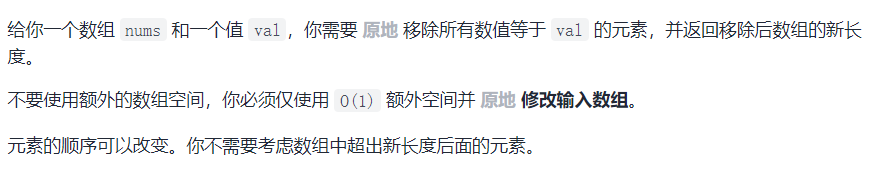
It can be said that there is no explicit operation to delete elements in the array ,, If you want to delete an element , Just overwrite this element , The method of overwriting is to move the elements behind the array forward .
1. Violence solution
Traversal array , When encounter is equal to x situations , Let the elements after this position move forward one position in turn . Because the elements that need to be deleted may be adjacent , therefore i Also one ahead .
//  Time complexity :O(n^2)
//  Spatial complexity :O(1)
class Solution {

public:
    int removeElement(vector<int>& nums, int val) {

        int size = nums.size();
        for (int i = 0; i < size; i++) {

            if (nums[i] == val) {
     //  Find the elements that need to be removed , Just move the array forward one bit
                for (int j = i + 1; j < size; j++) {

                    nums[j - 1] = nums[j];
                }
                i--; //  Because the subscript i All the later values are moved forward by one bit , therefore i Also move forward one bit
                size--; //  The size of the array -1
            }
        }
        return size;

    }
};
2、 Double finger needling
Double pointer is a very efficient idea , It is often used in arrays and linked lists .
In this question , We can define two pointers slow and fast, When the current element is not equal to x when , These two pointers move backward together , Be equal to x when ,fast Pointer backward ,slow The pointer doesn't change . And then use fast The element pointed to by the pointer is overwritten slow The element that the pointer points to . After the traversal is over , The length of the array is slow.
class Solution:
    def removeElement(self, nums: List[int], val: int) -> int:
        slow = fast = 0 # Initialization is 0
        while fast<len(nums):
            if nums[fast]!=val: # When you don't wait , Move backward together ; On equal terms ,slow unchanged ,fast Move backward
                nums[slow]=nums[fast]
                slow+=1
            fast+=1
        return slow # Returns the length of the array
3、 ... and 、LeetCode—— The square of an ordered array

1、 Violence solution
The solution to violence is simple , Not much explanation
class Solution:
    def sortedSquares(self, nums: List[int]) -> List[int]:
        for i in range(len(nums)):
            nums[i] *= nums[i]
        nums = sorted(nums)
        return nums
2、 Double finger needling
'''  Double pointer method , Create an additional array to store the returned results .  Because the original array has been ordered , So the largest number after the square is either the first element or the last element in the original array .  Put the biggest on res Last position in array , Traverse in turn  '''
class Solution:
    def sortedSquares(self, nums: List[int]) -> List[int]:
        i,j,k = 0,len(nums)-1,len(nums)-1
        res = [-1]*len(nums)

        while i<=j:
            lm = nums[i]*nums[i]
            rm = nums[j]*nums[j]
            if lm > rm:
                res[k] = lm
                i += 1
            else:
                res[k] = rm
                j -= 1
            k -= 1
        return res
Four 、LeetCode—— Minimum length array

1、 Violence solution
class Solution:
    def minSubArrayLen(self, target: int, nums: List[int]) -> int:
        res = float('inf') #res Initialize to infinity
        sum,sublenth = 0,0 #sum For the current and ,sublenth Is the length of the qualified sequence
        for i in range(0,len(nums)): #i Is the starting point of the subsequence
            sum = 0
            for j in range(i,len(nums)): #j Is the end position of the subsequence
                sum += nums[j]
                if sum>=target: # If the requirements are met , Calculate the length of the current sequence , And with res Compare
                    sublenth = j-i+1
                    res = min(res,sublenth)
                    break # Just find one that meets the requirements , Just break
        return res if res != float('inf') else 0 # If res Not assigned , Just go back to 0
2、 The sliding window ( Double finger needling )
So called sliding window , It's constantly adjusting the starting and ending positions of subsequences , So we can get the result that we want to think about .
In this topic, we realize the sliding window , The main points are as follows :
- What's in the window ?
- How to move the start of a window ?
- How to move the end of a window ?
The window is Satisfy it and ≥ s The smallest length of Continuous subarray .
How the start of the window moves : If the value of the current window is greater than s 了 , The window is about to move forward ( It's time to shrink ).
How the end of the window moves : The end of the window is the pointer that traverses the array , Set the starting position of the window as the starting position of the array .
'''  The sliding window  '''
class Solution:
    def minSubArrayLen(self, target: int, nums: List[int]) -> int:

        res = float('inf')
        subLenth = 0
        sum,index = 0,0  #sum For the current array element and ,index Is the starting position of the sliding window
        for i in range(len(nums)):# The end position of the sliding window is the pointer traversing the array
            sum += nums[i]
            while sum>=target:
                subLenth = i-index+1
                res = min(subLenth,res)
                sum -= nums[index] # Constantly changing the starting position of the sequence
                index += 1
        return 0 if res==float("inf") else res
5、 ... and 、LeetCode—— Find the first and last positions of the elements in the sort array

Use two bisections to find , A binary search to find the left boundary , The other is to find the right boundary .
This question can be divided into three situations :
- target stay nums[0] ~ nums[n-1] in ,nums in target. for example nums = [5,7,7,8,8,10],target = 8, return [3,4].
- target stay nums[0] ~ nums[n-1] in ,nums Does not exist in the target. for example nums = [5,7,7,8,8,10],target = 6, return [-1,-1].
- target < nums[0] perhaps target > nums[n-1]. for example nums = [5,7,7,8,8,10], target = 4, return [-1,-1].
Find the left boundary :
 def searchLeft(nums,target): # Looking for the left boundary
            left,right = 0,len(nums)-1
            while(left<=right):
                mid = left+(right-left)//2
                if nums[mid]<target:
                    left=mid+1
                else:
                    right=mid-1
            if nums[left]==target:
                return left
            else:
                return -1
Ordinary binary search is , When nums[mid] == target when , Go straight back to mid, And in this question , Is to continue to look to the left , See if there are any and target Equal array elements .
Find the right boundary
 def searchRight(nums,target): # Look for the right border
            left,right = 0,len(nums)-1
            while(left<=right):
                mid = left+(right-left)//2
                if nums[mid]>target:
                    right=mid-1
                else:
                    left=mid+1
            if nums[right]==target:
                return right
            else:
                return -1
When nums[mid]=target when , All the way to the right , See if there are any and target Equal array elements .
Don't forget that there is another situation :
 if len(nums)==0 or nums[0]>target or nums[-1]<target:
            return [-1,-1]
Complete code :
class Solution:
    def searchRange(self, nums: List[int], target: int) -> List[int]:
        def searchLeft(nums,target): # Looking for the left boundary
            left,right = 0,len(nums)-1
            while(left<=right):
                mid = left+(right-left)//2
                if nums[mid]<target:
                    left=mid+1
                else:
                    right=mid-1
            if nums[left]==target:
                return left
            else:
                return -1
        def searchRight(nums,target): # Look for the right border
            left,right = 0,len(nums)-1
            while(left<=right):
                mid = left+(right-left)//2
                if nums[mid]>target:
                    right=mid-1
                else:
                    left=mid+1
            if nums[right]==target:
                return right
            else:
                return -1
        if len(nums)==0 or nums[0]>target or nums[-1]<target:
            return [-1,-1]
        lb = searchLeft(nums,target)
        rb = searchRight(nums,target)
        return [lb,rb]
6、 ... and 、LeetCode—— Spiral matrix
There is no algorithm idea in this topic , Mainly to examine logic .
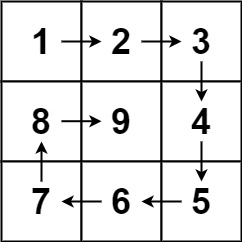
class Solution:
    def generateMatrix(self, n: int) -> List[List[int]]:
        matrix = [[0] * n for _ in range(n)]
        left,right,up,down = 0,n-1,0,n-1
        number = 1
        while left<right and up<down:
            for x in range(left,right):
                matrix[up][x] = number
                number += 1
            for y in range(up,down):
                matrix[y][right] = number
                number += 1
            for x in range(right,left,-1):
                matrix[down][x] = number
                number += 1
            for y in range(down,up,-1):
                matrix[y][left] = number
                number += 1

            left += 1
            right -= 1
            up += 1
            down -= 1
        # For odd numbers, you need to assign a value to the middle
        if n%2 != 0:
            matrix[n//2][n//2] = number

        return matrix
边栏推荐
- Apple TV HD with the first generation Siri remote is listed as obsolete
- About no module named'django.db.backends.mysql'
- Design of electronic scale based on 51 single chip microcomputer
- 2022.7.26-----leetcode.1206
- 在pycharm中部署yolov5报错问题
- Chapter 2 develop user traffic interceptors
- Upload files to OSS file server
- Pytorch learning record (II): tensor
- [netding Cup 2018] Fakebook records
- 13_ conditional rendering
猜你喜欢

Baidu website Collection

MVC three-tier architecture

What scenarios are Tencent cloud lightweight application servers suitable for?

关于可穿戴式NFT你应该知道的一切!

The basic operation of data tables in MySQL is very difficult. This experiment will take you through it from the beginning

分页插件--PageHelper
三层架构 模拟

The place where the dream begins ---- first knowing C language (2)

LeetCode——链表篇

买不到的数目
随机推荐
Share a regular expression
MySQL数据库复杂操作:数据库约束,查询/连接表操作
01 knapsack problem 416. Segmentation and equal sum subset -494. Goal and
嵌入式系统移植【8】——设备树和根文件系统移植
100. Same tree
Training team lpoj round10 d come minion!
Modulo (remainder) operation in the range of real numbers: how to find the remainder of negative numbers
Halloween treatments (drawer principle)
11_ Weather case - monitoring properties
今日份20220719折腾deeplabcut
JUnit、JMockit、Mockito、PowerMockito
三层架构 模拟
Meeting OA project seating function and submission function
Codeforces C1. Simple Polygon Embedding
Mysql database complex operations: Database Constraints, query / connect table operations
Codeforces d.constructing the array (priority queue)
When aw9523b chip is used to drive 16 channel led, the LED is wrongly lit
Can the stock account opening commission be adjusted? Is it safe to open an account on your mobile phone
在pycharm中部署yolov5报错问题
08_ Event modifier