当前位置:网站首页>Unity implements smooth interpolation
Unity implements smooth interpolation
2022-06-12 06:05:00 【VR technology Xiaoguang】
For those unfamiliar with Unity For people who , We all know that each script has three callable update Handle . When update processing is required, you can call Update, You can also call a better LateUpdate. Both of these use global variables Time.deltaTime To access the time interval between frames .FixedUpdate Use Time.fixedTimeDelta And run in a fixed time step , Therefore, each frame may be run many times .
About important Lerp problem .
This question seems to be asked again and again on the forum , How to achieve perfectly smooth interpolation and damping Damping. For example, you have a value a, And you want to smoothly interpolate it to another value b, You decide to use arbitrary interpolation coefficients r Linear interpolation . If you are in a variable frame rate function (Update or LateUpdate) A similar operation is performed in , Then you will encounter the following problems :
1 individual | a = Mathf.Lerp(a, b, r); |
There's something wrong with this code , Because it is in Of each frame a and b And we know that the frame rate is variable , So smoothness is variable .
Once this is clear , Maybe we can do some research , stay Unity In the document You will find it advisable to do so :
1 individual | a = Mathf.Lerp(a, b, r * Time.deltaTime); |
wait a moment , This is not quite right ... The interpolation coefficient may now exceed 1, This is not allowed . This is not allowed . What about next ? Let's consider not using primitive lerp, Do not apply deltatime 了 , But this time put it in FixedUpdate in , Use fixdeltatime.
But there are still potential problems . It's a little subtle , Because in FixedUpdate Something that runs in will almost never be in the correct state of the current frame , Because the update rate is different . This means that they need extrapolation or interpolation to achieve smooth display .Unity There is an option to enable extrapolation or interpolation for rigid bodies , therefore , If you enable this option and want to constrain rigid body attributes , Then the rigid body will work as expected . however , If you are not using extrapolation or interpolation , Then FixedUpdate for , Smoothing is technically smooth , But you will still see the Caton phenomenon on the screen .
Another problem that cannot be avoided with fixed updates is , If you need to change the update rate ( for example , Would you like to 100 Hz The frequency of running Physics ) And use common lerp, You need to readjust the smoothing value .
What are we trying to do ?
Let's simplify a few things , Let's see what we actually want to achieve here . Now? , Let's assume that we always interpolate to zero .
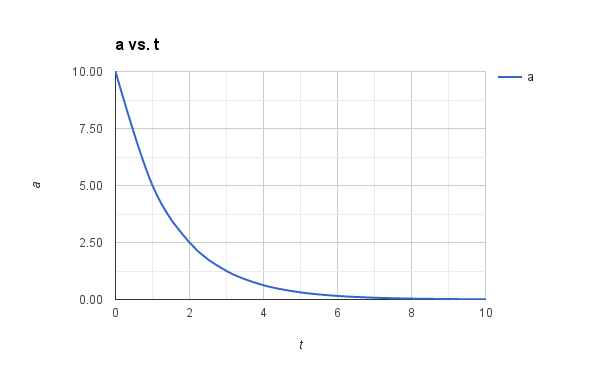
One way to solve this problem is to ask how many initial values should be retained after one second . Suppose our initial value is 10, Every second we lose half of our current value :

Let's look at its graph over time . We can see , From the starting value 10 To almost zero , This is a smooth curve . It will never reach zero completely , But it will be very close to zero .
View the number sequence , We can easily sum it up as :

Or for (0,1) Any ratio in the range r:

If we are one step ahead of the current value , What's going to happen ?

I hope the pattern here is clear , So we can say more generally :

This means that we can t Value , And in the future t + n in Calculate the value at any time . It must be realized here that n It doesn't have to be an integer value , So use... Here deltaTime very good . This means that we can now write a frame rate sensing function , This function will decay to zero , And use it in the variable rate update function
1 individual 2 3 4 5 6 7 8 9 10 11 12 13 14 15 16 17 18 year | // Smoothing rate dictates the proportion of source remaining after one second//publicstaticfloatDamp(floatsource, floatsmoothing, floatdt){ returnsource * Mathf.Pow(smoothing, dt);}privatevoidUpdate(){ a = Damp(a, 0.5f, Time.deltaTime);}// orprivatevoidFixedUpdate(){ a = Damp(a, 0.5f, Time.fixedDeltaTime);} |
If you interpolate in a specified range ?
If you want to value a Change to value b Not zero ? The key here is , It's just a graph in y Translate on the axis . If we start from 20 Decay to 10, Then it looks like this :
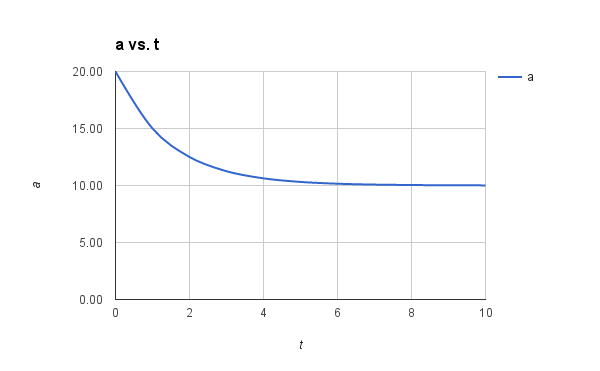
therefore , We need to use (a – b) Add damping , Then add b. Let's change the damping function to do this :

This should look familiar …… Its form and standard Lerp identical , but rate Parameter has exponent :
1 individual | a(t + n) = Lerp(b, a(t), Pow(r, n)) |
You may notice here that these parameters do not match the order you expect , But it's easy to solve , because :
1 individual | Lerp(a, b, t) = Lerp(b, a, 1 - t) |
therefore :
1 individual | a(t + n) = Lerp(a(t), b, 1 - Pow(r, n)) |
We can write this code directly , Or a better idea is to wrap it in a function , This function will perform frame rate aware damping between two arbitrary values :
1 individual 2 3 4 5 6 | // Smoothing rate dictates the proportion of source remaining after one second//publicstaticfloatDamp(floatsource, floattarget, floatsmoothing, floatdt){ returnMathf.Lerp(source, target, 1 - Mathf.Pow(smoothing, dt))} |
A smoothing rate of zero will return you the target value ( That is, no smoothing ), Technically, the impermissible rate is 1, Only the source value will be returned to you ( That is, infinite smoothing ). Please note that , This is related to lerp Parameters work the opposite way , But if you want to , Can be in Pow Inverse addition using smoothing parameters in .
Exponential decay
The keen eyes among you may have seen the picture , And think it looks very much like an exponential decay function . You will be right , Because it actually yes Exponential decay function . Understand why , Let's go back to not taking b Damping function of :
Now? , Compare it with the exponential decay formula :

Let's equate it with , See what happens

therefore

therefore , Another way to express the damping function is to use lambda A parameterized . Now it ranges from zero to infinity , Well expressed the fact that , That is, you can never really achieve b.
1 individual 2 3 4 | publicstaticfloatDamp(floata, floatb, floatlambda, floatdt){ returnMathf.Lerp(a, b, 1 - Mathf.Exp(-lambda * dt))} |
If you look at other codes , You will see the usual form of exponential decay , But I only know that it is frame rate aware Lerp Another form of ( vice versa , It depends on how you think about it ).
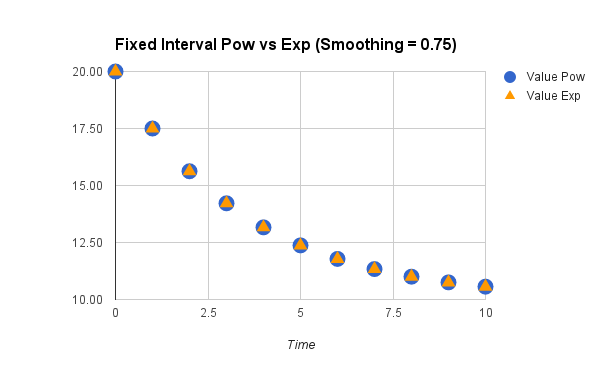
The following figure shows the two forms of λ damping . As you can see , They all match perfectly .
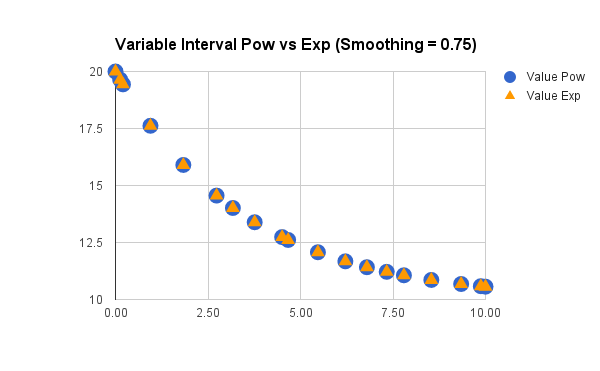
Last , This is the same picture , But this time it's a random interval .
Abstract
- Not in Update or FixedUpdate Internal use of ordinary Lerp Damping .
- stay FixedUpdate Use in Lerp Be careful , And ensure that the results will be interpolated or extrapolated .
- As far as possible , Even in FixedUpdate in , It is best to use the frame rate sensing damping function , Because it will allow you to change the fixed update rate without readjusting the damping .
I hope this will eliminate the need for proper use of damping values Lerp Some puzzles of .
边栏推荐
- R语言大作业(四):上海市、东京 1997-2018 年GDP值分析
- 单通道图片的读入
- 468. verifying the IP address
- 线程有哪些状态?
- Mysql笔记
- Review notes of naturallanguageprocessing based on deep learning
- Leetcode sword finger offer II 119 Longest continuous sequence
- Who is more fierce in network acceleration? New king reappeared in CDN field
- A preliminary understanding of function
- User login (medium)
猜你喜欢

E-book analysis

从传统网络IO 到 IO多路复用

Why doesn't the database use binary tree, red black tree, B tree and hash table? Instead, a b+ tree is used
![[untitled]](/img/75/599c5b13dd483fad50f73ddb431989.jpg)
[untitled]

Project technical structure

Login authentication filter

2D human pose estimation for pose estimation - pifpaf:composite fields for human pose estimation

sqlite交叉編譯動態庫

Win10 desktop unlimited refresh
IDEA常用配置
随机推荐
Redis transaction
Divide a folder image into training set and test set
Es6-es11 learning
(UE4 4.27) customize globalshader
交叉编译libev
Leetcode-646. Longest number pair chain
(UE4 4.27) customize primitivecomponent
nRF52832自定义服务与特性
Unity VSCode不能跳转到定义
Liunx Foundation
The application could not be installed: INSTALL_FAILED_TEST_ONLY
A preliminary understanding of function
软件项目架构简单总结
Flutter monitors application lifecycle status
MySQL master-slave, 6 minutes to master
cv2.fillPoly coco annotator segment坐标转化为mask图像
Understand Houdini's (heightfield) remap operation
Leetcode-1512. Number of good pairs
How to split a row of data into multiple rows in Informix database
为什么联合索引是最左匹配原则?