当前位置:网站首页>Go zero micro Service Practice Series (II. Service splitting)
Go zero micro Service Practice Series (II. Service splitting)
2022-06-12 13:39:00 【Microservice practice】
Overview of microservices
Microservice architecture is an architectural style , It builds a large system into a collection of multiple microservices , These microservices are built around business functions , Services focus on a single business function , These services have the following characteristics :
Highly maintainable and testable Loose coupling Independently deployable Build around business functions Maintained by different small teams
The microservice architecture can 、 frequent 、 Reliable delivery of large 、 Complex applications , Realize service componentization through business splitting , Use components for composition to quickly develop systems .

Division of services
Let's first divide the microservices , In actual project development , We usually adopt two micro service partition strategies , The first method is to divide the boundaries of microservices through business functions , The second way is through DDD The boundary context is used to divide the microservice boundary , Here, we use the business functions that are easy to understand to divide microservices , Once again, post the mind map of our e-commerce project :
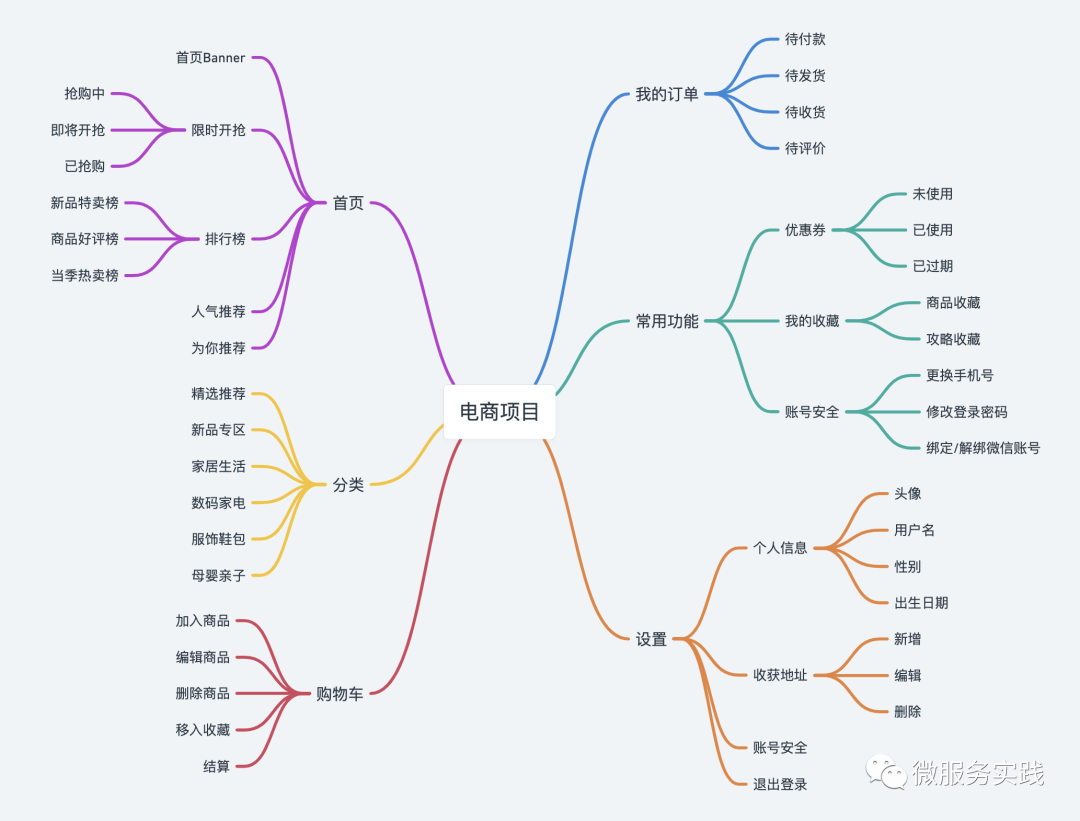
From the above mind map, we can see that the whole e-commerce system has many functions , We divide the following micro services according to business functions :
Goods and services (product) - Addition of goods 、 Information Service 、 Inventory management and other functions Shopping cart service (cart) - Add, delete, modify and check the shopping cart Order service (order) - Generate order , Order management Payment services (pay) - The payment function is realized by calling the third-party payment Account Services (user) - User information 、 Grade 、 Prohibition 、 Address management Recommended services (recommend) - Home page product recommendation Comment service (reply) - The comment function of the product 、 Comment reply function
BFF layer
Generally, we will use... For the client HTTP Interface to provide services , Does it mean that these micro services need to be provided directly HTTP The interface provides external services ? Of course you can , The architecture as a whole looks simple .
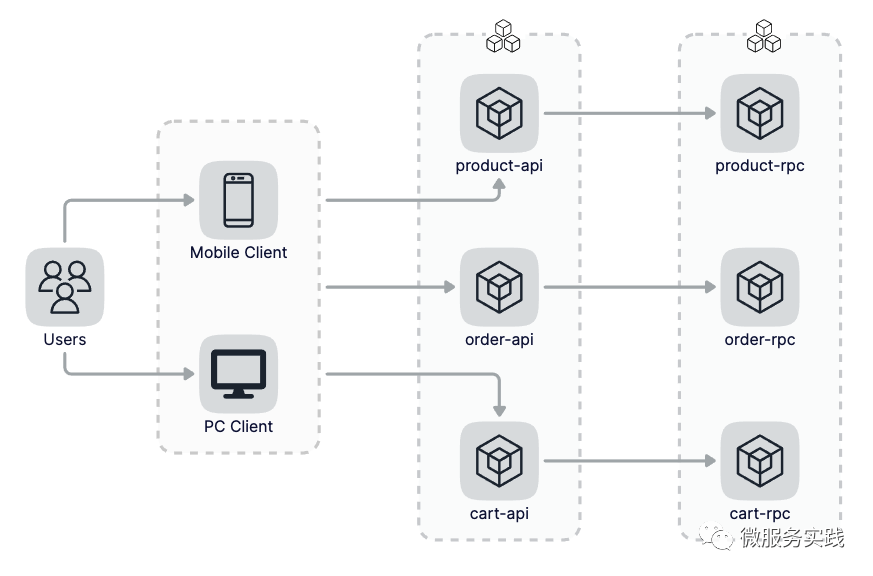
But for a complex and highly concurrent system , We need to deal with various exception scenarios , For example, a page needs to rely on data provided by multiple microservices , In order to avoid the time-consuming caused by serial requests , We usually request multiple microservices in parallel , At this time, if a service request is abnormal, we may need to do some special processing , For example, provide some degraded data . In addition, the data displayed on our pages are often business function oriented , Not just the data of a microservice , At this time, we often need to assemble the data of multiple microservices to meet the requirements , If each of our microservices is directly provided externally HTTP Interface , Then these complex data assembly and exception handling can only be completed by the client . As we all know, the client is not suitable for complex business logic , The client should focus more on the optimization of interactive experience , Our overall architecture needs to be light in the front and heavy in the back , That is, the client logic should be as few as possible and the heavier business processing logic should be sunk to the server , The server is divided into different microservices according to business functions , These microservices focus on a single business , So where should these complex logic processing for business scenarios be put ? Our solution is to add a layer , namely BFF layer , adopt BFF External provision HTTP Interface , Client only with BFF Interact .

BFF The introduction of layer solves the problems we encountered above , But adding one layer will increase the complexity of the architecture , So if your service is a single application , that BFF It's not necessary , Introducing it doesn't add any value . For our project , Our applications depend on microservices , At the same time, we need to provide business oriented functions HTTP Interface and ensure high availability of the interface , therefore BFF It is a suitable choice for our project .
We can provide multiple BFF Do you ? The answer is, of course .BFF The purpose of is to provide a centralized interface for the client , For example, the data protocols of mobile terminal pages and browser pages are different , In this case, in order to better represent the data , Two can be used BFF, Only one at the same time BFF If it's time to BFF Exceptions will affect all businesses , Provide multiple BFF It can also improve the availability of services , Reduce the impact of business exceptions . Multiple BFF The architecture is as follows :

In order to simplify our project, only one BFF service .
Engineering structure
We use centralized management , Put all the services in one big warehouse , The directory structure of the warehouse is as follows :

lebron For the name of the project ,lebron There is apps and pkg Two directories , among apps All our micro services are stored , such as order For order related microservices ,pkg The directory is the storage path of packages that all services depend on , For example, if all services need to rely on authentication, they can be put into pkg Under the table of contents .
app - BFF service cart - Shopping cart service order - Order service pay - Payment services product - Goods and services recommend - Recommended services reply - Comment service user - Account Services
Under each service directory, we will divide it into multiple services , There are mainly the following types of services :
api - External BFF service , Accept requests from clients , expose HTTP Interface rpc - Internal micro Services , Only accept other internal micro services or BFF Request , expose gRPC Interface rmq - Responsible for flow task processing , Upstream typically relies on message queues , such as kafka etc. admin - It is also an internal service , The difference in rpc, Most of them are oriented to the operation side and have high data authority , Isolation can lead to better code level security , Provide directly HTTP Interface
apps The structure of each service under the directory is as follows :

Most services are split into rpc、rmq and admin To meet the demand of providing rpc Interface and operational data requirements , At the same time through rmq To handle streaming tasks . What's more special is app There is only api service , because app yes BFF All but api service , It may be added later rmq service , For example, stream processing users' first login and experience every day , We can expand at any time later , For the time being, only api service .recommend Only rpc service , Because the recommendation service needs to rely on AI Data provided by the team or big data team , We only need to request the corresponding data interface and do some business processing , So here recommend Only rpc service .
Code initialization
The structure of the whole project has been clearly defined , Let's initialize the service code
We use goctl To initialize the project , For example, let's initialize order, Enter the first order Under the table of contents :
$ cd lebron/apps/order
Execute the following command to initialize order rpc Code
$ goctl rpc new rpc
The generated code structure is as follows :

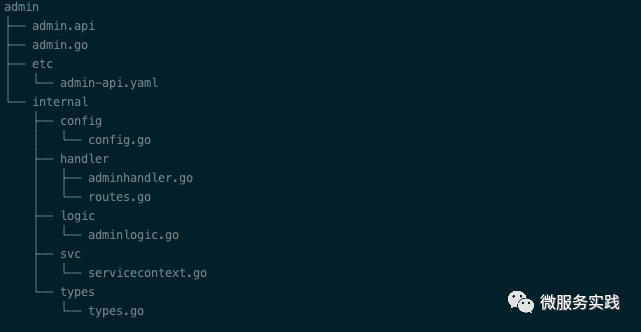
Execute the following command to initialize order admin Code , Be careful order admin by api service , Directly to the front end HTTP Interface
$ goctl api new admin
The generated code structure is as follows :
The generated service code can be run directly , Default listening is on 8888 port
$ go run admin.go

Starting server at 0.0.0.0:8888...
about rmq Service we will use go-zero Provided kq function , Here, first initialize main.go

Come here order The code initialization of the service has been completed , Other services and order The service is similar to , I won't go into that here .
pkg There is no need to initialize , When we need to provide general business functions, we add them .
Conclusion
In this article, we explained the definition of microservices , Microservices are built around business functions , Services focus on a single business , Lightweight communication mechanism is adopted between services , Each microservice can be deployed and tested independently .
We split the microservices according to the functions of the mall , Mainly split the shopping cart 、 Order 、 payment 、 goods 、 Comment on 、 recommend 、 Account number and other services , Then we explain why we need to introduce BFF service ,BFF It is essentially a service for data assembly , Provide business oriented or client oriented services externally UI Of HTTP Interface .
Then we define the directory structure of our project , It is mainly divided into api、rpc、rmq and admin Etc , Different services have different responsibilities ,api External provision HTTP Interface ,rpc Provide internally RPC Interface ,rmq Do streaming data processing ,admin Provide for the operation background HTTP Interface .
Finally, we passed goctl Initialize the project , Use goctl Project framework code can be generated with one click , Great productivity .
I hope this article can help you , thank you .
Every Monday 、 Thursday update
Code warehouse :https://github.com/zhoushuguang/lebron
Reference resources
https://microservices.io/index.html
https://blog.bitsrc.io/bff-pattern-backend-for-frontend-an-introduction-e4fa965128bf
Project address
https://github.com/zeromicro/go-zero
Welcome to use go-zero and star Support us !
WeChat ac group
Focus on 『 Microservice practice 』 Official account and click Communication group Get community group QR code .
边栏推荐
- torch_geometric mini batch 的那些事
- C language implementation of string and memory library functions
- Scyther工具形式化分析Woo-Lam协议
- Codeforces 1638 B. odd swap sort - tree array, no, simple thinking
- There was an error installing mysql. Follow the link below to CMD
- Code debugging - print log output to file
- 【SemiDrive源码分析】【X9芯片启动流程】26 - R5 SafetyOS 之 LK_INIT_LEVEL_TARGET 阶段代码流程分析(TP Drvier、Audio Server初始化)
- AWLive 结构体的使用
- 苹果电脑上MySQL安装完成找不到怎么办
- 高通平台开发系列讲解(协议篇)QMI简单介绍及使用方法
猜你喜欢

成功定级腾讯T3-2,万字解析

Innovation training (x) advanced interface beautification

Octopus network progress monthly report | may 1-May 31, 2022

【刷题篇】超级洗衣机

Resume NFT platform trustrecruit joined Octopus network as a candidate application chain

Codeforces 1629 F2. Game on sum (hard version) - Yang Hui's triangle, violence, finding rules

Experience and learning path of introductory deep learning and machine learning

Multi source BFS problem template (with questions)

Introduction to application design scheme of intelligent garbage can voice chip, wt588f02b-8s

Semantic segmentation with pytorch
随机推荐
view的子视图的递归
Scyther工具形式化分析Woo-Lam协议
Wechat web developer tools tutorial, web development issues
Codeforces 1629 F2. Game on sum (hard version) - Yang Hui's triangle, violence, finding rules
C language implementation of string and memory library functions
Innovation training (x) advanced interface beautification
镜像扫描工具预研
Codeforces 1638 B. odd swap sort - tree array, no, simple thinking
torch_geometric message passing network
2063: [example 1.4] cattle eat grass
Codeforces 1638 A. reverse - simple thinking
Qualcomm platform development series (Protocol) QMI brief introduction and usage
Implementing pytorch style deep learning framework similartorch with numpy
播放器屏幕方向方案
VGA display color bar and picture (FPGA)
imagemagick:a gentle introduction to magick++
颜色编码格式介绍
Django note 21: querying databases using native SQL
上海解封背后,这群开发者“云聚会”造了个AI抗疫机器人
【SemiDrive源码分析】【X9芯片启动流程】26 - R5 SafetyOS 之 LK_INIT_LEVEL_TARGET 阶段代码流程分析(TP Drvier、Audio Server初始化)