当前位置:网站首页>Vibrating liquid quantity detecting device
Vibrating liquid quantity detecting device
2022-06-26 16:28:00 【Zhuoqing】

One 、 Project overview
This device is the one I participated in this academic year SRT Project topic , It was completed by me in cooperation with another senior in automation department ( Two people work together ). This work is based on the common phenomenon of knocking glasses with different liquid volume to produce different pitches in life , Based on this method, a non-invasive liquid measurement device is designed . This work is applicable to some special environments where intrusive measurement methods cannot be used , For example, it is highly toxic 、 Non invasive measurement of highly corrosive liquid storage tanks . The project finally won the third prize in the final evaluation of the school challenge cup .
Two 、 Research ideas and experimental process
In order to break through the limitations of the existing non-invasive detection device , We have abandoned the traditional method of measuring the liquid storage height 、 Method for calculating liquid volume by weight and other indicators , Analyze the reservoir as a whole with the liquid in it . The core features here use the lessons learned in the course FFT The fundamental frequency of the system determined by the spectral analysis of the algorithm 、 Harmonic frequency . Then the finite element analysis software is used to determine the vibration modes corresponding to these frequencies , Then the excitation point and the receiving position of the sensor are determined , Finally, the neural network is used for data fitting .
3、 ... and 、 Experimental data and feature extraction
For the 500mL Open glass beaker , Paste the piezoelectric sensor on the cup wall , At the same time, knock and excite the cup wall and bottom , To receive 2s,40kHz The time domain signal with sampling rate is filtered by Gauss filter to eliminate low-frequency noise , Proceed again FFT Identify and extract the characteristic frequency in the spectrum . The data is shown in the figure below , The waveform above is the bottom excitation result , The waveform below is the result of side wall excitation . Time domain results are shown on the left , The right side is FFT The frequency domain results obtained after .

▲ chart 3.1 Test waveform and spectrum It can be seen that there are two obvious characteristic frequencies , among 1kHz The left and right frequencies are obvious under both excitation conditions , and 872Hz The frequency of only exists under the side wall excitation . Then the finite element analysis is used to simulate the excitation of these two positions ( The percussion excitation can be approximately one unit impulse ), The vibration modes corresponding to these two characteristic frequencies are obtained as follows :

▲ chart 3.2 Two different modes of vibration Thus, it can be determined that the vibration modes corresponding to the two striking points are two independent vibration modes . Then change the liquid volume , Yes 0-500mL The liquid level in the range is every 25mL Take one measurement at an interval , Extract the characteristic frequencies of the above two vibration modes , Perform the frequency of the two modes - Liquid level curve drawing , give the result as follows :

▲ chart 3.3 Relationship between beaker liquid volume and frequency You can see , The frequency change rate of bottom mode is higher at low liquid level , At high liquid level, the frequency change rate of sidewall mode is high . Traditional mode based liquid level detection only focuses on the sidewall mode , The range obtained is only the upper half level . And by introducing the bottom mode , Not only will the range be extended to the full level , It is even more difficult to measure the extremely low liquid level in the existing non-invasive liquid level detection device (0-50mL) It has extremely high precision performance .
Four 、 Device implementation
In order to realize fully automatic excitation 、 testing 、 Liquid volume analysis , We carry out data communication through single-chip microcomputer , Connect the upper computer with the sensor , Excitation device . On the selection of excitation device , In order to obtain more ideal unit impulse excitation , We tried different excitation devices , Finally, the combination of shrapnel and electromagnet is determined , The device has a good acoustic effect on the container used in the experiment , The resulting spectrum is the cleanest . The overall device diagram is as follows :( From left to right are the upper computer and its graphical interface , Single chip microcomputer , Interface circuit , Excitation devices and sensors )

▲ chart 4.1 Experimental test device In the actual measurement process , The upper computer will send instructions , The voltage signal is given by the single chip microcomputer to control the relay , And then drive the electromagnet to complete the excitation , Then the data collected by the sensor is transmitted to the single chip microcomputer through the interface circuit , The data structure is adjusted and transmitted to the upper computer , Data analysis 、 Processing and visual display .
For data fitting methods , We use neural network instead of the traditional exponential fitting method . by comparison , Neural network is closer to its original law , And the data of two channels can be fitted at the same time , Higher accuracy . The structure and training results of the neural network are as follows :

▲ chart 4.2 Use neural network for data fitting You can see , The training result curve is smooth , The projection law on the two planes is consistent with the experiment . Substitute into the test set for testing , give the result as follows :

▲ chart 4.3 Test set test results selection 20 Individual liquid volume ( Non calibration point data ) As a test set . The maximum error on the test set shall not exceed 5mL, The average error does not exceed 2mL. The average accuracy of measurement reaches the average error 0.3%, maximum error 0.68% .
5、 ... and 、 Summary of achievements and prospect
Compared with traditional non-invasive detection methods , The device realizes high-precision measurement at low liquid volume . This has important application value in the measurement of some expensive solutions . in addition , When the liquid level is inclined 、 In case of instability , This method also shows high robustness . In the works, neural network is used to fit 、 Instead of the traditional fixed function fitting method , It further improves the scientificity and accuracy of prediction . Experimental results show that , When the liquid level is low 、 When high , The measurement accuracy can reach two thousandths ; At the intermediate liquid level, the accuracy can also reach 5 ‰ .
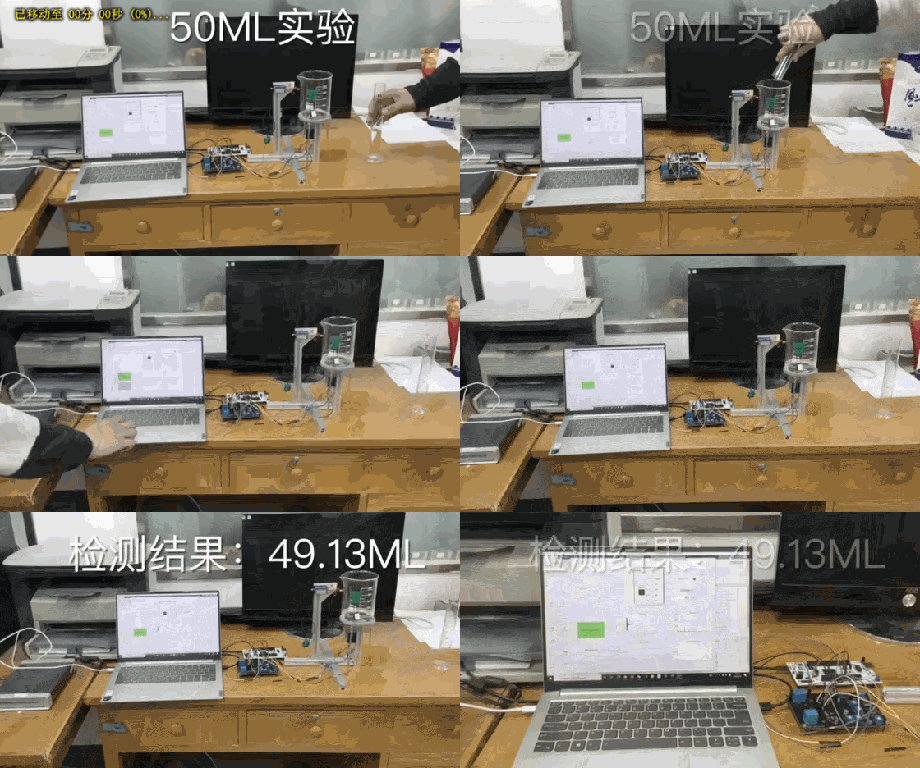
▲ chart 5.1 Testing process : Capacity 50mL6、 ... and 、 Experiment and course thoughts
This project has been studied since the summer vacation when I was a freshman , Until the middle of this semester, I will participate in the final examination of the challenge cup , It spans nearly a year . From the beginning of theoretical research 、 Literature research , To manual knocking test 、 Law exploration , And then to the construction of the device , System debugging 、 improvement , Finally, the experiment on the device 、 adjustment . We met many difficulties along the way , But we adjust step by step for our own goals and enthusiasm for this project 、 improvement , Finally, we got a satisfactory result . This is also my first scientific research experience , Although it is hard, I feel the harvest .
For the course of signal and system , The core of our whole subject is actually sampling and frequency domain analysis . Therefore, many knowledge in the course of signal and system have important applications in this subject , such as FFT Time-frequency conversion 、 Sampling theorem 、 wave filtering 、 System functions, etc . In the process of learning signals and systems, I have many new ideas about our subject 、 And the continuous advancement of the project also deepened my understanding of the course of signal and system . In the study of almost every new concept , I can find the practical application of this concept in our project , So as to help me better remember and understand .
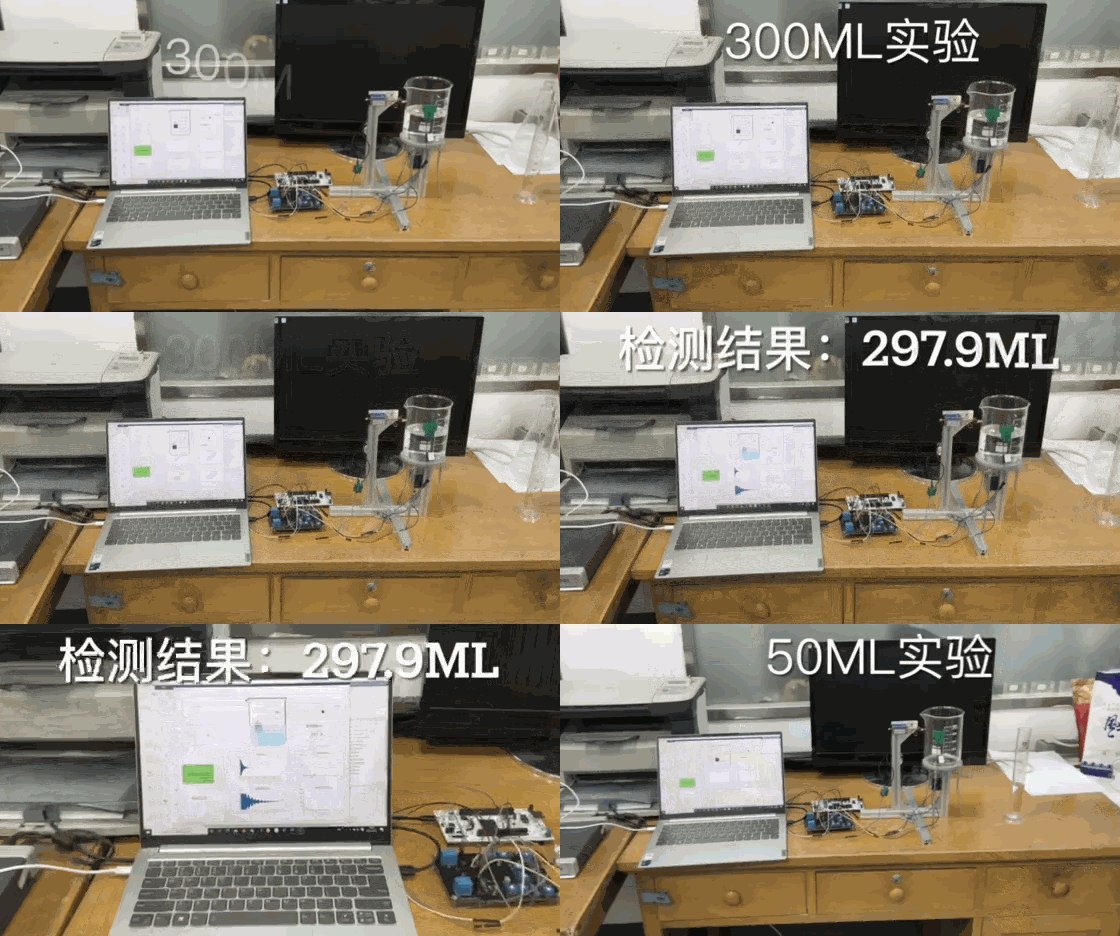
▲ chart 6.1 Testing process : Capacity 300mLThis also makes me understand that this course is a combination of theory and practice , And the importance of learning in practice . The achievement of our subject can not be achieved without the wonderful interpretation of the course of signal and system by Mr. Zhuo . so to speak , This course is the most practical one in my college , The most interesting course . Thank you for your hard work in this semester .
attach : Challenge Cup Award certificate

▲ chart 6.2 Challenge Cup Award certificate ● Related chart Links :
- chart 3.1 Test waveform and spectrum
- chart 3.2 Two different modes of vibration
- chart 3.3 Relationship between beaker liquid volume and frequency
- chart 4.1 Experimental test device
- chart 4.2 Use neural network for data fitting
- chart 4.3 Test set test results
- chart 6.2 Challenge Cup Award certificate
边栏推荐
- R language plot visualization: plot visualizes the normalized histogram, adds the density curve KDE to the histogram, and uses geom at the bottom edge of the histogram_ Adding edge whisker graph with
- day10每日3题(1):逐步求和得到正数的最小值
- 『C语言』题集 of ⑩
- Mono 的一些实例方法
- pybullet机器人仿真环境搭建 5.机器人位姿可视化
- The details of the first pig heart transplantation were fully disclosed: human herpes virus was found in the patient, the weight of the heart doubled after death, and myocardial cell fibrosis
- Redis order sorting command
- Niuke programming problem -- dynamic programming of must brush 101 (a thorough understanding of dynamic programming)
- mha 切换(操作流程建议)
- 精致妆容成露营“软实力”,唯品会户外美妆护肤产品销量激增
猜你喜欢
Arduino uno + DS1302 simple time acquisition and serial port printing
![[Li Kou brush question] monotone stack: 84 The largest rectangle in the histogram](/img/75/440e515c82b5613b117728ba760786.png)
[Li Kou brush question] monotone stack: 84 The largest rectangle in the histogram

大话领域驱动设计——表示层及其他

清华“神奇药水”登Nature:逆转干细胞分化,比诺奖成果更进一步,网友:不靠精子卵子就能创造生命了?!...

构造函数和析构函数
C语言 头哥习题答案截图

Dialogue with the senior management of Chang'an Mazda, new products will be released in Q4, and space and intelligence will lead the Japanese system

Supplement the short board - Open Source im project openim about initialization / login / friend interface document introduction

心情不好,我就这样写代码

Tencent Peking University's sparse large model training acceleration program het was selected into the VLDB of the international summit
随机推荐
7 user defined loss function
Oilfield exploration problems
(DFS search) acwing 2005 horseshoe
redis的二进制数组命令
神经网络“炼丹炉”内部构造长啥样?牛津大学博士小姐姐用论文解读
5 model saving and loading
牛客编程题--必刷101之动态规划(一文彻底了解动态规划)
Redis Guide (8): principle and implementation of Qianfan Jingfa distributed lock
JS tutorial - printing stickers / labels using the electronjs desktop application
数据分析----numpy快速入门
大话领域驱动设计——表示层及其他
我把它当副业月入3万多,新手月入过万的干货分享!
The first open source MySQL HTAP database in China will be released soon, and the three highlights will be notified in advance
Supplement the short board - Open Source im project openim about initialization / login / friend interface document introduction
Make up the weakness - Open Source im project openim about initialization / login / friend interface document introduction
Leetcode one week race 298, first three questions
若依微服务特殊字符串被过滤的解决办法
R语言plotly可视化:小提琴图、多分类变量小提琴图、分组(grouped)小提琴图、分裂的分组小提琴图、每个小提琴图内部分为两组数据、每个分组占小提琴图的一半、自定义小提琴图的调色板、抖动数据点
JS教程之使用 ElectronJS 桌面应用程序打印贴纸/标签
C. Inversion Graph