当前位置:网站首页>Ideal path problem
Ideal path problem
2022-06-26 16:03:00 【chengqiuming】
One Problem description
Given a n Nodes ,m Undirected graph of strip and edge , Painted on each side 1 Color . Find the node 1 To n A path for , To minimize the number of sides to pass , In advance , The color sequence passing through the edge is the smallest . There may be self rings and double edges .
Two Input and output
1 Input
Input common m+1 That's ok , The first 1 The row contains two integers :m and n. After that m That's ok , Each line contains 3 It's an integer a、b、c, Express a and b There's a color line between c The path of .
2 Output
The output consists of two lines , The first 1 The line contains positive integers k, Representation node 1 To n At least you need to go through k side . The first 2 Line inclusion k Positive integers separated by spaces , Representation node 1 To n The color of the edges that pass .
3 sample input
4 6
1 2 1
1 3 2
3 4 3
2 3 1
2 4 4
3 1 1
4 sample output
2
1 3
node 1 To 4 At least two sides :1 > 3, The color is 1( The last input side );3 > 4, The color is 3.
3、 ... and analysis
The solution node of this problem 1 To n The shortest distance , Under this premise , The color number sequence is the smallest . You can find the shortest distance first , Then examine the color number . Because in the slave node 1 Of the multiple sides of departure , I don't know which edge is the shortest path , Therefore, the minimum color number cannot be determined .
Four Algorithm design
1 From the node n Reverse breadth first traverses the elevation , node 1 Is exactly the height of the slave node 1 To n The shortest distance .
2 From the node 1 Forward breadth first traversal , Decrease along the height 1 Direction traversal of , Look for a smaller color number , If multiple color numbers are the smallest , The next color number is the smallest , Up to the node n end .
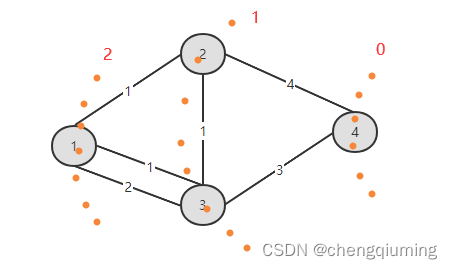
5、 ... and Graphic analysis
1 Create a diagram based on the input sample , And then the nodes n Reverse breadth first traverses the elevation , node 1 The height of 2, That is node 1 To n The shortest distance is 2, Output 2.
2 From the node 1 Forward breadth first traversal , Decrease along the height 1 Direction traversal of , Find the adjacency point with small edge quotient number , node 1 To 2 The color number of is 1, node 1 To 3 The color number of is 1, node 1 To 3 The color number of the other road is 2, The minimum color number is 1, Output 1,. It is currently not possible to determine which edge to select , Therefore, it is possible to take two adjacent contacts 2 and 3 Join the team and temporarily store .
3 From the node 2 And nodes 3 set out , Decrease along the height 1 Direction traversal of , Find the adjacency point with small color number on the edge , node 2 To 4 The color of is 4, node 3 To 4 The color number of is 3, The minimum color number is 3, Output 3.
6、 ... and Code
package graph.uva1599;

import java.util.LinkedList;
import java.util.Queue;
import java.util.Scanner;

public class UVA1599 {
    static final int inf = 0x7fffffff;
    static final int N = 100000 + 5;
    static final int M = 200000 + 5;
    static int n;
    static int m;
    static int cnt;
    static boolean vis[];
    //  Save node number
    static Queue<Integer> q1 = new LinkedList<>();
    //  Save color number
    static Queue<Integer> q2 = new LinkedList<>();
    //  Save the adjacency point number associated with the edge with the smallest color number
    static Queue<Integer> q3 = new LinkedList<>();
    static int head[];
    static int dis[] = new int[N];
    static Edge e[] = new Edge[M];

    static {
        for (int i = 0; i < e.length; i++) {
            e[i] = new Edge();
        }
    }

    //  Add an edge
    static void add(int u, int v, int c) {
        e[++cnt].to = v;
        e[cnt].c = c;
        e[cnt].next = head[u];
        head[u] = cnt;
    }

    //  Reverse the elevation to find the shortest distance
    static void bfs1() {
        int u, v;
        vis = new boolean[N];
        dis[n] = 0;
        q1.add(n);
        vis[n] = true;
        while (!q1.isEmpty()) {
            u = q1.peek();
            q1.poll();
            vis[u] = true;
            for (int i = head[u]; i > 0; i = e[i].next) {
                v = e[i].to;
                if (vis[v])
                    continue;
                dis[v] = dis[u] + 1;
                q1.add(v);
                vis[v] = true;
            }
        }
    }

    //  Forward color number sequence
    static void bfs2() {
        int u, v, minc, c;
        boolean first = true;
        vis = new boolean[N];

        vis[1] = true;
        // 1 All adjacency points of node No
        for (int i = head[1]; i > 0; i = e[i].next)
            //  Height reduction 1 The adjacency point
            if (dis[e[i].to] == dis[1] - 1) {
                q1.add(e[i].to);
                q2.add(e[i].c);
            }
        while (!q1.isEmpty()) {
            minc = inf;
            while (!q1.isEmpty()) {
                v = q1.peek();
                q1.poll();
                c = q2.peek();
                q2.poll();
                if (c < minc) {
                    while (!q3.isEmpty()) //  Found smaller queue empty
                        q3.poll();
                    minc = c;
                }
                if (c == minc)
                    q3.add(v);
            }
            if (first)
                first = false;
            else
                System.out.print(" ");
            System.out.print(minc);
            while (!q3.isEmpty()) { //  All nodes equal to the minimum color number
                u = q3.peek();
                q3.poll();
                if (vis[u])
                    continue;
                vis[u] = true;
                for (int i = head[u]; i > 0; i = e[i].next) { //  Expand each node
                    v = e[i].to;
                    if (dis[v] == dis[u] - 1) {
                        q1.add(v);
                        q2.add(e[i].c);
                    }
                }
            }
        }
    }

    public static void main(String[] args) {
        Scanner scanner = new Scanner(System.in);
        int u, v, c;
        while (true) {
            n = scanner.nextInt();
            m = scanner.nextInt();
            head = new int[N];
            for (int i = 0; i < head.length; i++) {
                head[i] = 0;
            }

            cnt = 0;
            for (int i = 1; i <= m; i++) {
                u = scanner.nextInt();
                v = scanner.nextInt();
                c = scanner.nextInt();


                add(u, v, c);
                add(v, u, c);
            }
            bfs1();
            System.out.println(dis[1]);

            bfs2();
            System.out.println();
        }
    }
}

class Edge {
    int to;
    int c;
    int next;
}
7、 ... and test
Green is the input , White is the output .

边栏推荐
- 【leetcode】48. Rotate image
- NFT transaction principle analysis (1)
- 11 introduction to CNN
- Svg capital letter a animation JS effect
- Solana扩容机制分析(2):牺牲可用性换取高效率的极端尝试 | CatcherVC Research
- STEPN 新手入門及進階
- AUTO sharding policy will apply DATA sharding policy as it failed to apply FILE sharding policy
- HW安全响应
- 大话领域驱动设计——表示层及其他
- 今年高考英语AI得分134,复旦武大校友这项研究有点意思
猜你喜欢

PCIe Capabilities List

5000 word analysis: the way of container security attack and defense in actual combat scenarios

Stepn débutant et avancé

Panoramic analysis of upstream, middle and downstream industrial chain of "dry goods" NFT

OpenSea上如何创建自己的NFT(Polygon)

Everyone is a scientist free gas experience Mint love crash

振动式液量检测装置

NFT交易原理分析(1)
svg野人动画代码

JVM notes
随机推荐
Nanopi duo2 connection WiFi
NFT 平台安全指南(2)
Audio and video learning (II) -- frame rate, code stream and resolution
golang 临时对象池优化
Why are encoder and decoder structures often used in image segmentation tasks?
Failed to get convolution algorithm. This is probably because cuDNN failed to initialize
PCIe Capabilities List
C语言读取数据
SAP OData 开发教程 - 从入门到提高(包含 SEGW, RAP 和 CDP)
R语言广义线性模型函数GLM、glm函数构建逻辑回归模型(Logistic regression)、分析模型是否过离散(Overdispersion)、使用残差偏差与二项式模型中的剩余自由度的比率评估
(1) Keras handwritten numeral recognition and recognition of self written numbers
Transformation of zero knowledge QAP problem
I want to know how to open an account through online stock? Is online account opening safe?
「干货」NFT 上中下游产业链全景分析
【leetcode】331. 验证二叉树的前序序列化
为什么图像分割任务中经常用到编码器和解码器结构?
R语言使用cor函数计算相关性矩阵进行相关性分析,使用corrgram包可视化相关性矩阵、行和列使用主成分分析重新排序、下三角形中使用平滑的拟合线和置信椭圆,上三角形中使用散点图、对角线最小值和最大值
Is it safe to open an account for mobile stock registration? Is there any risk?
Svg savage animation code
Reflection modification final