当前位置:网站首页>小样本故障诊断 - 注意力机制代码 - BiGRU代码解析实现
小样本故障诊断 - 注意力机制代码 - BiGRU代码解析实现
2022-06-24 06:57:00 【故障诊断与python学习】
文章目录
1 参考论文
Fault diagnosis for small samples based on attention mechanism
2 开源代码
https://github.com/liguge/Fault-diagnosis-for-small-samples-based-on-attention-mechanism
3.摘要
针对深度学习在故障诊断中的应用,机械旋转设备部件在复杂的工作环境下容易发生故障,工业大数据存在标记样本有限、工作条件不同、噪声等问题。针对上述问题,提出了一种基于双路径卷积与注意机制(DCA)和双向门控循环单元(DCA- bigru)的小样本故障诊断方法,该方法的性能可以通过最新的正则化训练策略进行有效挖掘。利用BiGRU实现时空特征融合,利用DCA提取融合了注意权的振动信号特征。此外,还将全局平均池化(GAP)应用于降维和故障诊断。实验表明,DCA-BiGRU具有出色的泛化能力和鲁棒性,能够有效地进行各种复杂情况下的诊断。
4.故障诊断流程图

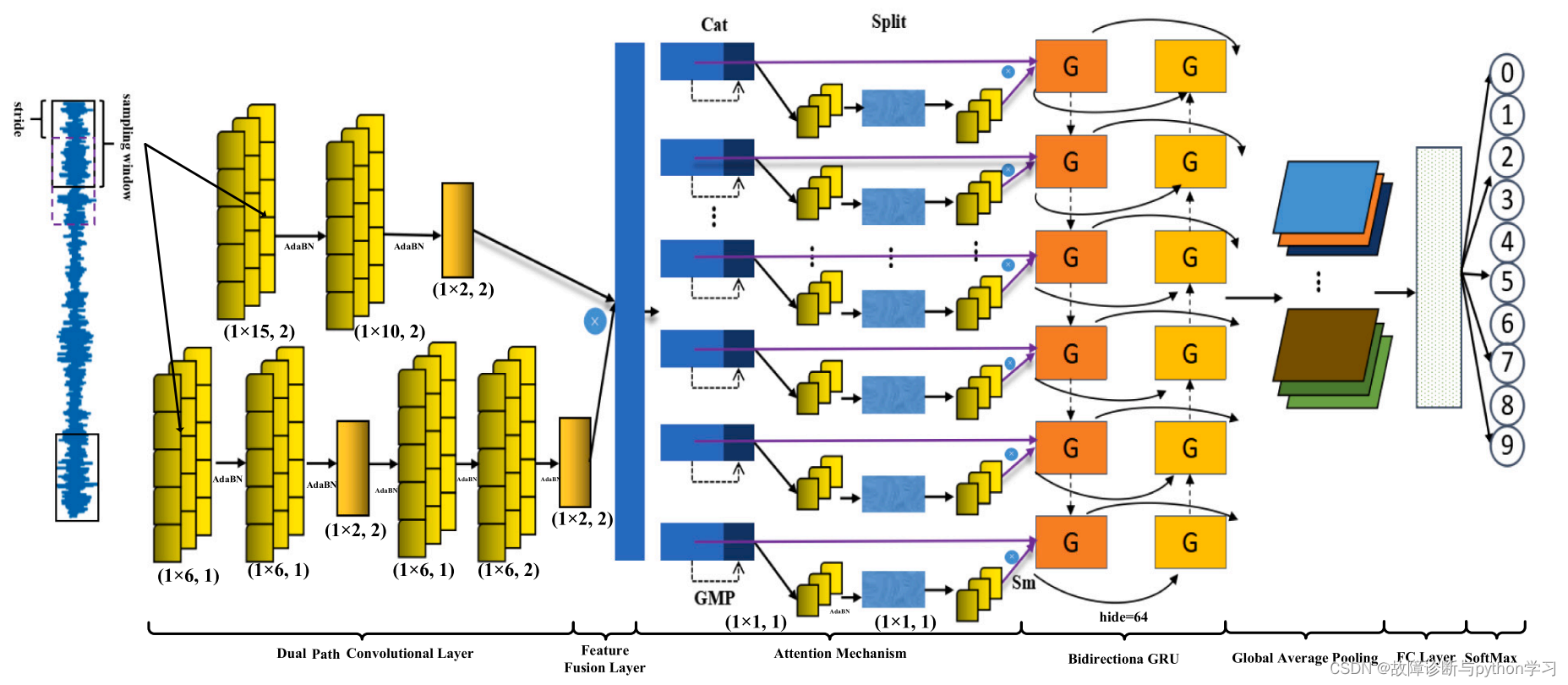
5.网络模型
6.网络结构简介
输入1维数据:[batch_size, 1, 1024]–>双通道卷积–>特征融合(cat)–>注意力机制–>Bidirection GRU–>全局平均池化(Global average pool)–>全连接层–>softmax求分类概率
7.网络模型代码
建议使用pytorch,jupyter notebook
7.1MetaAconC
模块代码
import torch
from torch import nn
class AconC(nn.Module):
    r""" ACON activation (activate or not). # AconC: (p1*x-p2*x) * sigmoid(beta*(p1*x-p2*x)) + p2*x, beta is a learnable parameter # according to "Activate or Not: Learning Customized Activation" <https://arxiv.org/pdf/2009.04759.pdf>. """

    def __init__(self, width):
        super().__init__()
        self.p1 = nn.Parameter(torch.randn(1, width, 1))
        self.p2 = nn.Parameter(torch.randn(1, width, 1))
        self.beta = nn.Parameter(torch.ones(1, width, 1))
    def forward(self, x):
        return (self.p1 * x - self.p2 * x) * torch.sigmoid(self.beta * (self.p1 * x - self.p2 * x)) + self.p2 * x


class MetaAconC(nn.Module):
    r""" ACON activation (activate or not). # MetaAconC: (p1*x-p2*x) * sigmoid(beta*(p1*x-p2*x)) + p2*x, beta is generated by a small network # according to "Activate or Not: Learning Customized Activation" <https://arxiv.org/pdf/2009.04759.pdf>. """

    def __init__(self, width, r=16):
        super().__init__()
        self.fc1 = nn.Conv1d(width, max(r, width // r), kernel_size=1, stride=1, bias=True)
        self.bn1 = nn.BatchNorm1d(max(r, width // r), track_running_stats=True)
        self.fc2 = nn.Conv1d(max(r, width // r), width, kernel_size=1, stride=1, bias=True)
        self.bn2 = nn.BatchNorm1d(width, track_running_stats=True)
        self.p1 = nn.Parameter(torch.randn(1, width, 1))
        self.p2 = nn.Parameter(torch.randn(1, width, 1))

    def forward(self, x):
        beta = torch.sigmoid(self.bn2(self.fc2(self.bn1(self.fc1(x.mean(dim=2, keepdims=True))))))
        return (self.p1 * x - self.p2 * x) * torch.sigmoid(beta * (self.p1 * x - self.p2 * x)) + self.p2 * x
代码测试
x = torch.randn(16, 64, 1024)  #假设输入x:batch_size=16, channel=64, length=1024
Meta = MetaAconC(64)  #创建对象时需输入参数width,其为输入数据的channel
y = Meta(x)
print(y.shape)
>>>output
x.shape: torch.Size([16, 64, 1024])
y.shape: torch.Size([16, 64, 1024])
由结果可见,输入x的shape与输出y的shape是相同的
7.2注意力机制
注意力机制结构图

模块代码
class CoordAtt(nn.Module):
    def __init__(self, inp, oup, reduction=32):
        super(CoordAtt, self).__init__()
        # self.pool_w = nn.AdaptiveAvgPool1d(1)
        self.pool_w = nn.AdaptiveMaxPool1d(1)
        mip = max(6, inp // reduction)
        self.conv1 = nn.Conv1d(inp, mip, kernel_size=1, stride=1, padding=0)
        self.bn1 = nn.BatchNorm1d(mip, track_running_stats=False)
        self.act = MetaAconC(mip)
        self.conv_w = nn.Conv1d(mip, oup, kernel_size=1, stride=1, padding=0)

    def forward(self, x):
        identity = x
        n, c, w = x.size()
        x_w = self.pool_w(x)
        y = torch.cat([identity, x_w], dim=2)
        y = self.conv1(y)
        y = self.bn1(y)
        y = self.act(y)
        x_ww, x_c = torch.split(y, [w, 1], dim=2)
        a_w = self.conv_w(x_ww)
        a_w = a_w.sigmoid()
        out = identity * a_w
        return out
模块代码测试
x = torch.randn(16, 64, 1024)  #假设输入x:batch_size=16, channel=64, length=1024
Att = CoordAtt(inp=64, oup=64)  #创建注意力机制对象,输入参数inp和oup参数分别为channel
y = Att(x)
print('y.shape:',y.shape)
>>>output
y.shape: torch.Size([16, 64, 1024])
由结果可见,输入x的shape与输出y的shape是相同的
7.3 BiGRU测试
BiGRU结构图

x = torch.randn(16, 64, 128)  #假设输入x:batch_size=16, channel=64, length=128
gru = nn.GRU(128, 64, bidirectional=True)  #创建GRU对象,128是输入数据x的长度;
                                           #如果bidirectional为False,64是输出数据的长度;如果bidirectional为True,则输出长度为64*2
y = gru(x)
print('y的值:\n',y)
print('y[0]的shape',y[0].shape)
>>>output
y的值:
 (tensor([[[-0.7509, -0.0468,  0.2881,  ..., -0.6559,  0.5780,  0.3481],
         [ 0.4099,  0.1912, -0.2534,  ..., -0.2067, -0.1099, -0.3594],
         [ 0.0275,  0.0937, -0.4309,  ..., -0.6266,  0.5375,  0.2510],
         ...,
         [-0.1896, -0.0118, -0.4895,  ...,  0.2022,  0.3144,  0.1806],
         [-0.5026,  0.4926, -0.2578,  ..., -0.3386, -0.3908, -0.1203],
         [-0.0431, -0.1084,  0.4494,  ...,  0.4320, -0.2916,  0.4126]]],
       grad_fn=<StackBackward0>))
y[0]的shape torch.Size([16, 64, 128])
由结果可以看出,y的输出为一个tuple元组类型,因此使用了y[0]获取里面的tensor数据。
7.4 全局平均池化GAP测试
# 第一步输入x
x = torch.randn(16, 64, 32) #假设输入x:batch_size=16, channel=64, length=128
print('x的值:\n',x)
print('x[0][0]的值:',x[0][0])
print('x[0][0]的平均值:',torch.mean(x[0][0]))

# 第二步进行自适应平均池化
adavp = nn.AdaptiveAvgPool1d(1) #
y = adavp(x)
print('y的值:',y)
print('y的shape:',y.shape)

# 第三步
z = y.squeeze()
print('z的shape:',z.shape)
x的值:
 tensor([[[ 7.8979e-01,  1.3657e-01, -9.9066e-01,  ...,  9.5261e-01,
           9.8295e-02,  6.5511e-01],
         [-3.5707e-01, -2.3277e+00, -3.2558e-01,  ..., -2.2010e-01,
          -1.6210e+00, -1.2564e+00],
         [ 1.0400e+00, -1.8403e-01,  1.1634e+00,  ...,  5.7404e-02,
          -7.0334e-01, -1.5286e-01],
         ...,
         [-1.7541e+00,  5.9410e-01, -1.3539e-01,  ...,  8.6600e-02,
           1.2851e+00, -2.1541e+00],
         [ 1.6649e+00, -3.0008e+00, -6.5557e-01,  ...,  3.8984e-01,
          -2.4122e+00,  1.3892e+00],
         [ 3.2660e-01,  1.4245e+00,  8.2627e-01,  ..., -1.1504e+00,
           8.5084e-01, -2.3794e-02]]])
x[0][0]的值: tensor([ 0.7898,  0.1366, -0.9907, -0.9970,  1.6666, -1.5021,  0.9952,  0.5044,
         0.0828,  1.1746, -1.1589, -1.2519, -1.6039, -0.9943,  0.4700, -0.5370,
         0.5983, -0.6333, -1.3765, -0.9212, -0.3939, -0.7217,  0.4318,  0.4706,
         0.6322, -0.4217, -1.0003,  1.6015,  0.5162,  0.9526,  0.0983,  0.6551])
x[0][0]的平均值: tensor(-0.0852)
y的值: tensor([[[-0.0852],
         [-0.6024],
         [-0.0316],
         ...,
         [ 0.0157],
         [-0.2135],
         [ 0.1926]]])
y的shape: torch.Size([16, 64, 1])
z的shape: torch.Size([16, 64])
由结果可以看出,输入数据x1.shape=[16, 64, 32]全局平均池化是将输入数据的最后一维,及32个数据点取平均值。得到[16, 64]
7.5 整体网络测试
整体网络代码
class Net(nn.Module):
    def __init__(self):
        super(Net, self).__init__()
        self.p1_1 = nn.Sequential(nn.Conv1d(in_channels=1, out_channels=50, kernel_size=18, stride=2),
                                  nn.BatchNorm1d(50, track_running_stats=False),
                                  MetaAconC(50))
        self.p1_2 = nn.Sequential(nn.Conv1d(50, 30, kernel_size=10, stride=2),
                                  nn.BatchNorm1d(30, track_running_stats=False),
                                  MetaAconC(30))
        self.p1_3 = nn.MaxPool1d(2, 2)
        self.p2_1 = nn.Sequential(nn.Conv1d(1, 50, kernel_size=6, stride=1),
                                  nn.BatchNorm1d(50, track_running_stats=False),
                                  MetaAconC(50))
        self.p2_2 = nn.Sequential(nn.Conv1d(50, 40, kernel_size=6, stride=1),
                                  nn.BatchNorm1d(40, track_running_stats=False),
                                  MetaAconC(40))
        self.p2_3 = nn.MaxPool1d(2, 2)
        self.p2_4 = nn.Sequential(nn.Conv1d(40, 30, kernel_size=6, stride=1), nn.BatchNorm1d(30, track_running_stats=False),MetaAconC(30))
        self.p3_0 = CoordAtt(30, 30)
        self.p2_5 = nn.Sequential(nn.Conv1d(30, 30, kernel_size=6, stride=2),
                                  nn.BatchNorm1d(30, track_running_stats=False),
                                  MetaAconC(30))
        self.p2_6 = nn.MaxPool1d(2, 2)

        self.p3_1 = nn.Sequential(nn.GRU(124, 64, bidirectional=True))  #
        # self.p3_2 = nn.Sequential(nn.LSTM(128, 512))
        self.p3_3 = nn.Sequential(nn.AdaptiveAvgPool1d(1))  #GAP
        self.p4 = nn.Sequential(nn.Linear(30, 10))

    def forward(self, x):
        p1 = self.p1_3(self.p1_2(self.p1_1(x)))
        print('p1.shape:',p1.shape)

        p2 = self.p2_6(self.p2_5(self.p2_4(self.p2_3(self.p2_2(self.p2_1(x))))))
        print('p2.shape:',p2.shape)

        encode = torch.mul(p1, p2)
        print('encode.shape:',encode.shape)

        # p3 = self.p3_2(self.p3_1(encode))
        p3_0 = self.p3_0(encode).permute(1, 0, 2)
        print('p3_0.shape:',p3_0.shape)

        p3_2, _ = self.p3_1(p3_0)
        print('p3_2.shape:',p3_2.shape)

        # p3_2, _ = self.p3_2(p3_1)
        p3_11 = p3_2.permute(1, 0, 2)  #
        print('p3_11.shape:',p3_11.shape)

        p3_12 = self.p3_3(p3_11).squeeze()
        print('p3_12.shape:',p3_12.shape)
        # p3_11 = h1.permute(1,0,2)
        # p3 = self.p3(encode)
        # p3 = p3.squeeze()
        # p4 = self.p4(p3_11) # LSTM(seq_len, batch, input_size)
        # p4 = self.p4(encode)
        p4 = self.p4(p3_12)
        print('p4.shape:',p4.shape)
        return p4
代码测试
model = Net()
x = torch.randn(16, 1, 1024) #假设输入x:batch_size=16, channel=1, length=1024
y = model(x)
>>>output
p1.shape: torch.Size([16, 30, 124])
p2.shape: torch.Size([16, 30, 124])
encode.shape: torch.Size([16, 30, 124])
p3_0.shape: torch.Size([30, 16, 124])
p3_2.shape: torch.Size([30, 16, 128])
p3_11.shape: torch.Size([16, 30, 128])
p3_12.shape: torch.Size([16, 30])
p4.shape: torch.Size([16, 10])
8 实验设置
8.1 模型参数设置

8.2 实验数据设置

9 实验验证
案例1:CWRU
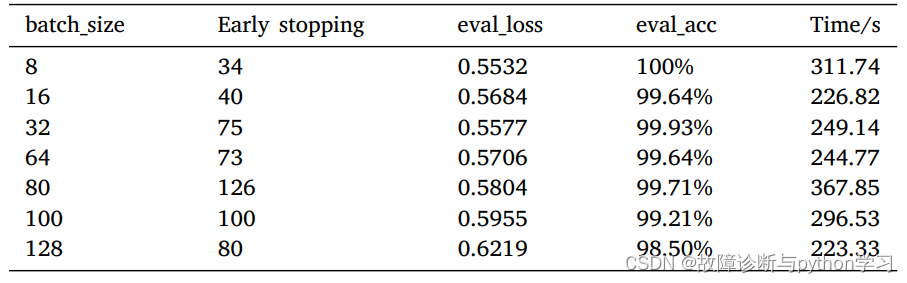
不同batch_size下的结果
不同负载下的结果

(后续继续完善)
注:
① 若本论文对你有帮助启发,建议引用本论文~
② 欢迎关注公众号《故障诊断与Python学习》
③ 若有好的开源代码,欢迎后台联系推荐~
边栏推荐
- In the post epidemic era, the home service robot industry has just set sail
- Swift extension networkutil (network monitoring) (source code)
- How does dating software cut your leeks
- Introduction to software engineering - Chapter 2 - feasibility study
- JS implementation to check whether an array object contains values from another array object
- etcd备份恢复原理详解及踩坑实录
- Getting started with crawler to giving up 06: crawler play Fund (with code)
- FPGA的虚拟时钟如何使用?
- Part 1: building OpenGL environment
- GraphMAE----論文快速閱讀
猜你喜欢

How to cancel the display of the return button at the uniapp uni app H5 end the autobackbutton does not take effect

For a detailed explanation of flex:1, flex:1
![[run the script framework in Django and store the data in the database]](/img/6b/052679e5468e5a90be5c4339183f43.png)
[run the script framework in Django and store the data in the database]

2021-03-09 COMP9021第七节课笔记

Pagoda panel installation php7.2 installation phalcon3.3.2

Application of JDBC in performance test
2021-03-16 COMP9021第九节课笔记
Part 1: building OpenGL environment

软件工程导论——第二章——可行性研究

Swift 基础 Swift才有的特性
随机推荐
Solution to the error of running NPM run eject
Leetcode exercise - jumping game, combination summation
C language_ Love and hate between string and pointer
Leetcode 174 Dungeon games (June 23, 2022)
Swift extension chainlayout (UI chain layout) (source code)
Atguigu---15- built in instruction
Four models of iPhone 13 series have been exposed, and indeed, they are 13 fragrant!
These dependencies were not found: * core JS / modules / es6 array. Fill in XXX
[ACNOI2022]做过也不会
Introduction to software engineering - Chapter 3 - Requirements Analysis
首次曝光 唯一全域最高等级背后的阿里云云原生安全全景图
The monthly salary of two years after graduation is 36K. It's not difficult to say
Installation and use of selenium IDE
Swift Extension ChainLayout(UI的链式布局)(源码)
OC Extension 检测手机是否安装某个App(源码)
Ad-gcl:advantageous graph augmentation to improve graph contractual learning
[test development] first knowledge of software testing
Methods of vector operation and coordinate transformation
MySQL source and target table row count check
研究生英语期末考试复习