当前位置:网站首页>[go] goroutine pool
[go] goroutine pool
2022-06-21 14:54:00 【Cabbage that wants to become powerful】
List of articles
One 、 Why Goroutine pool ?
Imagine a situation like this , If you assign one to each client session To maintain the connection , Then each session It will start 3 individual goroutine, One for reading messages , One for sending messages , One is used to detect the life cycle . that , When a large number of clients connect , that goroutine The quantity is 3 Times the number of clients . Even if goroutine Lighter weight , When millions of customers are pouring in , Memory can't be stretched .
golang It is said that it can be concurrent at millions of levels , but goroutine It should not be created without restrictions , After all, every time you request memory from the system , The system memory will run out one day . Is there anything like a pool , It can make goroutine Can be reused , There is no need for unrestrained creation ?
in other words , What can be done to slow down the scale Goroutine Scheduling and memory pressure on the system ? To solve the problem , The most important thing is to find the root cause of the problem , What is the root of the problem ?Goroutine Too many lead to resource encroachment , To solve this problem, we need to limit the operation of Goroutine Number , Reasonable reuse , Save resources , The concrete is — Goroutine Pooling .
This is the birth of Goroutine The concept of a pool .Goroutine Pool is not golang An official concept , It is a solution to the above problems found by programmers in practice goroutine When the actual problems arising from the train of thought .
Just imagine ,Goroutine A certain number of... Are stored in the pool in advance Goroutine , New tasks will no longer create new Goroutine The way to execute , Instead, publish the task to the task queue ,Goroutine In the pool Goroutine Constantly take out tasks from the task queue and execute , Can effectively reduce Goroutine The overhead of creating and destroying .
Summarize why you want to achieve Goroutine pool :
- Even if each goroutine Just assign 4KB Of memory , But if it's that amount of terror , many a little make a mickle , Memory usage will be too high .
- Would be right GC Create a great burden , First GC Will be recycled goroutine On consumption performance , secondly GC Itself is also goroutine , The memory is tight GC There will be problems in the scheduling of .
- Improve response time , Reduce the time to create a collaboration .
- Better management coordination , Control the maximum number of concurrent , Regular recycling .
Two 、Goroutine What is a pool ?
- Goroutine A pool is a pool , There's some in there Goroutine .
- This pool has a maximum capacity , Inside Goroutine The quantity cannot exceed its maximum capacity .
- You can put every in the pool Goroutine Think of it as a worker , Used to perform tasks .
More precisely ,Goroutine A pool is an architecture . The architecture consists of two parts :
- A pool , There's some in there Goroutine .
- A task queue , There are some for the pool Goroutine Tasks performed .
A new task has come , If the pool is full Goroutine , And they all work , Then put the task in the task queue , Waiting to be dealt with ;
If the pool is not full , Just open a new one Goroutine To handle the task .
3、 ... and 、 How to achieve Goroutine pool ?
1. Goroutine Pool is just an abstract concept
Golang There is no encapsulated thread pool .
Goroutine Pool is just a concept , We need to consciously implement when we write our own code Goroutine pool .
2. Goroutine The design idea of the pool
- Initialize a when starting the service Goroutine Pool, This process pool maintains Task pipeline and worker( That is to say Goroutine).
- External post request to Goroutine Pool,Goroutine Pool The operation of : Determine the current running worker Has it exceeded Pool The capacity of , If it exceeds, put the request into the task pipeline until it runs worker Execute the tasks in the pipeline ; If not, open a new one worker Handle .
3. Producer consumer model
In this The delivery —> wait for —> perform In the process of , It is easy to think of the producer consumer model :
producer --( Production task )–> queue --( Consumption task )–> consumer
actually , Used to perform tasks goroutine It's the consumer , Operation task pool goroutine It's the producer , Queues can use go Of buffer channel, thus , This is the end of the task pool modeling .
Four 、 An implementation Goroutine Examples of pools
subject :
- Calculate the sum of the digits of a number , For example, digital 123, The result is 1+2+3=6.
- Randomly generated numbers for calculation .
package main

import (
	"fmt"
	"math/rand"
)

type Job struct {
     // Mission
	// id
	Id int
	//  Random number to be calculated
	RandNum int
}

type Result struct {
     // result
	//  The object instance must be passed here
	job *Job
	//  Sum up
	sum int
}

func main() {

	//  need 2 A pipe
	//  Mission pipeline
	jobChan := make(chan *Job, 128)
	//  Result pipeline
	resultChan := make(chan *Result, 128)

	//  Work pool (goroutine pool )
	createPool(64, jobChan, resultChan) // There are... In the working pool 64 individual Goroutine at work


	//  Responsible for the printing process
	go func(resultChan chan *Result) {

		//  Traverse the result pipeline , Print
		for result := range resultChan {
     // From the tunnel resultChan Receives the value
			fmt.Printf("job id:%v randnum:%v result:%d\n", result.job.Id,
				result.job.RandNum, result.sum)
		}
	}(resultChan) // Pass in parameters to the function , Execute now

	// Main process
	var id int
	//  Loop creation job, Input to pipeline
	for {

		id++
		//  Generate random number
		r_num := rand.Int()
		job := &Job{

			Id:      id,
			RandNum: r_num,
		}
		jobChan <- job
	}
}

//  function createPool: Create a work pool
//  In the working pool Goroutine Responsible for calculating from jobChan Take the number , Then calculate the sum of all of you , And then output to resultChan
func createPool(num int, jobChan chan *Job, resultChan chan *Result) {

	//  open  num  Collaborators cheng , Do calculations
	for i := 0; i < num; i++ {

		go func(jobChan chan *Job, resultChan chan *Result) {

			//  Perform an operation
			//  Traverse job All data of the pipeline , Add additivity
			for job := range jobChan {

				//  Random numbers come in
				r_num := job.RandNum // Read random number
				//  Each bit of random number is added
				//  Define the return value
				var sum int
				for r_num != 0 {

					tmp := r_num % 10
					sum += tmp
					r_num /= 10
				}
				//  The desired result is Result
				r := &Result{

					job: job,
					sum: sum,
				}
				// The result of the calculation is thrown into the pipe
				resultChan <- r
			}
		}(jobChan, resultChan)
	}
}
The tip of the iceberg :
job id:62596 randnum:3542998448878732054 result:100
job id:62597 randnum:1412622303680101805 result:53
job id:62598 randnum:2405699357934002636 result:83
job id:62599 randnum:729922549175030513 result:74
job id:62600 randnum:8887708274878274993 result:116
job id:62601 randnum:5826041766204926306 result:77
job id:62602 randnum:5892735228296506585 result:97
job id:62603 randnum:5715834663741984020 result:83
job id:62604 randnum:3141293823040601058 result:60
job id:62605 randnum:8841672571116882462 result:87
job id:62606 randnum:3482484307097615774 result:89
job id:62607 randnum:8196261471617693666 result:95
job id:62608 randnum:8692192048687145566 result:97
job id:62609 randnum:2639146648002715963 result:82
job id:62610 randnum:3323717745941790047 result:83
job id:62611 randnum:7567210708242192793 result:82
explain :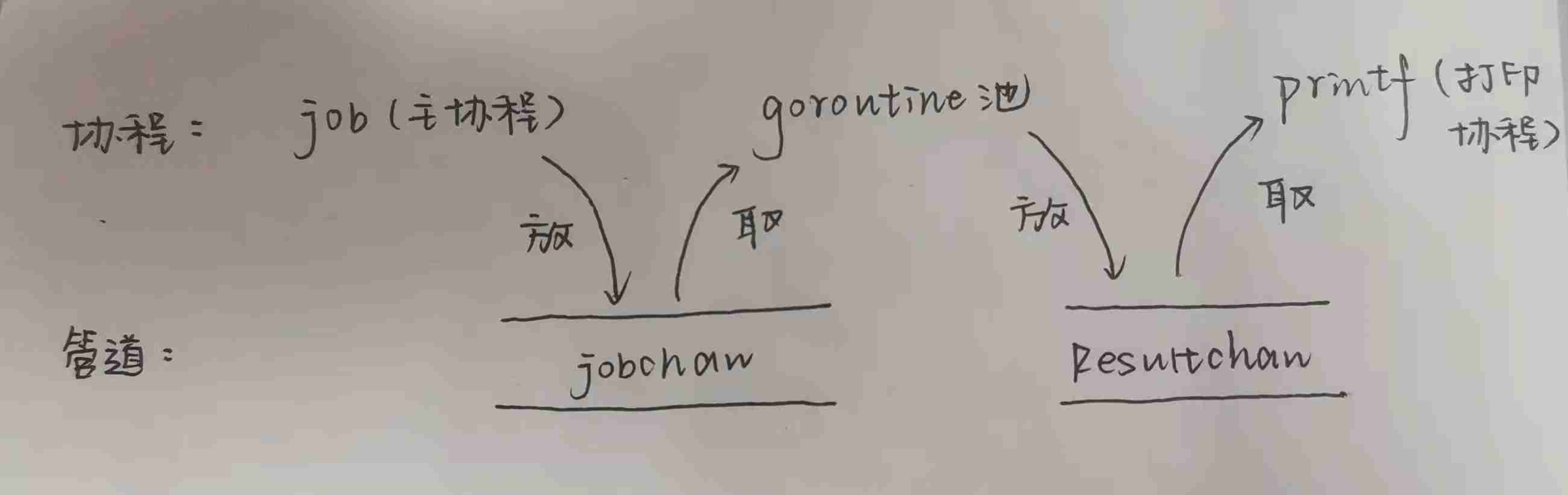
Pictured above , This procedure consists of two processes 、 A collaborative process pool 、 Two pipes make up .
job The coordination process continuously produces tasks , And then put in jobchan Task queue ; There are... In the process pool 64 Collaborators cheng , Constantly from the task queue jobchan Take the task to execute , Put the results in resultchan Task queue ;printf Assist from resultchan Take the results from the task queue and print them .
among , We can see two pairs of producers and consumers :job Synergy and synergy pool are a pair of producers and consumers , Process pool and printf Xiecheng is also a pair of producers and consumers .
explain :
In this case , The two pipelines and the process pool can be understood as “Goroutine pool ”.
Its function is always limited Goroutine Quantity is an unlimited amount of work .
Just imagine , If there are no these two pipelines and process pools :
job The collaboration process has been generating tasks , To perform a task, you need to create a coroutine to calculate it … That would be a myriad of collaborations …
5、 ... and 、 One Goroutine Pool practice —— ants
Project address :ants
Alibaba cloud's recommendation : It's easy to recommend Goroutine Connection pool
6、 ... and 、 summary
worker pool(goroutine pool ):
- It's essentially a producer consumer model
- Can effectively control goroutine Number , Prevent inflation
Reference link
- Goroutine pool
- golang Of goroutine pool ( Thread pool )
- Goroutine Pool implementation
- [go Language ]go goroutine Scheduling mechanism && goroutine pool
- The article of the boss is worth reading carefully :Goroutine In depth analysis of concurrent scheduling model provides a high performance Goroutine pool
边栏推荐
- PCA dimension reduction application of OpenCV (I)
- 网上开户安全吗?新手可以开账户吗
- Chapter 2 - physical layer (II) circuit switching, message switching and packet switching (datagram and virtual circuit)
- Continuous attack animation
- Solution of difficult and miscellaneous problems in MVN packaging
- T32 add toolbar button
- Nodejs setting domestic source
- Factorial summation
- C language function fgets
- 马拦过河卒
猜你喜欢
![NPM package management configuration file [package.json and node\u modules configuration details and how to develop their own packages and publish them on NPM]](/img/ff/2b92de728494542f614d4d5a57d20c.jpg)
NPM package management configuration file [package.json and node\u modules configuration details and how to develop their own packages and publish them on NPM]

ARP interaction process

Route add add route

Use ant for running program with command line arguments

Analysis of ROC and AUC

T32 add toolbar button

Teach you to stop visiting a website

T32 custom menu bar
![Native JS implements login function, and local cookies save login information -- [call Netease cloud API interface] - super detailed explanation](/img/e0/1d5c87dc6c8b477a1668083dcdca0f.jpg)
Native JS implements login function, and local cookies save login information -- [call Netease cloud API interface] - super detailed explanation

Leetcode hot topic Hot 100, to be updated
随机推荐
Use OpenCV to decompose the video into single frame pictures and synthesize the video with pictures
Is the switch network layer
Dplayer development barrage background
Write a compile time annotation
ARP interaction process
Why do you want to be naked with a router
Sliding validation tool class
JS hand tear pen test questions ~ not sorted out
Windows系统下C语言连接MySQL
Flex layout --- detailed explanation [Blue Bridge Cup classic dice layout]
Compile time annotation automatically generates dataholder
Solution of difficult and miscellaneous problems in MVN packaging
C语言的指针
Factorial summation
Redis5.0 installation and production startup steps
Word thesis typesetting tutorial
[font multi line display ellipsis] and [dialog box] implementation ----- case explanation, executable code
C language function fgets
Use Matplotlib to draw the first figure
Finding minimum spanning tree by using union search set