当前位置:网站首页>Summary of common constraints in MySQL foundation part I
Summary of common constraints in MySQL foundation part I
2022-06-11 10:29:00 【Jingxuan】
Common constraints are summarized in the first part
1. Overview of constraints
1.1 Why do we need constraints ?
Data integrity (Data Integrity) Refers to the of data Accuracy (Accuracy) and reliability (Reliability) It is to prevent the existence of Do not conform to the Semantically defined data and prevent Caused by input and output of error messages Invalid operation Or error messages . in order to Guarantee Data integrity ,SQL The specification defines table data in a constrained manner Additional conditionality .
Consider from the following four aspects :
① Entity integrity (Entity Integrity) : for example , In the same table , There can't be two identical records that can't be distinguished
② Domain integrity (Domain Integrity) : for example : Age range 0-120, Gender range “ male / Woman ”
③ Citation integrity (Referential Integrity) : for example : Employee's Department , Find this department in the Department list
④ User-defined integrity (User-defined Integrity) : for example : Unique user name 、 The password cannot be empty , The salary of the manager of the Department shall not be higher than the average salary of the employees of the Department 5 times .
1.2 What are constraints ?
Constraints are table level A mandatory provision . When creating the table, it is Column level constraints and Table level constraints , Column level constraint refers to appending constraint conditions after columns , Table level constraint means that after all fields are written , Write constraints on a single line .
You can specify constraints when you create a table ( adopt CREATE TABLE sentence ), Or, after the table is created, through ALTER TABLE sentence Stipulate constraints .
1.3 Classification of constraints
(1) According to the restrictions of constraint data columns
① Single column constraints : Each constraint constrains only one column
② Multi column constraint : Each constraint can constrain multiple columns of data
(2) According to the scope of the constraint
① Column level constraints : Can only act on one column , Follow the definition of the column
② Table level constraints : Can act on multiple columns , Not with columns , It is defined separately
(3) According to the function of constraints
①NOT NULL Non empty constraint , Specifies that a field cannot be empty
②UNIQUE Unique constraint , Specify that a field is unique in the whole table
③PRIMARY KEY Primary key ( Non empty and unique ) constraint
④FOREIGN KEY Foreign key constraints
⑤CHECK Check constraint
⑥DEFAULT Default constraint
View the existing constraints of a table
#information_schema Database name ( System libraries )
#table_constraints The name of the table ( Store constraints for individual tables )
SELECT * FROM information_schema.table_constraints
 WHERE table_name = ' The name of the table ';
2. Non empty constraint (NOT NULL)
2.1 Overview of non empty constraints
(1) effect
Limit a field / The value of a column cannot be empty
(2) keyword
NOT NULL
(3) characteristic
① Default , All types of values are It can be NULL, Include INT、FLOAT And so on
② Non empty constraints can only appear in Columns of table objects On , Can only A column qualifies separately Non empty , Cannot combine non empty
③ A table can have many columns, which are limited to non empty
④ An empty string ’' It's not equal to NULL,0 Also is not equal to NULL
2.2 Add non empty constraints
(1) Build table
Grammar format :
CREATE TABLE  The name of the table (
  Field name   data type ,  Field name   data type  NOT NULL,
  Field name   data type  NOT NULL
);
Use samples :
CREATE TABLE test1(
id INT NOT NULL,
last_name VARCHAR(15) NOT NULL,
email VARCHAR(25),
salary DECIMAL(10,2)
);

(2) After the establishment of the table
Use format :
alter table The name of the table modify Field name data type not null;
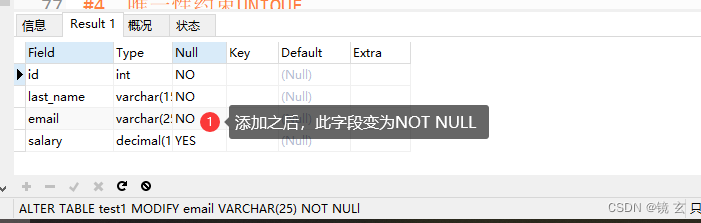
Use samples :
ALTER TABLE test1
MODIFY email VARCHAR(25) NOT NULl;
2.3 Delete non empty constraints
Use format :
alter table The name of the table modify Field name data type ;
Use samples :
ALTER TABLE test1
MODIFY email VARCHAR(25) NULL;

3. Uniqueness constraint UNIQUE
3.1 Overview of uniqueness constraints
(1) effect
Used to restrict a field / The value of a column cannot be repeated .
(2) keyword
UNIQUE
(3) characteristic
① The same table can have Multiple unique constraints .
② The only constraint can be a column It's worth it , You can also combine multiple columns to have unique values .
③ Uniqueness constraint Allow column value to be empty .
④ When creating unique constraints , If you don't name a unique constraint , The default is the same as the column name .
⑤MySQL A unique constraint column will be created by default unique index .
3.2 Add uniqueness constraints
(1) Build table
Add format :
The way 1:
create table  The name of the table (
 Field name   data type ,
 Field name   data type  unique,
 Field name   data type  unique key,
 Field name   data type
 );
Mode two :
create table  The name of the table (
 Field name   data type ,
 Field name   data type ,
 Field name   data type ,
 [constraint  Constraint name ] unique key( Field name )
 );
Use samples :
CREATE TABLE test2(
id INT UNIQUE,# Column level constraints
last_name VARCHAR(15),
email VARCHAR(25),
salary DECIMAL(10,2),
# Table level constraints
CONSTRAINT uk_test2_email UNIQUE(email)
);

Use the following statement , View the name of the constraint :
SELECT * FROM information_schema.TABLE_CONSTRAINTS
WHERE table_name = 'test2';

INSERT INTO test2(id,last_name,email,salary)
VALUES(1,'Tom','[email protected]',5000);
Inserting the following statement will produce an error :
#1062 - Duplicate entry ‘1’ for key ‘test2.id’
INSERT INTO test2(id,last_name,email,salary)
VALUES(1,'Jerry','[email protected]',5000);

(2) Specify the only key constraint after creating the table
The way 1:
alter table The name of the table add unique key( Field list );
The way 2:
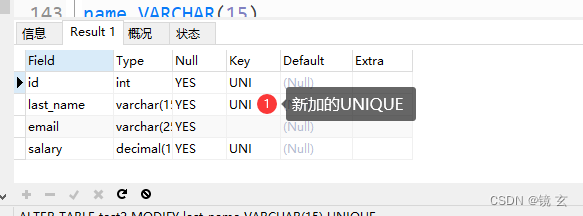
alter table The name of the table modify Field name Field type unique;
ALTER TABLE test2
MODIFY last_name VARCHAR(15) UNIQUE;
3.3 Compound unique constraint
Use format :
create table  The name of the table (
 Field name   data type ,
 Field name   data type ,
 Field name   data type , unique key( Field list ) # Multiple field names are written in the field list , Multiple field names are separated by commas , It means that it is compound and unique , That is more   The combination of two fields is unique
);
Use samples :
CREATE TABLE user(
id INT,
name VARCHAR(15),
password VARCHAR(15),
# Adding compound constraints , Table level constraints
CONSTRAINT uk_test2_name_pwd UNIQUE(name,password)
);
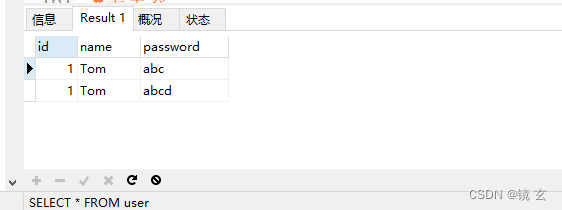
As long as the two fields are not Exactly the same Can be added successfully
INSERT INTO user
VALUES (1,'Tom','abc');
INSERT INTO user
VALUES (1,'Tom','abcd');
3.4 Remove the uniqueness constraint
explain
① Columns that add uniqueness constraints are also automatically Create unique index .
② The only way to delete a unique constraint is through Delete unique index Method to delete .
③ Need to specify when deleting Unique index name , The unique index name is the same as the unique constraint name .
④ If you do not specify a name when creating a unique constraint , If it's a single column , The default is the same as the column name ; If it's a composite column , Then default and () The first column in the list has the same name . You can also customize the uniqueness constraint name .
Delete the sample :
ALTER TABLE test2
DROP INDEX last_name;

Be careful : Can pass show index from The name of the table ; View the index of the table
4. Primary key constraint PRIMARY KEY
4.1 Overview of primary key constraints
(1) effect
Used to uniquely identify a row of records in the table .
(2) keyword
PRIMARY KEY
(3) characteristic
① The primary key constraint is equivalent to Unique constraint + Non empty constraint The combination of , Primary key constraint column No repetition , also Null values are not allowed .
② One watch is the most There can only be one primary key beam , The primary key constraint can be created in Column level establish , It can also be in Table level To create a .
③ The primary key constraint corresponds to one or more columns in the table ( Composite primary key )
④ If it is a multi column combination Composite primary key constraint , So these columns Null values are not allowed , And the combined value is not allowed to repeat .
⑤MySQL The primary key name of is always PRIMARY, Even if you name the primary key constraint name, it's useless .
⑥ When creating a primary key constraint , By default, the system will establish a corresponding column on the column or column combination primary key ( That can be queried according to the primary key , Query according to the primary key , More efficient ). If the primary key constraint is deleted , The index corresponding to the primary key constraint is automatically deleted .
⑦ One thing to note is that , Do not modify the value of the primary key field . Because the primary key is the unique identification of the data record , If you modify the value of the primary key , It may destroy the integrity of the data .
4.2 Add primary key constraint
(1) Specify the primary key constraint when creating the table
Use format :
Column level constraints
create table  The name of the table (
 Field name   data type  primary key, # Column level mode
 Field name   data type ,
  Field name   data type
 );
Table level constraints
create table  The name of the table (
 Field name   data type ,
 Field name   data type ,  Field name   data type ,
[constraint  Constraint name ] primary key( Field name ) # Table level mode
 );
Use examples :
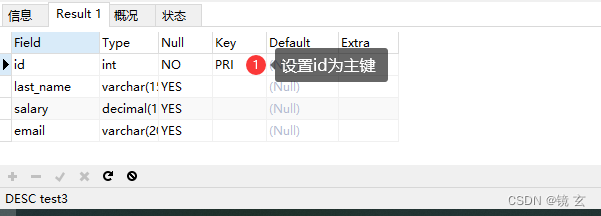
CREATE TABLE test3(
id INT PRIMARY KEY,# Column level constraints
last_name VARCHAR(15),
salary DECIMAL(10,2),
email VARCHAR(20)
);
CREATE TABLE test4(
id INT,
last_name VARCHAR(15),
salary DECIMAL(10,2),
email VARCHAR(20),
# Table level constraints
CONSTRAINT pk_test5_id PRIMARY KEY(id)
);
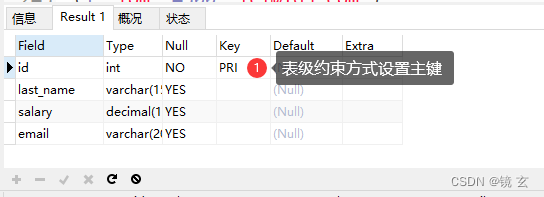
(2) Add a primary key constraint after creating a table
Use format :
ALTER TABLE The name of the table ADD PRIMARY KEY( Field list ); # The field list can be a field , It can also be multiple fields , If it is more If there are two fields , The primary key is compound
CREATE TABLE test6(
id INT,
name VARCHAR(15),
salary DECIMAL(10,2),
email VARCHAR(25)
);
ALTER TABLE test6
MODIFY id INT PRIMARY KEY;

4.3 Composite primary key
Use format :
create table  The name of the table (
 Field name   data type ,
  Field name   data type ,
   Field name   data type ,
  primary key( Field name 1, Field name 2) # Represents the field 1 And field 2 The combination is unique , You can also have more fields
  );
Use samples :
Student list
create table student(
sid int, # Student number
sname varchar(20), # full name
tel char(11) unique key, # Telephone
cardid char(18) unique key # ID number
);
The curriculum
create table course(
cid int, # Course number
cname varchar(20) # Course name
);
Course selection table
create table student_course(
id int,
sid int, # Student number
cid int, # Course number
score int,
unique key(sid,cid) # Compound the only
);
Add students and courses
insert into student values(1,' Zhang San ','13710011002','101223199012015623');# success
insert into student values(2,' Li Si ','13710011003','101223199012015624');# success
insert into course values(1001,'Java'),(1002,'MySQL');# success


Add student elective
When using a composite primary key : The content of the composite primary key Not to be repeated
insert into student_course
values
(1, 1, 1001, 89),
(2, 1, 1002, 90),
(3, 2, 1001, 88),
(4, 2, 1002, 56);# success

Primary key deletion format :
alter table The name of the table drop primary key;
The deletion of primary keys will not be described here , Because they are generally not used in actual use , Be careful when deleting .
边栏推荐
- ZigBee模块通信协议的树形拓扑组网结构
- Bcgcontrolbar Library Professional Edition, fully documented MFC extension class
- Pl/sql compilation check in kingbasees
- Detail measurement of DC-DC and PDN with network analyzer
- 批量对数据添加噪声并生成新命名标注文件
- 利用PHP开发的一款万能、表白墙系统部分代码片段
- rpc的正确打开方式|读懂Go原生net/rpc包
- TikTok在英国遭遇文化冲突,短期内众多员工离职
- Tiktok encounters cultural conflict in the UK, and many employees leave in a short time
- Excellent test engineer must have 4 safety test methods!
猜你喜欢

Dimension types for different CV tasks

Global pooling – pytoch

修复UICollectionView 没有到达底部安全区的问题
详述用网络分析仪测量DC-DC和PDN

Xilinx pin constraint file xdc

有哪些ABAP关键字和语法,到了ABAP云环境上就没办法用了?

ZigBee模块通信协议的树形拓扑组网结构

Pyspark case series 4-dataframe output to a single folder solution

Empire CMS imitation "game bird" template source code /92kaifa version large mobile game portal template

Sys in kingbasees_ Checksums bad block detection function
随机推荐
puppeteer入门之 Puppeteer 类
【K-Means】K-Means学习实例
Habitable planet
Initial deployment of Servlet
利用PHP开发的一款万能、表白墙系统部分代码片段
Knowledge drop - personality analysis - four types of method
面试复习手写题--函数截流与抖动
minIni移植到littlefs
Some understanding of inductive bias
Datagrip 2022, datagrip function
Detailed explanation of Lora module wireless transceiver communication technology
Kingbasees create database objects in batch
Batch add noise to data and generate new named annotation files
ZigBee模块无线传输星形拓扑组网结构简介
Preview component packaging graphic tutorial in cadence OrCAD capture schematic design interface
EMC rectification cases of electronic equipment radiation
C#入門系列(十一) -- 多維數組
MySQL comparison
Dimension types for different CV tasks
puppeteer入门之 BrowserFetcher 类