当前位置:网站首页>Implementation scheme of iteration and combination pattern for general tree structure
Implementation scheme of iteration and combination pattern for general tree structure
2022-06-12 01:55:00 【Illusory private school】
High quality resource sharing
| Learning route guidance ( Click unlock ) | Knowledge orientation | Crowd positioning |
|---|---|---|
| 🧡 Python Actual wechat ordering applet 🧡 | Progressive class | This course is python flask+ Perfect combination of wechat applet , From the deployment of Tencent to the launch of the project , Create a full stack ordering system . |
| Python Quantitative trading practice | beginner | Take you hand in hand to create an easy to expand 、 More secure 、 More efficient quantitative trading system |
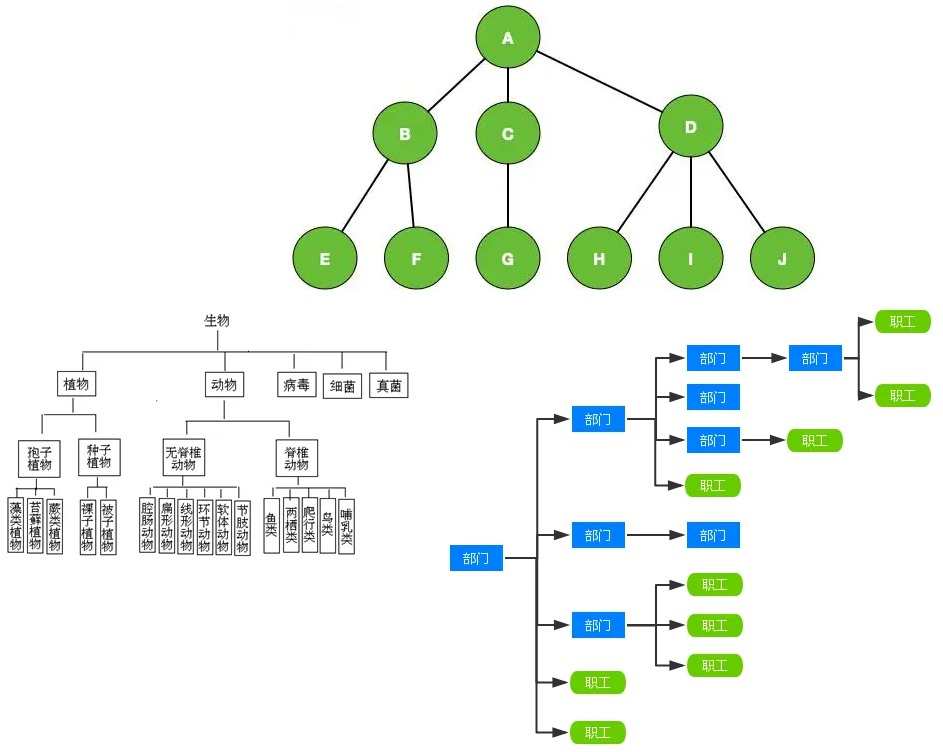
During the daily development process . Tree structure is used very frequently .
for example : Company structure 、 Various classification structures 、 Grouping structure, etc .


SET FOREIGN\_KEY\_CHECKS = 0;

CREATE TABLE IF NOT EXISTS `tbl\_sapo\_group` (
 `id` int(10) unsigned NOT NULL AUTO\_INCREMENT COMMENT ' Primary key ',
 `code` varchar(100) NOT NULL COMMENT ' Unique code ',
 `create\_time` datetime(3) NOT NULL COMMENT ' Creation time ',
 `last\_update\_time` datetime(3) DEFAULT NULL COMMENT ' Last update time ',
 `name` varchar(255) NOT NULL COMMENT ' name ',
 `detail` varchar(255) DEFAULT NULL COMMENT ' details ',
 `status` int(10) unsigned NOT NULL DEFAULT 2 COMMENT ' state :0- Invalid ,1- It works ,2- edit ',
 `group\_type` varchar(100) NOT NULL COMMENT ' Group type ',
 PRIMARY KEY (`id`),
 UNIQUE KEY `uni\_idx\_group\_code` (`code`),
 KEY `idx\_group\_group\_type` (`group\_type`),
 CONSTRAINT `fk\_group\_group\_type` FOREIGN KEY (`group\_type`) REFERENCES `tbl\_sapo\_group\_type` (`code`)
) ENGINE=InnoDB DEFAULT CHARSET=utf8 COMMENT=' Group ';

CREATE TABLE IF NOT EXISTS `tbl\_sapo\_group\_rel` (
 `id` int(10) unsigned NOT NULL AUTO\_INCREMENT COMMENT ' Primary key ',
 `create\_time` datetime(3) NOT NULL COMMENT ' Creation time ',
 `last\_update\_time` datetime(3) DEFAULT NULL COMMENT ' Last update time ',
 `parent\_code` varchar(100) NOT NULL COMMENT ' Parent node code ,tbl\_sapo\_group surface code',
 `child\_code` varchar(100) NOT NULL COMMENT ' Child node code ,tbl\_sapo\_group surface code',
 `status` int(10) unsigned NOT NULL DEFAULT 2 COMMENT ' state :0- Invalid ,1- It works ,2- edit ',
 `group\_rel\_type` varchar(100) NOT NULL COMMENT ' Group relationship type code , come from tbl\_sapo\_group\_rel\_type surface code',
 `tree\_code` varchar(100) NOT NULL COMMENT ' Tree node code ,tbl\_sapo\_tree surface code',
 PRIMARY KEY (`id`),
 KEY `idx\_group\_rel\_child\_code` (`child\_code`),
 KEY `idx\_group\_rel\_parent\_code` (`parent\_code`),
 KEY `idx\_group\_rel\_group\_rel\_type` (`group\_rel\_type`),
 KEY `idx\_group\_rel\_tree\_code\_status\_parent\_code\_child\_code` (`tree\_code`,`status`,`parent\_code`,`child\_code`),
 CONSTRAINT `fk\_group\_rel\_child\_code` FOREIGN KEY (`child\_code`) REFERENCES `tbl\_sapo\_group` (`code`),
 CONSTRAINT `fk\_group\_rel\_group\_rel\_type` FOREIGN KEY (`group\_rel\_type`) REFERENCES `tbl\_sapo\_group\_rel\_type` (`code`),
 CONSTRAINT `fk\_group\_rel\_parent\_code` FOREIGN KEY (`parent\_code`) REFERENCES `tbl\_sapo\_group` (`code`),
 CONSTRAINT `fk\_group\_rel\_tree\_code` FOREIGN KEY (`tree\_code`) REFERENCES `tbl\_sapo\_tree` (`code`)
) ENGINE=InnoDB DEFAULT CHARSET=utf8 COMMENT=' Group relationship ';

CREATE TABLE IF NOT EXISTS `tbl\_sapo\_group\_rel\_type` (
 `id` int(10) unsigned NOT NULL AUTO\_INCREMENT COMMENT ' Primary key ',
 `code` varchar(100) NOT NULL COMMENT ' Unique code ',
 `create\_time` datetime(3) NOT NULL COMMENT ' Creation time ',
 `last\_update\_time` datetime(3) DEFAULT NULL COMMENT ' Last update time ',
 `name` varchar(255) NOT NULL COMMENT ' name ',
 `detail` varchar(255) DEFAULT NULL COMMENT ' details ',
 `status` int(10) unsigned NOT NULL DEFAULT 2 COMMENT ' state :0- Invalid ,1- It works ,2- edit ',
 PRIMARY KEY (`id`),
 UNIQUE KEY `uni\_idx\_group\_rel\_type\_code` (`code`)
) ENGINE=InnoDB DEFAULT CHARSET=utf8 COMMENT=' Group relationship type ';

CREATE TABLE IF NOT EXISTS `tbl\_sapo\_group\_type` (
 `id` int(10) unsigned NOT NULL AUTO\_INCREMENT COMMENT ' Primary key ',
 `code` varchar(100) NOT NULL COMMENT ' Unique code ',
 `create\_time` datetime(3) NOT NULL COMMENT ' Creation time ',
 `last\_update\_time` datetime(3) DEFAULT NULL COMMENT ' Last update time ',
 `name` varchar(255) NOT NULL COMMENT ' name ',
 `detail` varchar(255) DEFAULT NULL COMMENT ' details ',
 `status` int(10) unsigned NOT NULL DEFAULT 2 COMMENT ' state :0- Invalid ,1- It works ,2- edit ',
 PRIMARY KEY (`id`),
 UNIQUE KEY `uni\_idx\_group\_type\_code` (`code`)
) ENGINE=InnoDB DEFAULT CHARSET=utf8 COMMENT=' Group type ';

CREATE TABLE IF NOT EXISTS `tbl\_sapo\_tree` (
 `id` int(10) unsigned NOT NULL AUTO\_INCREMENT COMMENT ' Primary key ',
 `code` varchar(100) NOT NULL COMMENT ' Unique code ',
 `create\_time` datetime(3) NOT NULL COMMENT ' Creation time ',
 `last\_update\_time` datetime(3) DEFAULT NULL COMMENT ' Last update time ',
 `name` varchar(255) NOT NULL COMMENT ' name ',
 `detail` varchar(255) DEFAULT NULL COMMENT ' details ',
 `status` int(10) unsigned NOT NULL DEFAULT 2 COMMENT ' state :0- Invalid ,1- It works ,2- edit ',
 PRIMARY KEY (`id`),
 UNIQUE KEY `uni\_idx\_tree\_code` (`code`)
) ENGINE=InnoDB DEFAULT CHARSET=utf8 COMMENT=' Tree definition ';

CREATE TABLE IF NOT EXISTS `tbl\_sapo\_tree\_group` (
 `id` int(10) unsigned NOT NULL AUTO\_INCREMENT COMMENT ' Primary key ',
 `create\_time` datetime(3) NOT NULL COMMENT ' Creation time ',
 `last\_update\_time` datetime(3) DEFAULT NULL COMMENT ' Last update time ',
 `group\_code` varchar(100) NOT NULL COMMENT ' Group code ,tbl\_sapo\_group surface code',
 `tree\_code` varchar(100) NOT NULL COMMENT ' Tree code ,tbl\_sapo\_tree surface code',
 `status` int(10) unsigned NOT NULL DEFAULT 2 COMMENT ' state :0- Invalid ,1- It works ,2- edit ',
 `is\_root` int(10) unsigned DEFAULT NULL COMMENT ' Whether the root node :1- The root node ,null Non root node ',
 PRIMARY KEY (`id`),
 UNIQUE KEY `uni\_idx\_tree\_group\_tree\_code\_is\_root` (`tree\_code`,`is\_root`),
 KEY `idx\_tree\_group\_group\_code` (`group\_code`),
 CONSTRAINT `fk\_tree\_group\_group\_code` FOREIGN KEY (`group\_code`) REFERENCES `tbl\_sapo\_group` (`code`),
 CONSTRAINT `fk\_tree\_group\_tree\_code` FOREIGN KEY (`tree\_code`) REFERENCES `tbl\_sapo\_tree` (`code`)
) ENGINE=InnoDB DEFAULT CHARSET=utf8 COMMENT=' Groups contained in the tree ';

SET FOREIGN\_KEY\_CHECKS = 1;
Create table statement
As shown in the figure, the relational database model , It basically meets the requirements of multiple trees in a system 、 The purpose for which groups can be reused .
The node of the tree may be a single node , It may also be the root of a subtree . When we need to traverse, we need different processing from different nodes , Use 【 polymorphic 】.
But don't distinguish which node it is when processing , Provide a kind of 【 Transparency 】 Processing mode , To implement, you need to reference two patterns : Iterative mode 、 Portfolio model
Old rules , First introduce the concept , After that .
| Iterator pattern | Provides a way to traverse a collection without exposing its implementation |
| Portfolio model | Customers can treat collections of objects as well as individual objects equally |
Iterator pattern :
|
| Iterator example : Array implementation iterator
//  Iterator interface
interface Iterator {
 boolean hasNext();

 Object next();
}

//  A menu item
class MenuItem {

 String name;
 String description;
 boolean vegetarian;
 double price;

 public MenuItem(String name, String description, boolean vegetarian, double price) {
 this.name = name;
 this.description = description;
 this.vegetarian = vegetarian;
 this.price = price;
 }
 // getter,setter Method
    public String getName() {
 return name;
 }
}

//  menu
class DinerMenu {
 static final int MAX\_ITEMS = 6;
 int numberOfItems = 0;
 MenuItem[] menuItems;

 public DinerMenu() {
 menuItems = new MenuItem[MAX\_ITEMS];
 addItem(" Stewed Pork Ball in Brown Sauce ", " Jiangnan famous dishes ", true, 50d);
 addItem(" Pork Lungs in Chili Sauce ", " It has nothing to do with husband and wife ", true, 70d);
 }

 public void addItem(String name, String description, boolean vegetarian, double price) {
 MenuItem menuItem = new MenuItem(name, description, vegetarian, price);
 if (numberOfItems >= MAX\_ITEMS) {
 System.out.println("sorry,menu is full");
 } else {
 menuItems[numberOfItems] = menuItem;
 numberOfItems += 1;
 }
 }

 public MenuItem[] getMenuItems() {
 return menuItems;
 }

 public Iterator createIteator() {
 return new DinerMenuIterator(menuItems);
 }
}

class DinerMenuIterator implements Iterator {
 MenuItem[] items;
 int position = 0;

 public DinerMenuIterator(MenuItem[] items) {
 this.items = items;
 }

 public Object next() {
 MenuItem menuItem = items[position];
 position = position + 1;
 return menuItem;
 }

 public boolean hasNext() {
 //  The array may not be full
        if (position >= items.length || items[position] == null) {
 return false;
 } else {
 return true;
 }
 }

 public void remove() {
 if (position <= 0) {
 throw new IllegalStateException("you can't an item unitl you've done at least on next()");
 }
 if (items[position - 1] != null) {
 for (int i = position - 1; i < (items.length - 1); i++) {
 items[i] = items[i + 1];
 }
 items[items.length - 1] = null;
 }

 }

}

//  test
class Test {
 public static void main(String[] args) {
 Iterator iterator = (new DinerMenu()).createIteator();
 while(iterator.hasNext()){
 MenuItem menuItem = (MenuItem) iterator.next();
 System.out.println(menuItem.getName());
 }

 }
}
 Example iterator pattern
Array iterator
1. Of course remove Can not be realized , Because it may be concurrent remove, Iterators are unsafe .
We simply deal with throwing java.lang.UnsupportedOperationException
2.java5 after , Collections can be used for/in The form replaces the creation iterator shown .
for( Object obj: collection){
} |
For different sets , We have different traversal methods . Is there a general pattern for traversing collections , Shield this difference , This pattern is the iterator .
The iterator pattern provides a way to access the elements of an aggregate object sequentially , Without exposing its internal representation .
In fact, it's plain , The iterator pattern is defined by defining a unified operation interface , To shield different underlying operating logic .
If you can have a unified method to access every object in the aggregation , You can write polymorphic code to match these aggregations .
Put the wandering task on the iterator , Instead of aggregating . This simplifies the interface and implementation of aggregation . Clear distribution of responsibilities .
accord with 【 Single responsibility 】, If you do not use the iterator pattern , If the set changes , For example, from a set to an array , This class must be changed , The traversal mode also changes .
Portfolio model :
Allows you to combine objects into a tree structure to represent “ whole / part ” hierarchy .
Composition allows customers to handle individual objects and composition of objects in a consistent way . That is, we can ignore the differences between object combinations and individual objects , Use the same operation .
Composite mode sacrifice 【 Single responsibility 】 obtain 【 transparency 】, Transparency means that customer processing combinations and leaf nodes are treated equally . Whether a node is a combination or a leaf node , Transparent to customers .
|
| Examples of combination patterns :
public abstract class MenuComponent {

 //  Operation nodes require methods
    public void add(MenuComponent menuComponent) {
 throw new UnsupportedOperationException();
 }
 public void remove(MenuComponent menuComponent) {
 throw new UnsupportedOperationException();
 }
 public MenuComponent getChild(int i) {
 throw new UnsupportedOperationException();
 }

 //  The menu itself
    public String getName() {
 throw new UnsupportedOperationException();
 }
 public String getDescription() {
 throw new UnsupportedOperationException();
 }
 public double getPrice() {
 throw new UnsupportedOperationException();
 }
 public boolean isVegetarian() {
 throw new UnsupportedOperationException();
 }

 public void print() {
 throw new UnsupportedOperationException();
 }
}
MenuComponent
public class Menu extends MenuComponent {
 ArrayList menuComponents = new ArrayList();
 String name;
 String description;

 public Menu(String name, String description) {
 this.name = name;
 this.description = description;
 }

 public void add(MenuComponent menuComponent) {
 menuComponents.add(menuComponent);
 }

 public void remove(MenuComponent menuComponent) {
 menuComponents.remove(menuComponent);
 }

 public MenuComponent getChild(int i) {
 return (MenuComponent) menuComponents.get(i);
 }

 public String getName() {
 return name;
 }

 public String getDescription() {
 return description;
 }

 public void print() {
 System.out.print("\n" + getName());
 System.out.println(", " + getDescription());
 System.out.println("---------------------");

 Iterator iterator = menuComponents.iterator();
 while (iterator.hasNext()) {
 MenuComponent menuComponent = (MenuComponent) iterator.next();
 menuComponent.print();
 }
 }
}
Menu
public class MenuItem extends MenuComponent {
 String name;
 String description;
 boolean vegetarian;
 double price;

 public MenuItem(String name,
 String description,
 boolean vegetarian,
 double price)
 {
 this.name = name;
 this.description = description;
 this.vegetarian = vegetarian;
 this.price = price;
 }

 public String getName() {
 return name;
 }

 public String getDescription() {
 return description;
 }

 public double getPrice() {
 return price;
 }

 public boolean isVegetarian() {
 return vegetarian;
 }

 public void print() {
 System.out.print("  " + getName());
 if (isVegetarian()) {
 System.out.print("(v)");
 }
 System.out.println(", " + getPrice());
 System.out.println("     -- " + getDescription());
 }
}
MenuItem
public class Waitress {
 MenuComponent allMenus;

 public Waitress(MenuComponent allMenus) {
 this.allMenus = allMenus;
 }

 public void printMenu() {
 allMenus.print();
 }
}
Waitress
|
Example :
Use iteration and composition patterns to implement a common tree structure :
1. Core and group to group relationships .
2. The scheme was implemented , Internal iterators and external iterators . Use according to the actual situation .
|
|
|


public abstract class GroupComponent {


 public abstract Iterator createIterator();

 //  The first line of characters is a few spaces empty
 protected abstract String printTreeStr(int i);

 public abstract String getName();

 public String printTreeStr() {
 return printTreeStr(0);
 };


 //  Print tree solution structure
 protected String padding\_n(int n) {
 StringBuffer space = new StringBuffer("");
 for (int i = 0; i < n; i++) {
 space.append("-");
 }
 space.append("|");
 return space.toString();
 }

 //  Get the tree structure recursively
 public static GroupComponent getTree(String groupCode) {
 //  Get general dao
 CommonDao dao = SpringUtil.getBean(CommonDao.class);
 //  Group details in the database model class
 SapoGroup sapoGroup = dao.getObj(SapoGroup.getInstance().setCode(groupCode));

 //  Query all the sons of this node
 List childList = dao.getObjListWithEmpty(SapoGroupRel.getInstance().setParentCode(groupCode));

 //  If there are no child nodes , Directly create a new leaf node and return
 if (childList == null || childList.size() == 0) {
 LeafGroup leafGroup = new LeafGroup();
 leafGroup.setLeafGroup(sapoGroup);
 return leafGroup;
 } else {
 //  If there are child nodes
 Group group = new Group();
 group.setGroupDetail(sapoGroup);
 for (SapoGroupRel rel : childList) {
 //  Recursively get the previous node
 GroupComponent child = getTree(rel.getChildCode());
 group.getList().add(child);
 }
 return group;
 }
 }
}
GroupComponent

public class Group extends GroupComponent {

 Iterator iterator = null;

 public List list = new ArrayList();

 public SapoGroup groupDetail;

 public SapoGroup getGroupDetail() {
 return groupDetail;
 }

 public void setGroupDetail(SapoGroup groupDetail) {
 this.groupDetail = groupDetail;
 }

 /*
 *  Print tree hierarchy
 */
 protected String printTreeStr(int i) {
 //  Fields to be printed
 String waitPrintStr = this.groupDetail.getName();

 StringBuilder sb = new StringBuilder();
 sb.append(padding\_n(i));
 sb.append(waitPrintStr);
 sb.append("\r\n");

 Iterator iterator = list.iterator();

 while (iterator.hasNext()) {
 GroupComponent next = iterator.next();
 //  Recursive traversal
 String printTree = next.printTreeStr(i + 2);
 sb.append(printTree);
 }
 return sb.toString();
 }

 public List getList() {
 return list;
 }

 public void setList(List list) {
 this.list = list;
 }

 @Override
 public Iterator createIterator() {
 if (iterator == null) {
 iterator = new GroupIterator(list.iterator());
 }
 return iterator;
 }

 @Override
 public String getName() {

 return "list: " + groupDetail.getName();
 }

}
Group

public class LeafGroup extends GroupComponent {

 private SapoGroup leafGroup;

 public SapoGroup getLeafGroup() {
 return leafGroup;
 }

 public void setLeafGroup(SapoGroup leafGroup) {
 this.leafGroup = leafGroup;
 }

 public Iterator createIterator() {
 return new NullIterator();
 }

 protected String printTreeStr(int i) {
 //  Key fields
 String waitPrintStr = this.getLeafGroup().getName();
 return padding\_n(i) + waitPrintStr + "\r\n";
 }

 /* (non-Javadoc)
 * @see cn.com.fmsh.nfcos.sapo.biz.testGroup.GroupComponent#getName()
 */
 @Override
 public String getName() {
 return "leaf: "+leafGroup.getName();
 }

}
LeafGroup

public class GroupIterator implements Iterator {

 Stack> stack = new Stack>();

 public GroupIterator(Iterator iterator) {
 stack.push(iterator);
 }

 public boolean hasNext() {
 if (stack.isEmpty()) {
 return false;
 } else {
 Iterator iterator = stack.peek();
 if (!iterator.hasNext()) {
 stack.pop();
 return hasNext();
 } else {
 return true;
 }
 }

 }


 public GroupComponent next() {
 if(hasNext()) {
 Iterator iterator = stack.peek();
 GroupComponent next = iterator.next();
 stack.push(next.createIterator());
 return next;
 }else {
 return null;
 }
 }

}
GroupIterator

public class NullIterator implements Iterator {

 public GroupComponent next() {
 return null;
 }

 public boolean hasNext() {
 return false;
 }


}
NullIterator
The test program , Traverse the tree structure 、 Print tree structure .
 @Test
 public void Test() {

 //  Use an external iterator to traverse
        GroupComponent tree = Group.getTree("hotel");

 Iterator iterator = tree.createIterator();

 while (iterator.hasNext()) {
 GroupComponent next = iterator.next();
 // TODO  Traverse the operation contents

 }

 System.out.println("---- Print tree structure -----");

 //  Print tree structure
 System.err.println(GroupComponent.getTree("hotel").printTreeStr());

 }

This article is from the blog Garden , author :wanglifeng, Reprint please indicate the original link :https://blog.csdn.net/wanglifeng717/p/16363485.html
边栏推荐
- Introduction to prism framework - Modular introduction
- [C language] C language file operation | C language file reading and writing | single character reading and writing | string reading and writing | format reading and writing | binary form reading and
- 2022 blind box applet app has become a new drainage outlet for enterprises
- 为什么我们要使用谷歌搜索广告?
- On the night of the joint commissioning, I beat up my colleagues
- C language programming classic games - minesweeping
- Perceptron from 0 to 1
- Simulated 100 questions and simulated examination for safety management personnel of metal and nonmetal mines (small open pit quarries) in 2022
- Linux(CentOS7)安裝MySQL-5.7版本
- 华为联运游戏或应用审核驳回:应用检测到支付serviceCatalog:X6
猜你喜欢

括号生成(回溯)

Alicloud OSS file upload system

Data in the assembly cannot start with a letter! 0 before the beginning of a letter

"C'est plus sûr d'apprendre une technologie!" Hangzhou Campus Little Brother transfer software test, Hi - Ti 10K + double break!

华为,这也太强了吧..

Point cloud perception algorithm interview knowledge points (I)
Redis實現消息隊列的4種方案

Sogou Pinyin official website screenshot tool pycharm installation

On the night of the joint commissioning, I beat up my colleagues

pip运行报错:Fatal error in launcher: Unable to create process using
随机推荐
"Xilin chain" of Southwest Forestry University passed the functional test of Electronic Standards Institute of the Ministry of industry and information technology | FISCO bcos case
初探性能优化!从2个月到4小时的性能提升!
C language programming classic games - minesweeping
Redis实现消息队列的4种方案
Annotate your own point cloud dataset with labelcloud open source tool as a tutorial of Kitti annotation format (support PCD and bin point clouds)
LeetCode Algorithm 1791. Find the central node of the star chart
Invert words in a string (split, double ended queue)
Linux(CentOS7)安裝MySQL-5.7版本
Database
如何为Excel中的单元格自动填充颜色
Loop loop and CX
pip运行报错:Fatal error in launcher: Unable to create process using
UoE UG3 Inf Course Research
Pytorch model loading and saving, and training based on the saved model
2022 blind box applet app has become a new drainage outlet for enterprises
Ce soir - là, j'ai battu mon collègue...
How to restore the redis cluster and retain the complete cluster data after changing the node IP
Basic use of MATLAB
Operating mechanism of Google ads bidding
Linux (centos7) installer mysql - 5.7