当前位置:网站首页>RAID disk array
RAID disk array
2022-08-05 06:15:00 【sologuai】
I. Introduction to RAID Disk Array
The full name of the disk array (Redundant Arrays of Inexpensive Disk, RAID), the Chinese abbreviation is Independent Redundant Disk Array.RAID can integrate multiple independent physical hard disks into a larger hard disk group (logical hard disk) through technology (software or hardware), which can be partitioned and formatted by users. In addition to storage, this logical hard disk also hasThe function of data protection provides data backup technology. RAID technology is divided into several different levels, which can provide different speed, security and cost performance.Selecting an appropriate RAID level according to the actual situation can meet the user's requirements for the availability, performance and capacity of the storage system. Due to the different levels selected for the entire RAID, the read and write performance of the integrated hard disks is somewhat different. The commonly used levels are:The following commonly used RAID levels are as follows: RAID0, RAID1, RAID5, RAID1+0, etc.
Second, RAID 0
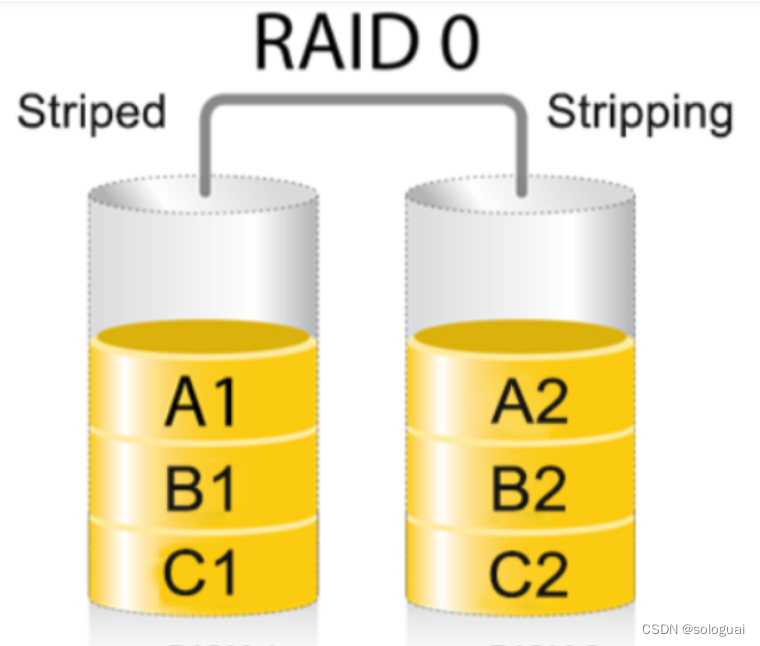
Because both reads and writes can be processed in parallel, RAID 0 is the fastest of all levels.But RAID 0 is neither redundant nor fault tolerant, if one disk is (physically) damaged, all data is lost.
Read and write performance improvement free space: N*min(S1,S2,...)
No fault tolerance
Minimum number of disks: 1+
Three, RAID 1

Also called mirroring, more than two groups of N disks mirror each other, which can have a very good read speed in some multi-threaded operating systems. Theoretically, the read speed is equal to the multiple of the number of hard disks, which is the same as RAID 0..In addition, there is a slight decrease in the writing speed.
Improved read performance and slightly decreased write performance
Available space: 1*min(S1,S2,...)
Disk utilization 50%
Redundant ability
Minimum number of disks: 2n
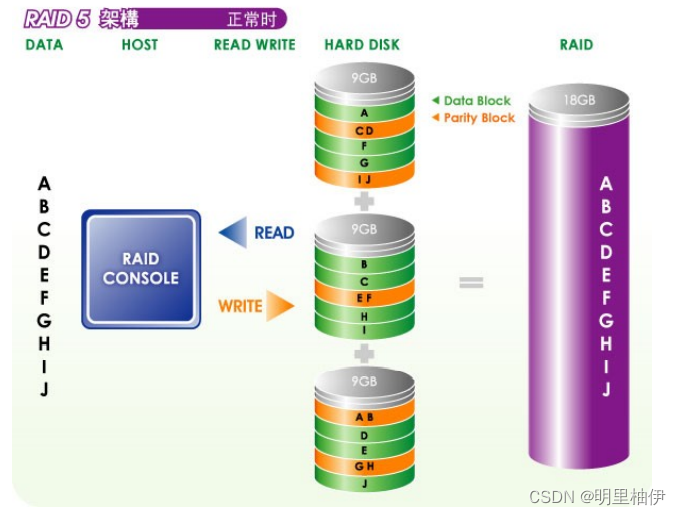
Three, RAID 5

Improved read and write performance
Available space: (N-1)*min(S1,S2,...)
Fault-tolerant: allow up to 1 disk corruption
Minimum number of disks: 3, 3+
Four. RAID 1+0
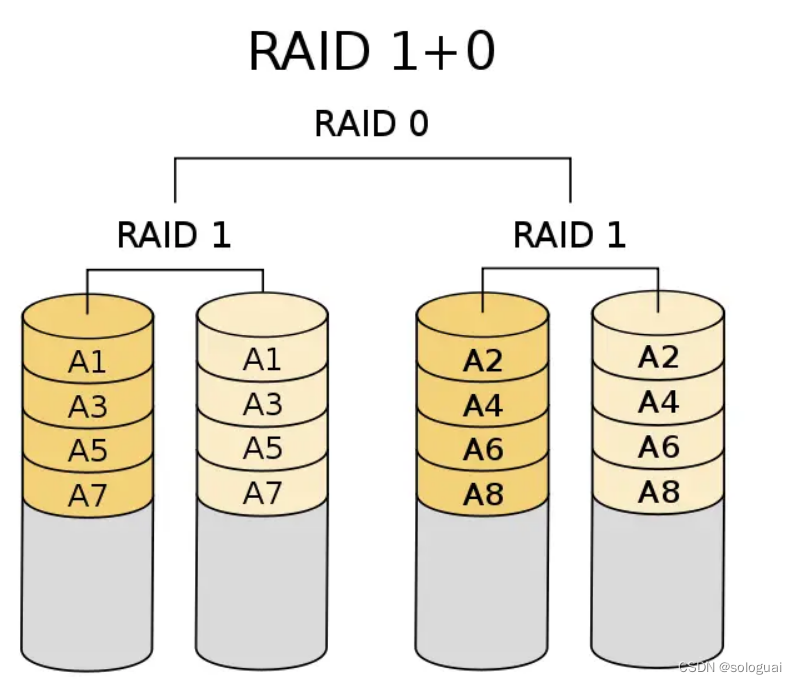
N (even, N>=4) disks are mirrored in pairs, and then combined into a RAID 0;
N/2 disk utilization, low usage;
N/2 disks are written at the same time, and N disks are read at the same time;
High performance, high reliability
V. Array card
1. An array card is a board used to implement RAID functions, usually composed of a series of components such as I/O processors, hard disk controllers, hard disk connectors and caches
2. Different RAID cards support different RAID functions: such as RAID0, RAID1, RAID5, RAID10, etc.
3. Interface type of RAID card:
- IDE interface (parallel interface, low price, strong compatibility)
- SCSI interface (serial interface, is a small computer system interface, widely used in high-speed data transmission technology on small computers, supports hot swap, low CPU usage, but high price)
- SATA interface (serial interface)
- SAS interface (a new generation of scsi interface, backward compatible with SATA)
边栏推荐
猜你喜欢
Getting Started Document 09 Standalone watch
NIO works is analysed
ACLs and NATs
Getting Started Documentation 10 Resource Mapping

Why can't I add a new hard disk to scan?How to solve?
IP数据包格式(ICMP协议与ARP协议)
【Day8】RAID Disk Array
IP packet format (ICMP protocol and ARP protocol)

Hugo搭建个人博客
Autoware中安装Yolo3目标检测模块遇到的问题
随机推荐
spark算子-repartition算子
Getting Started Document 09 Standalone watch
深度 Zabbix 使用指南——来自惨绿少年
Getting Started 04 When a task depends on another task, it needs to be executed in sequence
【Day8】使用LVM扩容所涉及的命令
Getting Started 05 Using cb() to indicate that the current task is complete
markdown editor template
spark source code - task submission process - 2-YarnClusterApplication
Small example of regular expression--validate email address
[Day8] (Super detailed steps) Use LVM to expand capacity
ROS视频教程
ALC实验
Introductory document 05-2 use return instructions the current task has been completed
入门文档04 一个任务依赖另外一个任务时,需要按顺序执行
I217-V在openwrt软路由下大流量断网问题
入职前,没想到他们玩的这么花
磁盘管理与文件系统
图片压缩失效问题
spark source code-RPC communication mechanism
【机器学习】1单变量线性回归