当前位置:网站首页>【CVPR 2021】Joint Generative and Contrastive Learning for Unsupervised Person Re-identification
【CVPR 2021】Joint Generative and Contrastive Learning for Unsupervised Person Re-identification
2022-06-26 09:21:00 【_ Summer tree】

Methods an overview
1, This paper proposes a joint generative contrastive learning framework for unsupervised pedestrian recognition , The generation and comparison modules improve each other's performance .
2, In the generation module , We introduced 3D Grid generator .
3, In the comparison module , We propose a perspective independent loss , To reduce the intra class variation between the generated sample and the original sample .
List of articles
Contents summary
| Title of thesis | abbreviation | meeting / Periodical | Year of publication | baseline | backbone | Data sets |
|---|---|---|---|---|---|---|
| Joint Generative and Contrastive Learning for Unsupervised Person Re-identification | GCL | CVPR | 2021 | 【JVTC】Li, J., Zhang, S.: Joint visual and temporal consistency for unsupervised domain adaptive person re- identification. pp. 1–14 (2020) | ImageNet [32] pre-trained ResNet50 [17] with slight modifications | Market-1501、DukeMTMC-reID, MSMT17 [41] |
Online links :https://openaccess.thecvf.com/content/CVPR2021/html/Chen_Joint_Generative_and_Contrastive_Learning_for_Unsupervised_Person_Re-Identification_CVPR_2021_paper.html
Source link : https: //github.com/chenhao2345/GCL.
Work Overview
1, we incorporate a Generative Adversarial Network (GAN) and a contrastive learning module into one joint training framework.
2, While the GAN provides online data augmentation for contrastive learning, the contrastive module learns view-invariant fea- tures for generation.
3, we propose a mesh- based view generator. Specifically, mesh projections serve as references towards generating novel views of a per- son.
4,we propose a view-invariant loss to fa- cilitate contrastive learning between original and gener- ated views.
Summary of results
our method significantly outperforms state-of-the-art methods under both, fully unsupervised and unsupervised domain adaptive settings on several large scale ReID dat- sets.
Methods,
Methods the framework
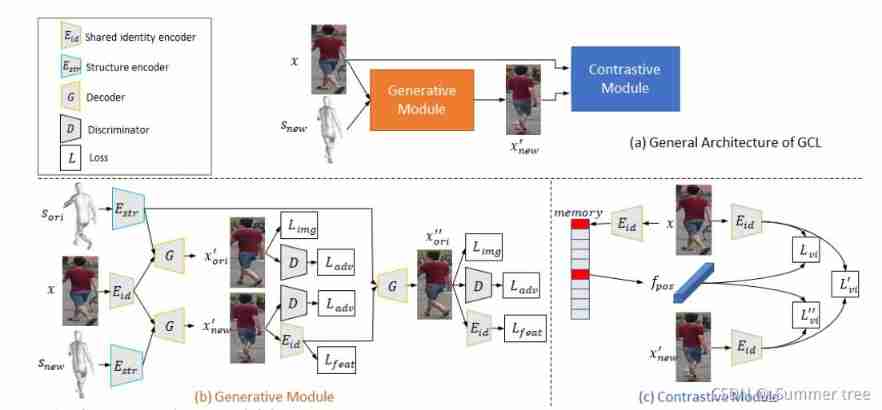
Figure 2: (a) General architecture of GCL: Generative and contrastive modules are coupled by the shared identity encoder Eid. (b) Generative module: The decoder G combines the identity features encoded by Eid and structure features Estr to generate a novel view x′
new with a cycle consistency. Contrastive module: View-invariance is enhanced by maximizing the agreement between original Eid(x), synthesized Eid(x′
new) and memory fpos representations.
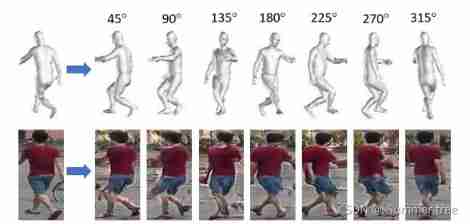
Figure 3: Example images as generated by the View Generator via 3D mesh rotation based on left input image.
Concrete realization
1,GCL The framework mainly includes Build modules and Compare the two modules .
2, In the generation module , The article passes through HMR structure 3D grid , Extract the appearance and pose of the image . Then the sample is reconstructed by rotating the pose at different angles , From the sample 、 The three levels of feature and decoding result constitute the loss gan.



3, In the comparison module , This article maintains a memory module (memory bank) To store the eigenvectors of the samples , And in the iteration process, according to the formula 5 to update . Then construct positive and negative sample pairs from the previous samples , Then compare the losses .


4, Joint training takes the form of hot start , be based on baseline Work training shall be conducted first 40epoch Study gan Loss , In the end 20 individual epoch To learn the total loss ( The formula 9)
experimental result


Overall evaluation
1, Basically, all the innovations are based on the idea of using 3D Grid to generate samples , On this basis , The innovation points in the back came out naturally .
2, I feel that the synthesis and combination of various samples are a little complicated .
3, When there is no beautiful big picture , Multi part group diagram can also be framework. The drawing is not high-end enough .
Small sample learning and intelligent frontier ( below ↓ official account ) The background to reply [JVTC+*], The paper electronic resources can be obtained .
Citation format
@inproceedings{DBLP:conf/cvpr/ChenWLDB21,
author = {Hao Chen and
Yaohui Wang and
Benoit Lagadec and
Antitza Dantcheva and
Fran{\c{c}}ois Br{’{e}}mond},
title = {Joint Generative and Contrastive Learning for Unsupervised Person
Re-Identification},
booktitle = { {CVPR}},
pages = {2004–2013},
publisher = {Computer Vision Foundation / {IEEE}},
year = {2021}
}
reference
[1] Slawomir Bak, Peter Carr, and Jean-Francois Lalonde. Do- main adaptation through synthesis for unsupervised person re-identification. In ECCV, 2018. 1
[2] Andrew Brock, Jeff Donahue, and Karen Simonyan. Large scale GAN training for high fidelity natural image synthesis. In ICLR, 2019. 2
[3] Caroline Chan, Shiry Ginosar, Tinghui Zhou, and Alexei A Efros. Everybody dance now. In ICCV, 2019. 2
[4] Hao Chen, Benoit Lagadec, and Francois Bremond. Learn- ing discriminative and generalizable representations by spatial-channel partition for person re-identification. In WACV, 2020. 1
[5] Hao Chen, Benoit Lagadec, and Francois Bremond. En- hancing diversity in teacher-student networks via asymmet- ric branches for unsupervised person re-identification. In WACV, 2021. 3
[6] Ting Chen, Simon Kornblith, Mohammad Norouzi, and Ge- offrey Hinton. A simple framework for contrastive learning of visual representations. In ICML, 2020. 1, 2
[7] Xinlei Chen, Haoqi Fan, Ross Girshick, and Kaiming He. Improved baselines with momentum contrastive learning. arXiv preprint arXiv:2003.04297, 2020. 1, 2
[8] Yanbei Chen, Xiatian Zhu, and Shaogang Gong. Instance- guided context rendering for cross-domain person re- identification. In ICCV, 2019. 3, 6
[9]Weijian Deng, Liang Zheng, Qixiang Ye, Guoliang Kang, Yi Yang, and Jianbin Jiao. Image-image domain adaptation with preserved self-similarity and domain-dissimilarity for person re-identification. In CVPR, 2018. 1, 3
[10] Chanho Eom and Bumsub Ham. Learning disentangled rep- resentation for robust person re-identification. In NeurIPS, 2019. 2, 7, 8
[11] Martin Ester, Hans-Peter Kriegel, J¨org Sander, and Xiaowei Xu. A density-based algorithm for discovering clusters in large spatial databases with noise. In KDD, 1996. 4
[12] Yang Fu, Yunchao Wei, Guanshuo Wang, Yuqian Zhou, Honghui Shi, and Thomas S Huang. Self-similarity group- ing: A simple unsupervised cross domain adaptation ap- proach for person re-identification. In ICCV, 2019. 3, 6, 7
[13] Yixiao Ge, Dapeng Chen, and Hongsheng Li. Mutual mean- teaching: Pseudo label refinery for unsupervised domain adaptation on person re-identification. In ICLR, 2020. 3, 6, 7
[14] Yixiao Ge, Zhuowan Li, Haiyu Zhao, Guojun Yin, Shuai Yi, Xiaogang Wang, and Hongsheng Li. Fd-gan: Pose-guided feature distilling gan for robust person re-identification. In NeurIPS, 2018. 2, 7, 8
[15] Ian Goodfellow, Jean Pouget-Abadie, Mehdi Mirza, Bing Xu, David Warde-Farley, Sherjil Ozair, Aaron Courville, and Yoshua Bengio. Generative adversarial nets. In NeurIPS, 2014. 1, 2
[16] Kaiming He, Haoqi Fan, Yuxin Wu, Saining Xie, and Ross Girshick. Momentum contrast for unsupervised visual rep- resentation learning. In CVPR, 2020. 1, 2
[17] Kaiming He, Xiangyu Zhang, Shaoqing Ren, and Jian Sun. Deep residual learning for image recognition. In CVPR, 2016. 5
[18] Martin Heusel, Hubert Ramsauer, Thomas Unterthiner, Bernhard Nessler, and Sepp Hochreiter. Gans trained by a two time-scale update rule converge to a local nash equilib- rium. In NeurIPS, 2017. 8
[19] Xun Huang and Serge Belongie. Arbitrary style transfer in real-time with adaptive instance normalization. In ICCV, 2017. 5
[20] Phillip Isola, Jun-Yan Zhu, Tinghui Zhou, and Alexei A Efros. Image-to-image translation with conditional adver- sarial networks. In CVPR, 2017. 5
[21] Angjoo Kanazawa, Michael J. Black, David W. Jacobs, and Jitendra Malik. End-to-end recovery of human shape and pose. In CVPR, 2018. 2, 3
[22] Tero Karras, Samuli Laine, and Timo Aila. A style-based generator architecture for generative adversarial networks. In CVPR, 2019. 2
[23] Tero Karras, Samuli Laine, Miika Aittala, Janne Hellsten, Jaakko Lehtinen, and Timo Aila. Analyzing and improving the image quality of StyleGAN. In CVPR, 2020. 2
[24] Jianing Li and Shiliang Zhang. Joint visual and tempo- ral consistency for unsupervised domain adaptive person re- identification. In ECCV, 2020. 1, 2, 3, 5, 6, 7
[25] Yu-Jhe Li, Ci-Siang Lin, Yan-Bo Lin, and Yu-Chiang Frank Wang. Cross-dataset person re-identification via unsuper- vised pose disentanglement and adaptation. In ICCV, 2019. 1, 2, 3, 6, 8
[26]Shan Lin, Haoliang Li, Chang-Tsun Li, and Alex Chichung Kot. Multi-task mid-level feature alignment network for un- supervised cross-dataset person re-identification. In BMVC, 2018. 3
[27] Yutian Lin, Xuanyi Dong, Liang Zheng, Yan Yan, and Yi Yang. A bottom-up clustering approach to unsupervised per- son re-identification. In AAAI, 2019. 1, 3, 6
[28] Yutian Lin, Lingxi Xie, Yu Wu, Chenggang Yan, and Qi Tian. Unsupervised person re-identification via softened similarity learning. In CVPR, 2020. 3, 6
[29] Chuanchen Luo, Chunfeng Song, and Zhaoxiang Zhang. Generalizing person re-identification by camera-aware in- variance learning and cross-domain mixup. In ECCV, 2020. 2, 6, 7
[30] Aaron van den Oord, Yazhe Li, and Oriol Vinyals. Repre- sentation learning with contrastive predictive coding. arXiv preprint arXiv:1807.03748, 2018. 2, 4
[31] Ergys Ristani, Francesco Solera, Roger Zou, Rita Cucchiara, and Carlo Tomasi. Performance measures and a data set for multi-target, multi-camera tracking. In ECCVW, 2016. 5
[32] Olga Russakovsky, J. Deng, H. Su, J. Krause, S. Satheesh, S. Ma, Zhiheng Huang, A. Karpathy, A. Khosla, M. Bern- stein, A. Berg, and Li Fei-Fei. Imagenet large scale visual recognition challenge. IJCV, 2015. 5
[33] Yifan Sun, Liang Zheng, Yi Yang, Qi Tian, and Shengjin Wang. Beyond part models: Person retrieval with refined part pooling (and a strong convolutional baseline). In ECCV, 2018. 1
[34] Sergey Tulyakov, Ming-Yu Liu, Xiaodong Yang, and Jan Kautz. MoCoGAN: Decomposing motion and content for video generation. In CVPR, 2018. 2
[35] DongkaiWang and Shiliang Zhang. Unsupervised person re- identification via multi-label classification. In CVPR, 2020. 1, 2, 3, 5, 6, 7
[36] Jingya Wang, Xiatian Zhu, Shaogang Gong, and Wei Li. Transferable joint attribute-identity deep learning for unsu- pervised person re-identification. CVPR, 2018. 3
[37] Yaohui Wang, Piotr Bilinski, Francois Bremond, and Antitza Dantcheva. G3AN: Disentangling appearance and motion for video generation. In CVPR, 2020. 2
[38] Yaohui Wang, Piotr Bilinski, Francois Bremond, and Antitza Dantcheva. Imaginator: Conditional spatio-temporal gan for video generation. In WACV, 2020. 2
[39] Yaohui Wang, Francois Bremond, and Antitza Dantcheva. Inmodegan: Interpretable motion decomposition generative adversarial network for video generation. arXiv preprint arXiv:2101.03049, 2021. 2
[40] Zhou Wang, Alan C Bovik, Hamid R Sheikh, and Eero P Simoncelli. Image quality assessment: from error visibility to structural similarity. TIP, 2004. 8
[41] Longhui Wei, Shiliang Zhang, Wen Gao, and Qi Tian. Person transfer gan to bridge domain gap for person re- identification. In CVPR, 2018. 1, 3, 5
[42] Guile Wu, Xiatian Zhu, and Shaogang Gong. Track- let self-supervised learning for unsupervised person re- identification. In AAAI, 2020. 3, 6
[43] YuWu, Yutian Lin, Xuanyi Dong, Yan Yan, Wei Bian, and Yi Yang. Progressive learning for person re-identification with one example. TIP, 2019. 3
[44] Zhirong Wu, Yuanjun Xiong, Stella X. Yu, and Dahua Lin. Unsupervised feature learning via non-parametric instance discrimination. In CVPR, 2018. 2, 4
[45] Fengxiang Yang, Ke Li, Zhun Zhong, Zhiming Luo, Xing Sun, Hao Cheng, Xiaowei Guo, Feiyue Huang, Rongrong Ji, and Shaozi Li. Asymmetric co-teaching for unsupervised cross-domain person re-identification. In AAAI, 2020. 3, 5, 6
[46] Liang Zheng, Liyue Shen, Lu Tian, Shengjin Wang, Jing- dong Wang, and Qi Tian. Scalable person re-identification: A benchmark. ICCV, 2015. 5
[47] Zhedong Zheng, Xiaodong Yang, Zhiding Yu, Liang Zheng, Yi Yang, and Jan Kautz. Joint discriminative and generative learning for person re-identification. In CVPR, 2019. 3, 5, 7, 8
[48] Zhun Zhong, Liang Zheng, Guoliang Kang, Shaozi Li, and Yi Yang. Random erasing data augmentation. In AAAI, 2020. 2
[49] Zhun Zhong, Liang Zheng, Shaozi Li, and Yi Yang. Gener- alizing a person retrieval model hetero- and homogeneously. In ECCV, 2018. 1, 3
[50] Zhun Zhong, Liang Zheng, Zhiming Luo, Shaozi Li, and Yi Yang. Invariance matters: Exemplar memory for domain adaptive person re-identification. In CVPR, 2019. 3, 6, 7
[51] Zhun Zhong, Liang Zheng, Zhiming Luo, Shaozi Li, and Yi Yang. Learning to adapt invariance in memory for person re-identification. PAMI, 2020. 3, 6, 7
[52] Zhun Zhong, Liang Zheng, Zhedong Zheng, Shaozi Li, and Yi Yang. Camera style adaptation for person re- identification. In CVPR, 2018. 2
[53] Jun-Yan Zhu, Taesung Park, Phillip Isola, and Alexei A Efros. Unpaired image-to-image translation using cycle- consistent adversarial networks. In ICCV, 2017. 2, 3
[54] Yang Zou, Xiaodong Yang, Zhiding Yu, B. V. K. Vijaya Ku- mar, and Jan Kautz. Joint disentangling and adaptation for cross-domain person re-identification. In ECCV, 2020. 1, 3, 5, 6, 7, 8
边栏推荐
- Behavior tree file description
- "One week's work on digital power" -- encoder and decoder
- 《一周搞定模电》—负反馈
- Real time data analysis tool
- Unity 接入图灵机器人
- 教程1:Hello Behaviac
- In depth study paper reading target detection (VII) Chinese version: yolov4 optimal speed and accuracy of object detection
- 运行时端常用类的介绍
- Jetson TX2 installing the SciPy Library
- Principe et application du micro - ordinateur à puce unique - Aperçu
猜你喜欢

Real time data analysis tool

phpcms小程序插件4.0版正式上线

《一周搞定数电》——编码器和译码器

Pycharm occasionally encounters low disk space
Spark based distributed parallel processing optimization strategy - Merrill Lynch data
Analysis of ROS calculation diagram level
![Modify coco evaluation index maxdets=[10,15,20]](/img/f6/a0fbf601371aa51ec5b0136574c756.jpg)
Modify coco evaluation index maxdets=[10,15,20]

Yolov5 advanced camera real-time acquisition and recognition

《单片机原理及应用》——概述

Detectron2 outputs validation loss during training
随机推荐
Principle and application of single chip microcomputer -- Overview
教程1:Hello Behaviac
Introduction to common classes on the runtime side
计算领域高质量科技期刊分级目录
《一周搞定模电》-二极管
《一周搞定模电》—55定时器
行為樹XML文件 熱加載
0 basic how to make a cool leadership cockpit?
phpcms小程序插件4.0版正式上线
Chargement à chaud du fichier XML de l'arbre de comportement
Unity webgl publishing cannot run problem
Common circuit design
"One week's data collection" -- combinational logic circuit
MySQL cannot be found in the service (not uninstalled)
Cookie session and token
JSON file to XML file
《一周搞定数电》-逻辑门
Analysis of ROS calculation diagram level
编辑类型信息
MATLAB basic operation command