当前位置:网站首页>Yolov5 network modification tutorial (modify the backbone to efficientnet, mobilenet3, regnet, etc.)
Yolov5 network modification tutorial (modify the backbone to efficientnet, mobilenet3, regnet, etc.)
2022-07-02 04:11:00 【rglkt】
In my undergraduate thesis , I use the Yolov5, And try to change it . It can be done to Yolov5 Make some customized modifications , For example, lighter Yolov5-MobileNetv3 Or Yolov5s better ( In doubt , I haven't run through big data sets , You can experiment by yourself )Yolov5-EfficientNet.
First, before modifying , First look at Yolov5 Network structure . The whole looks very complicated , But don't panic , The main modifications of this article Backbone( Feature extraction network ) It can be abstracted into only three parts , That is, you only need to modify this place .
Then understand the code we need to modify . The code that needs to be modified mainly focuses on yolov5 Of model Under the folder .yaml It is mainly the corresponding configuration file after modifying the code .common.py Add a new module ,yolo.py In, the model can support reading the corresponding configuration file .
The previous introduction is over . Now we officially start to modify the model , The first step is to select some feature extraction networks with better performance , For example, as mentioned above MobileNet、EfficientNet etc. . In fact, the better performance of feature extraction network , Most of them have been down sampled three times or more , We can get three different size feature maps . stay Yolov5 These three size feature maps will be fused ,FPN and APN The operation of , It's not detailed here , The main thing to note is that the feature extraction network needs to extract three different size feature maps , We choose the output of the last three down samples of the feature extraction network to Yolov5 The Internet , It completes the modification of the feature extraction network .
With MobileNetv3-Small For example ( We don't even need to build our own network , Direct appropriation pytorch Official network , Choose from the following networks )pytorch Official website 
Output network structure , Observation network .mobilenetv3 There are mainly features、avgpool、classify Three parts , The functions are feature extraction 、 Global pooling 、 classifier . We only need to focus on the feature extraction part , And focus on the last three downsampling , So let's look forward from the end .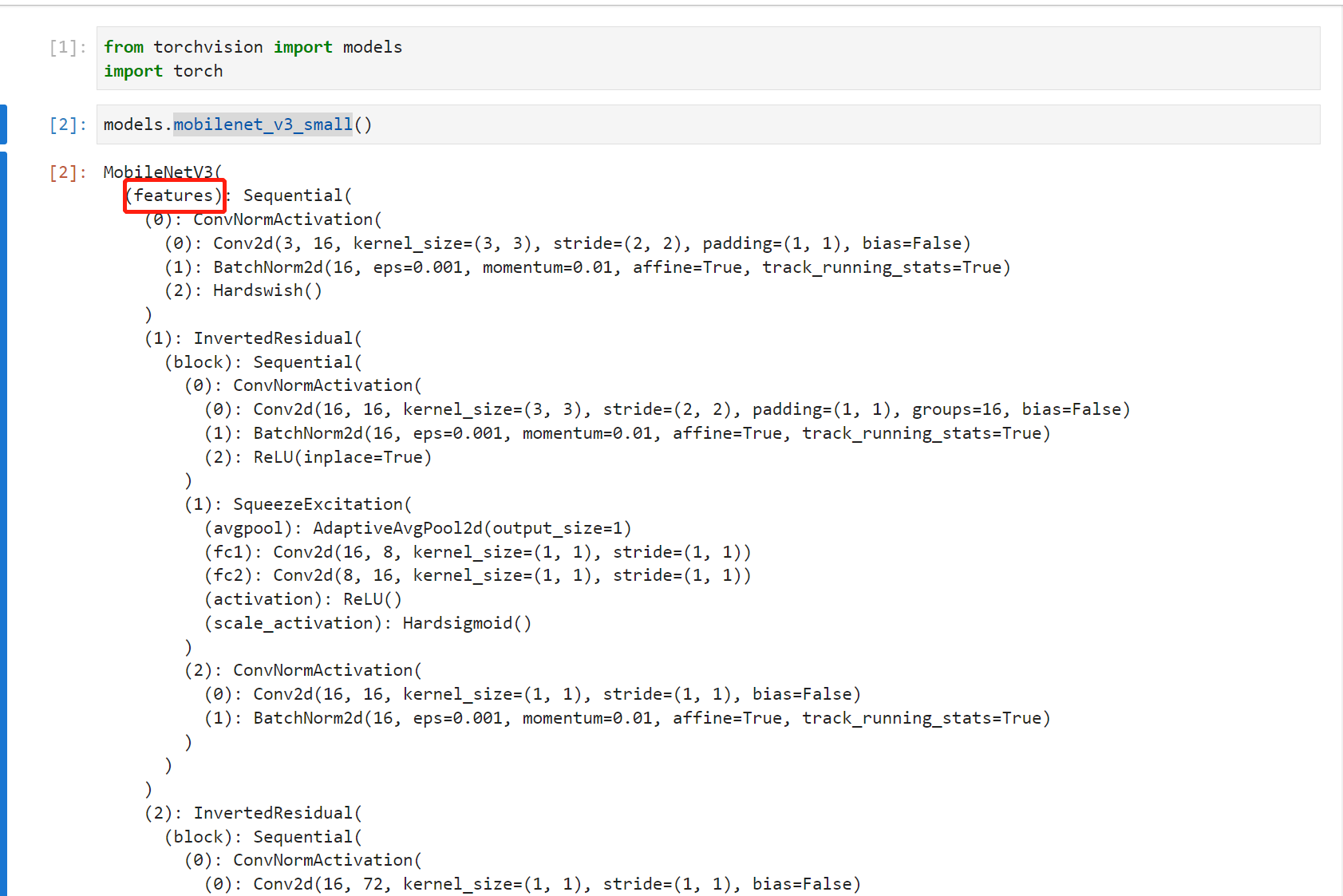
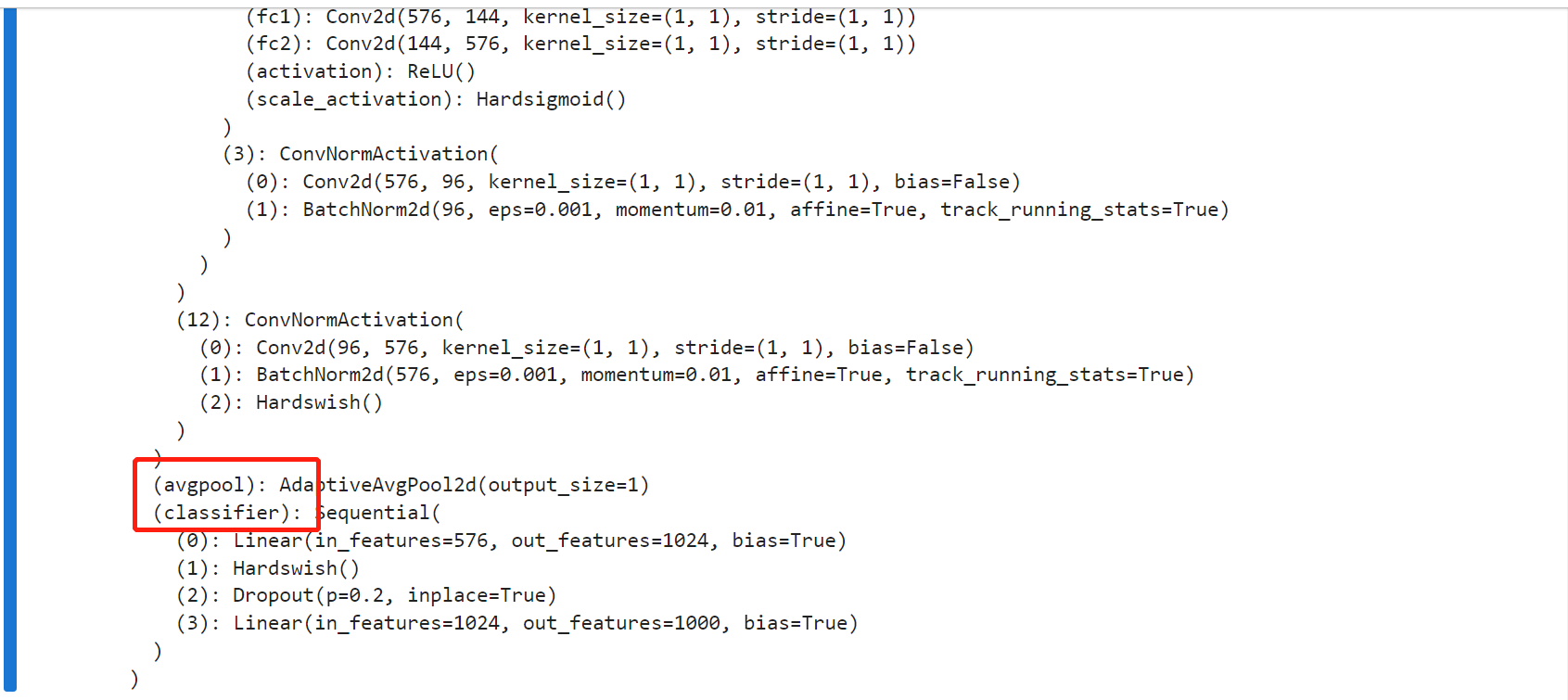
MobileNet The penultimate downsampling in occurs in the ninth module .( How to quickly see downsampling , The short answer is stride by 2 The place of . Of course, there are kernel_size be equal to 5 Or something else , But generally, relatively new networks kernel_size by 5 Along with that is 2 Of padding, So lazy can only watch stride) therefore 9-11 Corresponding YOLOv5 The penultimate downsampling .
The penultimate downsampling 4-8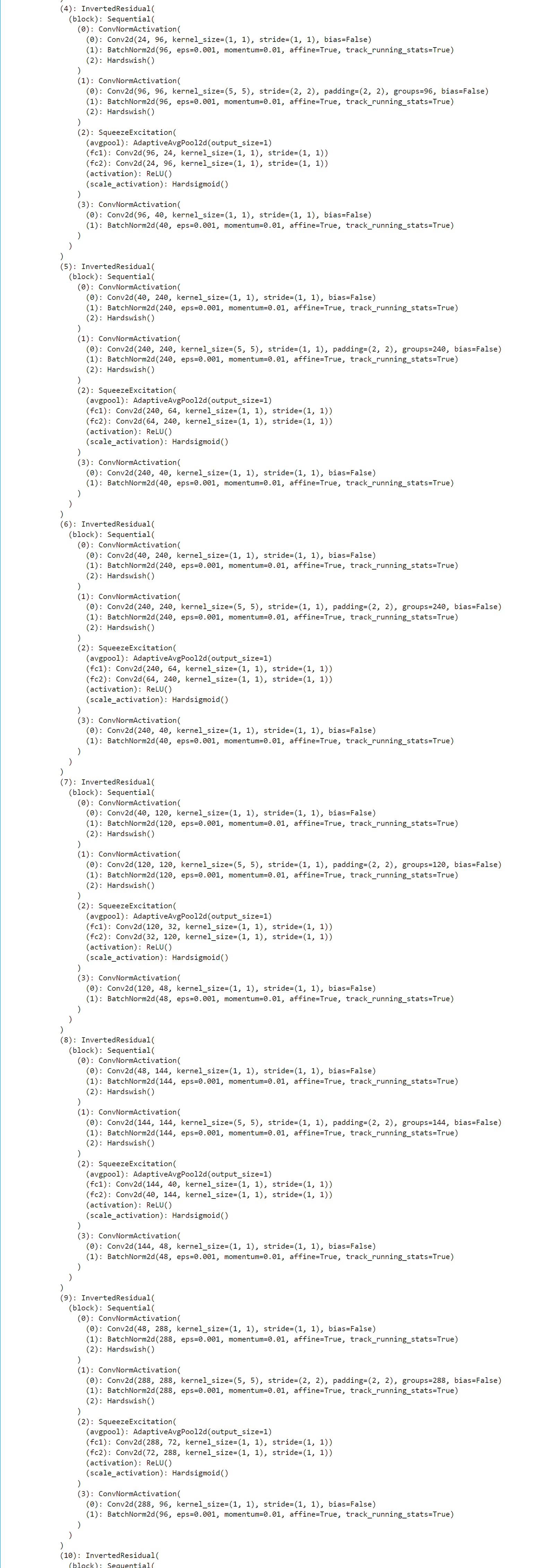
The penultimate downsampling 0-3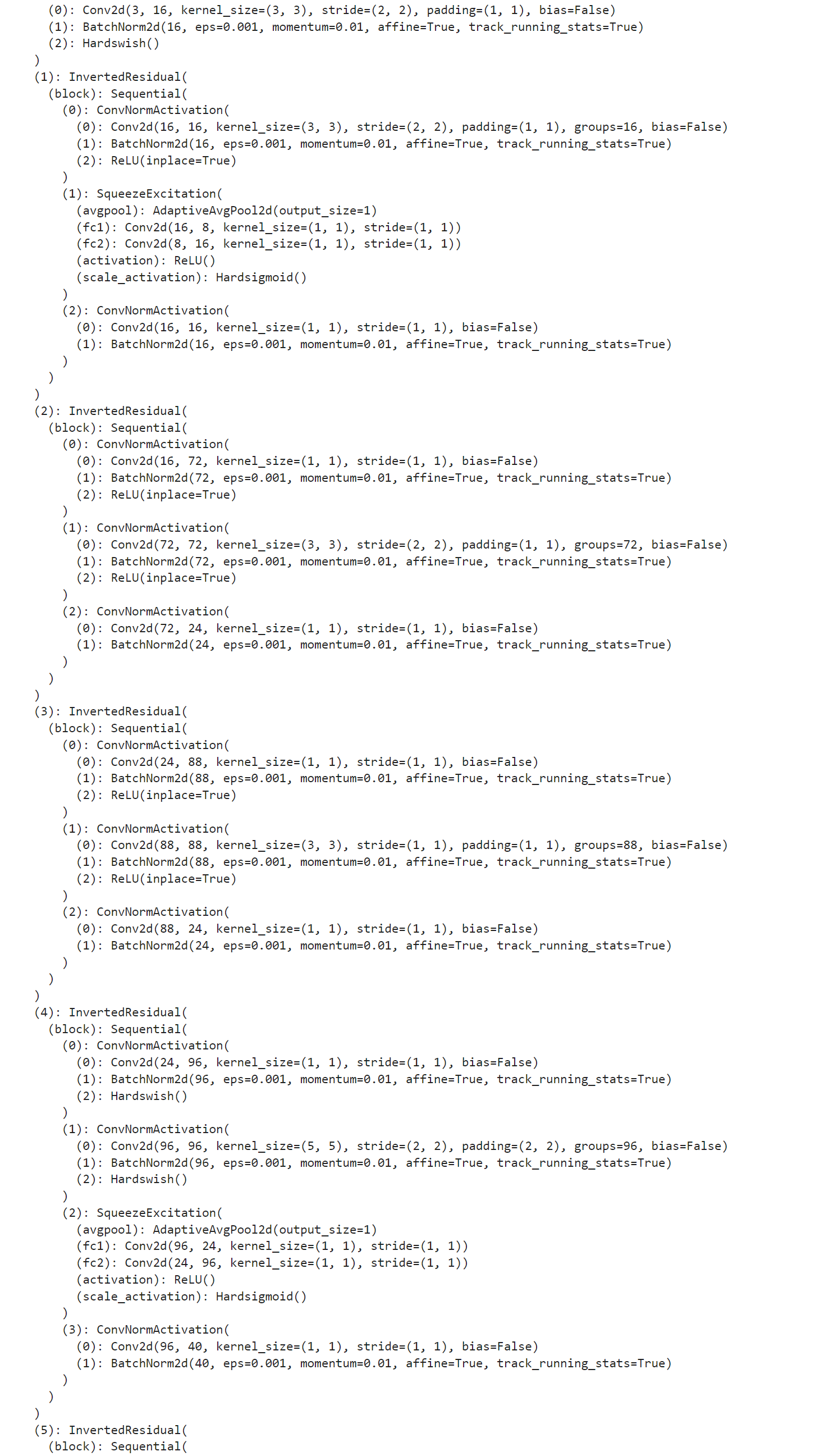
After determining the network extraction method , The second step , stay common.py Add module at the end of . You can see that it's very simple , Mainly add MobileNet Three parts of .
from torchvision import models

class MobileNet1(nn.Module):
    # out channel 24
    def __init__(self, ignore) -> None:
        super().__init__()
        model = models.mobilenet_v3_small(pretrained=True)
        modules = list(model.children())
        modules = modules[0][:4]
        self.model = nn.Sequential(*modules)

    def forward(self, x):
        return self.model(x)


class MobileNet2(nn.Module):
    # out 48 channel
    def __init__(self, ignore) -> None:
        super().__init__()
        model = models.mobilenet_v3_small(pretrained=True)
        modules = list(model.children())
        modules = modules[0][4:9]
        self.model = nn.Sequential(*modules)

    def forward(self, x):
        return self.model(x)


class MobileNet3(nn.Module):
    # out 576 channel
    def __init__(self, ignore) -> None:
        super().__init__()
        model = models.mobilenet_v3_small(pretrained=True)
        modules = list(model.children())
        modules = modules[0][9:]
        self.model = nn.Sequential(*modules)
    def forward(self, x):
        return self.model(x)
The third step , modify yolo.py Add this line of code in this section , It means parsing yaml Put the corresponding module .arg[0] Express yaml The first parameter following the module , This parameter should tell the model , The number of channels output by this module . You can go back up and have a look , The number of output channels of the three modules is 24、48、576.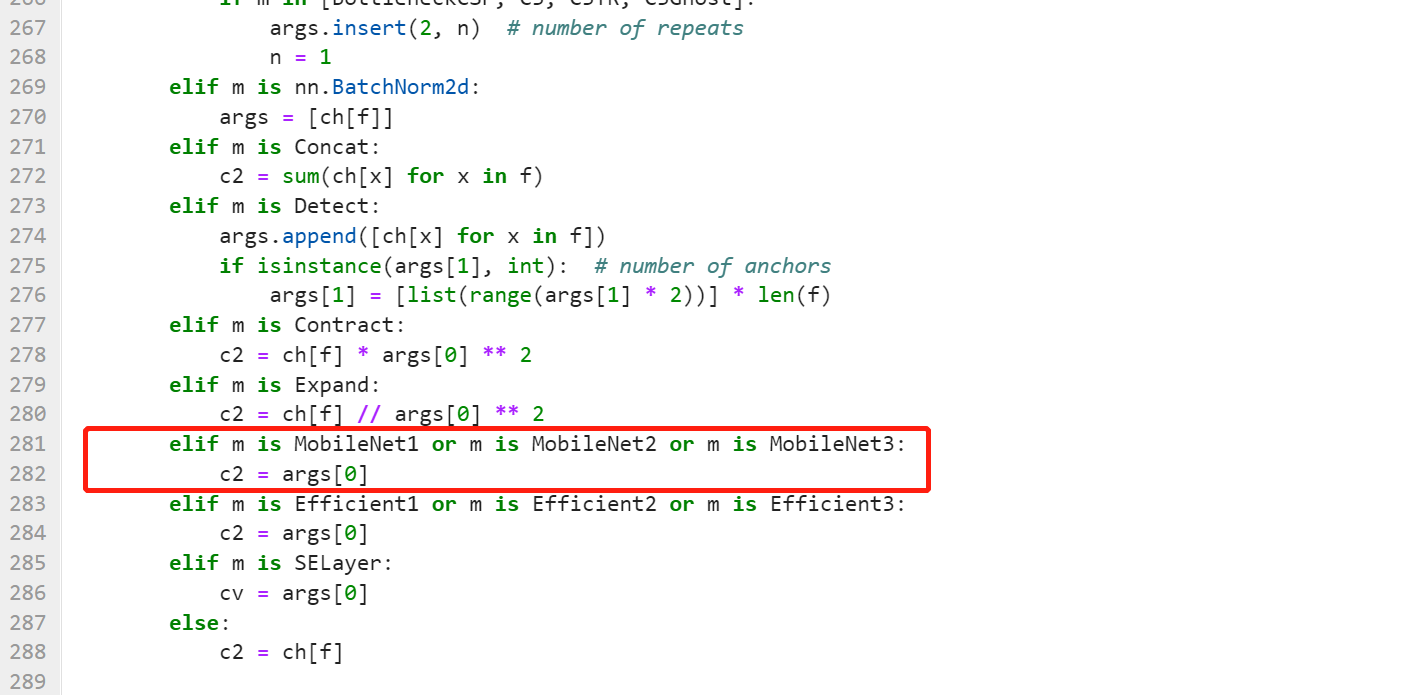
Finally, add the model yaml, I choose to yolov5n Modify the prototype .
yolov5n
# YOLOv5  by Ultralytics, GPL-3.0 license

# Parameters
nc: 80  # number of classes
depth_multiple: 0.33  # model depth multiple
width_multiple: 0.25  # layer channel multiple
anchors:
  - [10,13, 16,30, 33,23]  # P3/8
  - [30,61, 62,45, 59,119]  # P4/16
  - [116,90, 156,198, 373,326]  # P5/32

# YOLOv5 v6.0 backbone
backbone:
  # [from, number, module, args]
  [[-1, 1, Conv, [64, 6, 2, 2]],  # 0-P1/2
   [-1, 1, Conv, [128, 3, 2]],  # 1-P2/4
   [-1, 3, C3, [128]],
   [-1, 1, Conv, [256, 3, 2]],  # 3-P3/8
   [-1, 6, C3, [256]],
   [-1, 1, Conv, [512, 3, 2]],  # 5-P4/16
   [-1, 9, C3, [512]],
   [-1, 1, Conv, [1024, 3, 2]],  # 7-P5/32
   [-1, 3, C3, [1024]],
   [-1, 1, SPPF, [1024, 5]],  # 9
  ]

# YOLOv5 v6.0 head
head:
  [[-1, 1, Conv, [512, 1, 1]],
   [-1, 1, nn.Upsample, [None, 2, 'nearest']],
   [[-1, 6], 1, Concat, [1]],  # cat backbone P4
   [-1, 3, C3, [512, False]],  # 13

   [-1, 1, Conv, [256, 1, 1]],
   [-1, 1, nn.Upsample, [None, 2, 'nearest']],
   [[-1, 4], 1, Concat, [1]],  # cat backbone P3
   [-1, 3, C3, [256, False]],  # 17 (P3/8-small)

   [-1, 1, Conv, [256, 3, 2]],
   [[-1, 14], 1, Concat, [1]],  # cat head P4
   [-1, 3, C3, [512, False]],  # 20 (P4/16-medium)

   [-1, 1, Conv, [512, 3, 2]],
   [[-1, 10], 1, Concat, [1]],  # cat head P5
   [-1, 3, C3, [1024, False]],  # 23 (P5/32-large)

   [[17, 20, 23], 1, Detect, [nc, anchors]],  # Detect(P3, P4, P5)
  ]
yolov5n-mobilenet
# YOLOv5  by Ultralytics, GPL-3.0 license

# Parameters
nc: 80  # number of classes
depth_multiple: 0.33  # model depth multiple
width_multiple: 0.25  # layer channel multiple
anchors:
  - [10,13, 16,30, 33,23]  # P3/8
  - [30,61, 62,45, 59,119]  # P4/16
  - [116,90, 156,198, 373,326]  # P5/32

# YOLOv5 v6.0 backbone
backbone:
  # [from, number, module, args]
  [[-1, 1, MobileNet1, [24]],  # 0
   [-1, 1, MobileNet2, [48]],  # 1
   [-1, 1, MobileNet3, [576]],  # 2
   [-1, 1, SPPF, [1024, 5]],  # 3
  ]

# YOLOv5 v6.0 head
head:
  [[-1, 1, Conv, [512, 1, 1]],
   [-1, 1, nn.Upsample, [None, 2, 'nearest']],
   [[-1, 1], 1, Concat, [1]],  # cat backbone P4
   [-1, 3, C3, [512, False]],  # 7

   [-1, 1, Conv, [256, 1, 1]],
   [-1, 1, nn.Upsample, [None, 2, 'nearest']],
   [[-1, 0], 1, Concat, [1]],  # cat backbone P3
   [-1, 3, C3, [256, False]],  # 11 (P3/8-small)

   [-1, 1, Conv, [256, 3, 2]],
   [[-1, 7], 1, Concat, [1]],  # cat head P4
   [-1, 3, C3, [512, False]],  # 14 (P4/16-medium)

   [-1, 1, Conv, [512, 3, 2]],
   [[-1, 3], 1, Concat, [1]],  # cat head P5
   [-1, 3, C3, [1024, False]],  # 17 (P5/32-large)

   [[11, 14, 17], 1, Detect, [nc, anchors]],  # Detect(P3, P4, P5)
  ]
The revised words are actually easy to understand ,yolov5n Of back You can press it # Serial number of ,concat Is the lower sampling layer , Draw a cat like a gourd , Change the serial number to our module .
Finally using –cfg Call
python train.py --cfg yolov5n-mobileNet.yaml --weight yolov5n.pt
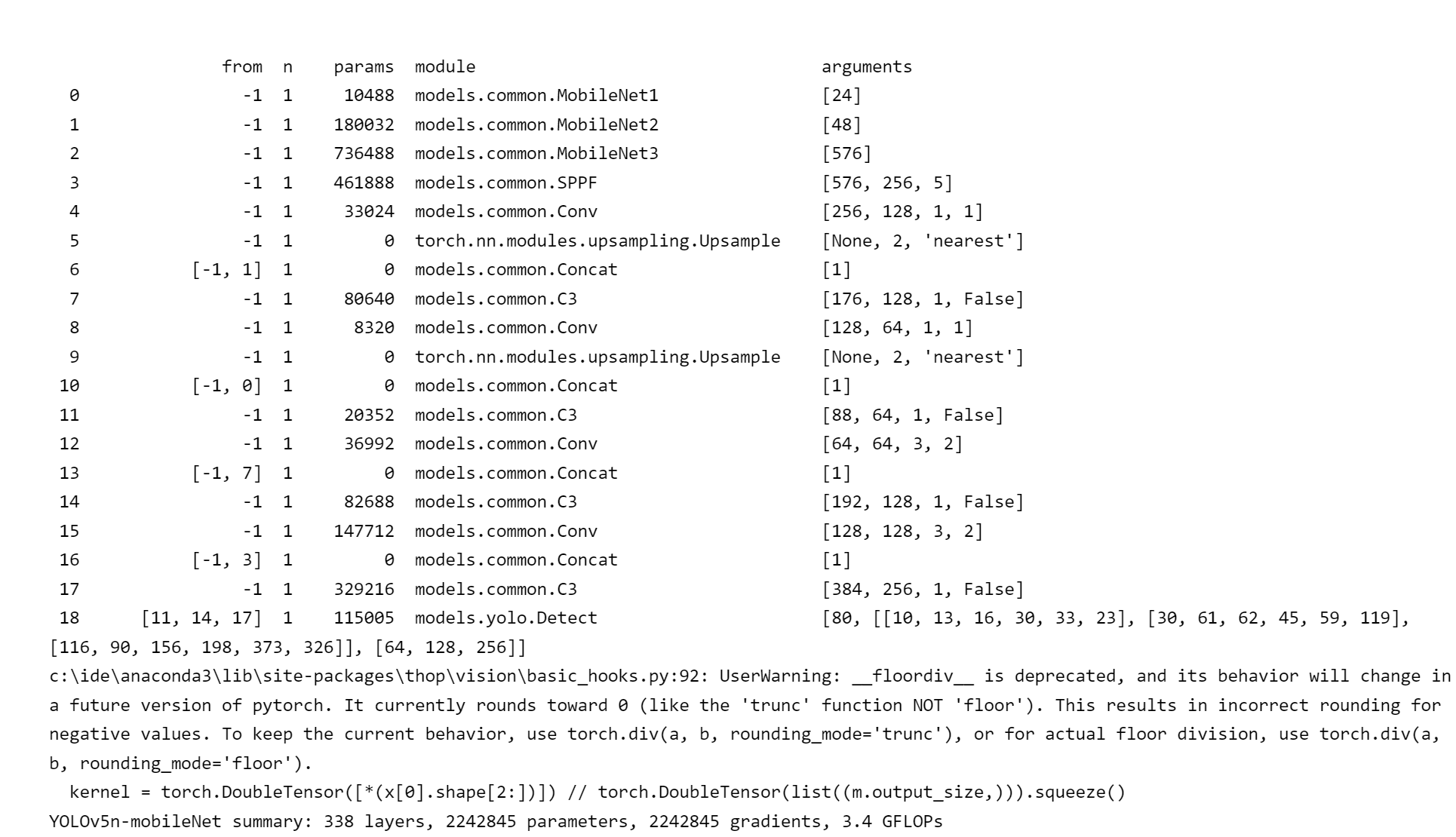
Just a quick note Yolov5-MobileNetv3 The performance of the ,GFLOPs That is, while the amount of computation is greatly reduced , Precision vs yolov5n The performance of the network without pre training is similar . however GPU The computing speed has not improved in the environment , Mainly due to SE The characteristics of the module , Don't go into detail , More suitable for CPU The mobile platform .
Show me , Only one number has been changed Yolov5 contributor . The next article will show you how to use TensorRT C++ Speed up yolov5.
边栏推荐
- 微信小程序 - 实现获取手机验证码倒计时 60 秒(手机号+验证码登录功能)
- 手撕——排序
- Lost a few hairs, and finally learned - graph traversal -dfs and BFS
- Is it safe to open an account with first venture securities? I like to open an account. How can I open it?
- 【小技巧】使用matlab GUI以对话框模式读取文件
- 蓝湖的安装及使用
- Playing with concurrency: what are the ways of communication between threads?
- WiFi 5GHz frequency
- Actual combat | use composite material 3 in application
- First acquaintance with string+ simple usage (II)
猜你喜欢
Microsoft Research Institute's new book "Fundamentals of data science", 479 Pages pdf

First acquaintance with string+ simple usage (II)

"No war on the Western Front" we just began to love life, but we had to shoot at everything

C language: examples of logical operation and judgment selection structure
MySQL error: expression 1 of select list is not in group by claim and contains nonaggre
BGP experiment the next day

WPViewPDF Delphi 和 .NET 的 PDF 查看组件

SQL Yiwen get window function

初识P4语言

PIP installation of third-party libraries
随机推荐
10 minutes to understand CMS garbage collector in JVM
Spring recruitment of Internet enterprises: Kwai meituan has expanded the most, and the annual salary of technical posts is up to nearly 400000
WiFi 5GHz frequency
【leetcode】81. Search rotation sort array II
手撕——排序
Www2022 | know your way back: self training method of graph neural network under distribution and migration
Li Kou interview question 02.08 Loop detection
初识P4语言
How to model noise data? Hong Kong Baptist University's latest review paper on "label noise representation learning" comprehensively expounds the data, objective function and optimization strategy of
【leetcode】74. Search 2D matrix
藍湖的安裝及使用
MySQL advanced SQL statement 2
Okcc why is cloud call center better than traditional call center?
LxC limits the number of CPUs
Suggestions on settlement solution of u standard contract position explosion
"No war on the Western Front" we just began to love life, but we had to shoot at everything
Monkey test
Introduction to vmware workstation and vSphere
MySQL error: expression 1 of select list is not in group by claim and contains nonaggre
A thorough understanding of the development of scorecards - the determination of Y (Vintage analysis, rolling rate analysis, etc.)