当前位置:网站首页>Quick sequencing and optimization
Quick sequencing and optimization
2022-07-27 03:22:00 【eat rice】
Quick sort
Select one element from the currently considered array at a time , Try to move this element to the position where it should be arranged , such as 4 This element , It has a property 4 The previous elements are smaller than it , Later elements are larger than it , After that, we need to do something about less than 4 And greater than 4 The array of continues to use the idea of quick sorting , Gradually recurse down to complete the whole sorting process .

For quick sort, the process of moving the selected elements to the correct position is also the core of quick sort , In this process, we usually choose the first element of the array as the marker of our boundary , We record this point as l , Then we gradually traverse all the elements on the right that have not been accessed , In the process of traversal, we gradually sort out a part that is less than v Of this element , Part of it is greater than v Of this element , When let's have a record, it's less than v And greater than v The dividing point of , This point is j , The currently accessed element record is i.
How can we decide how the current element changes to maintain its current nature , If the current element e It's better than v Even bigger , Then he put it directly on the greater than v Part of the back .
Then consider the next element .
If the current element e It's better than v And smaller .
We only need the current orange part, that is j The last element of the position referred to and the element currently being investigated i Exchange .
After that, let's do some location maintenance ++j,++i.

And so on , The whole array is divided into three parts , The first element is v, The orange part is smaller than v, The purple part is larger than v.
The last thing we need to do is put the array l This position and array j Exchange this position , In this way, the whole array forms what we imagine , The front is smaller than v, Rear greater than v.
Optimize
- For small arrays , Optimize with insert sort ;
- Random in arr[l…r] In the range of , Select a value as the calibration point pivot. The subtree divided in the recursive process of quick sort cannot guarantee that the whole array is divided into two equally every time , In other words, the sub array may be one large and one small .

- If the array is almost or completely ordered, then :
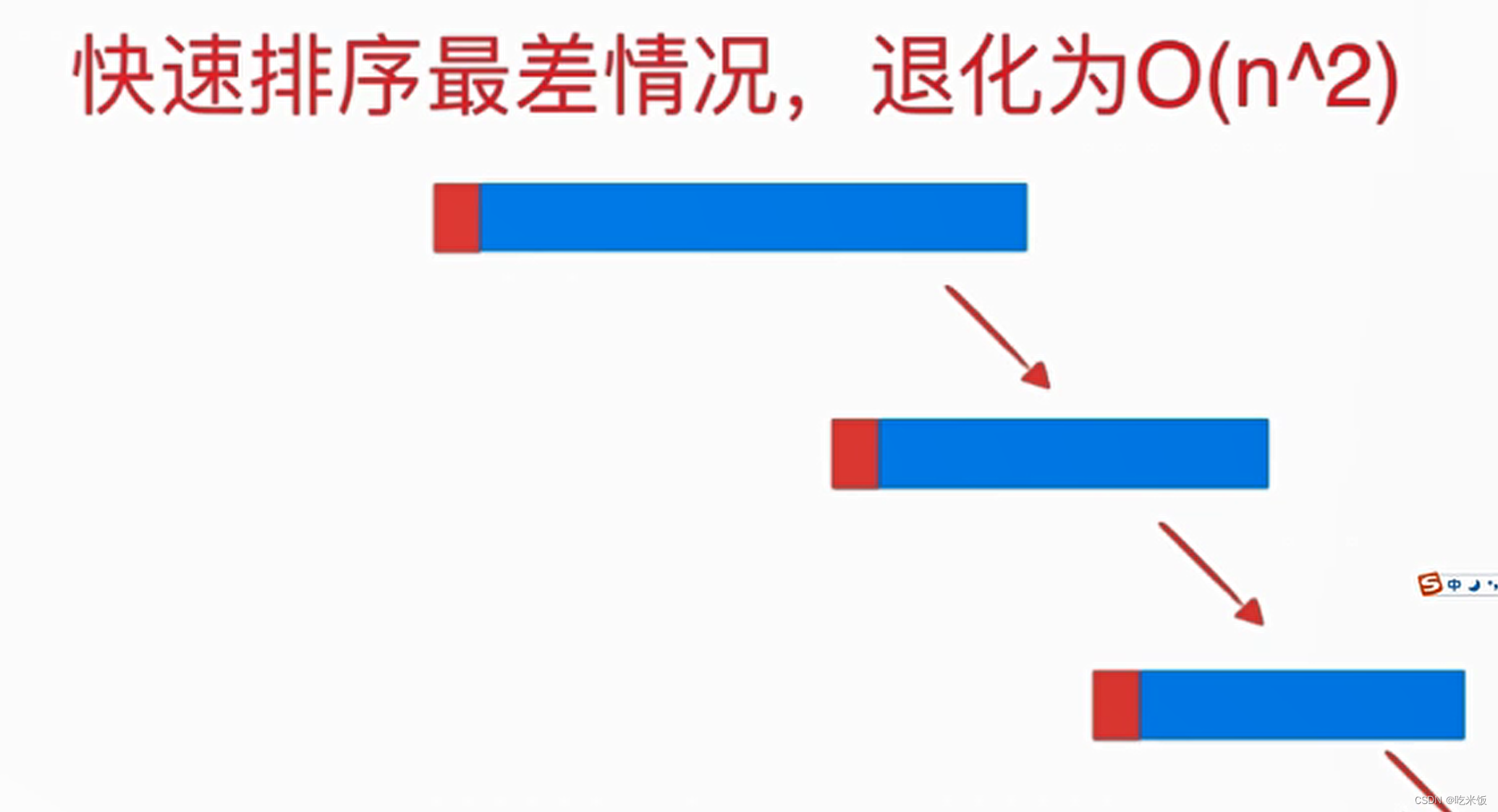
quickSort
//  Yes arr[l...r] Range array for insertion sort
template<typename T>
void insertionSort(T arr[], int l, int r) {

   for (int i = l + 1; i <= r; ++i) {

       T e = arr[i];
       int j;
       for (j = i; j > l && arr[j - 1] > e; --j) {

           arr[j] = arr[j - 1];
       }
       arr[j] = e;
   }
}

//  Yes arr[l...r] In part partition operation
//  return p,  bring arr[l...p-1] < arr[p] ; arr[p+1...r] > arr[p]
template<typename T>
int __partition1(T arr[], const int l, const int r) {

   //  Optimize : Random in arr[l...r] In the range of ,  Select a value as the calibration point pivot
   std::swap(arr[l], arr[rand() % (r - l + 1) + l]);
   const T v = arr[l];
   int j = l;
   // arr[l+1...j] < v ; arr[j+1...i) > v
   for (int i = l + 1; i <= r; ++i) {

       if (arr[i] < v) {

           std::swap(arr[++j], arr[i]);
       }
   }
   std::swap(arr[l], arr[j]);
   return j;
}
//  Yes arr[l...r] Quick sort the parts
template<typename T>
void __quickSort(T arr[], const int l, const int r) {

   //  Optimize : For small arrays ,  Optimize with insert sort
   if (r - l <= 15) {

       insertionSort(arr, l, r);
       return;
   }
   const int p = __partition1(arr, l, r);
   __quickSort(arr, l, p - 1);
   __quickSort(arr, p + 1, r);
}

// Quick sort
template<typename T>
void quickSort(T arr[], const int n) {

   srand(time(NULL));
   __quickSort(arr, 0, n - 1);
}
Two way quick sort
In the previous quick sort, we didn't discuss equal v The situation of , Here, whether you put the equals on the left or the right , If there are a lot of duplicate elements in the whole array , Then it will cause extreme imbalance between the left and right arrays, so that the algorithm degenerates into O(n^2).
Now we will be less than v And greater than v At both ends of the array . First we start with i This position starts scanning backwards , When the element we face is still less than v When we continue to scan backwards , Know that we have encountered elements e, It is greater than or equal to v Of .
Again j The same is true ,
In this way, the two green parts are merged into orange and purple respectively .
and i and j Just exchange the positions of these two elements .
Then maintain the position ++i,–j, And so on .
quickSort2Ways
//  Yes arr[l...r] Range array for insertion sort
template<typename T>
void insertionSort(T arr[], int l, int r) {

   for (int i = l + 1; i <= r; ++i) {

       T e = arr[i];
       int j;
       for (j = i; j > l && arr[j - 1] > e; --j) {

           arr[j] = arr[j - 1];
       }
       arr[j] = e;
   }
}

//  Two way quick sort partition
//  return p,  bring arr[l...p-1] <= arr[p] ; arr[p+1...r] >= arr[p]
//  The element of two-way fast row processing is exactly equal to arr[p] Pay attention to , See note below :)
template<typename T>
int __partition2(T arr[], int l, int r) {

   //  Random in arr[l...r] In the range of ,  Select a value as the calibration point pivot
   std::swap(arr[l], arr[rand() % (r - l + 1) + l]);
   const T v = arr[l];
   // arr[l+1...i) <= v; arr(j...r] >= v
   int i = l + 1, j = r;
   while (true) {

       //  Pay attention to the boundary here , arr[i] < v,  It can't be arr[i] <= v
       //  Think about why ?
       while (i <= r && arr[i] < v)++i;
       //  Pay attention to the boundary here , arr[j] > v,  It can't be arr[j] >= v
       //  Think about why ?
       while (j >= l + 1 && arr[j] > v)--j;
       if (i > j)break;
       std::swap(arr[i], arr[j]);
       //arr[i] < v.  In the case of many consecutive same numbers ,i Move backward only once , meanwhile j Move forward at least once , Relative balance .
       //arr[i] <= vb,  In the case of many consecutive same numbers , i First, keep moving backwards , Until the conditions are met , Cause imbalance .
       ++i;
       --j;
   }
   std::swap(arr[l], arr[j]);
   return j;
}

//  Yes arr[l...r] Quick sort the parts
template<typename T>
void __quickSort2Ways(T arr[], const int l, const int r) {

   //  For small arrays ,  Optimize with insert sort
   if (r - l <= 15) {

       insertionSort(arr, l, r);
       return;
   }
   const int p = __partition2(arr, l, r);
   __quickSort2Ways(arr, l, p - 1);
   __quickSort2Ways(arr, p + 1, r);
}

// Quick sort
template<typename T>
void quickSort2Ways(T arr[], const int n) {

   srand(time(NULL));
   __quickSort2Ways(arr, 0, n - 1);
}
Three way quick sorting
The previous idea of quick sorting is less than v Greater than v, The idea of three-way quick sorting is less than v be equal to v Greater than v. After such segmentation, in the process of recursion , For equal to v We don't care at all , Only recursion less than v Greater than v Do the same quick sort for the parts of .
Now we have to deal with i The element of position e, If the current element e It's exactly the same as v, So the element e Directly include green is equal to v Part of , Corresponding ++i, Let's deal with the next element .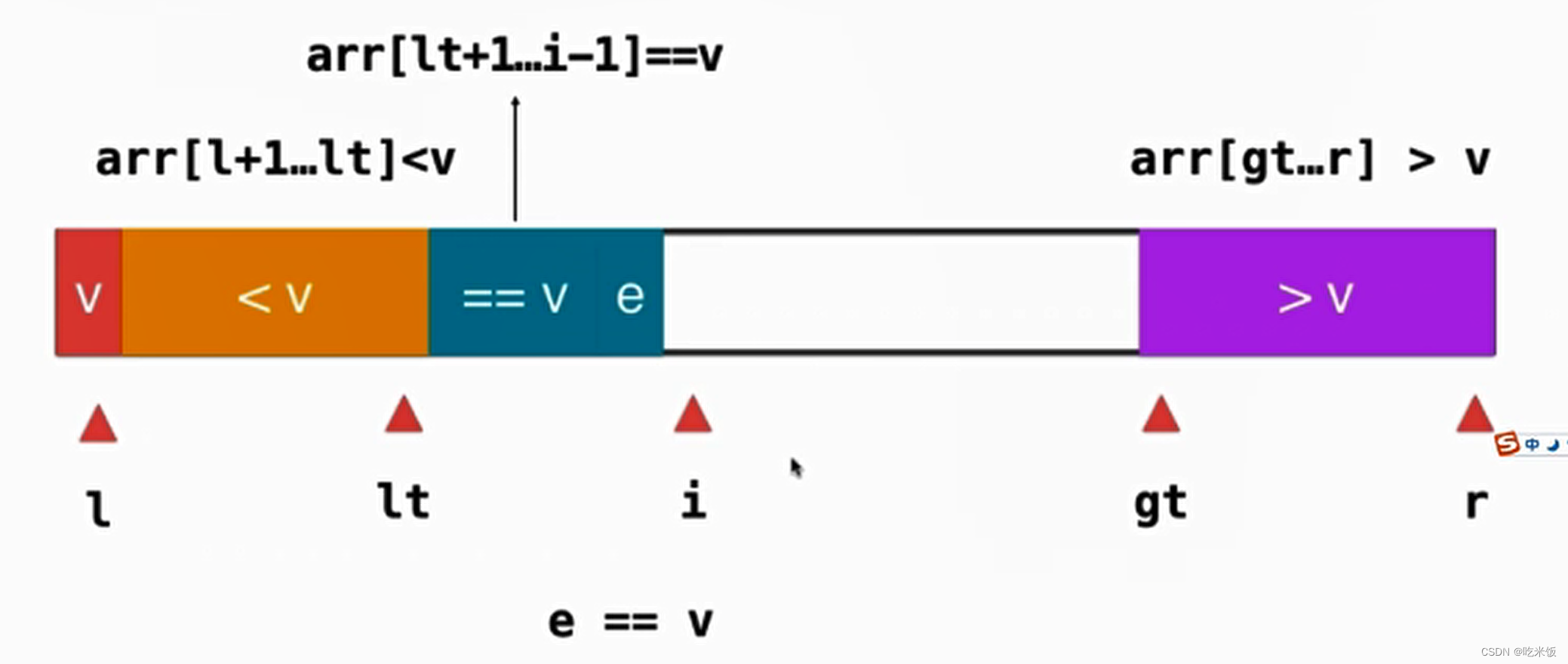
If the current element e Less than v, We just need to sum this element up to v Just exchange the first element of the part once .
After that, we should maintain the position ,++i,++lt, To see the next element .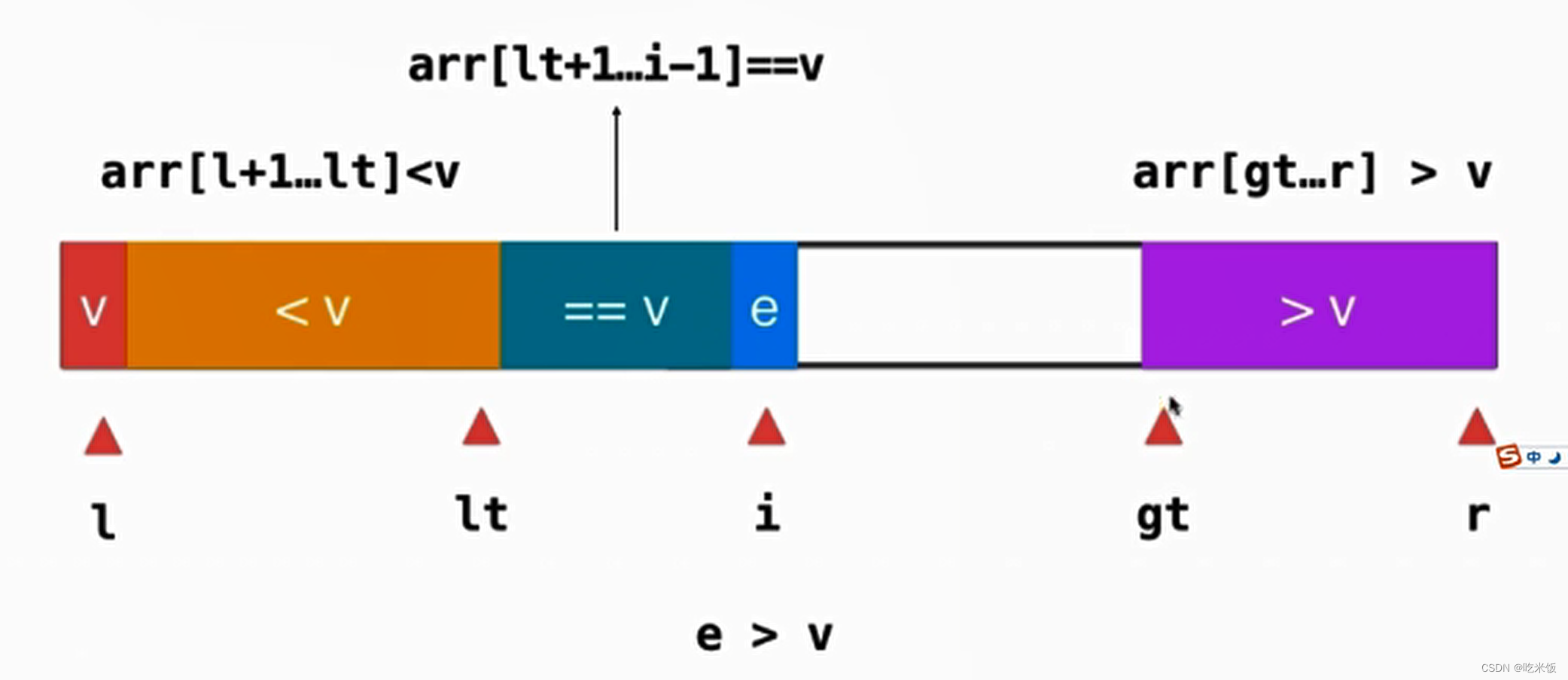
If the current element e Greater than v, We just need to combine this element with gt-1 Just exchange the elements of position once .
Accordingly, we should maintain gt The location of –gt, It should be noted that i We don't need to touch it , Because the position element exchanged with it has not been discussed .
And so on , Finally, we need l and lt The elements of position exchange positions .
At this point, our entire array becomes like this , After that, we just need to check the value of less than v The sum of parts is greater than v It's good to recursively sort the parts of , As for equal to v It has been placed in the appropriate position of the array .
quickSort3Ways
//  Yes arr[l...r] Range array for insertion sort
template<typename T>
void insertionSort(T arr[], int l, int r) {

   for (int i = l + 1; i <= r; ++i) {

       T e = arr[i];
       int j;
       for (j = i; j > l && arr[j - 1] > e; --j) {

           arr[j] = arr[j - 1];
       }
       arr[j] = e;
   }
}

//  Recursive three-way quick sorting algorithm
template<typename T>
void __quickSort3Ways(T arr[], const int l, const int r) {

   //  For small arrays ,  Optimize with insert sort
   if (r - l <= 15) {

       insertionSort(arr, l, r);
       return;
   }

   //  Random in arr[l...r] In the range of ,  Select a value as the calibration point pivot
   std::swap(arr[l], arr[rand() % (r - l + 1) + l]);

   T v = arr[l];

   int lt = l;     // arr[l+1...lt] < v
   int gt = r + 1; // arr[gt...r] > v
   int i = l + 1;    // arr[lt+1...i) == v
   while (i < gt) {

       if (arr[i] < v) {

           std::swap(arr[i], arr[lt + 1]);
           ++i;
           ++lt;
       } else if (arr[i] > v) {

           std::swap(arr[i], arr[gt - 1]);
           --gt;
       } else {
     // arr[i] == v
           ++i;
       }
   }
   std::swap(arr[l], arr[lt]);
   __quickSort3Ways(arr, l, lt - 1);
   __quickSort3Ways(arr, gt, r);
}

//  For arrays that contain a lot of duplicate data ,  Three way fast platoon has great advantages
template<typename T>
void quickSort3Ways(T arr[], const int n) {

   srand(time(nullptr));
   __quickSort3Ways(arr, 0, n - 1);
}
summary


边栏推荐
猜你喜欢

【1206. 设计跳表】

“date: write error: No space left on device”解决

Activiti5.22.0扩展支持达国产数据库,以GBase据库为例
Redis四大特殊数据类型的学习和理解

安全员及环保员岗位职责
Yilingsi T35 FPGA drives LVDS display screen

队列达到最大长度代码实战
【树链剖分】模板题

Complete source code of mall applet project (wechat applet)

Practice of online problem feedback module (XV): realize the function of online updating feedback status
随机推荐
《稻盛和夫给年轻人的忠告》阅读笔记
Best practices of opentelemetry in service grid architecture
Code practice when the queue reaches the maximum length
国内服务器与海外服务器用1个数据库,怎样可以访问的快?
PyCharm中Debug模式进行调试详解
【flask】服务端获取客户端的请求头信息
Common events of window objects
shell awk
Idea 中添加支持@Data 插件
Activiti5.22.0 extension supports domestic databases, taking gbase database as an example
延时队列的几种实现姿势?日常必备技能!
177. 第N高的薪水(简单)
Boom 3D new 2022 audio enhancement app
How many implementation postures of delay queue? Daily essential skills!
注解@Autowired和@Resource的区别总结
Call jshaman's Web API interface to realize JS code encryption.
将幕布文章OPML转换为Markdown的方法
Byte side: can TCP and UDP use the same port?
2649: segment calculation
volatile关键字及其作用