BitMap
Modern computers use binary (bit, position ) As the basic unit of information ,1 Bytes are equal to 8 position , for example
big
Strings are created by 3 Byte composition , But it is actually represented in binary when stored in the computer ,
big
Respectively corresponding ASCII The codes are 98、105、103, The corresponding binaries are 01100010、01101001 and 01100111.
Many development languages provide the function of operation bits , Reasonable use of bits can effectively improve memory utilization and development efficiency .
Bit-map The basic idea is to use one bit Bit to mark the corresponding value, and key That's the element . Because of the adoption of bit Store data in units , So in terms of storage space , Can save a lot .
stay Java in ,int Occupy 4 byte ,1 byte = 8 position (1 byte = 8 bit), If we use this 32 individual bit If the value of each bit of a bit represents a number, can it represent 32 A digital , in other words 32 Only one number is needed int The space occupied is enough , Then you can reduce the space 32 times .
1 Byte = 8 Bit,1 KB = 1024 Byte,1 MB = 1024 KB,1GB = 1024 MB
Suppose the website has 1 Billion users , The users who visit independently every day are 5 Ten million , If you use set type and BitMap Store active users separately :
If the user id yes int type ,4 byte ,32 position , The space occupied by the collection type is 50 000 000 * 4/1024/1024 = 200M;
So how to use BitMap To represent a number ?
It says use bit Bit to mark the corresponding value, and key That's the element , We can BitMap Think of it as a bit
Array
, Each unit of an array can only store 0 and 1(0 Indicates that this number does not exist ,1 Indicates presence ), The subscript of the array is in BitMap It's called offset . For example, we need to express
{1,3,5,7}
The number four , as follows :

If there is a number 65 Well ? Just drive
int[N/32+1]
individual int The array can store all this data ( among N Represents the maximum value in this group of data ), namely :
int[0]: Can be said 0~31
int[1]: Can be said 32~63
int[2]: Can be said 64~95
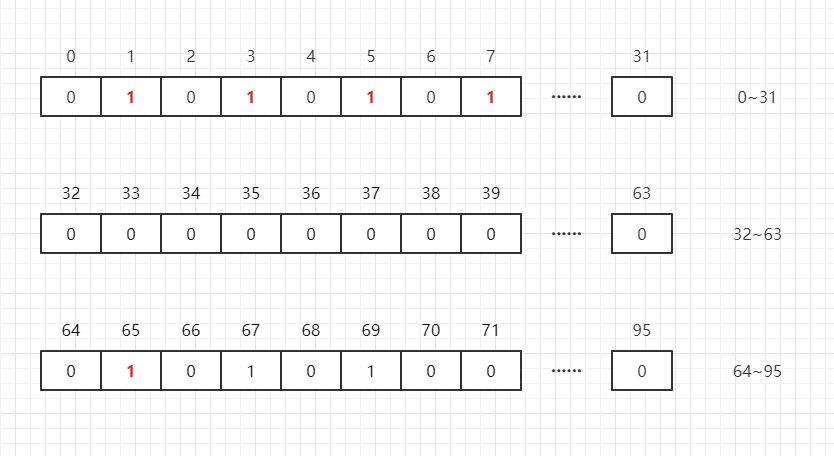
Suppose we want to determine whether any integer is in the list , be
M/32
You get the subscript ,
M%32
I know where it is in this subscript , Such as :
65/32 = 2
,
65%32=1
, namely 65 stay
int[2]
No 1 position .
The bloon filter
In essence, the bloom filter is a data structure , A more ingenious probabilistic data structure , Features efficient insertion and query , It can be used to tell you “ some Something must or may not exist ”.
Compared to traditional List、Set、Map And so on , It's more efficient 、 Take up less space , But the disadvantage is that the returned result is probabilistic , Not exactly .
actually , Bloom filters are widely used in
Web blacklist system
、
Spam filtering system
、
Crawler website weight judgment system
etc. ,Google Famous distributed database Bigtable Used a bloom filter to find non-existent rows or columns , To reduce the number of disk lookups IO frequency ,Google Chrome Browser uses bloom filter to speed up safe browsing service .
In many Key-Value The system also uses the bloom filter to speed up the query process , Such as Hbase,Accumulo,Leveldb, generally speaking ,Value Save on disk , It takes a lot of time to access the disk , However, using a bloom filter can quickly determine a certain Key Corresponding Value Whether there is , So you can avoid a lot of unnecessary disks IO operation .
Through one Hash Function maps an element to a bit array (Bit Array) A point in . thus , We just need to see if this point is 1 We'll know if it's in the set . This is the basic idea of bloon filter .
Use scenarios
1、 There are 10 A natural number of billion , To arrange in disorder , It needs to be sorted . The limit is 32 It's done on the machine , Memory is limited to 2G. How to complete ?
2、 How to quickly locate in the 100 million blacklist URL Whether the address is on the blacklist ?( Every one of them URL Average 64 byte )
3、 User login behavior analysis is required , To determine the user's activity ?
4、 Web crawler - How to determine URL Has it been climbed ?
5、 Quickly locate user attributes ( The blacklist 、 White list, etc )?
6、 Data is stored on disk , How to avoid a large number of invalid IO?
7、 To judge whether an element exists in billion level data ?
8、 Cache penetration .
Shortcomings of traditional data structures
Generally speaking , Page URL Save it into the database for search , Or create a hash table to look it up OK 了 .
When the amount of data is small , It's right to think so , You can actually map values to HashMap Of Key, Then you can go to O(1) Within the time complexity of Return results , Extremely efficient . however HashMap The implementation also has disadvantages , For example, the proportion of storage capacity is high , Considering the existence of load factor , Usually space cannot be used up , For example, if a 1000 ten thousand HashMap,Key=String( Length not exceeding 16 character , With minimal repeatability ),Value=Integer, How much space will it take ?1.2 individual G.
In fact, it uses bitmap,1000 m int type , It only needs 40M( 10 000 000 * 4/1024/1024 =40M) Left and right space , Proportion 3%,1000 m Integer, need 161M Left and right space , Proportion 13.3%.
It can be seen that once you are worth a lot, such as hundreds of millions , that HashMap The amount of memory occupied can be imagined .
But if the whole web blacklist system contains 100 Hundreds of millions of web pages URL, Searching in the database is time-consuming , And if each URL Space for 64B, Then the required memory is 640GB, It is difficult for ordinary servers to meet this demand .
Realization principle
Suppose we have a set A,A There is n Elements . utilize
k A hash hash
function , take A Every element in
mapping
To a length of a Bit array B At different locations in , Binary numbers at these locations are set to 1. If the element to be checked , Through here k After the mapping of a hash function , Found that the k Binary numbers in two positions
All for 1
, This element probably belongs to the collection A, conversely ,
It must not belong to the set A
.
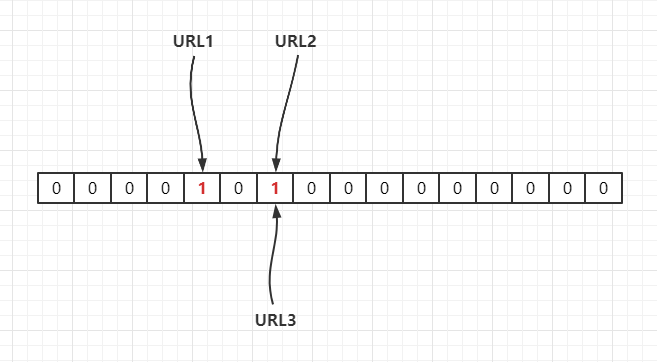
For example, we have 3 individual URL
{URL1,URL2,URL3}
, Through one hash The function maps them to a length of 16 On the array of , as follows :

If the current hash function is
Hash1()
, Map to the array through hash operation , hypothesis
Hash1(URL1) = 3
,
Hash1(URL2) = 6
,
Hash1(URL3) = 6
, as follows :
therefore , If we need to judge
URL1
Whether in this collection , Through
Hash(1)
Calculate its subscript , If its value is 1 It means that there is .
because Hash Hash conflict exists , Like above
URL2,URL3
All in one place , hypothesis Hash The function is good , If our array length is m A little bit , So if we want to reduce the conflict rate to, for example
1%
, This hash table can only hold
m/100
Elements , Obviously, the space utilization rate becomes low , That is, you can't do
Space is effective
(space-efficient).
The solution is simple , Multiple is the use of Hash Algorithm , If one of them says that the element is not in the set , It must not be , as follows :
Hash1(URL1) = 3,Hash2(URL1) = 5,Hash3(URL1) = 6

Hash1(URL2) = 5,Hash2(URL2) = 8,Hash3(URL2) = 14

Hash1(URL3) = 4,Hash2(URL3) = 7,Hash3(URL3) = 10
The above is the practice of Bloom filter , Used
k Hash functions
, Each string is followed by k individual bit Corresponding , So it reduces the probability of conflict .
Misjudgment phenomenon
The above approach also has problems , Because as the value increases, more and more , Be set to 1 Of bit More and more , In this way, even if a value has not been stored , But in case the hash function returns three bit Bits are set by other values 1 , Then the program will still judge that this value exists . For example, a nonexistent
URL1000
, After hashing , Find out bit Bit down :
Hash1(URL1000) = 7,Hash2(URL1000) = 8,Hash3(URL1000) = 14
But these above bit Bit has been
URL1,URL2,URL3
Set as 1 了 , At this point, the program will judge
URL1000
The value is .
This is the misjudgment of Bloom filter , therefore ,
The bloom filter judges that the existing does not necessarily exist , however , Judge that what does not exist must not exist .
Bloom filter can accurately represent a set , It can accurately determine whether an element is in this set , The accuracy is determined by the user's specific design , achieve 100% It's impossible to be right . But the advantage of the bloom filter is ,
High accuracy can be achieved by using very little space
.
Realization
Redis Of bitmap
be based on redis Of bitmap Data structure to execute .
RedisBloom
The bloom filter can be used Redis Bitmap in (bitmap) Operation implementation , until Redis4.0 This version provides plug-in functions ,Redis The officially provided bloom filter was officially launched , The bloom filter is loaded as a plug-in to Redis Server in , The official website recommends one RedisBloom As Redis Of the bloom filter Module.
Detailed installation 、 Instruction operation reference :https://github.com/RedisBloom/RedisBloom
Document address :https://oss.redislabs.com/redisbloom/
Guava Of BloomFilter
Guava Project release 11.0 when , One of the new features is BloomFilter class .
Reference resources :https://blog.csdn.net/dnc8371/article/details/106705929
Redisson
Redisson The bottom layer implements a bloom filter based on bitmap .
public static void main(String[] args) {
Config config = new Config();
// Stand alone environment
config.useSingleServer().setAddress("redis://192.168.153.128:6379");
// structure Redisson
RedissonClient redisson = Redisson.create(config);
RBloomFilter<String> bloomFilter = redisson.getBloomFilter("nameList");
// Initialize the bloon filter : The expected element is 100000000L, The error rate is 3%, Based on these two parameters, the bottom level will be calculated bit Array size
bloomFilter.tryInit(100000L, 0.03);
// take 10086 Insert it into the bloon filter
bloomFilter.add("10086");
// Determine whether the following numbers are in the bloom filter
System.out.println(bloomFilter.contains("10086"));//true
System.out.println(bloomFilter.contains("10010"));//false
System.out.println(bloomFilter.contains("10000"));//false
} Solve cache penetration
Cache penetration refers to a fundamental query
Nonexistent data
, Neither the cache tier nor the storage tier will hit , If no data can be found from the storage layer, it will not be written to the cache layer .
Cache penetration will cause non-existent data to be queried in the storage layer every time it is requested , Lost the significance of cache protection back-end storage . Cache penetration issues can make
The back-end storage load increases
, Because many back-end storage does not have high concurrency , It may even cause the back-end storage to go down .
So we can use bloom filter to solve , Before accessing the cache layer and storage layer , There will be key Save in advance with a bloom filter , Do the first level intercept .
for example : A recommendation system has 4 Billion users id, Every hour, the algorithm engineer will calculate the recommended data according to each user's previous historical behavior and put it into the storage layer , But the latest users have no historical behavior , There will be cache penetration behavior , For this reason, users of all recommended data can be made into Bloom filters . If the bloom filter thinks that the user id non-existent , Then there is no access to the storage tier , It protects the storage layer to a certain extent .
notes :
The bloom filter may misjudge , Let go of some requests , When it doesn't affect the whole , So at present, this scheme is the best scheme to deal with such problems
Reference resources :
https://juejin.cn/post/7000159119059451941
https://www.cnblogs.com/cjsblog/p/11613708.html
原网站版权声明
本文为[InfoQ]所创,转载请带上原文链接,感谢
https://yzsam.com/2022/173/202206220949495533.html