当前位置:网站首页>General solution of island problems and DFS framework
General solution of island problems and DFS framework
2022-06-28 16:17:00 【bitcarmanlee】
Reference link :
https://leetcode.cn/problems/number-of-islands/solution/dao-yu-lei-wen-ti-de-tong-yong-jie-fa-dfs-bian-li-/
See an article on the general solution of island problems , The summary is quite up to standard and easy to understand . On this basis , I further summarize and process , Simultaneous use c++ Code implementation .
1. Of grid problems DFS Traversal methods
What we are familiar with DFS( Depth-first search ) The problem is usually carried out on the tree or graph structure . And what we're going to talk about today DFS problem , It's in a 「 grid 」 In the structure . The island problem is this kind of grid DFS Typical representative of the problem . The traversal of grid structure is more complex than binary tree , If you don't master certain methods ,DFS Code is easy to write lengthy and complicated .
The grid problem is caused by m * n A grid of small squares , Each small square is considered adjacent to its upper, lower, left and right squares , To do some kind of search on such a grid .
Island problem is a typical grid problem . The number in each grid may be 0 perhaps 1. Let's call the number 0 Think of your grid as an ocean grid , The number is 1 Think of your grid as a land grid , In this way, the adjacent land grids are connected into an island .
Under such a setting , There are various variants of the island problem , Including the number of Islands 、 area 、 Perimeter, etc . But these questions , Basically, it can be used DFS Traversal to solve .

2.DFS The basic structure
The grid structure is slightly more complex than the binary tree structure , It is actually a simplified version of the diagram structure . Write on the grid DFS Traverse , First of all, we need to understand DFS Traversal methods , Then write the analogy on the grid structure DFS Traverse . The binary tree we wrote DFS Traversal is generally like this :
void traverse(TreeNode root) {
    //  Judge  base case
    if (root == null) {
        return;
    }
    //  Access two adjacent nodes : Left child node 、 Right child node
    traverse(root.left);
    traverse(root.right);
}
You can see , Binary tree DFS There are two elements :「 Access adjacent nodes 」 and 「 Judge base case」.
The first element is access to adjacent nodes . The adjacent nodes of a binary tree are very simple , There are only two left and right child nodes . Binary tree itself is a recursively defined structure : A binary tree , Its left subtree and right subtree are also a binary tree . So our DFS Traversal only needs to recursively call the left subtree and the right subtree .
The second element is Judge base case. Generally speaking , Binary tree traversal base case yes root == null. Such a conditional judgment actually has two meanings : One side , This means root The subtree pointed to is empty , There is no need to traverse further . On the other hand , stay root == null Return in time , You can let the back root.left and root.right There will be no null pointer exception in the operation .
For... On the grid DFS, We can refer to the binary tree DFS, Write out the grid DFS The two elements of :
First , How many adjacent nodes are there in the grid structure ? The answer is up, down, left and right . For lattice (r, c) Come on (r and c Represent row coordinates and column coordinates respectively ), The four adjacent grids are (r-1, c)、(r+1, c)、(r, c-1)、(r, c+1). let me put it another way , The grid structure is 「 Quad 」 Of .
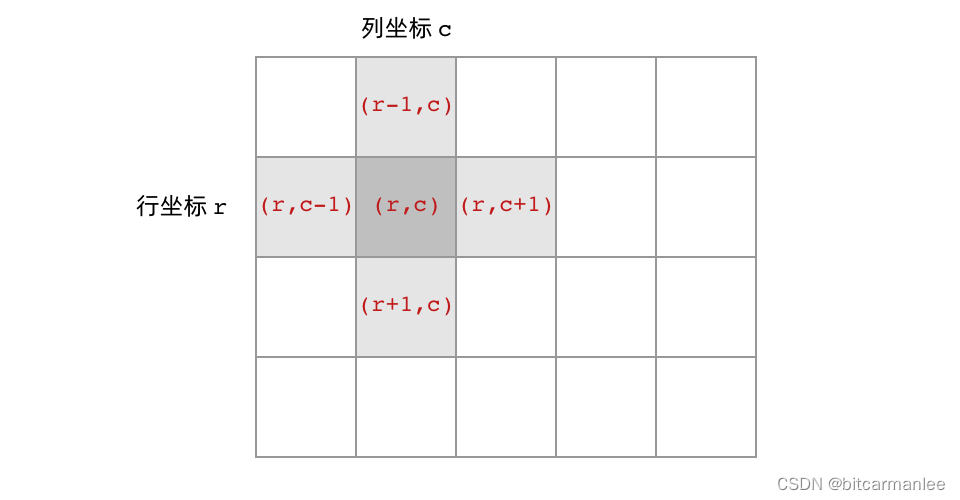
secondly , grid DFS Medium base case What is it? ? From the binary tree base case Corresponding to , It should be that there is no need to continue traversing in the grid 、grid[r][c] An array subscript out of bounds exception will appear , That is, those grids beyond the grid .

This is a little counterintuitive , The coordinates can temporarily exceed the scope of the grid ? This method I call 「 Pollution before treatment 」—— No matter which grid you are currently in , Take a step in four directions first , If you find that you are out of the grid range, return quickly . This is the same as the traversal method of binary tree , First recursively call , Find out root == null Back again .
therefore , grid DFS The traversal framework code is
void dfs(int[][] grid, int r, int c) {
    //  Judge  base case
    //  If the coordinates  (r, c)  Out of grid , Go straight back to
    if (!inArea(grid, r, c)) {
        return;
    }
    //  Visit 、 Next 、 Left 、 Four adjacent nodes on the right
    dfs(grid, r - 1, c);
    dfs(grid, r + 1, c);
    dfs(grid, r, c - 1);
    dfs(grid, r, c + 1);
}

//  Judge coordinates  (r, c)  In grid or not
boolean inArea(int[][] grid, int r, int c) {
    return 0 <= r && r < grid.length
        	&& 0 <= c && c < grid[0].length;
3. How to avoid repeated traversal
Grid structured DFS And binary tree DFS The biggest difference is , Traversal may encounter traversed nodes . This is because , Grid structure is essentially a 「 chart 」, We can think of each lattice as a node in the graph , Each node has four sides up, down, left and right . When traversing the graph , Naturally, you may encounter repeated traversal nodes .
Now ,DFS May keep 「 Go around in circles 」, Never stop .
How to avoid such repeated traversal ? The answer is to mark the lattice that has been traversed . Take the island issue as an example , We need all values to be 1 On the land grid DFS Traverse . Every time you walk through a land grid , Just change the value of the grid to 2, So when we meet 2 When , I know this is the traversed lattice . in other words , Each grid may take three values :
0 —— Ocean grid
1 —— Land grid ( Not traversed )
2 —— Land grid ( Has traversed )
We add statements to the framework code to avoid repeated traversal :
void dfs(int[][] grid, int r, int c) {
    //  Judge  base case
    if (!inArea(grid, r, c)) {
        return;
    }
    //  If this grid is not an island , Go straight back to
    if (grid[r][c] != 1) {
        return;
    }
    grid[r][c] = 2; //  Mark the grid as 「 Has traversed 」

    //  Visit 、 Next 、 Left 、 Four adjacent nodes on the right
    dfs(grid, r - 1, c);
    dfs(grid, r + 1, c);
    dfs(grid, r, c - 1);
    dfs(grid, r, c + 1);
}

//  Judge coordinates  (r, c)  In grid or not
boolean inArea(int[][] grid, int r, int c) {
    return 0 <= r && r < grid.length
        	&& 0 <= c && c < grid[0].length;
}
such , We have an island problem 、 And even the general purpose of various grid problems DFS Traversal methods . Here are some examples , In fact, it only needs to be in DFS Traverse the framework with a little modification .
4.leetcode 200 Number of Islands
Here you are ‘1’( land ) and ‘0’( water ) A two-dimensional mesh of , Please calculate the number of islands in the grid .
Islands are always surrounded by water , And each island can only be combined by horizontal direction / Or a vertical connection between adjacent lands .
Besides , You can assume that all four sides of the mesh are surrounded by water .
Input :grid = [
[“1”,“1”,“1”,“1”,“0”],
[“1”,“1”,“0”,“1”,“0”],
[“1”,“1”,“0”,“0”,“0”],
[“0”,“0”,“0”,“0”,“0”]
]
Output :1
Input :grid = [
[“1”,“1”,“0”,“0”,“0”],
[“1”,“1”,“0”,“0”,“0”],
[“0”,“0”,“1”,“0”,“0”],
[“0”,“0”,“0”,“1”,“1”]
]
Output :3
If you apply the above frame , We can easily think of the following solution
Scan the entire 2D mesh , If a position is 1, Take it as the starting point DFS. It's going on DFS In the process , Every time you search 1, Will be marked as 0, Avoid repeated searches .
#include<iostream>
#include<vector>
using namespace std;

bool inArea(vector<vector<string>> &grid, int r, int c) {
    return r>=0 && r<grid.size() && c>=0 && c<grid[0].size();
}

void dfs(vector<vector<string>> &grid, int r, int c) {
    if (!inArea(grid, r, c))  return;
    if (grid[r][c]=="0") return;
    grid[r][c] = "0";
    dfs(grid, r-1, c);
    dfs(grid, r+1, c);
    dfs(grid, r, c-1);
    dfs(grid, r, c+1);
}

void run() {
    //vector<vector<string>> grid = {
   {"1","1","1","1","0"}, {"1","1","0","1","0"},
    //                                {"1","1","0","0","0"}, {"0","0","0","0","0"}};
    vector<vector<string>> grid = {
   {"1","1","0","0","0"}, {"1","1","0","0","0"},
                                    {"0","0","1","0","0"}, {"0","0","0","1","1"}};
    int row = grid.size(), col = grid[0].size();
    int ansnum = 0;
    for(int i=0; i<row; i++) {
        for(int j=0; j<col; j++) {
            if (grid[i][j]=="1") {
                ansnum++;
                dfs(grid, i, j);
            }
        }
    }
    cout<<"ansnum is: "<<ansnum<<endl;
}

int main(int argc, char const *argv[])
{
    run();
    return 0;
}
In the above code ,inArea It is judgement. bad case. If not area In the area , Go straight back to .
if (grid[r][c]==“0”), That means it's not an island , Go straight back to .
grid[r][c] = “0”, Mark the island as traversed , Avoid repeated traversal later .
4. leetcode 695 Max Area of Island
Give you a size of m x n The binary matrix of grid .
Islands It's made up of some neighboring 1 ( Representing land ) A combination of components , there 「 adjacent 」 Ask for two 1 Must be in In four horizontal or vertical directions adjacent . You can assume grid The four edges of are all 0( Representative water ) Surrounded by a .
The area of the island is the value of 1 Number of cells .
Calculate and return grid The largest island area in . If there were no Islands , Then the return area is 0 .
Example 1:
Input :grid = [[0,0,1,0,0,0,0,1,0,0,0,0,0],[0,0,0,0,0,0,0,1,1,1,0,0,0],[0,1,1,0,1,0,0,0,0,0,0,0,0],[0,1,0,0,1,1,0,0,1,0,1,0,0],[0,1,0,0,1,1,0,0,1,1,1,0,0],[0,0,0,0,0,0,0,0,0,0,1,0,0],[0,0,0,0,0,0,0,1,1,1,0,0,0],[0,0,0,0,0,0,0,1,1,0,0,0,0]]
Output :6
explain : The answer should not be 11 , Because the island can only contain horizontal or vertical 1 .
#include<iostream>
#include<vector>
using namespace std;

bool inArea(vector<vector<int>> &grid, int r, int c) {
    return r>=0 && r<grid.size() && c>=0 && c<grid[0].size();
}

int dfs(vector<vector<int>> &grid, int r, int c) {
    if (!inArea(grid, r, c)) {
        return 0;
    }
    if (grid[r][c] != 1) {
        return 0;
    }
    grid[r][c] = 0;
    return 1 + dfs(grid, r-1, c)+dfs(grid, r+1, c)+dfs(grid, r, c-1)+dfs(grid, r, c+1);
}

void run() {
    vector<vector<int>> grid = {
   {0,0,1,0,0,0,0,1,0,0,0,0,0},{0,0,0,0,0,0,0,1,1,1,0,0,0},
    {0,1,1,0,1,0,0,0,0,0,0,0,0},{0,1,0,0,1,1,0,0,1,0,1,0,0},
    {0,1,0,0,1,1,0,0,1,1,1,0,0},{0,0,0,0,0,0,0,0,0,0,1,0,0},
    {0,0,0,0,0,0,0,1,1,1,0,0,0},{0,0,0,0,0,0,0,1,1,0,0,0,0}};

    int maxarea = 0;
    int row=grid.size(), col=grid[0].size();
    for(int i=0; i<row; i++) {
        for(int j=0; j<col; j++) {
            if (grid[i][j]==1) {
                int curarea = dfs(grid,i,j);
                maxarea = max(curarea, maxarea);
            }
        }
    }
    std::cout<<"maxarea is: "<<maxarea<<endl;
}

int main(int argc, char const *argv[])
{
    run();
    return 0;
}
The only difference from the previous calculation of the number of islands is ,dfs In the process of finding the area , If you encounter 1, The area of the current island is in four directions dfs And add the area 1.
5.LeetCode 463. Island Perimeter
Given a row x col Two dimensional grid map of grid , among :grid[i][j] = 1 Representing land , grid[i][j] = 0 Water area .
Grid in Grid Horizontal and vertical The directions are connected ( The diagonal directions are not connected ). The whole grid is completely surrounded by water , But there happens to be an island ( Or say , An island made up of one or more grids representing land ).
There's No... in the island “ lake ”(“ lake ” And not connected to the water around the island ). The side length of the grid is 1 The square of . The grid is rectangular , And the width and height are not more than 100 . Calculate the perimeter of the island .
Example 1:
Input :grid = [[0,1,0,0],[1,1,1,0],[0,1,0,0],[1,1,0,0]]
Output :16
explain : Its circumference is the circumference in the picture above 16 A yellow edge
#include<iostream>
#include<vector>
using namespace std;

bool isArea(vector<vector<int>> grid, int r, int c) {
    return r>=0 && r<grid.size() && c>=0 && c<grid[0].size();
}

int dfs(vector<vector<int>> grid, int r, int c) {
    //  Beyond the boundary of the island , Perimeter plus 1
    if (!isArea(grid, r, c)) {
        return 1;
    }
    //  At this time, I came across the sea , Perimeter plus 1
    if (grid[r][c] == 0) {
        return 1;
    }
    if (grid[r][c] != 1) {
        return 0;
    }
    //  Note that the value cannot be assigned to 0
    grid[r][c] = -1;
    return dfs(grid, r-1, c)+dfs(grid, r+1, c)+dfs(grid, r, c-1)+dfs(grid, r, c+1);
}

void run() {
    vector<vector<int>> grid = {
   {0,1,0,0}, {1,1,1,0}, {0,1,0,0}, {1,1,0,0}};
    int result = 0;
    for(int i=0; i<grid.size(); i++) {
        for(int j=0; j<grid[0].size(); j++) {
            if (grid[i][j]==1) {
                result = dfs(grid, i, j);
            }
        }
    }
    cout<<"result is: "<<result<<endl;
}

int main(int argc, char const *argv[])
{
    run();
    return 0;
}
The general idea is the same as above , The only difference , The logic of perimeter calculation , For details, please refer to the notes in the code .
边栏推荐
- Interviewer: how does the thread pool reuse threads? Do you know? Tell me about it
- C#/VB.NET 将PDF转为Excel
- [high concurrency foundation] hidden dangers and solutions of MySQL concurrency under different transaction isolation levels
- Introduction to reverse commissioning PE structure details 02/07
- 扎克伯格致投资者:不要对元宇宙有任何期待
- Mysql自连接查询「建议收藏」
- [MySQL] official website document learning query statement SQL precautions
- ID卡复制教程(使用T5577卡复制4100卡)
- Technical secrets of ByteDance data platform: implementation and optimization of complex query based on Clickhouse
- The world has embraced Web3.0 one after another, and many countries have clearly begun to seize the initiative
猜你喜欢

有哪些好用的供应商管理系统

防火墙基础之流量管理与控制

5 minutes to make a bouncing ball game

Briefly introduce the conversion between tensorflow and pytorch (mainly tensorflow to pytorch)

Slim GAIN(SGAIN)介绍及代码实现——基于生成对抗网络的缺失数据填补

24岁秃头程序员教你微服务交付下如何持续集成交付,学不会砍我

The first place on the list - brake by wire "new cycle", the market competitiveness of local suppliers is TOP10

What is the maximum number of concurrent TCP connections for a server? 65535?

openGauss内核:SQL解析过程分析

RedmiBook Pro 14增强版 打不开台达软件DRAStudio_v1.00.07.52
随机推荐
Super automation and the future of network security
字节跳动数据平台技术揭秘:基于ClickHouse的复杂查询实现与优化
Soliciting articles and contributions - building a blog environment with a lightweight application server
Traffic management and control of firewall Foundation
部门新来了个字节25K出来的,让我见识到了什么是天花板
【初学者必看】vlc实现的rtsp服务器及转储H264文件
【高并发基础】MySQL 不同事务隔离级别下的并发隐患及解决方案
Deep learning convolutional neural network of machine learning to realize handwritten font recognition based on CNN network
Visual Studio 2010 configuring and using qt5.6.3
PostgreSQL enables grouping statistics by year, month, day, week, hour, minute and second
QQ出现大规模盗号,为什么会这样?就没有解决方法了吗?
Gartner发布当前至2024年的五大隐私趋势
逆向调试入门-PE结构详解02/07
STM32CubeMX使用方法及功能介绍
wallys/DR7915-wifi6-MT7915-MT7975-2T2R-support-OpenWRT-802.11AX-supporting-MiniPCIe-Module
QT create 5.0.3 configuring qt4.8.7
昨日元宇宙|Meta “元宇宙”部门一季度亏损29.6亿美元,六福珠宝发行数字藏品
Operating excel with openpyxl
10 years of testing experience, worthless in the face of the physiological age of 35
IPDK — Overview