当前位置:网站首页>Minimum spanning tree and bipartite graph in graph theory (acwing template)
Minimum spanning tree and bipartite graph in graph theory (acwing template)
2022-07-01 14:26:00 【lihua777】
Directory navigation :

Minimum spanning tree :
For one there is n A picture of a point , Edge must be greater than or equal to n − 1 The article , Minimum spanning tree , Is to choose from these edges
n -1 Bar out to connect all n A little bit , And this n − 1 The sum of the edge weights of the edges is the smallest of all schemes
Say a little more :
It's in the original picture n A little bit , Edge greater than n-1 strip , Delete the redundant edges , Make the rest n-1 The side length of the strip is the smallest
Prim The algorithm constructs the minimum spanning tree
The diagram written by the great God is very vivid :
Minimum spanning tree _ZhuRanCheng The blog of -CSDN Blog _ Minimum spanning tree
To sum up, it is : Greedy Algorithm
Choose the smallest edge every time , And put the smallest edge into the set I have updated , And use this set to update other points
Algorithmic thought :
inf=0x3f3f3f3f// A large number
dist[i]<----inf// The initialization distance is a large number
for(i=0;i<n;i++)
{
	t<---- Find the point closest to the set outside the set
	 use t Update the distance from other points to the collection
	st[t]=true// Mark
}
Example :
Given a n A little bit m Undirected graph of strip and edge , There may be double edges and self rings in the graph , The edge weight may be negative .
Find the sum of tree edge weights of the minimum spanning tree , If the minimum spanning tree does not exist, output impossible.
Given an undirected graph with weights G=(V, E), among V Represents the set of points in the graph ,E Represents a set of edges in a graph ,
n=|V|,m=|E|.
from V All of n A vertex and E in n-1 An undirected connected subgraph composed of edges is called G A spanning tree of , The spanning tree in which the sum of the weights of the edges is the smallest is called an undirected graph G The minimum spanning tree of
The meaning of the title is the meaning summarized above , If there is no connection between two points , Then the minimum spanning tree cannot be generated
Code implementation :
#include <iostream>
#include <cstring>
using namespace std;
const int N = 510, INF = 0x3f3f3f3f;

int n, m;
int g[N][N], dist[N];// A dense picture
// Adjacency matrix stores all edges
//dist Store other points to S Distance of ;
bool st[N];// Judge array

int prim() {
    // If the graph is disconnected, return INF,  Otherwise return to res
    memset(dist, INF, sizeof dist);// The initialization distance is a large number
    int res = 0;// result

    for (int i = 0; i < n; i++)
    {
        int t = -1;// Any meaningless number is enough
        for (int j = 1; j <= n; j++)
            if (!st[j] && (t == -1 || dist[t] > dist[j]))
                t = j;
        // Look for a set of outliers S Some recent
        if (i && dist[t] == INF) return INF;// The first time i=0  Do not execute the if
        // Judge whether it is connected , Is there a minimum spanning tree

        if (i) res += dist[t];// If i>0  And t To the assembly S The distance to dist[t]
        //cout << i << ' ' << res << endl;
        st[t] = true;// Mark
        // Update the latest S Weight sum of
        for (int j = 1; j <= n; j++) dist[j] = min(dist[j], g[t][j]);// And dijstra Where the algorithm is different :
    }

    return res;
}

int main() {
    cin >> n >> m;// points , Number of edges
    int u, v, w;

    for (int i = 1; i <= n; i++)
        for (int j = 1; j <= n; j++)
            if (i == j) g[i][j] = 0;// Heavy edge : The distance to oneself is initialized to 0
            else g[i][j] = INF;// Not for re editing :i->j The distance is initialized to INF

    while (m--)//m side
    {
        cin >> u >> v >> w;//u->v The length of w
        g[u][v] = g[v][u] = min(g[u][v], w);// Put the original INF The side length of
    }
    int t = prim();// Receive return value
    // Temporary storage prevents the function from executing twice, resulting in only returning 0
    if (t == INF) puts("impossible");// Description: unable to connect
    else cout << t << endl;// Sum of output side lengths
}
And dijstra The difference and connection of algorithms :
You can see the whole and dijstra The idea of the algorithm is the same , The code is about the same
The difference is :Dijkstra The algorithm is to update the distance to the starting point ,Prim Is to update to the collection S Distance of
In the code is reflected as :for (int j = 1; j <= n; j++) dist[j] = min(dist[j], g[t][j]);
and dijstra Algorithm for :
for (int j = 1; j <= n; j++)// Traverse 1 It's on the n Number point
dist[j] = min(dist[j], dist[t] + g[t][j]);//1~j The distance between points becomes :1~t Distance of +t~j Distance of
Kruskal Algorithm
Illustrations of algorithms are still recommended :
Minimum spanning tree _ZhuRanCheng The blog of -CSDN Blog _ Minimum spanning tree
Generalization : Or greedy !
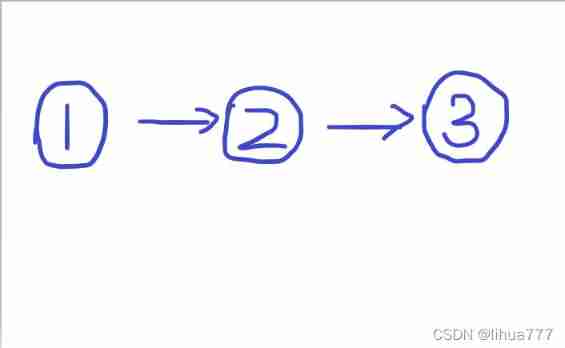
Sort each edge by its length , The side length is small on the top ! Then we get the shortest distance from an edge to an edge , Connect in order , That is to say, connect it first , In the process of edge construction , Loops may occur :1->2->3->1, This is not allowed , So skip this side and don't choose , Finally, a minimum spanning tree without loops is formed !
Realization function :
(1) Sort , Sort by side length
(2) a key : Judge whether adding this edge will form a loop
You can think of the connected blocks in the data structure section , Just prove that the ancestors of these two sides are the same , Then come to Unicom
(3) Add this edge res, Finally back to res that will do
Code brief :
Algorithm ideas :① Sort all edges by weight from small to large
② Enumerate each edge a,b, The weight is c
if a,b Disconnected
Add this edge to the set
Example :
Given a n A little bit m Undirected graph of strip and edge , There may be double edges and self rings in the graph , The edge weight may be negative .
Find the sum of tree edge weights of the minimum spanning tree , If the minimum spanning tree does not exist, output impossible.
Given an undirected graph with weights G=(V, E), among V Represents the set of points in the graph ,E Represents a set of edges in a graph ,n=|V|,m=|E|.
from V All of n A vertex and E in n-1 An undirected connected subgraph composed of edges is called G A spanning tree of , The spanning tree in which the sum of the weights of the edges is the smallest is called an undirected graph G The minimum spanning tree of .
Code implementation :
#include<iostream>
#include<algorithm>
using namespace std;
const int N = 2e5 + 5;
int n, m;
struct Edge // Defining structure , Convenient for correspondence , And sort
{
	int u, v, w;
	bool operator<(const Edge& a) const // Preprocessing of sorting
	{
		return w < a.w;
	}
}edge[N];
int p[N];
int find(int x)// And look for the same ancestors in the search set
{
	return p[x] == x ? x : p[x] = find(p[x]);
}
int main()
{
	int n, m;
	scanf("%d%d", &n, &m);
	for (int i = 0; i < m; i++)
	{
		int u, v, w;
		scanf("%d%d%d", &u, &v, &w);
		edge[i] = { u,v,w };
	}
	sort(edge, edge + m);// Yes m Sort by edge
	for (int i = 1; i <= n; i++) p[i] = i;// Storage nodes
	int cnt = 0, sum = 0;//cnt: frequency   sum: The sum of side lengths
	for (int i = 0; i < m; i++)// I'm going to go through each edge
	{
		int a = edge[i].u, b = edge[i].v, w = edge[i].w;
		a = find(a);// seek a The ancestor node of
		b = find(b);// seek b The ancestor node of
		if (a != b)// If the ancestral node is different : prove a,b Unconnected
		{
			cnt++;// take a,b connected , frequency ++
			sum += w;// Add the side length sum The sum of the
			p[a] = b;// take a Nodes connecting to b node
		}
	}
	if (cnt < n - 1) puts("impossible");
	else printf("%d", sum);
}
The core :
Understand that the ancestor nodes before connection are different , After connection, it is the same , If it is 1->2->3 3->1 : We can't connect , Why? ? Because their ancestral nodes are the same , So skip this situation , This perfectly realizes the Kruskal Algorithm
Bipartite graph
Important conclusions : A graph is a bipartite graph , If and only if the graph does not contain odd rings
(1) To judge a bipartite graph by coloring
problem :
Given a n A little bit m Undirected graph of strip and edge , There may be double edges and self rings in the graph .
Please judge whether this graph is bipartite
The illustration :
summary : Dye the starting point as 1, The tinge connected with the starting point is 2, By analogy , The colors of adjacent dots cannot be the same , If there is no conflict , Then the graph is a bipartite graph , If there is a conflict , Then the graph is not a bipartite graph
Depth first search :
#include<iostream>
#include<algorithm>
#include<cstring>
using namespace std;
const int N = 1e5 + 10, M = 2e5 + 10;
int n, m;
int h[N], e[M], ne[M], idx; // Storage of adjacency table
int color[N];

void add(int a, int b)
{
	e[idx] = b, ne[idx] = h[a], h[a] = idx++;
}

bool dfs(int u, int c)
{
	color[u] = c; // At this point u The color of is  c

	for (int i = h[u]; i != -1; i = ne[i])// Traversal of the list
	{
		int j = e[i];// Record nodes
		if (!color[j]) //u  The adjacency point  j  Not stained
		{
			dfs(j, 3 - c); // u If the color of is 1,j Namely 3-1=2;u If the color of is 2,j Namely 3-2=1
		}
		else if (color[j] == c) return false; // Two adjacent dots are dyed in the same color
	}
	return true;
}

int main()
{
	cin >> n >> m;
	memset(h, -1, sizeof(h));

	while (m--)
	{
		int a, b;
		scanf("%d%d", &a, &b);
		add(a, b), add(b, a); //  An undirected graph has two opposite sides
	}

	bool flag = true;
	for (int i = 1; i <= n; i++) // Traverse all points of the graph
		if (!color[i])// Unstained
		{
			if (!dfs(i, 1))// take 1 Node No. is colored 1, And dye it downward  : If dfs The result is false, Then mark flag=false
			{
				flag = false;
				break;
			}
		}

	if (flag)  cout << "Yes";
	else cout << "No";
}
Breadth first search :
#include<iostream>
#include<algorithm>
#include<cstring>
#include<queue>
using namespace std;
typedef pair<int, int> PII; //first Storage point No ,second Save color
const int N = 1e5 + 10, M = 2e5 + 10;
int n, m;
int h[N], e[M], ne[M], idx; // Storage of adjacency table
int color[N];

void add(int a, int b)
{
	e[idx] = b, ne[idx] = h[a], h[a] = idx++;
}

bool bfs(int u)
{
	queue<PII> q;
	q.push({ u,1 });// The team
	color[u] = 1; // At this point u The color of is  c

	while (q.size()) // The queue is not empty
	{
		PII t = q.front();
		q.pop();// Take out the team leader

		int ver = t.first, c = t.second;
		for (int i = h[ver]; i != -1; i = ne[i])// Traversing the linked list
		{
			int j = e[i];

			if (!color[j]) // Not stained
			{
				color[j] = 3 - c;
				q.push({ j,3 - c });// The team
			}
			else if (color[j] == c) return false; // Two adjacent dots are dyed in the same color
		}
	}
	return true;
}

int main()// And dfs Same framework
{
	cin >> n >> m;
	memset(h, -1, sizeof(h));

	while (m--)
	{
		int a, b;
		scanf("%d%d", &a, &b);
		add(a, b), add(b, a); //  An undirected graph has two opposite sides
	}

	bool flag = true;
	for (int i = 1; i <= n; i++) // Traverse all points of the graph
		if (!color[i])
		{
			if (!bfs(i))
			{
				flag = false;
				break;
			}
		}

	if (flag)  cout << "Yes";
	else cout << "No";
}
Fallible :
The storage of single linked lists does not have to be connected in order, such as :
A tree structure :

The structure stored in the single linked list :
And dfs The difference lies in the connection order of the single linked list , The point is to build the simulation in your mind dfs,bfs
hungarian algorithm
Algorithm ideas :
Specific examples : Brother, I like that girl , Why don't you change to another girl who likes you , This girl let me

#include<iostream>
#include<algorithm>
#include<cstring>
using namespace std;
const int N = 510, M = 1e5 + 10;
int n1, n2, m;
int h[N], e[M], ne[M], idx; // Adjacency list
int match[N];
bool st[N];

void add(int a, int b)//a->b
{
	e[idx] = b, ne[idx] = h[a], h[a] = idx++;
}

bool find(int x)
{
	for (int i = h[x]; i != -1; i = ne[i]) //  Traverse  x  Boys like all girls
	{
		int j = e[i];
		if (!st[j]) //  If st[j] = true  Don't think about this girl
		{
			st[j] = true; //  Mark  j  This girl , The function is if this girl has a boyfriend , When we went to see if her boyfriend could be with other girls , There is no need to consider his current object  j  了
			if (match[j] == 0 || find(match[j]))//  The girl has no partner or her boyfriend can be with other girls she likes
			{
				match[j] = x; // The match is successful
				return true;
			}
		}
	}
	return false;
}

int main()
{
	cin >> n1 >> n2 >> m;
	memset(h, -1, sizeof(h));
	while (m--)
	{
		int a, b;
		scanf("%d%d", &a, &b);
		add(a, b); // It's enough to save only one male to female side
	}
	int res = 0; //  Current matching quantity
	for (int i = 1; i <= n1; i++) //  Traverse every boy
	{
		memset(st, false, sizeof(st)); // On behalf of the girl has not considered , Every girl only considers once
		if (find(i)) res++;  //  The boy matched
	}
	cout << res;
}
边栏推荐
- 百度上找的期货公司安全吗?期货公司怎么确定正规
- Après avoir été licencié pendant trois mois, l'entrevue s'est effondrée et l'état d'esprit a commencé à s'effondrer.
- SWT / anr problem - how to capture performance trace
- Guess lantern riddles, not programmers still can't understand?
- sqlilabs less13
- Opencv mat class
- 那个很努力的学生,高考失败了……别慌!你还有一次逆袭机会!
- C language course design topic
- 【R语言数据科学】:机器学习常见评估指标
- 用栈实现队列、用队列实现栈(C语言_leetcode_232+225)
猜你喜欢
![[IOT completion. Part 2] stm32+ smart cloud aiot+ laboratory security monitoring system](/img/b2/e8f81ecda6f5f4fc65501aaf9f13cf.gif)
[IOT completion. Part 2] stm32+ smart cloud aiot+ laboratory security monitoring system
【IoT毕设.下】STM32+机智云AIoT+实验室安全监控系统

深度合作 | 涛思数据携手长虹佳华为中国区客户提供 TDengine 强大企业级产品与完善服务保障

Sqlachemy common operations
![[repair version] imitating the template of I love watching movies website / template of ocean CMS film and television system](/img/fa/15b1cc3a8a723ff34eb457af9f701e.jpg)
[repair version] imitating the template of I love watching movies website / template of ocean CMS film and television system

原来程序员搞私活这么赚钱?真的太香了

The integration of computing and Internet enables the transformation of the industry, and the mobile cloud lights up a new roadmap for the future of digital intelligence

643. Maximum average number of subarrays I

sqlilabs less-11~12

日志中打印统计信息的方案
随机推荐
Provincial election + noi Part 10 probability statistics and polynomials
Research Report on development trend and competitive strategy of global 4-aminodiphenylamine industry
"National defense seven sons" funding soared, with Tsinghua reaching 36.2 billion yuan, ranking second with 10.1 billion yuan. The 2022 budget of national colleges and universities was made public
Research Report on the development trend and competitive strategy of the global ultrasonic scalpel system industry
[flask] flask starts and implements a minimal application based on flask
Research Report on the development trend and competitive strategy of the global diamond suspension industry
What "hard core innovations" does Intel have in the first half of 2022? Just look at this picture!
Basic operation of queue (implemented in C language)
[NLP] pre training model - gpt1
户外LED显示屏应该考虑哪些问题?
sqlilabs less10
数据湖系列之一 | 你一定爱读的极简数据平台史,从数据仓库、数据湖到湖仓一体
【R语言数据科学】:机器学习常见评估指标
Research Report on the development trend and competitive strategy of the global navigation simulator industry
[IOT design. Part I] stm32+ smart cloud aiot+ laboratory security monitoring system
基于算力驱动、数据与功能协同的分布式动态(协同)渲染/功能运行时
Provincial election + noi Part XI others
微服务大行其道的今天,Service Mesh是怎样一种存在?
玩转MongoDB—搭建MongoDB集群
2022. Let me take you from getting started to mastering jetpack architecture components - lifecycle