当前位置:网站首页>TIPC messaging3
TIPC messaging3
2022-07-02 11:08:00 【Cheng Gouzi walking in the clouds】
Messaging
Datagram messaging
Unicast, anycast or multicast, Depends on the type of address used 、- Socket address 、 Service address or service scope .
If there are multiple sockets matching the given service address , Then select the target in a circular way .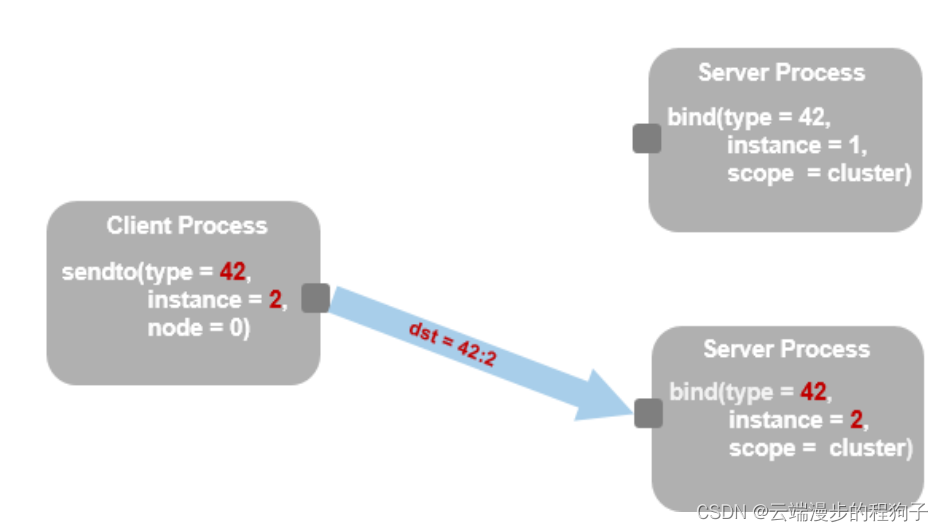
1、 Reliable transmission between nodes .
2、 receive socket Buffer overload protection
3、 There is no end-to-end flow control , Therefore, the message may still be rejected by the receiving socket .
4、 According to the configuration of sending socket , Rejected messages may be discarded or returned to the sender .
5、 If you return , The message will be truncated with an error code .Connections
Establish a connection by using a service address or socket address
1、 Use the one-way setting of data transmission information ( Also known as “0-RTT”)
2、 Or traditional TCP The style is set
1、Stream- or message oriented.
2、End-to-end flow control for socket receive buffer overflow protection.
3、No socket level sequence numbers, acknowledges or retransmissions, - link layer takes care of that.Connection breaks immediately if peer becomes unavailable.
1、Leverages link level heartbeats and kernel/socket cleanup functionality.
2、No socket level “keepalive” heartbeats needed.Communication Groups( Communication group )
Communication groups can be described as brokerless message bus instances. Such instances are user created, - the first joining member socket implicitly creates the group. This feature is available from Linux 4.14.
A socket joins a group by indicating a service address, - the address type field serves as group identity, the address instance field serves as member identity.
Groups are closed, - members can only exchange messages with other sockets in the same group.
Each member socket has two addresses: a socket address bound by the system and a service address (group:member tuple) bound by the user. Both addresses are delivered to a message receiving user.
Member sockets may optionally provide the user with join/leave events for other group members, leveraging the service tracking capabilities of the binding table.
Member sockets may optionally receive loopback copies of their own anycast/multicast/broadcast messages.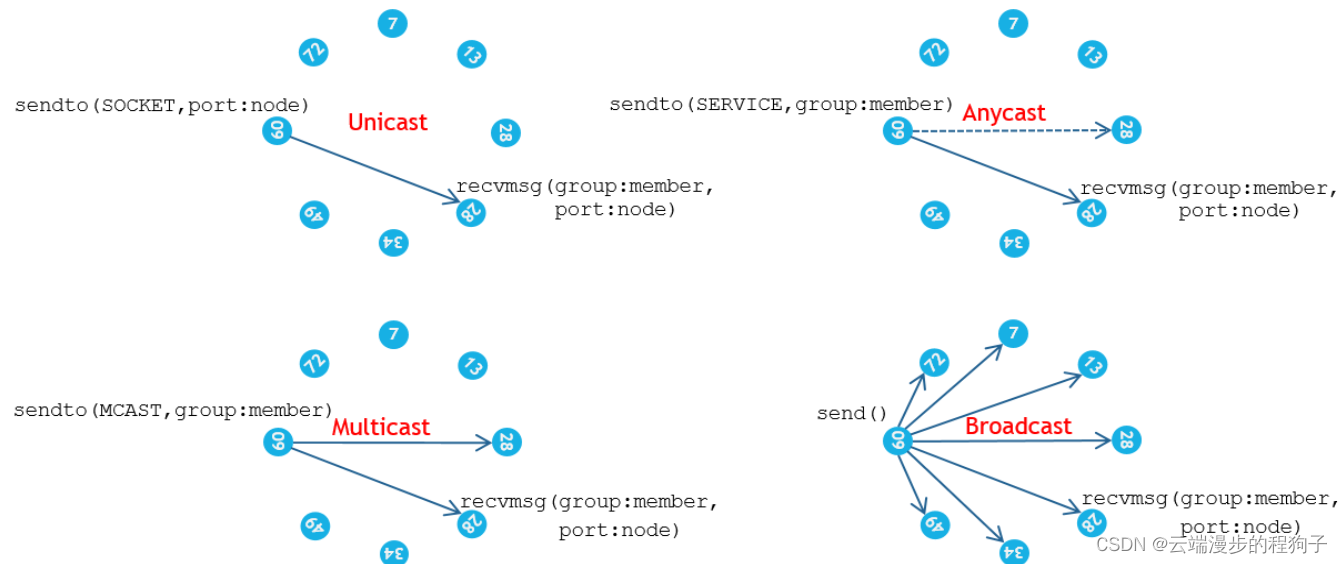
Within a group there are four different transmission modes available.
Unicast when the sender indicates a socket address as destination.
Anycast when the sender indicates a service address as destination. If there is more than one matching destination, one will be selected by round-robin, but also considering the destination’s load, which can be inferred from the destination’s advertised window.
Multicast when the sender indicates a service range as destination. If there is more than one matching destination, all of them will receive a copy of the sent message.
Broadcast when the sender uses the send() primitive with no destination address. All member sockets, irrespective of member instance number, receive a copy of the message.
Both broadcast and multicast leverage Ethernet broadcast/UDP multicast when possible and deemed favorable.
Delivery and sequence order is guaranteed, even between different transmission modes. Among other things, this implies that all messages must be subject to end-to-end flow control.
Messages will never be dropped because of destination buffer overflow.
Same mechanism covers all tranmsmission modes.
Point-to-point and point-to-multipoint: - “sliding window” algorithm.
Multipoint-to-point: - “coordinated sliding window” algorithm, unique for TIPC.
边栏推荐
- PCL extracts a subset from a point cloud
- AppGallery Connect场景化开发实战—图片存储分享
- TIPC 寻址2
- The first white paper on agile practice in Chinese enterprises was released | complete download is attached
- 计算序列之和
- 点云投影图片
- 快应用中实现自定义抽屉组件
- Summary of cases of players' disconnection and reconnection in Huawei online battle service
- Openmldb meetup No.4 meeting minutes
- 洛谷 P1892 [BOI2003]团伙(并查集变种 反集)
猜你喜欢
TIPC messaging3

使用华为性能管理服务,按需配置采样率
二叉树专题--AcWing 47. 二叉树中和为某一值的路径(前序遍历)
![[AI application] Hikvision ivms-4200 software installation](/img/4e/1640e3cafac13ce4d39520195c3217.png)
[AI application] Hikvision ivms-4200 software installation

二.Stm32f407芯片GPIO编程,寄存器操作,库函数操作和位段操作

金山云——2023届暑期实习

软件产品管理系统有哪些?12个最佳产品管理工具盘点
JSP webshell free -- the basis of JSP

One trick to quickly realize custom application titlebar
【快应用】text组件里的文字很多,旁边的div样式会被拉伸如何解决
随机推荐
学习open62541 --- [66] UA_String的生成方法
【ARK UI】HarmonyOS ETS的启动页的实现
PCL projection point cloud
static 函数中的静态变量
How to implement tabbar title bar with list component
使用华为性能管理服务,按需配置采样率
Flink two Open, implement Batch Lookup join (attached source)
二叉树专题--洛谷 P1229 遍历问题(乘法原理 已知前、后序遍历求中序遍历个数)
Special topic of binary tree -- acwing 1497 Traversal of the tree (use post and mid order traversal to build a binary tree)
力扣(LeetCode)182. 查找重复的电子邮箱(2022.07.01)
2022-06-17
How does the whole network display IP ownership?
Special topic of binary tree -- acwing 18 Rebuild the binary tree (construct the binary tree by traversing the front and middle order)
点云投影图片
flink二开,实现了个 batch lookup join(附源码)
V2x SIM dataset (Shanghai Jiaotong University & New York University)
Why does LabVIEW lose precision in floating point numbers
STM32单片机编程学习
金山云——2023届暑期实习
Oracle notes