当前位置:网站首页>Three methods of finding LCA of the nearest common ancestor
Three methods of finding LCA of the nearest common ancestor
2022-07-02 13:14:00 【litian355】
The definition of recent common ancestor : If the node c Satisfy :
Catalog
3. Use offline tarjan Algorithm for LCA Time complexity O(n+m)
1.c yes a and b The public ancestor node of .
2.c It's distance a,b The nearest public ancestor node .
Then call it c yes a and b The latest public ancestor of .
1. Upward marking method
Respectively from the a, Mark all a The ancestor node of , let b Jump up , The node that first encounters a tag is the nearest common ancestor .
n Node time complexity O(n*n)
2. Doubling Algorithm
step1: Preprocess all points from the top 2 Of k Who is the father of power ,fa[i][j] From i Start walking up 2 Of j The node to which the power can go
0<=j<=log2(n)
At the same time, preprocess the depth of each node depth[i].
step2: seek x,y The latest public ancestor of :
1. hypothesis x Depth ratio of y Big , That is to say x stay y Below , First, let x Multiply jump to and y At the same depth ( enumeration 2 Omega to an integer power )
2. Let the two points jump up at the same time , Jump to the next level of the nearest public ancestor , The answer is fa[a][0] perhaps fa[b][0];
Time complexity O(n*logn);
3. Use offline tarjan Algorithm for LCA Time complexity O(n+m)
1. The graph is divided into three categories by depth first traversal, and the representative elements of each traversed point are obtained by using the union search set :
0. No access points
1. The point being searched
2. Points that have been traversed
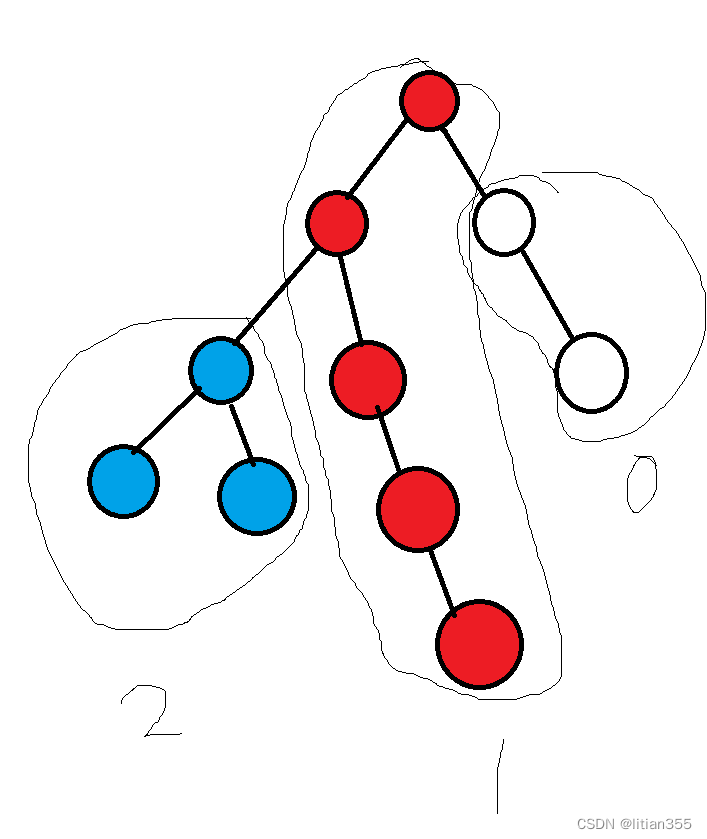
2. All the nearest common ancestors that have traversed the point associated with the point set being searched are the representative elements of this point .
Be careful : Because it is an offline algorithm, it needs to store each query and the answer of each query .
1172. Grandson asked
Given a tree containing n A rooted undirected tree of nodes , Node numbers are different from each other , But not necessarily 1∼n.
Yes m A asked , Each query gives a pair of node numbers x and y, inquiry x And y The relationship between our ancestors and grandchildren .
Input format
The first line of input includes an integer Represents the number of nodes ;
Next n One pair of integers per line a and b, Express a and b There is an undirected edge between them . If b yes −1, that a It's the root of the tree ;
The first n+2 The row is an integer m Number of questions ;
Next m That's ok , Two different positive integers per line x and y, It's a question .
Output format
For each inquiry , if x yes y Our ancestors output 1, if y yes x Our ancestors output 2, Otherwise output 0.
Data range
1≤n<=4e4,
1≤ The number of each node ≤4e4
sample input :
10
234 -1
12 234
13 234
14 234
15 234
16 234
17 234
18 234
19 234
233 19
5
234 233
233 12
233 13
233 15
233 19
sample output :
1
0
0
0
2
Naked LCA, Doubling Algorithm .
code:
// Use the multiplication algorithm to find the nearest common ancestor
//1. Let node a、b The same depth
//2. Let node a、b Jump to the LCA The next layer of .
#include<bits/stdc++.h>
using namespace std;
int n,m;
int root;
const int N=4e4+10,M=N*2;
int h[N],e[M],ne[M],idx;
int fa[N][16];
int depth[N];
void add(int a,int b){
  e[idx]=b,ne[idx]=h[a],h[a]=idx++;
}
int q[N];
void bfs(){
  int hh=0,tt=0;
  memset(depth,0x3f,sizeof depth);
  q[0]=root;
  depth[0]=0;
  depth[root]=1;
  while(hh<=tt){
    int t=q[hh++];
    for(int i=h[t];~i;i=ne[i]){
      int j=e[i];
      if(depth[j]>depth[t]+1){
        depth[j]=depth[t]+1;
        q[++tt]=j;
        fa[j][0]=t;
        for(int k=1;k<=15;k++){
          fa[j][k]=fa[fa[j][k-1]][k-1];
        }
      }
    }
  }
}
int lca(int a,int b){
  if(depth[a]<depth[b]) swap(a,b);
    for(int i=15;i>=0;i--){
      if(depth[fa[a][i]]>=depth[b]){
        a=fa[a][i];
      }
    }
    if(a==b) return a;
    for(int i=15;i>=0;i--){
    if(depth[fa[a][i]]!=depth[fa[b][i]])
      {
        a=fa[a][i];
        b=fa[b][i];
      }
    }
    return fa[a][0];
}
signed  main(){
  cin>>n;
  memset(h,-1,sizeof h);
  for(int i=1;i<=n;i++){
    int a,b;
    cin>>a>>b;
    if(b==-1) root=a;
    else add(a,b),add(b,a);
  }
  bfs();
  cin>>m;
  while(m--){
    int a,b;
    cin>>a>>b;
    int p=lca(a,b);
    if(p==a) cout<<1<<endl;
    else if(p==b) cout<<2<<endl;
    else cout<<0<<endl;
  }
  return 0;
}
1171. distance
give n A tree at a point , Ask for the shortest distance between two points many times .
Be careful :
- Side is Undirected Of .
- The number of all nodes is 1,2,…,n
Input format
The first line is two integers n and m.n Represents the number of points ,m It means the number of inquiries ;
Come down n−1 That's ok , Three integers per row x,y,k, Indication point x Sum point y There is an edge between which the length is k;
Next m That's ok , Two integers per line x,y, Indicates a query point x point-to-point y The shortest distance .
The node number in the tree is from 1 To n.
Output format
common m That's ok , For each inquiry , Output a line of query results .
Data range
2≤n≤1e4
1≤m≤2×1e4
0<k≤100
1≤x,y≤n
sample input 1:
2 2
1 2 100
1 2
2 1
sample output 1:
100
100
sample input 2:
3 2
1 2 10
3 1 15
1 2
3 2
sample output 2:
10
25
Ideas , For two nodes in the tree x,y We can use the formula for the distance between dist[x],dist[y] ,dist[lca(x,y)] , respectively x,y, as well as x and y The distance from the nearest common ancestor of to the root node .
that distance=dist[x]+dist[y]-2*dist[lca(x,y)];
code:
// Treelike tarjan Algorithm offline calculation LCA
//1. Find the distance from each point in the tree to the root node
//2. use tarjan The algorithm classifies the midpoint , Update and u About the node LCA to update dist
//
//
#include<bits/stdc++.h>
using namespace std;
typedef pair<int, int> PII;

const int N = 10010, M = N * 2;

int n, m;
int h[N], e[M], w[M], ne[M], idx;
int dist[N];
int p[N];
int res[M];
int st[N];
vector<PII> query[N];   // first Another query save point ,second Save query number

void add(int a, int b, int c)
{
    e[idx] = b, w[idx] = c, ne[idx] = h[a], h[a] = idx ++ ;
}

void dfs(int u, int fa)
{
    for (int i = h[u]; ~i; i = ne[i])
    {
        int j = e[i];
        if (j == fa) continue;
        dist[j] = dist[u] + w[i];
        dfs(j, u);
    }
}

int find(int x)
{
    if (p[x] != x) p[x] = find(p[x]);
    return p[x];
}

void tarjan(int u)
{
    st[u] = 1;
    for (int i = h[u]; ~i; i = ne[i])
    {
        int j = e[i];
        if (!st[j])
        {
            tarjan(j);
            p[j] = u;
        }
    }

    for (auto item : query[u])
    {
        int y = item.first, id = item.second;
        if (st[y] == 2)
        {
            int anc = find(y);
            res[id] = dist[u] + dist[y] - dist[anc] * 2;
        }
    }

    st[u] = 2;
}

int main()
{
    scanf("%d%d", &n, &m);
    memset(h, -1, sizeof h);
    for (int i = 0; i < n - 1; i ++ )
    {
        int a, b, c;
        scanf("%d%d%d", &a, &b, &c);
        add(a, b, c), add(b, a, c);
    }

    for (int i = 0; i < m; i ++ )
    {
        int a, b;
        scanf("%d%d", &a, &b);
        if (a != b)
        {
            query[a].push_back({b, i});
            query[b].push_back({a, i});
        }
    }

    for (int i = 1; i <= n; i ++ ) p[i] = i;

    dfs(1, -1);
    tarjan(1);

    for (int i = 0; i < m; i ++ ) printf("%d\n", res[i]);

    return 0;
}
边栏推荐
- ADB basic commands
- Unity SKFramework框架(十四)、Extension 扩展函数
- PR usage skills, how to use PR to watermark?
- 诚邀青年创作者,一起在元宇宙里与投资人、创业者交流人生如何做选择……...
- Package management tools
- Lucky numbers in the [leetcode daily question] matrix
- SSL证书的分类有哪些?如何选择合适的SSL证书?
- 面渣逆袭:MySQL六十六问,两万字+五十图详解!有点六
- [opencv learning] [moving object detection]
- 无向图的桥
猜你喜欢
Unity skframework framework (XV), singleton singleton
![[opencv learning] [template matching]](/img/4c/7214329a34974c59b4931c08046ee8.jpg)
[opencv learning] [template matching]

Unity SKFramework框架(二十一)、Texture Filter 贴图资源筛选工具
2022零代码/低代码开发白皮书【伙伴云出品】附下载
![[opencv] [image gradient]](/img/37/1f366501e2b4e70ecee6365088167c.jpg)
[opencv] [image gradient]

net share

Js1day (input / output syntax, data type, data type conversion, VaR and let differences)

自主可控三维云CAD:CrownCAD赋能企业创新设计
腾讯三面:进程写文件过程中,进程崩溃了,文件数据会丢吗?

Apply lnk306gn-tl converter, non isolated power supply
随机推荐
Sensor adxl335bcpz-rl7 3-axis accelerometer complies with rohs/weee
Jerry's weather code table [chapter]
Unity SKFramework框架(二十一)、Texture Filter 贴图资源筛选工具
Structured data, semi-structured data and unstructured data
Oracle from entry to mastery (4th Edition)
诚邀青年创作者,一起在元宇宙里与投资人、创业者交流人生如何做选择……...
记忆函数的性能优化
机器学习基础(二)——训练集和测试集的划分
自主可控三维云CAD:CrownCAD赋能企业创新设计
无向图的桥
Professor of Shanghai Jiaotong University: he Yuanjun - bounding box (containment / bounding box)
三面阿里,有惊无险成功拿到offer定级P7,只能说是真的难
【OpenGL】笔记二十九、高级光照(镜面高光)
Rust language document Lite (Part 1) - cargo, output, basic syntax, data type, ownership, structure, enumeration and pattern matching
js3day(数组操作,js冒泡排序,函数,调试窗口,作用域及作用域链,匿名函数,对象,Math对象)
OLED screen driver based on stm32
[opencv learning] [image pyramid]
Fully autonomous and controllable 3D cloud CAD: crowncad's convenient command search can quickly locate the specific location of the required command.
js1day(輸入輸出語法,數據類型,數據類型轉換,var和let區別)
Unity SKFramework框架(十二)、Score 计分模块