当前位置:网站首页>UCORE overview
UCORE overview
2022-07-03 16:45:00 【Focus on web0 years】
brief introduction
In this paper, the knowledge of the operating system is roughly studied according to the Muke materials
ucore Course documentation
Course address
lab Answer address
Some answers have questions , But it can be used for reference
The first order
CPU Initialization will be carried out after power on , Then read the first instruction in memory . Part of the memory is ROM、 Part of it is RAM. After power failure RAM Information will disappear , however ROM The content is always .
The first instruction to read is CS:IP Address to ( The value should be the default ), Just powered on CPU be in 16 In bit real mode , The addressing space size is 2 Of 20 Power (1MB),CS、IP All are 16 Bit .CS*16+IP(0xFFFF0) Is the address of the first instruction , meanwhile CS:IP To be in 2 Of 20 In the addressing space of the power . The first instruction is at the bottom 1MB In space . This first instruction and its following instructions are BIOS, It should provide some services , then CPU To access disk devices .
BIOS
BIOS Read boot sector from disk (512 byte ) Loader in , Write it to memory 0x7c00, then CS:IP Jump there and execute the loader (bootloader).
Say in detail ,BIOS Only run in real mode , It first checks the hardware , Perform device initialization . When repairing the computer , The display does not work , You can guess that there is a memory problem . because BIOS Check the memory first , It doesn't need to be checked later , Also don't start the system . Then check the inserted U disc 、 Disk or something . The information generated by inspection becomes BIOS data . although ROM The data will not disappear , But because the hardware inserted each time is different , therefore BIOS Will change these data . Finally, read the first sector of our disk .BIOS First read the main boot sector of the disk (512 byte ). Because the information provided by this thing can help us choose which operating system in the boot disk . Select and read the active partition according to the information of the primary boot sector ( Partition boot sector ). First execute the jump instruction of the partition boot sector , Jump to the startup code and start the loader .
Loader
The loader puts the disk's ucore Operating system data and code are loaded into memory , Jump to ucore Initial address . Give control to the operating system .
In detail , The loader will first read the boot configuration information from the file system , Based on this information, decide how to load the kernel , In this place, if we can get an option on the display ( Start menu ), It's good to change the parameters . Finally, skip to the kernel .
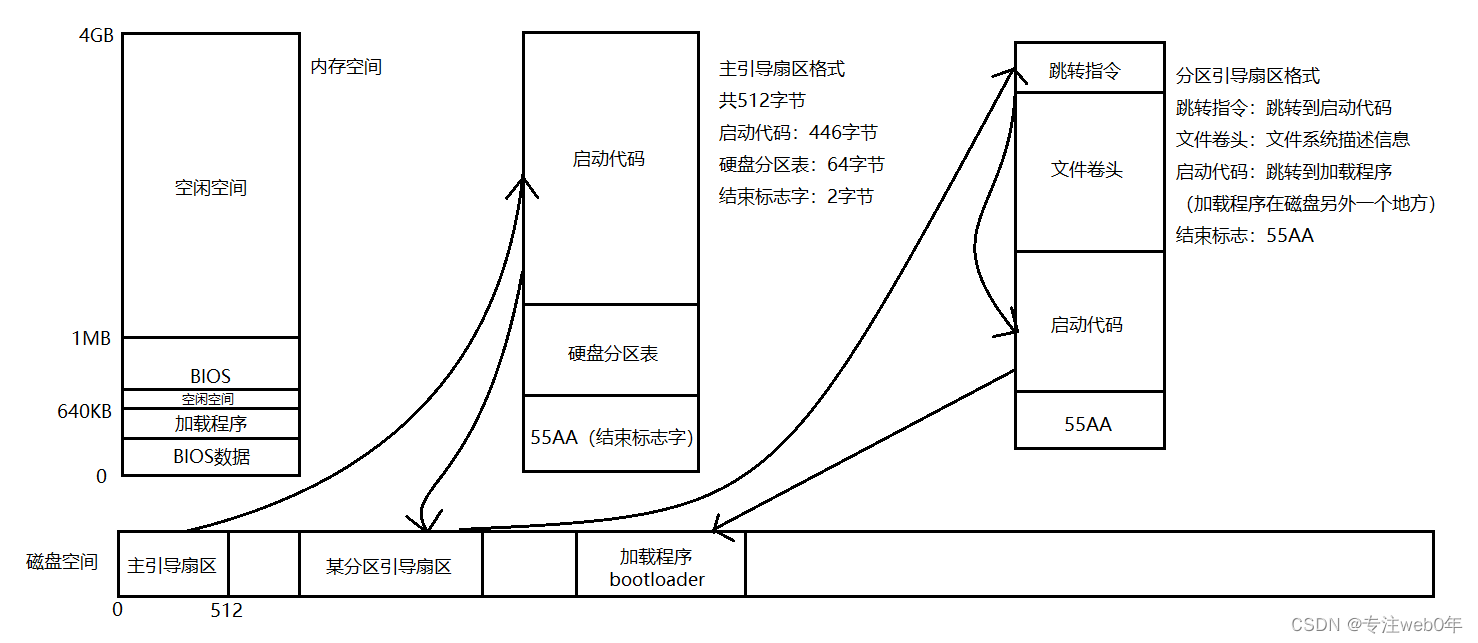
Not detailed enough
It's still rough to know these , If you write an actual program , Also based on CPU manual 、BIOS standard ( Where to read the first , Above is 0xFFFF0). So you still need to check a lot of information to write your own operating system .
System startup specification
BIOS
The hard disk partition table of the primary boot sector here has only four partition information , Information of each partition 16 byte (BIOS-MBR).BIOS-GPT Support more than four partitions .PXE It's network startup , Download data from the server to the disk to start , here BIOS There should be network download function ,BIOS It's complicated . What I said earlier is to start on the local disk .
UEFI
Start the operating system consistently on all platforms . Boot any system on the disk . For the sake of safety , Check whether the boot record is credible . Only read the boot record that meets the signature .
Check information
边栏推荐
- Preventing/catching “IllegalArgumentException: parameter must be a descendant of this view” error
- Deep understanding of grouping sets statements in SQL
- Google Earth engine (GEE) - daymet v4: daily surface weather data set (1000m resolution) including data acquisition methods for each day
- 【剑指 Offer 】57 - II. 和为s的连续正数序列
- 拼夕夕二面:说说布隆过滤器与布谷鸟过滤器?应用场景?我懵了。。
- ThreeJS 第二篇:顶点概念、几何体结构
- 【剑指 Offer】58 - I. 翻转单词顺序
- Shentong express expects an annual loss of nearly 1billion
- Mysql database -dql
- NLP four paradigms: paradigm 1: fully supervised learning in the era of non neural networks (Feature Engineering); Paradigm 2: fully supervised learning based on neural network (Architecture Engineeri
猜你喜欢

What is the material of sa302grc? American standard container plate sa302grc chemical composition

What material is sa537cl1? Sa537cl1 corresponds to the national standard material

What material is 12cr1movr? Chemical property analysis of pressure vessel steel plate 12cr1movr

What material is sa537cl2? Analysis of mechanical properties of American standard container plate
PyTorch 1.12发布,正式支持苹果M1芯片GPU加速,修复众多Bug
Thread pool executes scheduled tasks
There are several APIs of airtest and poco that are easy to use wrong in "super". See if you have encountered them

What is the pledge pool and how to pledge?
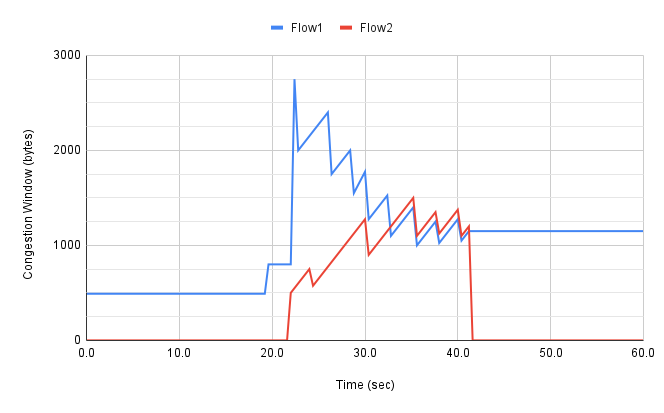
TCP congestion control details | 3 design space

What material is sa537cl2 equivalent to in China? Sa537cl2 corresponding material
随机推荐
Overview of satellite navigation system
Data driving of appium framework for mobile terminal automated testing
PHP CI (CodeIgniter) log level setting
Top k questions of interview
What kind of material is 14Cr1MoR? Analysis of chemical composition and mechanical properties of 14Cr1MoR
NSQ源码安装运行过程
Daily code 300 lines learning notes day 10
PHP production website active push (website)
深入理解 SQL 中的 Grouping Sets 语句
PHP CI(CodeIgniter)log级别设置
Characteristic polynomial and constant coefficient homogeneous linear recurrence
手机注册股票开户安全吗 开户需要钱吗
PyTorch 1.12发布,正式支持苹果M1芯片GPU加速,修复众多Bug
Mysql database DDL and DML
[mathematical logic] equivalent calculus and reasoning calculus of propositional logic (propositional logic | equivalent calculus | principal conjunctive (disjunctive) paradigm | reasoning calculus)**
[combinatorics] recursive equation (example 1 of recursive equation | list recursive equation)
MySQL user management
Détails du contrôle de la congestion TCP | 3. Espace de conception
Acwing game 58
Mysql 将逗号隔开的属性字段数据由列转行