当前位置:网站首页>Redis design and Implementation (II) | database (deletion strategy & expiration elimination strategy)
Redis design and Implementation (II) | database (deletion strategy & expiration elimination strategy)
2022-06-30 08:21:00 【Just look, not like】
List of articles
database
1. Database in server
- structure
struct redisServer {

    //  An array holds all the databases of the server
    redisDb *db;
    //  Number of databases on the server
    int dbnum;
    //  Record the database being used by the client
	redisDb *db;
}
1.1 Switch database
- summary
redisBoth the server and the client in the server maintain16A database , The default is0Number , Can passselect( The bottom layer is through modificationredisClient.dbPointer to modify ) To change the database point of the client

1.2 Database key space
- summary
Redis It's a key-value pair
(key-value pair)database server , Each database in the server consists of aredis.h/redisDbStructural representation , among ,redisDbStructuraldictThe dictionary holds all key value pairs in the database , We call this dictionary key space(key space ):
- The key of the key space is also the key of the database , Each key is a string object .
- The value of the key space is the value of the database , Each value can be a string object 、 List objects 、 Hash table object 、 Any of a collection object and an ordered collection object Redis object .
typedef struct redisDb {

	// ...
	// Database key space , Save all key value pairs in the database
	dict *dict;
	// Save the integer representation number of the database
	redisDb *id;
	// The expiration time of the save key
	redisDb *expires;
}redisDb;
- Example
redis>SET message "hello world"
OK
redis> RPUSH alphabet "a" "b" "c"
(integer) 3
redis> HSET book name "Redis in Action"
(integer) 1
redis> HSET book author "Josiah L.Carlson"
(integer) 1
redis>HSET book publisher "Manning"
(integer) 1

Procedure for finding keys ()
- summary
There is no need to add, delete or change , It's simple , Just find the location and perform the corresponding operation , We said earlier redis The whole data is based on k-v Is stored in the form of , that redisDb Dictionary in structure Dict The bottom layer is the hash table ,Dict Address to hash table , As we said before , Hash table is divided into 0 Number and 1 Number ;0 Number is used to store elements ,1 Number is rehash When using
lookup ( Addressing ) The process :
- First judge 0 Hash table No ,1 Whether the hash table is empty , If 0 If No. is empty, it will directly return null.
- Judge 0 No. is in progress rehash, If in the rehashing Stage , that 2 All tables may exist key. If it's going on rehash, Will call once _dictRehashStep Method ,_dictRehashStep For database dictionary 、 And hash key dictionary for passive rehash.
- To calculate hash value , According to the current dictionary and key value , To calculate the hash value .
- Calculate the index , According to the current dictionary and hash value , To calculate the key The index .
- According to the index value , Find the corresponding linked list , Traverse the link to find key Matching data .
- When ht[0] After searching , Again rehash Judge , If not rehashing, And end it , Otherwise, yes ht[1] repeat
3 4 5step .( If in the rehashing Stage , be ht[1] It may also exist key, At this time, you need to ht[1] Repeat on 345 step , If not rehash Stage , be ht[1] If it is empty, there is no need to judge )
1.4 Set the key's lifetime or expiration time
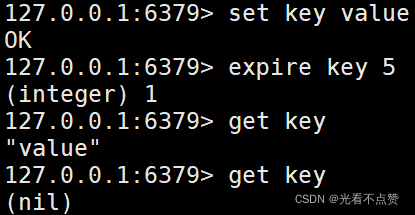
- Set the expiration time of the key
expire and expireatIt's all about setting the expiration time , One moresetexcommand , This is to set a string key and set the expiration time for the key ,setexString keys only

- Get the expiration time of the key
TTL and PTTL Command can get the remaining expiration time of a key , These remaining expiration times are saved in redisDB Of expires Dictionaries ( Out of date Dictionary ) in

Expired key determination :
- Through out of date dictionaries , The program can use the following steps to check whether a given key has expired
Check whether the given key exists in the expired Dictionary ; If there is , So get the expiration time of the key
- Check current UNIX Whether the time stamp is greater than the expiration time of the key
- If yes , Then the key has expired
- No. , Key not expired
- Summarize four commands for setting expiration time
EXPIRE<key> <ttl>: The command is used to key key The lifetime of is set to ttl second .PEXPIRE<key> <ttl>: The command is used to key key The lifetime of is set to ttl millisecond .EXPIREAT<key> <timestamp>: The command is used to key key The expiration time for is set to timestamp The time stamp of the specified number of seconds .PEXPIREAT<key> <timestamp>: The command is used to key key The expiration time for is set to timestamp The specified number of milliseconds .
- summary
Although there are many different units and different forms of setting commands , But actually
EXPIRE、PEXPIRE、EXPIREATAll three commands usePEXPIREATCommand to achieve : No matter which of the above four commands is executed by the client , After the conversion , The final execution effect is the same as the executionPEXPIREATcommand .

- Remove expiration time
persistcommand
- Expired keys under two persistence policies
- about ROB The generation and loading of files ignore the expiration key, that is, they are not affected by the expiration key , But the process is a little different , For example, for ROB When loading files , If it is loaded into the slave server, all keys will be loaded , However, when synchronizing to the primary server, the expiration key will be filtered out
- about AOF File writing and rewriting are the same as filtering out expired keys
- Copy
When the master and slave servers are replicating , Whether the expiration key is deleted or not is entirely up to the master server , After the primary server queries, it is checked that this key is an expired key to be deleted DEL command , This command synchronizes to the slave server and deletes the corresponding key from the server , Because of this mechanism , When the master server and the slave server have the same expiration key and the reconstruction is not queried and checked on the master server DEL when , When you query the expired key from the server, you will return the corresponding value It's worth it , But if you visit the primary server first, you will return null, And delete the key of the master-slave server
- Database notification
- Key space notification : Pay attention to what commands are executed on this key
- Key time notification : Notice what key is executing a command
1.5 Expiration deletion policy & Redis Expired policies used
Expiration deletion policy
- Three deletion strategies for expired keys , The first and third are active deletion strategies , The second is passive deletion
- Delete regularly : While setting the key expiration time , Create a timer (timer), Let the timer when the key expires , Delete the key immediately .
- Lazy deletion : Let the key expire , But every time you get a key from the key space , Check whether the obtained key is expired , If it's overdue , Delete the key ; If it doesn't expire , Just go back to the key .
- Delete periodically : Every once in a while , Program on the database for a check , Delete the expiration key inside . As for how many expiration keys to delete , And how many databases to check , It's up to the algorithm .
- Delete regularly
advantage : Timing is very memory friendly ,
shortcoming :
- But for CPU Will increase resource consumption , When there are a large number of expired keys, it is necessary to establish a timer to record the deletion , that CPU Will take a long time to process , When there are many connections to handle CPU Resources should be placed on processing connections rather than deleting expired keys ,
- And the creation timer needs redis Middleware to assist implementation , This is a linked list, and the timer needs to On Complexity , That's why I picked up sesame seeds and lost watermelon **
- Lazy deletion
advantage : This pair CPU It's friendly , You can check the expiration time after getting the key , This can ensure that the operation of deleting the expired key will only be carried out when it has to be done , And the target of deletion is limited to the currently processed key , This policy does not spend any time deleting other unrelated expired keys CPU Time
shortcoming : But not memory friendly , Because a key that has expired will still be saved in the database , As long as this key is not deleted, it will remain in memory , When enough expired keys are not deleted, it can be regarded as a memory leak , The server will not take the initiative to release . So especially for log journal , When it exceeds a certain time, it will be automatically deleted
- Delete periodically
For the complementarity of the above two strategies , But we need to find a balance between time and frequency , Otherwise, there will be serious consequences
- Periodically delete the policy and delete the expired key every once in a while , And by limiting the duration and frequency of deletion operation, the deletion operation pair can be reduced CPU The effect of time
- By removing the expired key on a regular basis , The periodic deletion strategy effectively reduces the memory waste caused by expired keys
Redis Expired policies used
- Redis Expired policies used
Redis Use lazy delete and periodic delete fits , The server can allocate resources reasonably
Implementation of lazy delete strategy :
The lazy deletion policy for expired keys is determined by expireIfNeeded Function implementation , All read and write databases Redis Commands call... Before execution expireIfNeeded Function to check the input key ( This function is like a AOP Prior notice of , Delete expired keys before actually executing the command )
- If the input key has expired , that expireIfNeeded Function deletes the input key from the database
- If the input key has not expired , that expireIfNeeded The function does not act
Periodically delete the implementation of the policy :
The periodic deletion policy of expired keys is determined by activeExpireCycle Function implementation , whenever Redis The periodic operation of the server serverCron Function execution time ,activeExpireCycle The function will be called , It's within the prescribed time , Traverse the databases in the server several times , From the database expires Randomly check the expiration time of some keys in the dictionary , And delete the expiration key
- The running steps of the function :
- Every time the function runs , Take a certain number of random keys from a certain number of databases for inspection , And delete the expiration key
- Global variables current_db Will record the current activeExpireCycle Function to check the progress , And next time activeExpireCycle When a function is called , Then process the last progress . for instance , If at present activeExpireCycle The function is traversing 10 Database number returned , So next time activeExpireCycle Function execution time , Will be taken from 11 No. database starts to find and delete expired keys
- With activeExpireCycle The continuous execution of functions , All databases in the server will be checked , Then the function will current_db The variable is reset to 0, Then start a new round of inspection again
1.6 Redis Expiration elimination strategy
- summary
With the expiration time, there may still be a large number of key Can't be cleaned up OOM, So in order to solve this problem ,Redis To build the 8 Expiration elimination strategy in , To complement expired deletion
- The classification is as follows
volatile-lru(least recently used): From the set of data for which the expiration time has been set (server.db[i].expires) Choose the least recent to make ⽤ The data is eliminated .allkeys-lru(least recently used): When memory is not ⾜ To accommodate newly written ⼊ Data time , In key space , Remove the most recent to make ⽤ Of key( This is the most common ⽤ Of ).
3.volatile-lfu(least frequently used): From the set of data for which the expiration time has been set (server.db[i].expires) Choose the least often to make ⽤ The data is eliminated .allkeys-lfu(least frequently used): When memory is not ⾜ To accommodate newly written ⼊ Data time , In key space , Remove the least frequently made ⽤ Of key.volatile-random: From the set of data for which the expiration time has been set (server.db[i].expires) In the arbitrary selection of data elimination .allkeys-random: From the data set (server.db[i].dict) In the arbitrary selection of data elimination .volatile-ttl(time to live): From the set of data for which the expiration time has been set (server.db[i].expires) To select the data to be expired .no-eviction: Forbid ⽌ Expulsion data , That is, when memory is not ⾜ To accommodate newly written ⼊ Data time , New writing ⼊ The operation will report an error .( The default configuration , But you shouldn't use this ).
LRU The implementation of the :
Redis One was maintained internally 24 Bit clock , Each object also maintains a clock , Every time you use an object , The clock will become the timestamp of the current system , When it needs to be done LRU When , For example, select the clock to eliminate the object with the longest current system time .
LFU The implementation of the :
take 24 The bit clock is divided into two parts , front 16 Bits represent time , after 8 Bits represent the number of times used , If used many times before , It has not been used recently. It will decay according to time , in addition , To prevent a key Just joined and deleted , So I'll be interested in the new key Assign an initial value 5.
边栏推荐
- Opencv video
- Redis设计与实现(七)| 发布 & 订阅
- C# ListBox如何获取选中的内容(搜了很多无效的文章)
- [flower carving experience] 14 line blank board pingpong library test external sensor module (one)
- Build a docker image of Henkel database from 0
- MySQL cannot connect to the intranet database
- Unity simple shader
- Conversion between basic data types in go data types
- Is it difficult to jump job ByteDance? With these skills, you can easily pass
- [flower carving experience] 13 build the platformio ide development environment of esp32c3
猜你喜欢

【NVMe2.0b 14-8】Set Features(下篇)

Gilbert Strang's course notes on linear algebra - Lesson 4
![[untitled]](/img/b8/e3f54fe5d1079663799887e62cb07c.jpg)
[untitled]

What management improvements can CRM bring to enterprises

1. Problems related to OpenGL window and environment configuration

【NVMe2.0b 14-2】Create/Delete Queue

Graffiti Wi Fi & ble SoC development slide strip

【NVMe2.0b 14】NVMe Admin Command Set

电流探头电路分析

Do you know the IP protocol?
随机推荐
Qqquickpainteditem implements graffiti program drawing board
Want to ask, how to choose securities companies for stock speculation? Is it safe to open an account online?
What management improvements can CRM bring to enterprises
【NVMe2.0b 14-6】Format NVM、Keep Alive、Lockdown command
【NVMe2.0b 14-3】Doorbell Buffer Config command、Device Self-test command
TP5 set direct download file
【NVMe2.0b 14-6】Format NVM、Keep Alive、Lockdown command
How CRM & PM helps enterprises create optimal sales performance
【kotlin 协程】万字协程 一篇完成kotlin 协程进阶
Leetcode47. full arrangement II
String and underlying character types of go data type
Swagger use
Wechat official account third-party platform development, zero foundation entry. I want to teach you
全栈最全性能测试理论-总结
Cesium learning notes (II) uploading data using rest API
【NVMe2.0b 14-5】Firmware Download/Commit command
Construction of energy conservation supervision system for campus buildings of ankery University
Experiment 3 remote control
C # listbox how to get the selected content (search many invalid articles)
涂鸦Wi-Fi&BLE SoC开发幻彩灯带