当前位置:网站首页>神经网络入门之模型选择(PyTorch)
神经网络入门之模型选择(PyTorch)
2022-07-03 09:27:00 【-素心向暖】
文章目录
模型选择
训练误差和泛化误差
- 训练误差:模型在训练数据上的误差
- 泛化误差:模型在新数据上的误差
- 例子:根据模考成绩来预测未来考试分数
- 在过去的考试中表现很好(训练误差)不代表未来考试一定很好(泛化误差)
- 学生 A 通过背书在模考中拿到很好成绩
- 学生 B 知道答案后面的原因
验证数据集和测试数据集
- 验证数据集:一个用来评估模型好坏的数据集
- 例如拿出50%的训练数据
- 不要跟训练数据混在一起(常犯错误)
- 测试数据集:只用一次的数据集。例如
- 未来的考试
- 我出价的房子的实际成交价
- 用在 Kaggle 私有排行版中的数据集
- 因为验证数据集没有参与训练,一定程度上可以反映模型超参数选择的好坏
- 验证数据集和训练数据及一定不能混在一起
K-则交叉验证
- 在没有足够多数据时使用(这是常态)
- 算法:
- 将训练数据分割成 K 快
- For i =1,…,K
- 使用第 i 块作为验证数据集,其余的作为训练数据集
- 报告 K 个验证数据集误差的平均
- 常用:K=5 或 10
validation dataset 测试数据集
总结
- 训练数据集:训练模型参数
- 验证数据集:选择模型超参数
- 非大数据集上通常使用 k-折交叉验证
k-折交叉验证(k-fold cross-validation)
分成K份,做K次,每次留一份做验证,剩下的作为训练集
来通过K折的平均误差来判断超参数的好坏
过拟合和欠拟合
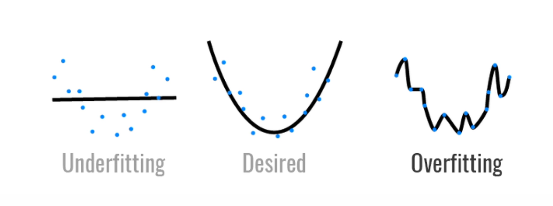
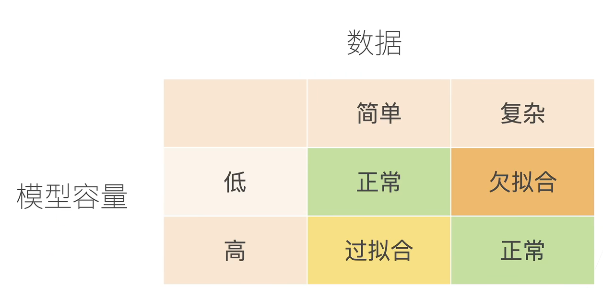
capacity 容量,也可以理解为能力
模型容量
- 拟合各种函数的能力
- 低容量的模型难以拟合训练数据
- 高容量的模型可以记住所有的训练数据
模型容量的选择
高阶多项式函数比低阶多项式函数复杂得多。 高阶多项式的参数较多,模型函数的选择范围较广。 因此在固定训练数据集的情况下, 高阶多项式函数相对于低阶多项式的训练误差应该始终更低(最坏也是相等)。 事实上,当数据样本包含了 x x x的不同值时, 函数阶数等于数据样本数量的多项式函数可以完美拟合训练集。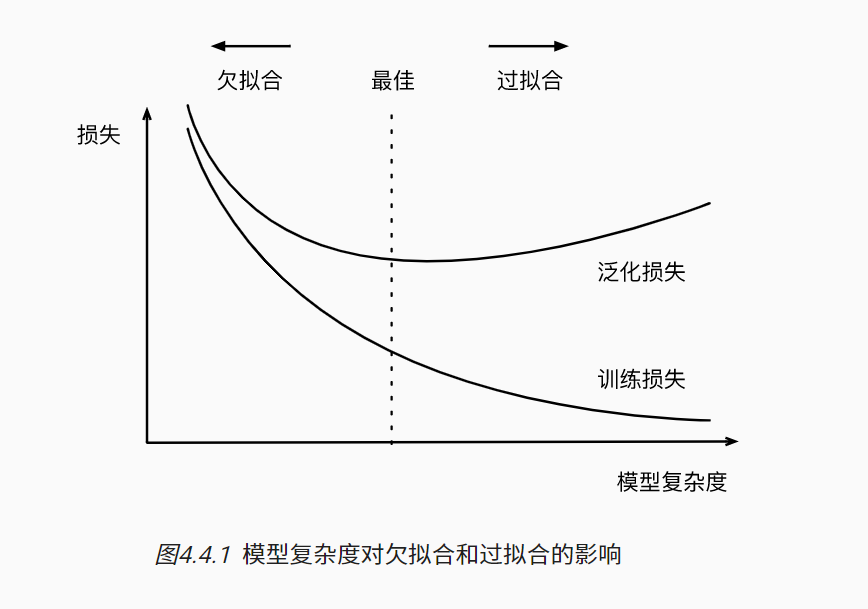
估计模型容量
- 难以在不同的种类算法之间比较
- 例如树模型和神经网络
- 给定一个模型种类,将有两个主要参数
- 参数的个数
- 参数值的选择范围

线性模型的参数个数是 d+1 ,1是参数的偏移
VC维
- 统计学习理论的一个核心思想
- 对于一个分类模型,VC等于一个最大的数据集的大小,不管如何给定标号,都存在一个模型来对它进行完美分类
林轩田这块讲得很好(vc dimension),<<机器学习基石>>
线性分类器的VC维
2维输入的感知机,VC维=3
- 能够分类任何三个点,但不是4个(xor)


- 能够分类任何三个点,但不是4个(xor)
支持 N 维输入的感知机的 VC 维是 N+1
一些多层感知机的 VC 维 O ( N l o g 2 N ) O(N log_2N) O(Nlog2N)
2为输入感知机意思是,输入特征是2,输出是1
VC维的用处
- 提供为什么一个模型好的理论依据
- 它可以衡量训练误差和泛化误差之间的间隔
- 但深度学习中很少使用
- 衡量不是很准确
- 计算深度学习模型的 VC 维很困难
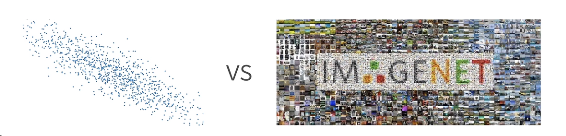
数据复杂度
- 多个重要因素
- 样本个数
- 每个样本的元素个数
- 时间、空间结构
- 多样性
总结
- 模型容量需要匹配数据复杂度,否则可能导致欠拟合和过拟合
- 统计机器学习提供数学工具来衡量模型复杂度
- 实际中一般靠观察训练误差和验证误差
代码
多项式回归
通过多项式拟合来探索这些概念
import math
import numpy as np
import torch
from torch import nn
from d2l import torch as d2l
生成数据集
给定,我们将使用以下三阶多项式来生成训练和测试数据的标签:
噪声项 ϵ \epsilon ϵ服从均值为0且标准差为0.1的正态分布。 在优化的过程中,我们通常希望避免非常大的梯度值或损失值。 这就是我们将特征从 x i x^i xi调整为 x i i ! {x^i \over i!} i!xi的原因, 这样可以避免很大的带来的特别大的指数值。 我们将为训练集和测试集各生成100个样本。
max_degree = 20  # 多项式的最大阶数
n_train, n_test = 100, 100  # 训练和测试数据集大小
true_w = np.zeros(max_degree)  # 分配大量的空间
true_w[0:4] = np.array([5, 1.2, -3.4, 5.6])

features = np.random.normal(size=(n_train + n_test, 1))
np.random.shuffle(features)
poly_features = np.power(features, np.arange(max_degree).reshape(1, -1))
for i in range(max_degree):
    poly_features[:, i] /= math.gamma(i + 1)  # gamma(n)=(n-1)!
# labels的维度:(n_train+n_test,)
labels = np.dot(poly_features, true_w)
labels += np.random.normal(scale=0.1, size=labels.shape)
同样,存储在poly_features中的单项式由gamma函数重新缩放,其中 Γ ( n ) = ( n − 1 ) ! \Gamma(n)=(n-1)! Γ(n)=(n−1)!。 从生成的数据集中查看一下前2个样本, 第一个值是与偏置相对应的常量特征。
# NumPy ndarray转换为tensor
true_w, features, poly_features, labels = [torch.tensor(x, dtype=
    torch.float32) for x in [true_w, features, poly_features, labels]]

features[:2], poly_features[:2, :], labels[:2]
对模型进行训练和测试
损失函数
首先让我们实现一个函数来评估模型在给定数据集上的损失。
def evaluate_loss(net, data_iter, loss):  #@save
    """评估给定数据集上模型的损失"""
    metric = d2l.Accumulator(2)  # 损失的总和,样本数量
    for X, y in data_iter:
        out = net(X)
        y = y.reshape(out.shape)
        l = loss(out, y)
        metric.add(l.sum(), l.numel())
    return metric[0] / metric[1]
训练函数
现在定义训练函数。
def train(train_features, test_features, train_labels, test_labels,
          num_epochs=400):
    loss = nn.MSELoss(reduction='none')
    input_shape = train_features.shape[-1]
    # 不设置偏置,因为我们已经在多项式中实现了它
    net = nn.Sequential(nn.Linear(input_shape, 1, bias=False))
    batch_size = min(10, train_labels.shape[0])
    train_iter = d2l.load_array((train_features, train_labels.reshape(-1,1)),
                                batch_size)
    test_iter = d2l.load_array((test_features, test_labels.reshape(-1,1)),
                               batch_size, is_train=False)
    trainer = torch.optim.SGD(net.parameters(), lr=0.01)
    animator = d2l.Animator(xlabel='epoch', ylabel='loss', yscale='log',
                            xlim=[1, num_epochs], ylim=[1e-3, 1e2],
                            legend=['train', 'test'])
    for epoch in range(num_epochs):
        d2l.train_epoch_ch3(net, train_iter, loss, trainer)
        if epoch == 0 or (epoch + 1) % 20 == 0:
            animator.add(epoch + 1, (evaluate_loss(net, train_iter, loss),
                                     evaluate_loss(net, test_iter, loss)))
    print('weight:', net[0].weight.data.numpy())
三阶多项式函数拟合(正常)
我们将首先使用三阶多项式函数,它与数据生成函数的阶数相同。 结果表明,该模型能有效降低训练损失和测试损失。 学习到的模型参数也接近真实值 w = [ 5 , 1.2 , − 3.4 , 5.6 ] w=[5, 1.2, -3.4, 5.6] w=[5,1.2,−3.4,5.6]。
# 从多项式特征中选择前4个维度,即1,x,x^2/2!,x^3/3!
train(poly_features[:n_train, :4], poly_features[n_train:, :4],
      labels[:n_train], labels[n_train:])
weight: [[ 5.0008 1.2447366 -3.4524488 5.443078]]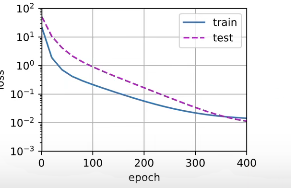
线性函数拟合(欠拟合)
让我们再看看线性函数拟合,减少该模型的训练损失相对困难。 在最后一个迭代周期完成后,训练损失仍然很高。 当用来拟合非线性模式(如这里的三阶多项式函数)时,线性模型容易欠拟合。
# 从多项式特征中选择前2个维度,即1和x
train(poly_features[:n_train, :2], poly_features[n_train:, :2],
      labels[:n_train], labels[n_train:])
weight: [[3.4807658 3.1861916]]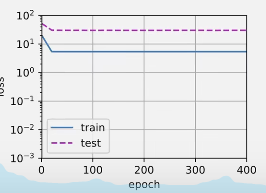
损失根本就没怎么降
高阶多项式函数拟合(过拟合)
现在,让我们尝试使用一个阶数过高的多项式来训练模型。 在这种情况下,没有足够的数据用于学到高阶系数应该具有接近于零的值。 因此,这个过于复杂的模型会轻易受到训练数据中噪声的影响。 虽然训练损失可以有效地降低,但测试损失仍然很高。 结果表明,复杂模型对数据造成了过拟合。
# 从多项式特征中选取所有维度
train(poly_features[:n_train, :], poly_features[n_train:, :],
      labels[:n_train], labels[n_train:], num_epochs=1500)
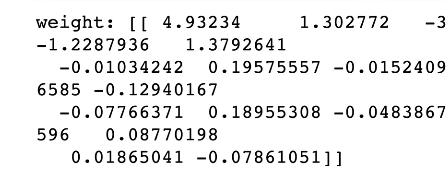
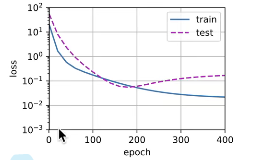
可以看到后面W本来应该都是0的,都被赋予了值
QA
时间序列上的数据,训练集和验证集可能会有自相关性,这时候应该怎么处理?
切一块,不能从中间取一块模型参数和超参数不一样吗?
模型参数是指W和b
超参数,例如是选线性模型还是多层感知机。如果是多层感知机,是选多少层,每层多大,训练的时候学习率是多少。模型参数以外,所有我们要来设计的,都是超参数。如何有效设计超参数,是不是只能搜索?最好用的搜索是贝叶斯方法还是网格、随机?
超参数的设计靠自己的经验。
可以每次随机选择一个模型,然后遍历出其中最好的一个。
边栏推荐
- CV learning notes - image filter
- Handwritten digit recognition: CNN alexnet
- [LZY learning notes -dive into deep learning] math preparation 2.1-2.4
- 20220601 Mathematics: zero after factorial
- CV learning notes - edge extraction
- Hands on deep learning pytorch version exercise solution -- implementation of 3-2 linear regression from scratch
- The imitation of jd.com e-commerce project is coming
- High imitation bosom friend manke comic app
- Rewrite Boston house price forecast task (using paddlepaddlepaddle)
- CV learning notes - camera model (Euclidean transformation and affine transformation)
猜你喜欢

Timo background management system
重写波士顿房价预测任务(使用飞桨paddlepaddle)
LeetCode - 715. Range 模块(TreeSet) *****

CV learning notes alexnet
LeetCode - 715. Range module (TreeSet)*****

Leetcode - the k-th element in 703 data flow (design priority queue)

Neural Network Fundamentals (1)

CV learning notes - scale invariant feature transformation (SIFT)

What can I do to exit the current operation and confirm it twice?
Basic use and actual combat sharing of crash tool
随机推荐
Leetcode-100:相同的树
LeetCode - 5 最长回文子串
Leetcode刷题---1385
Leetcode刷题---202
Hands on deep learning pytorch version exercise solution - 2.3 linear algebra
重写波士顿房价预测任务(使用飞桨paddlepaddle)
二分查找法
Leetcode刷题---10
实战篇:Oracle 数据库标准版(SE)转换为企业版(EE)
[LZY learning notes dive into deep learning] 3.4 3.6 3.7 softmax principle and Implementation
Leetcode刷题---374
Seata分布式事务失效,不生效(事务不回滚)的常见场景
Leetcode - 1172 plate stack (Design - list + small top pile + stack))
CV learning notes - BP neural network training example (including detailed calculation process and formula derivation)
GAOFAN Weibo app
[C question set] of Ⅵ
Out of the box high color background system
20220601 Mathematics: zero after factorial
LeetCode - 1172 餐盘栈 (设计 - List + 小顶堆 + 栈))
. DLL and Differences between lib files