当前位置:网站首页>Learn CV two loss function from scratch (1)
Learn CV two loss function from scratch (1)
2022-07-08 02:19:00 【pogg_】

notes : Most of the content of this blog is not original , But I sort out the data I collected before , And integrate them with their own stupid solutions , Convenient for review , All references have been cited , And has been praised and collected ~
Preface : In deep learning , The loss function plays an important role . Through the loss function, the model can reach the convergence state , Reduce the error of model prediction . therefore , The influence of different loss functions on the model is also different ( One of the daily work of the dispatcher ). In this chapter , We will explain what is the loss function , Image classification 、 object detection 、 What are the common loss functions of face recognition , What are the specific characteristics ~
1. What is the loss function
In a nutshell , Loss function (loss function) It is used to estimate the predicted value of the model f(x) And the real value Y The degree of inconsistency , It's a non negative real value function , Usually use L(Y, f(x)) To express , The smaller the loss function , The better the robustness of the model .
2. The kind of loss function
2.1 Image classification
2.1.1 Cross entropy loss (Cross Entropy Loss)
For the classification problem , The most commonly used loss function is the cross entropy loss function Cross Entropy Loss, however , The cross entropy loss function can be divided into two application scenarios .
1. II. Classification scenario
Consider two categories , In the second category we usually use Sigmoid Function to compress the output of the model to (0, 1) Within the interval , Since there are only two categories of problems, there are only positive and negative categories ( Yes or no ), So we also get the probability of negative classes .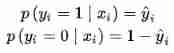
From the perspective of maximum likelihood , The two cases can be combined into one formula :
I don't know ? In fact, it can be seen that
When the real sample label y=0 when , The first term of the above formula ( y ^ i ) y i \left(\hat{y}_{i}\right)^{y_{i}} (y^i)yi The value is 1, The probability equation is transformed into :
When the real sample label y=1 when , The second term of the above formula ( 1 − y ^ i ) 1 − y i \left(1-\hat{y}_{i}\right)^{1-y_{i}} (1−y^i)1−yi for 1, The probability equation is transformed into :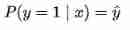
It is the same as the two formulas given at the beginning !
Suppose the data points are independent and identically distributed , Then the likelihood can be expressed as 
Log the likelihood , Then add a minus sign to minimize the negative log likelihood , Is the form of cross entropy loss function 
The following figure is a visualization of the cross entropy loss function of two categories , The blue line is the target value of 0 The loss of different outputs , The yellow line is the target value of 1 The loss of time . You can see that the closer you get to the target value loss The smaller it is , As the error increases ,loss Exponential growth .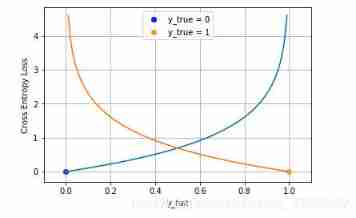
2. Multi category scenarios
In multi category tasks , The derivation of cross entropy loss function is the same as that of binary classification , What changes is the real value y_i Now it's a One-hot vector [4], At the same time, the compression of the model output is changed from the original Sigmoid Replace function with Softmax function ( We said in the last chapter ,sigmoid The function is softmax A special case of , It works softmax Of , It will work sigmoid. Concrete , When the scene becomes binary ,softmax≈sigmoid, Although not rigorous , But it is convenient for everyone to understand ). Softmax The function limits the output range of each dimension to (0,1) Between , At the same time, the output sum of all dimensions is 1, Used to represent a probability distribution .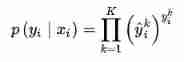
among k ∈ K k \in K k∈K Express K One of the categories , The same assumption is that data points are independent and identically distributed , The negative log likelihood can be obtained as 
because y i y_i yi It's a one-hot vector , Except that the target class is 1 The output on other categories is 0, Therefore, the above formula can also be written as 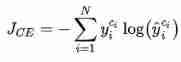
among c i c_i ci Is the sample x i x_i xi Target class of . Usually, this cross entropy loss function applied to multi classification is also called Softmax Loss perhaps Categorical Cross Entropy Loss.
3. Characteristics of cross entropy loss function
(1) It's also a logarithmic likelihood function in essence , It can be used in binary and multi classification tasks .
(2) When using sigmoid As an activation function , Cross entropy loss function is often used instead of mean square error loss function , Because it can perfectly solve the problem that the weight of the square loss function is updated too slowly , have ” When the error is large , Weight update fast ; When the error is small , Weight update is slow ” Good properties of .
2.1.2 Hinge loss (Hinge Loss)
Hinge loss Hinge Loss Is another two class loss function , Support vector machine Support Vector Machine (SVM) The loss function of the model is essentially Hinge Loss + L2 Regularization . The formula of hinge loss is as follows 
characteristic :
(1) Hinge Loss It means that if it is classified correctly , The loss is 0, Otherwise, the loss will be 1 − y f ( x ) 1-y f(x) 1−yf(x) .SVM Is to use this loss function .
(2) General f(x) It's the forecast , stay -1 To 1 Between ,y It's the target value (-1 or 1), Its meaning is ,f(x) The value of the -1 and +1 Just between , Do not encourage |f(x)| > 1, That is, the classifier is not encouraged to be overconfident , Make a correctly classified sample more than... From the dividing line 1 There will be no reward , Thus, the classifier can focus more on the overall error .
(3) Robustness is relatively high , For outliers 、 Noise is not sensitive , But it doesn't have a very good probability explanation .
5.1.3 0-1 Loss (zero-one loss)
0-1 Loss refers to the fact that the predicted value is not equal to the target value, which is 1, Otherwise 0: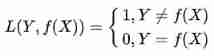
characteristic :
(1) 0-1 The loss function directly corresponds to the number of classification errors , But it's a nonconvex function .
(2) The perceptron uses this loss function . But the condition of equality is too strict , So you can relax the conditions , The meet ∣ Y − f ( x ) ∣ < T |Y- f(x)| < T ∣Y−f(x)∣<T When you think it's equal , The recent fire RepMlp You can pay attention to .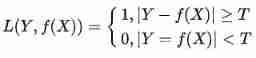
Structure diagram of multilayer perceptron (MLP and CNN Similar structure , but MLP The input is the column vector , and CNN It's a matrix ):
2.2 object detection
The loss function of target detection task is determined by Classificition Loss and Bounding Box Regeression Loss Two parts make up . The following describes the target detection tasks in recent years Bounding Box Regression Loss Function The evolution of , Its evolution route is Smooth L1 Loss→IoU Loss→GIoU Loss→DIoU Loss→CIoU Loss, This article follows this route .
2.2.1 Smooth L1 Loss
This method was proposed by Microsoft ,Fast RCNN This method is proposed in this paper
hypothesis x Is the difference between the predicted box and the real box , frequently-used L1 and L2 as well as Smooth Loss Defined as :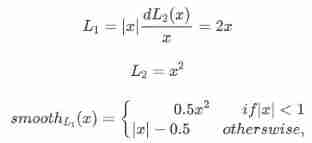
Aforementioned 3 A loss function pair x The derivatives of are :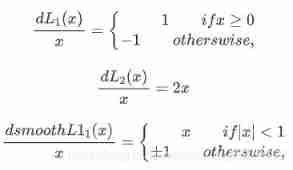
From loss function pair x The derivative of :
(1) L 1 L_1 L1 Yes x x x The derivative of is a constant . This leads to late training , Forecast value and ground truth The difference is very small , The absolute value of the derivative of the loss to the predicted value is still 1, and learning rate If it doesn't change , The loss function will fluctuate near the stable value , It is difficult to continue convergence to achieve higher accuracy .
(2) x x x When it increases , L 2 L_2 L2 Loss pair x x x The derivative of also increases . This leads to early training , Forecast value and groud truth When the difference is too big , The gradient of the loss function to the predicted value is very large , Unstable training .
(3) S m o o t h L 1 Smooth_{L_1} SmoothL1 stay x x x More hours , Yes x x x And the gradient will be smaller , And in the x x x When a large , Yes x x x The absolute value of the gradient reaches the upper limit 1, It's not too big to break the network parameters . S m o o t h L 1 Smooth_{L_1} SmoothL1 Perfectly avoided L 1 L_1 L1 and L 2 L_2 L2 Lost defects . The function image is as follows :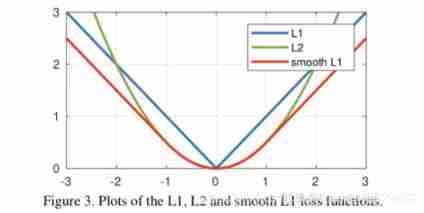
The loss in the regression task of the actual target detection frame loss by 
among v = ( v x , v y , v w , v h ) v=\left( v_{x},v_{y},v_{w},v_{h} \right) v=(vx,vy,vw,vh) Express GT Frame coordinates of , t u = ( t x u , t y u , t w u , t h u ) t^{u} = \left( t_{x}^{u} ,t_{y}^{u} ,t_{w}^{u} ,t_{h}^{u} \right) tu=(txu,tyu,twu,thu) Represents the predicted frame coordinates , That is, find 4 Point loss, Then add as Bounding Box Regression Loss.
shortcoming :
(1) The three above Loss A method for calculating target detection Bounding Box Loss when , Find out independently 4 Point Loss, Then add to get the final Bounding Box Loss, The assumption of this approach is 4 The two points are independent of each other , In fact, there is a certain correlation
(2) The indicator of the actual evaluation box is to use IOU, The two are not equivalent , Multiple check boxes may have the same size s m o o t h L 1 ( x ) smooth_{L_{1}}\left( x \right) smoothL1(x) Loss, but IOU It can be very different , In order to solve this problem, we introduced IOU Loss.
2.2.2 Focal Loss
This method was developed by he Kaiming's team in ICCV 2017 Put forward , Thesis link :
https://arxiv.org/pdf/1708.02002.pdf
Focal loss Mainly to solve one-stage In target detection, the proportion of positive and negative samples is seriously unbalanced . The loss function reduces the weight of a large number of simple negative samples in training , It can also be understood as a kind of difficult sample mining .
Focal loss It is based on the cross entropy loss function , First of all, we review the loss on the intersection of two categories :
Because it's binary ,p Indicates that the prediction sample belongs to 1 Probability ( The scope is 0-1),y Express label,y The values for {+1,-1}. When it's true label yes 1, That is to say y=1 when , If a sample x Forecast as 1 The probability of this class p=0.6, So the loss is -log(0.6), Note that the loss is greater than or equal to 0 Of . If p=0.9, So the loss is -log(0.9), therefore p=0.6 The loss is greater than p=0.9 The loss of , It's easy to understand . Let's just take dichotomy as an example , Multi classification and so on .
For convenience , use p t p_t pt Instead of p, And the above mentioned p Express True Label Probability 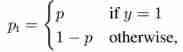
The top formula can be written as :
Next, we introduce a basic improvement of cross entropy , since one-stage detector When training, there is a big gap between the number of positive and negative samples , Then a common way is to add weight to the positive and negative samples , Negative samples appear more frequently , Then reduce the weight of negative samples , The number of positive samples is small , We should increase the weight of positive samples . So you can set α t \alpha_t αt To control the sum of positive and negative samples loss The shared weight of . α t \alpha_t αt Take a smaller value to reduce the negative sample ( More samples ) The weight of .
Obviously, the previous formula 3 Although we can control the weight of positive and negative samples , But there is no way to control the weight of easy to classify and difficult to classify samples , So there was Focal Loss:
there γ γ γ Referred to as focusing parameter, γ > = 0 γ >= 0 γ>=0 , and ( 1 − p t ) γ \left(1-p_{t}\right)^{\gamma} (1−pt)γ It's called modulation coefficient
The purpose of adding modulation coefficient is to reduce the weight of easily classified samples , Thus, the model focuses on the hard to classify samples in training .
The picture below is Focal Loss Compare with the curve of cross entropy function
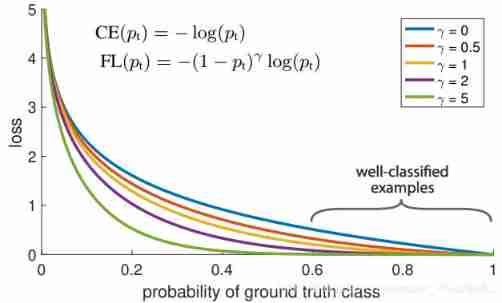
γ=0 Is the standard cross entropy function , It can be seen that ,focal loss It can make the model converge faster
Focal Loss Characteristics :
(1) When a sample is wrongly divided , p t p_t pt It's very small , So the modulation factor ( 1 − p t ) (1-p_t) (1−pt) near 1 , The loss is not affected ; When p t → 1 p_t→1 pt→1, factor ( 1 − p t ) (1-p_t) (1−pt) near 0, So the score is better (well-classified) The weight of the sample is lowered . So the modulation coefficient tends to 1, That is to say, compared with the original loss There's no big change . When p t p_t pt Tend to 1 When ( At this point, the classification is correct and easy to classify samples ), The modulation coefficient tends to 0, That is, for the total loss My contribution is very small .
(2) When γ = 0 γ = 0 γ=0 When ,focal loss It's the traditional cross entropy loss , When γ γ γ When it's added , The modulation coefficient also increases . Focus on the parameters γ γ γ It smoothly adjusts the proportion of easy to separate samples to lower the weight . γ γ γ Increase can enhance the influence of modulation factor , It was found that γ γ γ take 2 best . Intuitively , The modulation factor reduces the loss contribution of easily separated samples , Broaden the range of low loss received by the sample . When γ γ γ At certain times , For example, equal to 2, Some easy to classify samples ( p t = 0.9 ) ( p_t=0.9) (pt=0.9) Of loss It's better than the standard cross entropy loss Small 100+ times , When p t = 0.968 p_t=0.968 pt=0.968 when , smaller 1000+ times , But for hard to classify samples ( p t < 0.5 ) ( p_t < 0.5) (pt<0.5),loss It's small at most 4 times . In this case hard example The relative weight has been increased a lot . This reduces the misclassification
The author used the following in the experiment focal loss The formula ( In this way, the weight of positive and negative samples can be adjusted , It can also control the weight of difficult and easy to classify samples )
Generally speaking, when γ γ γ When it's added , α \alpha α It needs to be reduced a little ( In the experiments γ = 2 γ =2 γ=2, α = 0.25 \alpha =0.25 α=0.25 It works best )
Focal Loss Comparison with other networks :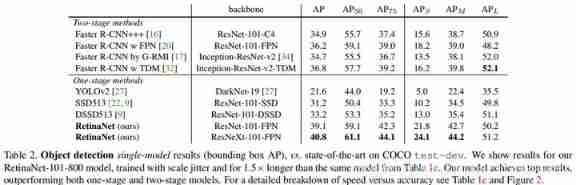
The last line is to use Focal Loss Network of
Reference resources :
[1] https://zhuanlan.zhihu.com/p/49981234
[2] https://zhuanlan.zhihu.com/p/77686118
[3] https://www.cnblogs.com/dengshunge/p/12252820.html
[4] What is? one-hot vector ?
one-hot Vector is a process of transforming category variables into a form that machine learning algorithms are easy to use , The representation of this vector is the eigenvector of an attribute , That is, there is only one activation point at the same time ( Not for 0), This vector has only one feature that is not 0 Of , Others are 0, Particularly sparse .
for instance : One feature “ Gender ”, Gender has “ men ”、“ women ”, This feature has two eigenvalues , There are only two eigenvalues , If this feature is carried out one-hot code , Then the eigenvalue is “ men ” The code of is “10”,“ women ” The code of is “01”, If the eigenvalue has m Discrete eigenvalues , be one-hot The representation of the post eigenvalue is a m Dimension vector , The characteristics of each sample can only have one value , The vector coordinate of this value is 1, Others are 0, If there are multiple characteristics ,“ Gender ” There are two characteristics ,“ Size ”:M、L、XL Three values , We use it “01” For men ,M by “100”,L by “010”,XL by “001”, So a sample ,【“ men ”、"L”】 one-hot Encoded as [10 010], A sample is 5 Dimension vector , This is it. one-hot form .
one-hot The vector is expressed as t i = { 0 , 0 , 0 , … , 1 , … 0 } t_{i}=\{0,0,0, \ldots, 1, \ldots 0\} ti={ 0,0,0,…,1,…0} , The length is determined by all discrete eigenvalues of the feature , The number of discrete eigenvalues of all features is added , Generally more than the number of features , The number of specific scene features is different .
边栏推荐
- Vim 字符串替换
- Kwai applet guaranteed payment PHP source code packaging
- VR/AR 的产业发展与技术实现
- [knowledge map paper] attnpath: integrate the graph attention mechanism into knowledge graph reasoning based on deep reinforcement
- Principle of least square method and matlab code implementation
- JVM memory and garbage collection-3-runtime data area / heap area
- leetcode 866. Prime Palindrome | 866. 回文素数
- 力扣4_412. Fizz Buzz
- 阿锅鱼的大度
- [knowledge map paper] Devine: a generative anti imitation learning framework for knowledge map reasoning
猜你喜欢

Thread deadlock -- conditions for deadlock generation
咋吃都不胖的朋友,Nature告诉你原因:是基因突变了

实现前缀树

Applet running under the framework of fluent 3.0

leetcode 865. Smallest Subtree with all the Deepest Nodes | 865.具有所有最深节点的最小子树(树的BFS,parent反向索引map)

Semantic segmentation | learning record (5) FCN network structure officially implemented by pytoch
Introduction à l'outil nmap et aux commandes communes
#797div3 A---C

Strive to ensure that domestic events should be held as much as possible, and the State General Administration of sports has made it clear that offline sports events should be resumed safely and order

文盘Rust -- 给程序加个日志
随机推荐
leetcode 865. Smallest Subtree with all the Deepest Nodes | 865.具有所有最深节点的最小子树(树的BFS,parent反向索引map)
"Hands on learning in depth" Chapter 2 - preparatory knowledge_ 2.1 data operation_ Learning thinking and exercise answers
Why did MySQL query not go to the index? This article will give you a comprehensive analysis
Literature reading and writing
Spock单元测试框架介绍及在美团优选的实践_第四章(Exception异常处理mock方式)
Key points of data link layer and network layer protocol
[knowledge atlas paper] minerva: use reinforcement learning to infer paths in the knowledge base
excel函数统计已存在数据的数量
阿锅鱼的大度
MQTT X Newsletter 2022-06 | v1.8.0 发布,新增 MQTT CLI 和 MQTT WebSocket 工具
COMSOL --- construction of micro resistance beam model --- final temperature distribution and deformation --- addition of materials
Deeppath: a reinforcement learning method of knowledge graph reasoning
Force buckle 4_ 412. Fizz Buzz
【每日一题】736. Lisp 语法解析
Neural network and deep learning-5-perceptron-pytorch
Popular science | what is soul binding token SBT? What is the value?
Completion report of communication software development and Application
Talk about the cloud deployment of local projects created by SAP IRPA studio
文盘Rust -- 给程序加个日志
Ml backward propagation