当前位置:网站首页>Realization of basic function of sequence table
Realization of basic function of sequence table
2022-07-02 08:28:00 【Ischanged】
️ The concept of linear tables
The linear table (linear list) yes n A finite sequence of data elements with the same characteristics . Linear table is a data structure widely used in practice , often
See the linear table of : The order sheet 、 Linked list 、 Stack 、 queue 、 character string …
A linear table is logically a linear structure , That is to say, it is a continuous straight line . But it is not necessarily continuous in physical structure ( For example, linked list ), When a linear table is physically stored , It is usually stored in the form of array and chain structure
️ The order sheet
The concept of sequential table :
A sequence table is a linear structure in which data elements are sequentially stored in a section of storage cells with continuous physical addresses , In general, array storage is used . Add, delete, check and modify the data on the array .
Implementation of dynamic sequence table
First of all, let's think about a question , The data structure at the bottom of the sequence table is an array , Then you can replace the sequence table with this array , Why is there such a sequence table ?? Why should there be a sequence table ?
We can simply think like this , A sequence table is a data structure , A way to describe and organize data , There are many kinds of data stored in memory , In order to process data , Realize different functions , There are different data structures , for instance , When calculating the number of elements in the array , If we traverse the array , Define a counter , Encounter non 0 The counter is just +1, encounter 0 End the program , If the data encountered is 0 He Fei 0 The numbers cross , Or the data we store is itself 0, This algorithm is problematic , Arrays are chicken ribs , Therefore, we realize this function through the sequence table , Put a number and record it once .
Diagram sequence table
Next, we implement the sequence table through the object-oriented idea ,1. Find object to , This sequence table has only one object, which is this sequence table ,2. Create objects , The member properties of the order table object include an array , A tag that records the number of array elements usedsize, A member that identifies the capacity of the array , Then use the object .
Create member properties , Call the constructor to initialize the object
public class MyArrayList {

    public int[] elem;//elem=null
    public int usedSize;// Element number
    public static  int capacity = 10;// The capacity of the array is more than the number of elements , Otherwise, it will be expanded

    public MyArrayList() {

        this.elem = new int[capacity];
        //this.usedSize = 0;
    }
After we initialize the object , object , The relationship between member attributes and memory layout are roughly as follows :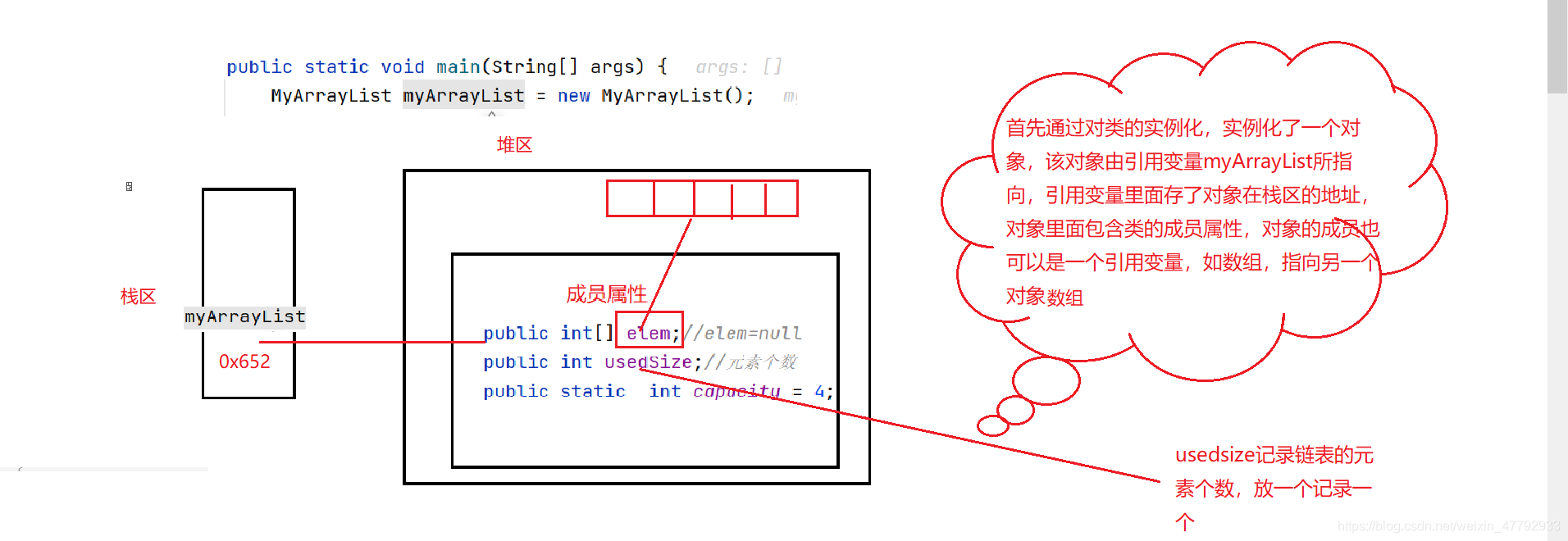
Add an element at a certain position in the sequence table , There are roughly two situations , As shown in the figure below
 public boolean isFull() {
    // Determine whether the array elements are full , Full return ture, Otherwise return to false
        /*if(this.usedSize == capacity) { return true; } return false;*/
        return this.usedSize == capacity;
    }

    //  stay  pos  Location new element
    public void add(int pos, int data) {

        if(pos < 0 || pos > this.usedSize) {

            System.out.println("pos Illegal location !");
            return;
        }
        //1、 Full condition  2、pos The legal situation of
        if(isFull()) {

            // Capacity expansion
            this.elem =Arrays.copyOf(this.elem,2*capacity);// Expand at least twice the capacity
            capacity *= 2;// New capacity
        }
        for(int i = this.usedSize-1; i >= pos;i--) {

            this.elem[i+1] = this.elem[i];// The number of elements does not reach the capacity of the array ,i+1 It will not cross the boundary
        }
        this.elem[pos] = data;// Add a new element when there is no element for the first time or in pos Position the element to be added
        this.usedSize++;
    }
Situation 1 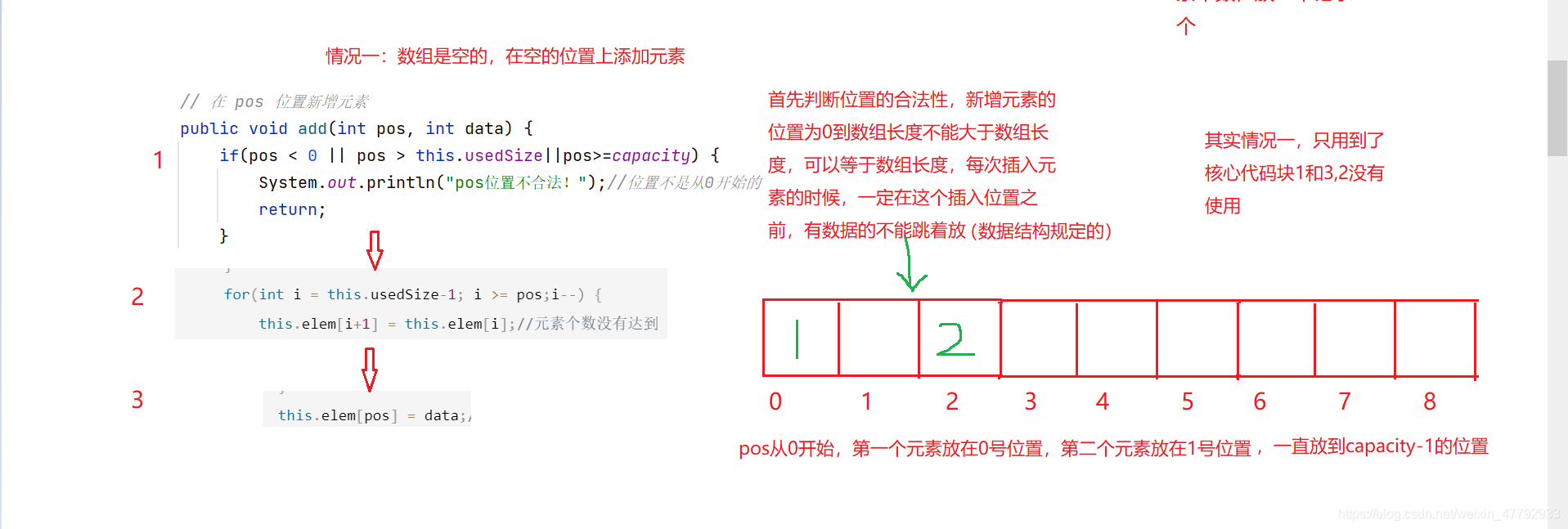
Situation two 
Print order table , Just traverse the array
 //  Print order table
    public void display() {

        for (int i = 0; i < this.usedSize; i++) {

            System.out.print(this.elem[i] +" ");
        }
        System.out.println();
    }
Determine whether to include an element
It's easy to determine whether an element is included . Just traverse the array , Function return value boolean type , Return if it is found to be true true, False return if not found false
public boolean isEmpty() {

        return this.usedSize == 0;
    }
    //  Determine whether to include an element
    public boolean contains(int toFind) {

        if(isEmpty()) return false;// Return directly if it is empty
        for (int i = 0; i < this.usedSize; i++) {

            if(this.elem[i] == toFind) {

                return true;
            }
        }
        return false;
    }
Find the corresponding position of an element , Return the corresponding element subscript , If the sequence table is empty , No return found -1
//  Find the corresponding position of an element
    public int search(int toFind) {

        if(isEmpty()) return -1;// Just go back to -1 I just can't find
        for (int i = 0; i < this.usedSize; i++) {

            if(this.elem[i] == toFind) {

                return i;
            }
        }
        return -1;
    }
obtain pos The element of location
because pos Is used as an array subscript , Returns the of the element at the corresponding position , the pos The values for 0~usedSize-1( It includes two endpoints )
//  obtain  pos  The element of location
    public int getPos(int pos) {

        if(isEmpty()) {

            //return -1;  Business processing , return -1 We should know that the sequence table is empty at this time
            throw new RuntimeException(" The order table is empty ");// Manually throw an error ( abnormal )
        }
        if(pos < 0 || pos >= this.usedSize) {
    // Judge the legitimacy of the location
            throw new RuntimeException("pos illegal ");// Manually throw an error ( abnormal )
        }

        return this.elem[pos];
    }
Get the length of the order table , Directly return the member attribute udedSize Value
 //  Get the length of the order table
    public int size() {

        return this.usedSize;
    }
to pos The element of the position is set to value,pos Also as an array subscript ,pos by 0 Said to 0 The element of location , The first element is set to value value , And so on , So the judge pos When it comes to legitimacy ,pos To be less than usedSize.
 //  to  pos  The element of the position is set to  value
    public void setPos(int pos, int value) {

        if(pos < 0 || pos >= this.usedSize) {

            System.out.println("pos illegal !");
            return;
        }
        if(isEmpty()) {

            System.out.println(" Sequence table is empty !");// It's OK not to judge whether it is empty , If it is empty ,usedsize  by 0 The length of the array is 0, Judging from above pos Legitimacy , No matter what you type , It's all illegal
            return;
        }
        this.elem[pos] = value;
    }
Delete the first keyword key
 // Delete the first keyword key
    public void remove(int toRemove) {

        if(isEmpty()) return;
        int index = search(toRemove);
        if(index == -1) {

            System.out.println(" There are no numbers you want to delete ");
            return;
        }
        for (int i = index; i < this.usedSize-1; i++) {
    //usedsize Need to get 1, Prevent cross-border
            this.elem[i] = this.elem[i+1];// When deleting, move to the position where the subscript of the array is small
        }
        this.usedSize--;// The last element that has not been moved can also be deleted by the print function
    }

️ Clear the sequence table , Set all elements to 0, Element number usedSize Also set to 0 that will do .
 //  Clear the sequence table
    public void clear() {

        for (int i = 0; i < this.usedSize; i++) {

            this.elem[i] = 0;
        }
        this.usedSize = 0;
    }
}
️ Copy all the above code to MyArrayList Class is the complete code , Here's a test class , Test the function of the sequence table .
public class TestDemo {


    public static void main(String[] args) {

        MyArrayList myArrayList = new MyArrayList();
        //myArrayList.add(-1, 1);
        myArrayList.add(0, 2);
        myArrayList.add(1, 3);
        myArrayList.add(2, 4);
        myArrayList.add(3, 4);
        myArrayList.remove(4);
    // myArrayList.add(5, 4);
        myArrayList.display();
        }
        }
︿( ̄︶ ̄)︿ (▽) ( ^∀^)/ welcome \( ^∀^)
Remember to hold
边栏推荐
- 方法递归(斐波那契数列,青蛙跳台阶,汉诺塔问题)
- ICMP协议
- Array and string processing, common status codes, differences between PHP and JS (JS)
- On November 24, we celebrate the "full moon"
- One of the reasons for WCF update service reference error
- VS Code配置问题
- 力扣方法总结:双指针
- sqli-labs第8关(布尔盲注)
- Force buckle method summary: sliding window
- Generate database documents with one click, which can be called swagger in the database industry
猜你喜欢
Don't know mock test yet? An article to familiarize you with mock

OpenCV3 6.3 用滤波器进行缩减像素采样

Carsim-实时仿真的动画同步问题
Carsim-問題Failed to start Solver: PATH_ID_OBJ(X) was set to Y; no corresponding value of XXXXX?

Gateway 简单使用

sqli-labs第1关

Chinese garbled code under vscade
CarSim problem failed to start solver: path_ ID_ OBJ(X) was set to Y; no corresponding value of XXXXX?

W10 is upgraded to W11 system, but the screen is black, but the mouse and desktop shortcuts can be used. How to solve it
顺序表基本功能函数的实现
随机推荐
Multi site high availability deployment
Carla-ue4editor import Roadrunner map file (nanny level tutorial)
Intelligent manufacturing solutions digital twin smart factory
Learn to write article format
Don't know mock test yet? An article to familiarize you with mock
STL速查手册
ARP and ARP Spoofing
install. IMG production method
程序猿学英语-Learning C
力扣方法总结:滑动窗口
Valin cable: BI application promotes enterprise digital transformation
Wang extracurricular words
HCIA—應用層
idea中注释代码取消代码的快捷键
2022 Heilongjiang latest food safety administrator simulation exam questions and answers
Force buckle method summary: sliding window
Rotating linked list (illustration)
链表经典面试题(反转链表,中间节点,倒数第k个节点,合并分割链表,删除重复节点)
Library function of C language
sqli-labs第12关