当前位置:网站首页>Find the first k small element select_ k
Find the first k small element select_ k
2022-07-05 18:00:00 【Jingling cat】
preface
Don't offer Solutions for : Sort all elements first , Then I'll find , At this time, the time complexity is O(nlgn)
Fast selection algorithm - Quick select
Quick select and Quick sort It's all by Tony Hoare Invented
Quick select  Of   The average time complexity is zero  O(n)
 The worst time complexity is  O(n^2)

 The algorithm does not use extra space ,swap Operation is inplace operation , So the space complexity is zero O(1).
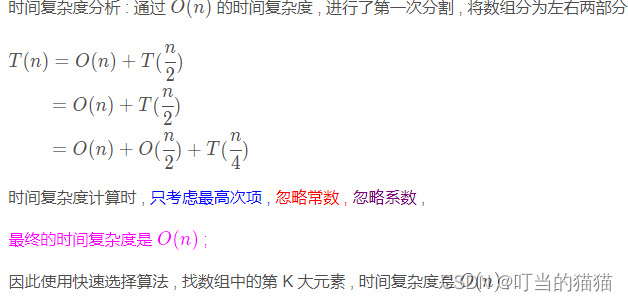
Quick select Adopt and Quick sort Similar steps . First choose one pivot, And then according to Each number is related to this pivot The size of the relationship Divide the entire array into Two parts .
that And Quick sort The difference is ,Quick select Only consider The molecular array where the target is sought , and Non image Quick sort And then separate the two sides . That's why ,Quick select take The average time complexity ranges from O(nlogn) Down to O(n)
public static int quickSelectK(int[] arr, int l, int r, int k) {

    if (arr == null || arr.length == 0) {

        return -1;
    }
    if (k > arr.length) return -1;
    if (l == r) return arr[l];
    int smallIndex = partitionForQuickSelect(arr, l, r);
    int num = smallIndex - l + 1;
    if (k == num) return arr[smallIndex];
    else if (k < num) return quickSelectK(arr, l, smallIndex - 1, k);
    else return quickSelectK(arr, smallIndex + 1, r, k - num);
}

private static int partitionForQuickSelect(int[] arr, int l, int r) {

    int pivot = (int) (l + Math.random() * (r - l + 1));
    swap(arr, pivot, r);
    int less = l - 1;
    for (int i = l; i < r; i++) {

        if (arr[i] <= arr[r]) swap(arr, i, ++less);
    }
    swap(arr, less + 1, r);
    return less + 1;
}
Linear time selection algorithm
Expected linear time - Randomized_Select Random partition linear selection
The input data are different .Randomized_Select Algorithm to Fast sorting algorithm For the model , You can ask for The... In an array k Small elements .
Unlike quick sorting , Quick sort Meeting Recursively handle both sides of the partition , and Randomized_Select Only deal with Divided side
 Average time complexity :  O(n+k)=O(n)  ( When k More hours )
 Due to the partition operation  randomized_partition  The limitations of , Of the selection algorithm   The worst   Time complexity   by  O(n^2)
 The quick sort algorithm needs to deal with both sides of the partition recursively , And the choice algorithm is to deal with only one side .

 This difference leads to differences in performance :
 The expected running time of the quick sort algorithm is  Θ(nlgn), The expected running time of the selection algorithm is  Θ(n)
The core :
Every time Divide the array by the hub of the quick row [ begin....mid...end ]
If target<mid, It's in [ begin....mid-1 ] Recursive search The first k Elements
If target>mid, It's in [ mid+1...end ] Recursive search The first k - (mid-begin+1) Elements
public static int randomizedSelectK(int[] arr, int l, int r, int k) {

    if (k > arr.length) return -1;      // The first  k  individual   Greater than   The length of the array
    if (l == r) return arr[l];           //l == r  For example, an array with only one element ,l==r
    int lessIndex = randomizedPartition(arr, l, r);
    int num = lessIndex - l + 1;    // Less than or equal to the last subscript of the area   It is the present.  [l,r]  Which element of the region
    if (num == k) {
                     // It happens to be the  k  individual
        return arr[lessIndex];
    } else if (k < num) {
               //  In the area less than or equal to , stay  [l,lessIndex - 1]  Find in the area
        return randomizedSelectK(arr, l, lessIndex - 1, k);
    } else {

        return randomizedSelectK(arr, lessIndex + 1, r, k - num);   //  In greater than area , stay  [lessIndex + 1,r]  Find in the area , Pay attention to the last  k - num
    }
}

// Partition , find   Less than or equal to   The last subscript
public static int randomizedPartition(int[] array, int l, int r) {

    int pivot = (int) (l + Math.random() * (r - l + 1));   //  Find one.  [l,r]  The random number in
    int lessIndex = l - 1;     //l  The previous element of
    swap(array, pivot, r);     // Swap with the last element
    for (int i = l; i < r; i++) {

        if (array[i] <= array[r]) {
         // Less than or equal to
            swap(array, ++lessIndex, i);      // Swap with the last number smaller than the region   And self increase
        }
    }
    swap(array, lessIndex + 1, r);    //  Less than or equal to the next number of the zone , and  r  In exchange for , bring  lessIndex + 1  The number of positions is less than or equal to the last number of areas
    return lessIndex + 1;
}

public static void main(String[] args) {

    // int[] arr = {7, 1, 3, 4, 2, 6, 2, 8, 10, 9, 5};
    int[] arr = {
    30, 0, 61, 34, 69, 4, 75, 67, 23, 59, 16, 41, 33, 52, 3, 51, 23, 12, 28, 24, 12, 0, 44, 45, 14, 40, 28, 8, 4, 24, 2, 98, 32, 39, 73, 26, 2, 3, 1, 59, 82, 19, 4, 39, 33, 35, 6, 89, 70, 32, 16, 24, 24, 54, 13, 27, 25, 44, 79, 1, 38, 55, 49, 9, 6, 75, 86, 7, 20, 33, 46, 77, 35, 68, 9, 14, 2, 17, 12, 52, 13, 59, 88, 71, 6, 32, 28, 49, 11, 59, 66, 4, 16, 18, 6, 63, 17, 0};
    for (int j = 1; j <= arr.length; j++) {

        System.out.print(randomizedSelectK(arr, 0, arr.length - 1, j) + ", ");
    }
    System.out.println();
    Arrays.sort(arr);
    System.out.println(Arrays.toString(arr));
}
Use Divided into three areas partition
Fast selection algorithm ( Find the... In the array K Big element ) - It's divided into three areas
public static int randomizedSelectK(int[] arr, int l, int r, int k) {

    if (k > arr.length) return -1;
    if (l == r) return arr[l];
    int[] p = randomizedPartition(arr, l, r);   // It's divided into three areas

    /** *  From the first element of the equal zone to  l  The number of the first element in the area , Not from   Smaller than the last to  l  The first element of  *  for example  * item 0 1 2 2 3 4 * index 0 1 2 3 4 5 *  If  p = [2,3] * * k=2  when ,res  Should be  1,  It's time to enter  if (k < lessPart) * k=3  when ,res  Should be  2,  It's time to enter  if (k >= lessPart && k <= morePart) |  The border  lessPart = 3 = p[0] - l + d ==》 d = 1 * k=4  when ,res  Should be  2,  It's time to enter  if (k >= lessPart && k <= morePart) |  The border  morePart = 4 = p[1] - l + c ==》 c = 1 * k=5  when ,res  Should be  3,  It's time to enter  if (k > morePart) */
    int lessPart = p[0] - l + 1;
    int morePart = p[1] - l + 1;
    if (k < lessPart) {

        return randomizedSelectK(arr, l, p[0] - 1, k);
    } else if (k > morePart) {

        return randomizedSelectK(arr, p[1] + 1, r, k - morePart);    // hypothesis  k = 5,  That should be in  morePart  Area find No  1  A small number ,1 = 5 - 4 = k - morePart
    } else {

        return arr[p[0]];     //arr[p[0]]  perhaps  arr[p[1]]
    }
}

public static int[] randomizedPartition(int[] arr, int l, int r) {

    int rand = (int) (l + Math.random() * (r - l + 1));
    swap(arr, rand, r);

    int less = l - 1;
    int more = r;
    while (l < more) {

        if (arr[l] < arr[r]) swap(arr, ++less, l++);
        else if (arr[l] > arr[r]) swap(arr, --more, l);
        else l++;
    }
    swap(arr, more, r);
    return new int[]{
    less + 1, more};
}
The worst case is linear time - SELECT Median linear time selection
On average, it can O(N) Complexity
 and  randomizedSelect  equally ,select  The algorithm finds the required elements by recursively dividing the input array
 however , In the process of division  select  The algorithm can always guarantee to get a “ good ” Division
select  The deterministic partition algorithm from quick sorting is also used  partition , But it was modified ------ The principal component of the partition is also used as the input parameter .

 adopt select Algorithm , It can be determined that one has n>1 The... In the input array of different elements p Big elements
 With 5 Elements are 1 Group   Divide   aggregate
 Find each group 5 The median of the elements
 recursive select The algorithm finds the median of these median  k
 The time complexity of the above process is essentially 0(n) Grade
 And then to k Operate for the hub Randomized Select Recursive part of the algorithm
 because k The lowest lower limit of the partition can be guaranteed ( Each median ensures that half of the elements are greater than or less than it , Therefore, the median of the median is guaranteed to be as close as possible to half of the nodes that are greater than or less than ), So the algorithm is also in the worst case 0(n) Level of complexity
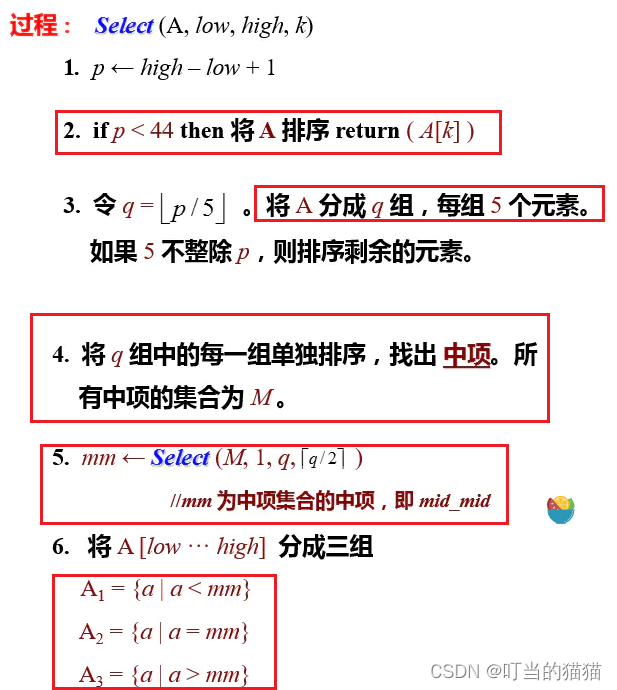
First step : grouping
(1)  When the scale is less than a certain threshold , Directly use the sorting algorithm to return the results .

(2)  When  n  Greater than   threshold   when , hold  n  Elements are divided into  n/5  Divided three intervals , if  n  No 5  Multiple , Then exclude the remaining elements ( No impact , Here is just for the middle mm), Only up to 1 The group consists of the rest  n%5  Elements make up .
	 Sort them separately
	 Then pick out   The middle value of each group of elements
	 Right again   All intermediate values  , Recursively call   This algorithm , Pick out the middle value  mm,mm  That is to say   The middle of the middle

(3)  Divide all elements into  A1、A2、A3  Three groups of , Each contains   Less than 、 be equal to 、 Greater than  mm  The elements of
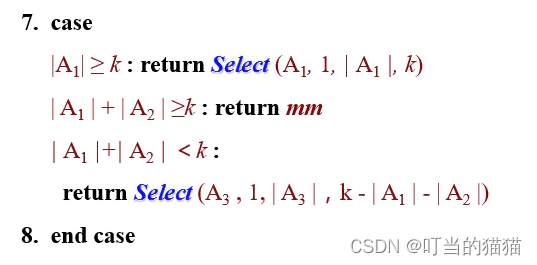
The second step : Judge k stay Which group
 There are three situations , Find out   The first  k  Which of these three arrays is the small element :
	a. if  A1  The number of elements   Greater than or equal to k , namely   The first K The elements are  A1 Group   Inside : stay  A1  in   Recursive search   The first k Minor elements
		p<k , Then recursively call... In the low area select Find the first k Big elements

	b. if  A1  The number of elements   Less than  k , also  A1  and  A2  Element number   The sum is greater than or equal to  k, namely   The first k Elements   stay  A2  in ,A2  in   The elements are  mm: return mm
		p=k (p yes  partition  Return value ,k Is the number to choose k Big elements ), Then return to  a[p]    // The following code follows here

	c. otherwise , The first k The elements are  A3 Group : stay  A3  in   Recursively find the number (k-|A1、A2 Sum of elements |) Minor elements
		 if  p>k , Recursively call in the high area select Find the first  p-k  Big elements
public static int select(int[] arr, int l, int r, int k) {

    if (r - l < 75) {

        quickSort(arr, l, r);    // Sort with insert sort
        return arr[l + k - 1];
    }
    // grouping
    int group = (r - l + 5) / 5;    // Each group  5  Number   common  group  Group
    for (int i = 0; i < group; i++) {

        int left = l + 5 * i;
        int right = (l + i * 5 + 4) > r ? r : l + i * 5 + 4;  // If it exceeds the right boundary, assign a value with the right boundary
        int mid = (left + right) / 2;
        quickSort(arr, left, right);    // Each group   Sort
        swap(arr, l + i, mid);     //  Compare the median of each group with   The first  i  individual   In exchange for
    }
    int pivot = select(arr, l, l + group - 1, (group + 1) / 2);  // Find the median of the median
    int p = partition(arr, l, r, pivot);    // Use the median of the median as the reference position
    int leftNum = p - l + 1;       //leftNum  Used to record   In front of the reference position   Number of elements of
    if (k == leftNum)
        return arr[p];
    else if (k < leftNum)
        return select(arr, l, p - 1, k);
    else                    // if k Behind the reference position , Count from the back of the reference position , That is to say (k - leftNum - 1) individual
        return select(arr, p + 1, r, k - leftNum - 1);
}

private static int partition(int[] array, int start, int end, int pivot) {

    int smallIndex = start - 1;
    swap(array, pivot, end);
    for (int i = start; i <= end; i++)
        if (array[i] <= array[end]) {

            smallIndex++;
            if (i > smallIndex)
                swap(array, i, smallIndex);
        }
    return smallIndex;
}
边栏推荐
- leetcode每日一题:字符串中的第一个唯一字符
- 热通孔的有效放置如何改善PCB设计中的热管理?
- Neural network self cognition model
- Redis Foundation
- Ant financial's sudden wealth has not yet begun, but the myth of zoom continues!
- IDC report: Tencent cloud database ranks top 2 in the relational database market!
- Eliminate the writing of 'if () else{}'
- Clickhouse (03) how to install and deploy Clickhouse
- Isprs2022 / Cloud Detection: Cloud Detection with Boundary nets Boundary Networks Based Cloud Detection
- Oracle recovery tools -- Oracle database recovery tool
猜你喜欢

论文阅读_医疗NLP模型_ EMBERT
Anaconda中配置PyTorch环境——win10系统(小白包会)
Binder开辟线程数过多导致主线程ANR异常

leetcode每日一练:旋转数组
神经网络自我认知模型
flask接口响应中的中文乱码(unicode)处理

2022新版PMP考试有哪些变化?

小林coding的内存管理章节
Configure pytorch environment in Anaconda - win10 system (small white packet meeting)
nacos -分布式事务-Seata** linux安装jdk ,mysql5.7启动nacos配置ideal 调用接口配合 (保姆级细节教程)
随机推荐
消除`if()else{ }`写法
Disabling and enabling inspections pycharm
What are the requirements for PMP certification? How much is it?
PMP认证需具备哪些条件啊?费用多少啊?
Cmake tutorial Step3 (requirements for adding libraries)
使用Jmeter虚拟化table失败
leetcode每日一题:字符串中的第一个唯一字符
"Xiaodeng in operation and maintenance" is a single sign on solution for cloud applications
多线程(一) 进程与线程
matlab内建函数怎么不同颜色,matlab分段函数不同颜色绘图
使用QT设计师界面类创建2个界面,通过按键从界面1切换到界面2
[JMeter] advanced writing method of JMeter script: all variables, parameters (parameters can be configured by Jenkins), functions, etc. in the interface automation script realize the complete business
Cmake tutorial step1 (basic starting point)
IDC report: Tencent cloud database ranks top 2 in the relational database market!
How to modify MySQL fields as self growing fields
LeetCode 练习——206. 反转链表
Cmake tutorial Step2 (add Library)
Sophon autocv: help AI industrial production and realize visual intelligent perception
请问下为啥有的表写sql能查到数据,但在数据地图里查不到啊,查表结构也搜不到
Star ring technology data security management platform defender heavy release