当前位置:网站首页>Analyses the mainstream across technology solutions
Analyses the mainstream across technology solutions
2022-08-05 04:13:00 【speedoooo】
write once, run everywhere
Android applications are written in Java or Kotlin, iOS applications are written in Objective-C or Swift, and web applications are written in HTML/CSS/JavaScript.When it is necessary to develop applications that support multiple terminals, each terminal needs to be independently developed and tested until it is launched.
In order to solve the problem of multi-terminal independent development, cross-terminal technology is favored.
There are so many scenarios that the front-end needs to deal with at the moment, such as android, ios, pc, smart watch, car, smart TV, etc. When certain scenarios are very similar, we hope to use the least development cost to achieve the mostGood effect, rather than requiring a separate set of manpower for each end to maintain.
So in today's cross-end solutions, such as the most well-known react native, flutter, electron, weex, small programs, etc., do they have any common characteristics, and can we find them?In essence, this is the question that this article wants to talk about.
I. Mainstream cross-end implementation scheme
1. Web-based H5 Hybrid solution
In fact, the browser is a cross-end implementation, because you only need to enter the URL, you can open your web page on any end browser.So, if we embed the browser into the app, and then hide the address bar and other content, can we embed our web page into the native app?And this browser embedded in the app, we call it webview , so as long as a certain end supports webview , then it can use this scheme to cross-end.
At the same time, this is also a solution with the least development cost, because this is actually writing a front-end interface, which is not much different from developing ordinary web pages.
2. Framework layer + native rendering scheme
The typical representative is react-native. Its development language is js, and the syntax used is exactly the same as that of react. In fact, it can be said that it is react, which is our framework layer.Unlike general react applications, it needs to use native capabilities to render, and components will eventually be rendered as native components, which can bring a better experience to users.
3. Framework layer + self-rendering engine scheme
The difference between this scheme and the above is that it does not directly borrow native capabilities to render components, but uses the lower-level rendering capabilities to render components by itself.Obviously, in this way, the link will be shorter than that of the above scheme, so the performance will be better, and at the same time, it will be more reliable than the previous scheme in ensuring the consistency of multi-terminal rendering.A typical example of such a framework is flutter.
4. Mini Program Cross-End Solution
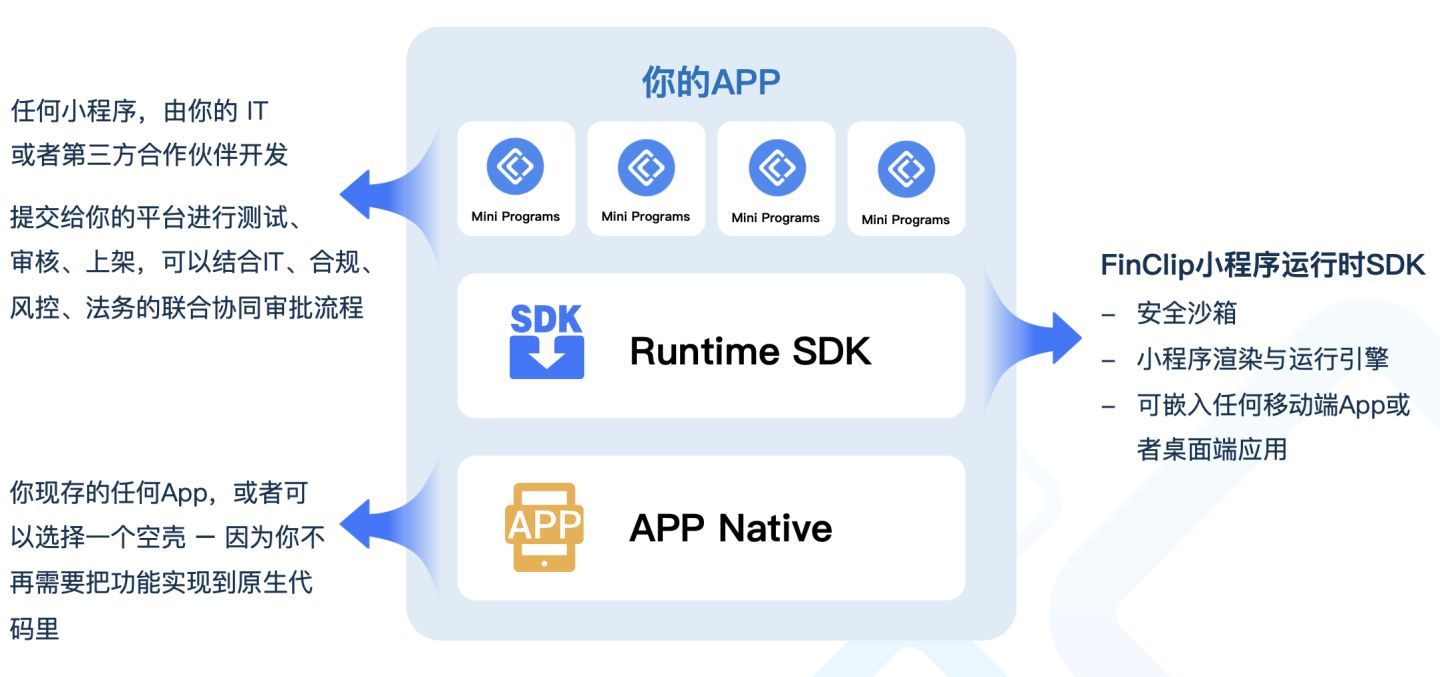
As we all know, one thing has become very popular in recent years: Mini Programs. Now many big manufacturers have begun to enter Mini Programs, but now Mini Program technology is no longer exclusive to BAT, and Mini Programs have already been launched on the market.Container technology solution, after integrating the applet container SDK, whether it is iPhone, Android, Flutter, React Native, computer, TV, car or IoT device, it can enable different applications or terminal devices to quickly have the ability to run appletMoreover, the same applet scenario can be distributed to different terminals to run, and there is no need to write different codes for different terminals. This kind of applet container technology can learn from FinClip .

Second, what are the common cross-end scenarios
- Across PC.For example across Windows Linux Macos
- Across multiple Native platforms: for example, across Android and iOS
- Cross-launching APPs: With the increasing number of super APPs, many businesses need to deploy the same business scenario in multiple APPs.
- Cross Web, Mini Programs, QuickApps, etc.: In fact, it is similar to Cross APP, but the Mini Program itself is a closed ecology controlled by each company, so there is a demand for one development to adapt to multiple closed ecology.

Three, cross-end technical solution selection
Cross-end technical solutions focus on the following four aspects: R&D efficiency, dynamics, multi-end consistency, and performance experience.
R&D Efficiency: Maximize code reuse, reduce the adaptation workload for multi-terminal differences, and reduce development costs. Even after the business is launched, it can be maintained at low cost and speed up the development of new functions.Iterative speed, which is an ongoing efficiency gain.
Dynamic: It can realize rapid business iteration, which is not only a requirement of cross-platform technology, but also a must-have for native technology, which is also an important assessment point for evaluating cross-end technology.
Multi-terminal consistency: Good products are often designed with a unified overall style in the multi-terminal UI design. Therefore, after the business side adopts the native independent development, it will take a lot of extra time to modify the UI to ensure thatMulti-end consistency; it can be seen that the independent implementation of the development method at each end brings about a lag in efficiency, not only the workload of developing a code for Android and iOS, but also the consistent alignment of the two-end UI.
Performance experience: Generally, cross-end technical solutions have multiple advantages of the above, but in terms of performance, they are worse than native smoothness.It is reasonable to sacrifice part of the experience in exchange for improved efficiency. Just imagine that a cross-platform technical solution can achieve these four points at the same time, then the native technology may have withdrawn from the historical stage, and it has long been the world of cross-platform technology, so every cross-platform technologyThe performance of the platform technology becomes the core indicator.
Four. Ending
For business technology teams, the essence of cross-end is to improve efficiency.Proposing new solutions in response to new changes is one aspect, and more importantly, how to make this efficiency improvement really long-term and stable, so that our efficiency improvement will not become a jump from one new solution to another.
Cross-end demands and corresponding solutions will still be in frequent changes, and there will not be a solution to all cross-end problems.And the relatively unchanged part is worth investing in for the sake of long-term stability.
边栏推荐
- Bytebuffer put flip compact clear method demonstration
- 使用IDEA连接TDengine服务器
- Some conventional routines of program development (1)
- Haproxy搭建Web群集
- DEJA_VU3D - Cesium功能集 之 059-腾讯地图纠偏
- 数组常用方法总结
- 如何解决复杂的分销分账问题?
- iMedicalLIS监听程序(2)
- 多列属性column元素的可见性:display、visibility、opacity、垂直对齐方式:vertical-align、z-index 越大越显示在上层
- In the WebView page of the UI automation test App, the processing method when the search bar has no search button
猜你喜欢



![[BJDCTF2020]EasySearch](/img/60/464de3bcdda876171b9f61ad31bff1.png)
随机推荐
开发属于自己的node包
There are a lot of 4T hard drives remaining, prompting "No space left on device" insufficient disk space
[SWPU2019]Web1
flink reads mongodb data source
UE4 opens doors with overlapping events
从企业的视角来看,数据中台到底意味着什么?
【informix】解决启动报错大全,以及解决办法
炎炎夏日教你利用小米智能家居配件+树莓派4接入Apple HomeKit
iMedicalLIS监听程序(2)
bytebuffer 使用demo
虚证、实证如何鉴别?
【Mysql进阶优化篇02】索引失效的10种情况及原理
Bosses, I noticed that a mysql CDC connector parameters scan. The incremental. Sna
XMjs cross-domain problem solving
MySql index learning and use; (I think it is detailed enough)
token, jwt, oauth2, session parsing
工业级远距离无线传输装置的功能有哪些?
No regrets, the appium automation environment is perfectly built
2022软件测试工程师最全面试题
Learning and finishing of probability theory 8: Geometric and hypergeometric distributions