当前位置:网站首页>[C language] address book - dynamic and static implementation
[C language] address book - dynamic and static implementation
2022-07-05 03:39:00 【Sincere George】
Catalog
One . Static address book implementation
1. Division logic of environment
Two . Dynamic implementation of address book
Preface :
I believe everyone knows about the address book
Its functions include simple : Add or delete check change
In this issue, we will realize a C Language implementation of the address book
Continue what I talked about last time -- Dynamic memory allocation
Then I will realize it in the two ways given by the title
One . Static address book implementation
1. Division logic of environment
Because the process is a little long , Easy to understand , So a total of three files will be used
There are two source files test.c、contact.c , There is also a header file contact.h To achieve
test.c Is the subject , It is the test logic of the address book
contact.c It is the implementation logic of the address book
contact.h Is the declaration of the address book function
2. Functions to be realized
Each function of the address book is relatively independent
Therefore, different functions can be used to realize the functions of each part
contact.c The functions included are as follows :
1. Initialization of structure
2. Add a Contact
3. Show your contacts
4. Delete Contact
5. Find contacts
6. Modify contact
The specific code is as follows :
3.contact.h
#define _CRT_SECURE_NO_WARNINGS 1
#include<stdio.h>
#include<string.h>
// The address book can be used to store 1000 Personal information , Everyone's information includes : full name 、 Gender 、 Age 、 Telephone 、 address
typedef struct  Introduction
{
	char name[20];
	char sex[10];
	int  age;
	char tele[20];
	char addr[30];
} Introduction;
typedef struct contact
{
	Introduction data[1000];
	int sz;
}contact;

// Initialization of structure
void Initcontact(contact* pc);
// Add a Contact
void Add(contact* pc);
// Show your contacts
void show(contact* pc);
// Delete Contact
void Dele(contact* pc);
// Find contacts
void Find(contact* pc);
// Modify contact
void Exchange(contact* pc);4.contact.c
#define _CRT_SECURE_NO_WARNINGS 1
#include"contact.h"
void Initcontact(contact* pc)// Initialization of structure
{
    pc->sz = 0;
    memset(pc->data, 0, sizeof(pc->data));
}

void Add(contact* pc)// Add a Contact
{
    // Judge whether it is not full
    if (pc->sz == 1000)
    {
        printf(" The address book is full \n");
        return;
    }
    printf(" Please enter a name >:");
    scanf("%s", pc->data[pc->sz].name);
    printf(" Please enter age >:");
    scanf("%d", &(pc->data[pc->sz].age));
    printf(" Please enter gender :>");
    scanf("%s", pc->data[pc->sz].sex);
    printf(" Please input the phone number :>");
    scanf("%s", pc->data[pc->sz].tele);
    printf(" Please enter the address :>");
    scanf("%s", pc->data[pc->sz].addr);
    pc->sz++;
    printf(" Add contact successfully \n");
}

void show(contact* pc)// Show your contacts
{
    int i = 0;
    printf("%-10s\t%-10s\t%-10s\t%-10s\t%-10s\t\n ", " name ", " Age ", " Gender ", " Telephone ", " Address ");
    for (i = 0; i < pc->sz; i++)
    {
        printf("%-10s\t%-10d\t%-10s\t%-10s\t%-10s\t\n ",
        pc->data[i].name, pc->data[i].age, pc->data[i].sex, pc->data[i].tele, pc->data[i].addr);
    }
}

int SearchByName(contact* pc, char name[])
{
    int i = 0;
    for (i = 0; i < pc->sz; i++)
    {
        if (strcmp(pc->data[i].name, name) == 0)
        {
            return i;
        }
    }
    return -1;
}

void Dele(contact* pc)// Delete Contact
{
    int i = 0; char name[10];
    printf(" Enter the name of the person you want to delete >:\n");
    scanf("%s", name);
    if (pc->sz == 0)
    {
        printf(" Address book is empty , Cannot delete \n");
    }
    // Determine whether there are contacts
    int pos = SearchByName(pc, name);
    if (pos == -1)
    {
        printf(" Contact not found \n");
    }
    else
    {
        for (i = pos; i < pc->sz - 1; i++)
        {
            pc->data[i] = pc->data[i + 1];
        }
        pc->sz--;
        printf(" Delete contact successfully \n");
    }
}


void Find(contact* pc)// Find contacts
{
    char name[10];
    printf(" Enter the name of the person you want to find >:\n");
    scanf("%s", name);
    int pos = SearchByName(pc, name);
    if (pos == -1)
    {
        printf(" There is no person's name in the address book ");
    }
    else
    {
        printf(" The person information searched is :>");
        printf("%-10s\t%-10s\t%-10s\t%-10s\t%-10s\t\n ", " name ", " Age ", " Gender ", " Telephone ", " Address ");
        printf("%-10s\t%-10d\t%-10s\t%-10s\t%-10s\t\n ",
        pc->data[pos].name, pc->data[pos].age, pc->data[pos].sex, pc->data[pos].tele, pc->data[pos].addr);
    }
}


void Exchange(contact* pc)// Modify contact
{
    char name[10];
    printf(" Enter the name of the person to modify >:\n");
    scanf("%s", name);
    int pos = SearchByName(pc, name);
    if (pos == -1)
    {
        printf(" There is no modifier's name in the address book ");
    }
    else
    {
        printf(" Please enter a name >:");
        scanf("%s", pc->data[pos].name);
        printf(" Please enter age >:");
        scanf("%d", &(pc->data[pos].age));
        printf(" Please enter gender :>");
        scanf("%s", pc->data[pos].sex);
        printf(" Please input the phone number :>");
        scanf("%s", pc->data[pos].tele);
        printf(" Please enter the address :>");
        scanf("%s", pc->data[pos].addr);
        printf(" Modification successful ");
    }
}
5.test.c
#define _CRT_SECURE_NO_WARNINGS 1
#include"contact.h"
void menu()
{
	printf("**********************************************\n");
	printf("*******     1.Add        2.Dele      *********\n");
	printf("*******     3.Find       4.Exchange **********\n");
	printf("*******     5.show       0.exit     **********\n");
	printf("**********************************************\n");
}
int main()
{
	int input = 0;
	contact con;
    Initcontact(&con);
	do
	{
		menu();
		printf(" Please enter a number >:");
		scanf("%d", &input);
		switch (input)
		{
		case 1:
			Add(&con);
			break;
		case 2:
			Dele(&con);
			break;
		case 3:
			Find(&con);
			break;
		case 4:
			Exchange(&con);
			break;
		case 5:
			show(&con);
			break;
		case 0:
			printf(" Exit address book \n");
			break;
		default:
			printf(" Wrong choice \n");
		}

	} while (input);
	return 0;
}
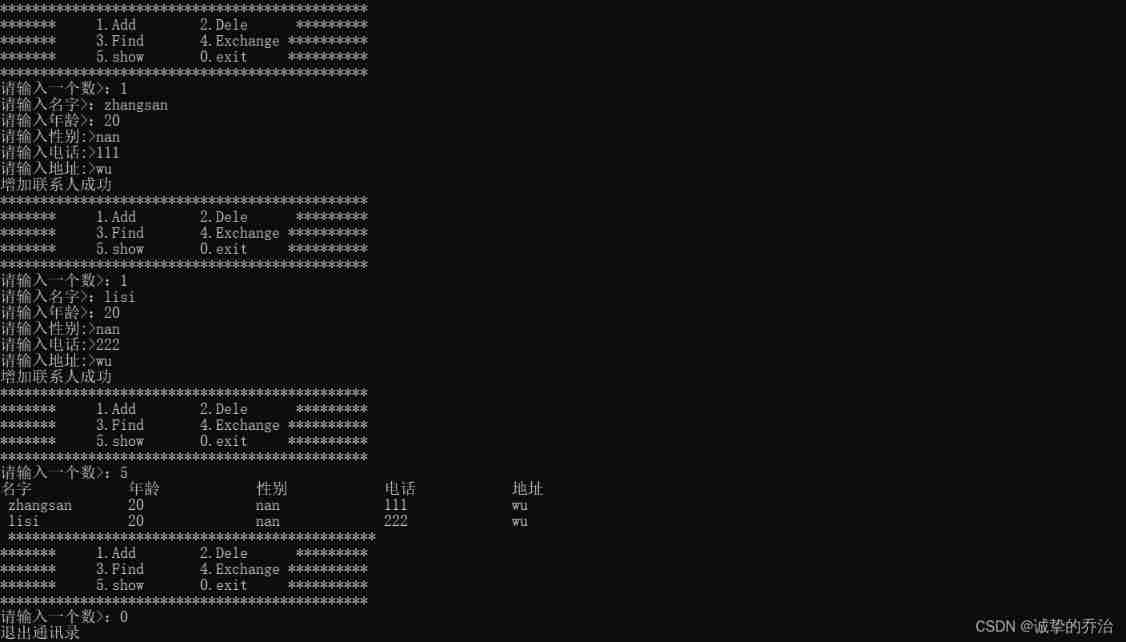
6. Realization effect
Two . Dynamic implementation of address book
Compared with static implementation , The difference between the two is not big
The former uses a fixed array to store elements
The latter uses dynamically applied memory to store , The advantage is that you can save memory
The difference lies in
Initialization of address book , Here's a quote from capcity Capacity to compare existing capacity
To determine the amount of memory used , Easy to expand
The second is Add function , Add contacts
Finally, release the released memory
The code is as follows :
1.contact.h
#define _CRT_SECURE_NO_WARNINGS 1
#include<stdio.h>
#include<string.h>
#include<assert.h>
#include<stdlib.h>

typedef struct Introduction
{
	char name[20];
	char sex[10];
	int  age;
	char tele[20];
	char addr[30];
}Introduction;

typedef struct contact
{
	Introduction* data;
	int sz;
	int capcity;
}contact;

// Initialization of structure
void Initcontact(contact* pc);
// Add a Contact
void Add(contact* pc);
// Show your contacts
void show(contact* pc);
// Delete Contact
void Dele(contact* pc);
// Find contacts
void Find(contact* pc);
// Modify contact
void Exchange(contact* pc);
// Destroy the address book
void destroy(contact*pc);
2.contact.c
#define _CRT_SECURE_NO_WARNINGS 1
#include"contact.h"
#define TARGET_sz 3   // Initial address book target capacity

void Initcontact(contact* pc)// Initialization of structure
{
    assert(pc);// Judge the validity of the pointer
    pc->sz = 0;
    contact* tmp = 0;
    tmp=(contact*)malloc(sizeof(Introduction)*TARGET_sz);
    if (tmp!=NULL)
    {
        pc->data = tmp;
    }
    else
    {
        printf(" Expansion failed , Please check the reason \n");
        return;
    }
    pc->capcity = TARGET_sz;
}

void Add(contact* pc)// Add a Contact
{
    assert(pc);
    if (pc->capcity == pc->sz)
    {
        Introduction* tmp = 0;
        tmp=(Introduction*)realloc(pc->data,sizeof(Introduction)*(pc->capcity+2));
        if (tmp != NULL)
        {
            pc->capcity += 2;
            pc->data = tmp;
            printf(" Expansion successful \n");
        }
        else
        {
            printf(" Expansion failed , Please check the reason \n");
        }
    }
    printf(" Please enter a name >:");
    scanf("%s", pc->data[pc->sz].name);
    printf(" Please enter age >:");
    scanf("%d", &(pc->data[pc->sz].age));
    printf(" Please enter gender :>");
    scanf("%s", pc->data[pc->sz].sex);
    printf(" Please input the phone number :>");
    scanf("%s", pc->data[pc->sz].tele);
    printf(" Please enter the address :>");
    scanf("%s", pc->data[pc->sz].addr);
    pc->sz++;
    printf(" Add contact successfully \n");
}

void show(contact* pc)// Show your contacts
{
    int i = 0;
    printf("%-10s\t%-10s\t%-10s\t%-10s\t%-10s\t\n ", " name ", " Age ", " Gender ", " Telephone ", " Address ");
    for (i = 0; i < pc->sz; i++)
    {
        printf("%-10s\t%-10d\t%-10s\t%-10s\t%-10s\t\n ",
            pc->data[i].name, pc->data[i].age, pc->data[i].sex, pc->data[i].tele, pc->data[i].addr);
    }
}

int SearchByName(contact* pc, char name[])
{
    int i = 0;
    for (i = 0; i < pc->sz; i++)
    {
        if (strcmp(pc->data[i].name, name) == 0)
        {
            return i;
        }
    }
    return -1;
}

void Dele(contact* pc)// Delete Contact
{
    int i = 0; char name[10];
    printf(" Enter the name of the person you want to delete >:\n");
    scanf("%s", name);
    if (pc->sz == 0)
    {
        printf(" Address book is empty , Cannot delete \n");
    }
    // Determine whether there are contacts
    int pos = SearchByName(pc, name);
    if (pos == -1)
    {
        printf(" Contact not found \n");
    }
    else
    {
        for (i = pos; i < pc->sz - 1; i++)
        {
            pc->data[i] = pc->data[i + 1];
        }
        pc->sz--;
        printf(" Delete contact successfully \n");
    }
}


void Find(contact* pc)// Find contacts
{
    char name[10];
    printf(" Enter the name of the person you want to find >:\n");
    scanf("%s", name);
    int pos = SearchByName(pc, name);
    if (pos == -1)
    {
        printf(" There is no person's name in the address book ");
    }
    else
    {
        printf(" The person information searched is :>");
        printf("%-10s\t%-10s\t%-10s\t%-10s\t%-10s\t\n ", " name ", " Age ", " Gender ", " Telephone ", " Address ");
        printf("%-10s\t%-10d\t%-10s\t%-10s\t%-10s\t\n ",
        pc->data[pos].name, pc->data[pos].age, pc->data[pos].sex, pc->data[pos].tele, pc->data[pos].addr);
    }
}


void Exchange(contact* pc)// Modify contact
{
    char name[10];
    printf(" Enter the name of the person to modify >:\n");
    scanf("%s", name);
    int pos = SearchByName(pc, name);
    if (pos == -1)
    {
        printf(" There is no modifier's name in the address book ");
    }
    else
    {
        printf(" Please enter a name >:");
        scanf("%s", pc->data[pos].name);
        printf(" Please enter age >:");
        scanf("%d", &(pc->data[pos].age));
        printf(" Please enter gender :>");
        scanf("%s", pc->data[pos].sex);
        printf(" Please input the phone number :>");
        scanf("%s", pc->data[pos].tele);
        printf(" Please enter the address :>");
        scanf("%s", pc->data[pos].addr);
        printf(" Modification successful ");
    }
}
void destroy(contact* pc)
{
    assert(pc);
    free(pc->data);
    pc->data = NULL;
    pc->capcity = 0;
    pc->sz = 0;
}
3.test.c
#define _CRT_SECURE_NO_WARNINGS 1
#include"contact.h"
void menu()
{
	printf("**********************************************\n");
	printf("*******     1.Add        2.Dele      *********\n");
	printf("*******     3.Find       4.Exchange **********\n");
	printf("*******     5.show       0.exit     **********\n");
	printf("**********************************************\n");
}
int main()
{
	int input = 0;
	contact con;
	Initcontact(&con);
	do
	{
		menu();
		printf(" Please enter a number >:");
		scanf("%d", &input);
		switch (input)
		{
		case 1:
			Add(&con);
			break;
		case 2:
			Dele(&con);
			break;
		case 3:
			Find(&con);
			break;
		case 4:
			Exchange(&con);
			break;
		case 5:
			show(&con);
			break;
		case 0:
			destroy(&con);
			printf(" Exit address book \n");
			break;
		default:
			printf(" Wrong choice \n");
		}

	} while (input);
	return 0;
}
Welcome to like collection and attention , If you have any questions, you can ask
边栏推荐
猜你喜欢

Share the newly released web application development framework based on blazor Technology
Leetcode42. connect rainwater
Blue Bridge Cup single chip microcomputer -- PWM pulse width modulation

Accuracy problem and solution of BigDecimal
grandMA2 onPC 3.1.2.5的DMX参数摸索
![[groovy] loop control (number injection function implements loop | times function | upto function | downto function | step function | closure can be written outside as the final parameter)](/img/45/6cb796364efe16d54819ac10fb7d05.jpg)
[groovy] loop control (number injection function implements loop | times function | upto function | downto function | step function | closure can be written outside as the final parameter)
Azkaban installation and deployment
![[wp][入门]刷弱类型题目](/img/d0/9eb3ade701057837d98e4a20082a10.png)
[wp][入门]刷弱类型题目
Utilisation simple de devtools
VM in-depth learning (XXV) -class file overview
随机推荐
glibc strlen 实现方式分析
Port, domain name, protocol.
MySQL winter vacation self-study 2022 11 (9)
Unity implements the code of the attacked white flash (including shader)
LeetCode146. LRU cache
[Chongqing Guangdong education] 2777t green space planning reference questions of National Open University in autumn 2018
The architect started to write a HelloWorld
Google Chrome CSS will not update unless the cache is cleared - Google Chrome CSS doesn't update unless clear cache
有个疑问 flink sql cdc 的话可以设置并行度么, 并行度大于1会有顺序问题吧?
51 independent key basic experiment
In MySQL Association query, the foreign key is null. What if the data cannot be found?
A brief introduction to the behavior tree of unity AI
UE4 DMX和grandMA2 onPC 3.1.2.5的操作流程
Monitoring web performance with performance
[software reverse analysis tool] disassembly and decompilation tool
Clickhouse物化视图
When sqlacodegen generates a model, how to solve the problem that the password contains special characters?
线程基础知识
Why are there fewer and fewer good products produced by big Internet companies such as Tencent and Alibaba?
汇编-入门