当前位置:网站首页>leetcode:297. 二叉树的序列化与反序列化
leetcode:297. 二叉树的序列化与反序列化
2022-07-03 03:47:00 【uncle_ll】
297. 二叉树的序列化与反序列化
来源:力扣(LeetCode)
序列化是将一个数据结构或者对象转换为连续的比特位的操作,进而可以将转换后的数据存储在一个文件或者内存中,同时也可以通过网络传输到另一个计算机环境,采取相反方式重构得到原数据。
请设计一个算法来实现二叉树的序列化与反序列化。这里不限定你的序列 / 反序列化算法执行逻辑,你只需要保证一个二叉树可以被序列化为一个字符串并且将这个字符串反序列化为原始的树结构。
提示: 输入输出格式与 LeetCode 目前使用的方式一致,详情请参阅 LeetCode 序列化二叉树的格式。你并非必须采取这种方式,你也可以采用其他的方法解决这个问题。
示例 1:
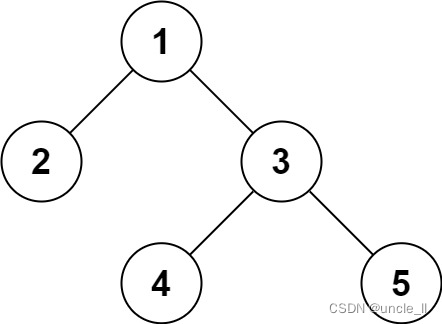
输入:root = [1,2,3,null,null,4,5]
输出:[1,2,3,null,null,4,5]
示例 2:
输入:root = []
输出:[]
示例 3:
输入:root = [1]
输出:[1]
示例 4:
输入:root = [1,2]
输出:[1,2]
提示:
- 树中结点数在范围 [0, 1 0 4 10^4 104] 内
- -1000 <= Node.val <= 1000
解法
树的序列化与反序列化,自己设定序列化规则与反序列化规则,这里以先序遍历为序列化规则,根左右;先序遍历有递归和迭代两种方式,这里以递归和层序遍历为解题方法。
递归:从根节点开始,然后就是左子节点,然后就是右子节点,最后将其拼接为一个字符串,注意中间要保存空节点;
bfs循环: bfs层序遍历,先根节点,然后根节点的左右节点加入队列中;
代码实现
递归
python实现
# Definition for a binary tree node.
# class TreeNode(object):
# def __init__(self, x):
# self.val = x
# self.left = None
# self.right = None

class Codec:

    def serialize(self, root):
        """Encodes a tree to a single string. :type root: TreeNode :rtype: str """
        res = []
        def helper(node):
            if not node:
                res.append(node)
            else:
                res.append(node.val)
                helper(node.left)
                helper(node.right)

        helper(root)
        string = ''
        for node in res:
            string += str(node) + ','
        return string


    def deserialize(self, data):
        """Decodes your encoded data to tree. :type data: str :rtype: TreeNode """
        def helper(ss):
            if ss[0] == 'None':
                ss.pop(0)
                return None

            root = TreeNode(ss.pop(0))
            root.left = helper(ss)
            root.right = helper(ss)
            return root

        return helper(data.split(','))


# Your Codec object will be instantiated and called as such:
# ser = Codec()
# deser = Codec()
# ans = deser.deserialize(ser.serialize(root))
c++实现
/** * Definition for a binary tree node. * struct TreeNode { * int val; * TreeNode *left; * TreeNode *right; * TreeNode(int x) : val(x), left(NULL), right(NULL) {} * }; */
class Codec {

public:

    void reserialize(TreeNode* root, string& str) {

        if (root == nullptr)
            str += "None,";
        else {

            str += to_string(root->val) + ",";
            reserialize(root->left, str);
            reserialize(root->right, str);
        }
    }

    // Encodes a tree to a single string.
    string serialize(TreeNode* root) {

        string ret;
        reserialize(root, ret);
        return ret;
    }

    TreeNode* rdeserialize(list<string>& dataAarray) {

        if (dataAarray.front() == "None") {

            dataAarray.erase(dataAarray.begin());
            return nullptr;
        }

        TreeNode* root = new TreeNode(stoi(dataAarray.front()));
        dataAarray.erase(dataAarray.begin());
        root->left = rdeserialize(dataAarray);
        root->right = rdeserialize(dataAarray);
        return root;
    }


    // Decodes your encoded data to tree.
    TreeNode* deserialize(string data) {

        list<string> dataAarray;
        string str;
        for (auto& ch: data) {

            if (ch == ',') {

                dataAarray.push_back(str);
                str.clear();
            }
            else
                str.push_back(ch);
        }

        if (!str.empty()) {

            dataAarray.push_back(str);
            str.clear();
        }
        return rdeserialize(dataAarray);
    }
};

// Your Codec object will be instantiated and called as such:
// Codec ser, deser;
// TreeNode* ans = deser.deserialize(ser.serialize(root));
复杂度分析
- 时间复杂度: O ( N ) O(N) O(N) 每个节点都遍历一次
- 空间复杂度: O ( N ) O(N) O(N) 递归栈空间每节点
BFS循环
python实现
# Definition for a binary tree node.
# class TreeNode(object):
# def __init__(self, x):
# self.val = x
# self.left = None
# self.right = None

class Codec:

    def serialize(self, root):
        """Encodes a tree to a single string. :type root: TreeNode :rtype: str """
        if not root:
            return '[]'
        # bfs
        res = []
        queue = [root]
        while queue:
            node = queue.pop(0)
            res.append(node.val) if node else res.append('null')
            if node:
                queue.append(node.left) if node.left else queue.append(None)
                queue.append(node.right) if node.right else queue.append(None)
        res = [str(i) for i in res]
        while res[-1] == 'null':
            res.pop()
        return '[' + ','.join(res) + ']'

    def deserialize(self, data):
        """Decodes your encoded data to tree. :type data: str :rtype: TreeNode """
        if data == '[]':
            return None
        vals = data[1: -1].split(',')
        root = TreeNode(int(vals[0]))
        i = 1
        queue = [root]
        length = len(vals)
        while queue:
            node = queue.pop(0)
            if i < length and vals[i] != 'null':
                node.left = TreeNode(int(vals[i]))
                queue.append(node.left)
            i += 1
            if i < length and vals[i] != 'null':
                node.right = TreeNode(int(vals[i]))
                queue.append(node.right)
            i += 1
        return root


# Your Codec object will be instantiated and called as such:
# codec = Codec()
# codec.deserialize(codec.serialize(root))
c++实现
class Codec {

public:

    // Encodes a tree to a single string.
    string serialize(TreeNode* root) {

        // 层序遍历 BFS
        string ret;
        queue<TreeNode*> que;
        que.emplace(root);
        while (!que.empty()) {

            int size = que.size();
            for (int i = 0; i < size; i++) {

                TreeNode* node = que.front();
                que.pop();
                // 空节点直接加入"None,"
                if (node == NULL) ret += "None,";
                else {

                    // 加入节点val,并依次遍历左右子树
                    ret += to_string(node->val) + ",";
                    que.emplace(node->left);
                    que.emplace(node->right);
                }
            }
        }
        return ret;
    }

    // Decodes your encoded data to tree.
    TreeNode* deserialize(string data) {

        if (data.size() == 0) return NULL;
        list<string> dataArray;
        string str;
        for (auto& c : data) {

            if (c == ',') {

                dataArray.emplace_back(str);
                str.clear();
            } else {

                str.push_back(c);
            }
        }
        if (str.size() != 0) {

            dataArray.emplace_back(str);
            str.clear();
        }
        queue<TreeNode*> que;
        if (dataArray.front() == "None") return NULL;
        TreeNode* root = new TreeNode(stoi(dataArray.front()));
        que.emplace(root);
        dataArray.pop_front();
        while (!que.empty() && !dataArray.empty()) {

            int size = que.size();
            for (int i = 0; i < size && !dataArray.empty(); i++) {

                TreeNode* cur = que.front(); // 父节点
                que.pop();
                // 第一个为左节点
                if (dataArray.front() != "None") {

                    TreeNode* node1 = new TreeNode(stoi(dataArray.front()));
                    cur->left = node1;
                    que.push(node1);
                }
                dataArray.pop_front();

                // 第二个为右节点
                if (dataArray.front() != "None") {

                    TreeNode* node2 = new TreeNode(stoi(dataArray.front()));
                    cur->right = node2;
                    que.push(node2);
                }
                dataArray.pop_front();
            }
        }
        return root;
    }
};
复杂度分析
- 时间复杂度: O ( N ) O(N) O(N)
- 空间复杂度: O ( N ) O(N) O(N)
边栏推荐
- [learning notes] seckill - seckill project - (11) project summary
- In Net 6 project using startup cs
- 小程序获取用户头像和昵称
- Table structure of Navicat export database
- Hi3536c v100r001c02spc040 cross compiler installation
- Recursion: depth first search
- 2022 P cylinder filling examination content and P cylinder filling practice examination video
- 如何迈向IPv6之IPv6过渡技术-尚文网络奎哥
- Convert binary stream to byte array
- Introduction à mongodb
猜你喜欢

docker安装及启动mysql服务

Tidal characteristics of the Bohai Sea and the Yellow Sea

User value is the last word in the competition of mobile phone market

递归:深度优先搜索

Elsevier latex submitted the article pdftex def Error: File `thumbnails/cas-email. jpeg‘ not found: using draf

2022 P cylinder filling examination content and P cylinder filling practice examination video

Applet get user avatar and nickname
学会pytorch能干什么?

Download and install captura and configure ffmpeg in captura
What can learning pytorch do?
随机推荐
错误 C2694 “void Logger::log(nvinfer1::ILogger::Severity,const char *)”: 重写虚函数的限制性异常规范比基类虚成员函数
Separable bonds and convertible bonds
Docker install and start MySQL service
Advanced redis applications [password protection, data persistence, master-slave synchronization, sentinel mode, transactions] [not completed yet (semi-finished products)]
MongoDB簡介
2022 tea master (primary) examination questions and tea master (primary) examination question bank
Hutool dynamically adds scheduled tasks
npm : 无法将“npm”项识别为 cmdlet、函数、脚本文件或可运行程序的名称。请检查名称的拼写,如果包括路径,请确保路径正确,然后再试一次。
In Net 6 project using startup cs
ffmpeg之 一张/多张图片合成视频
shardingsphere动态数据源
Recursion: depth first search
pytorch项目怎么跑?
小程序获取用户头像和昵称
Compare float with 0
用Three.js做一個簡單的3D場景
js中#号的作用
Simple wechat applet development page Jump, data binding, obtaining user information, obtaining user location information
简易版 微信小程序开发之页面跳转、数据绑定、获取用户信息、获取用户位置信息
静态网页 和 动态网页的区别 & WEB1.0和WEB2.0的区别 & GET 和 POST 的区别