当前位置:网站首页>教你自己训练的pytorch模型转caffe(一)
教你自己训练的pytorch模型转caffe(一)
2022-07-05 20:41:00 【FeboReigns】
首先要有一个pytorch模型,我这里选用googelnet 为例,
我们可以使用pytorch 提供的imagenet的预训练模型。
import torchvision
googlenet = torchvision.models.googlenet(pretrained=True)
input = torch.randn(2,3,224,224)
out = googlenet(input)

#控制台会下载预训练模型,找到下载的模型,然后直接使用
如果想自己训练的话,就接着往下看,否则阅读结束。
我是用的罗浩提供的框架,训练了一个猫狗分类,下面是罗浩的框架的github,以及B 站教学视频
https://github.com/michuanhaohao/deep-person-reidhttps://www.bilibili.com/video/BV1Pg4y1q7sN第一步我们要准备猫狗数据集
链接:https://pan.baidu.com/s/1HBewIgKsFD8hh3ICOnnTwA
提取码:ktab
顺便直接下载我的源代码吧。
链接: https://pan.baidu.com/s/1l6mrSpbfNSOsbmw2FT0zYw
提取码: r799
来自 https://blog.csdn.net/qq_43391414/article/details/118462136
然后就是改罗浩老师的框架了
第一步先写googlenet 网络,在models文件夹新建GoogLeNet.py
from __future__ import absolute_import

import torch
from torch import nn
from torch.nn import functional as F
import torchvision
__all__ = ['GoogLeNet']

class GoogLeNet(nn.Module):
    def __init__(self, num_classes=2, loss={'xent'}, **kwargs):
        super(GoogLeNet, self).__init__()
        self.loss = loss
        googlenet = torchvision.models.googlenet(pretrained=True)
        # self.base = googlenet
        self.base = nn.Sequential(*list(googlenet.children())[:-2])
        self.classifier = nn.Linear(1024, num_classes)
        self.feat_dim = 1024 # feature dimension

    def forward(self, x):
        x = self.base(x)
        # x = F.avg_pool2d(x, x.size()[2:])
        f = x.view(x.size(0), -1)

        y = self.classifier(f)
        return y
        if not self.training:
            return f
        y = self.classifier(f)

        if self.loss == {'xent'}:
            return y
        elif self.loss == {'xent', 'htri'}:
            return y, f
        elif self.loss == {'cent'}:
            return y, f
        elif self.loss == {'ring'}:
            return y, f
        else:
            raise KeyError("Unsupported loss: {}".format(self.loss))

if __name__ == "__main__":
    input = torch.randn(2,3,224,224)
    model = GoogLeNet()
    out = model(input)
    aaa= 100
在models/__init__.py修改相应配置
最上面加上
from .GoogLeNet import *

factory 加上
'GoogLeNet':GoogLeNet,
第二步修改数据集相关代码
在data_manage.py新增class
class CatDog(object):
    dataset_dir = 'dog_cat_dataset'

    def __init__(self, root='E:\\workspace\\dataset', **kwargs):
        self.dataset_dir = osp.join(root, self.dataset_dir)
        self.train_dir = osp.join(self.dataset_dir, 'train')
        self.test_dir = osp.join(self.dataset_dir, 'test')

        self.class_num = 2
        self._check_before_run()

        train, num_train_imgs = self._process_dir(self.train_dir)
        test,  num_test_imgs = self._process_dir(self.test_dir)

        num_total_imgs = num_train_imgs + num_test_imgs

        print("=> Dog Cat dataset loaded")
        print("Dataset statistics:")
        print("  ------------------------------")
        print("  subset   | # images")
        print("  ------------------------------")
        print("  train    | {:8d}".format(num_train_imgs))
        print("  test    | {:8d}".format(num_test_imgs))
        print("  ------------------------------")
        print("  total    | {:8d}".format(num_total_imgs))
        print("  ------------------------------")

        self.train = train
        self.test = test

    def _check_before_run(self):
        """Check if all files are available before going deeper"""
        if not osp.exists(self.dataset_dir):
            raise RuntimeError("'{}' is not available".format(self.dataset_dir))
        if not osp.exists(self.train_dir):
            raise RuntimeError("'{}' is not available".format(self.train_dir))
        if not osp.exists(self.test_dir):
            raise RuntimeError("'{}' is not available".format(self.test_dir))


    def _process_dir(self, dir_path):
        img_paths = glob.glob(osp.join(dir_path, '*.jpg'))

        dataset = []
        for img_path in img_paths:
            img_path = img_path.replace('\\', '/')
            class_name = img_path.split(".")[0].split("/")[-1]
            if not class_name in ["dog","cat"]: continue
            if class_name == "dog":
                class_index = 0
            elif class_name == "cat":
                class_index = 1
            dataset.append((img_path, class_index))
        num_imgs = len(dataset)
        return dataset, num_imgs
修改一下factory,新增条目
__img_factory = {
    'market1501': Market1501,
    'cuhk03': CUHK03,
    'dukemtmcreid': DukeMTMCreID,
    'msmt17': MSMT17,
    'cat_dog':CatDog,
}
一些解释:
root是dataset_dir 的路径,上面是数据集的文件夹,看下的我的文件结构,训练集和测试集随便分分就好,如果用我的代码,文件夹的名称和我一致。

在dataset_loader.py新增代码
class DogCatDataset_test(Dataset):
    """Image Person ReID Dataset"""
    def __init__(self, dataset, transform=None):
        self.dataset = dataset
        self.transform = transform

    def __len__(self):
        return len(self.dataset)

    def __getitem__(self, index):
        img_path, class_index = self.dataset[index]
        img = read_image(img_path)
        if self.transform is not None:
            img = self.transform(img)
        return img_path.split("/")[-1],img, class_index
class DogCatDataset(Dataset):
    """Image Person ReID Dataset"""
    def __init__(self, dataset, transform=None):
        self.dataset = dataset
        self.transform = transform

    def __len__(self):
        return len(self.dataset)

    def __getitem__(self, index):
        img_path, class_index = self.dataset[index]
        img = read_image(img_path)
        if self.transform is not None:
            img = self.transform(img)
        return img, class_index
训练和测试脚本:

from __future__ import print_function, absolute_import
import os
import sys
import time
import datetime
import argparse
import os.path as osp
import numpy as np

import torch
import torch.nn as nn
import torch.backends.cudnn as cudnn
from torch.utils.data import DataLoader
from torch.optim import lr_scheduler

import data_manager
from dataset_loader import ImageDataset, DogCatDataset, DogCatDataset_test
import transforms as T
import models
from losses import CrossEntropyLabelSmooth, DeepSupervision, CrossEntropy_loss
from utils import AverageMeter, Logger, save_checkpoint
from eval_metrics import evaluate
from optimizers import init_optim

parser = argparse.ArgumentParser(description='Train image model with cross entropy loss')
# Datasets
parser.add_argument('--root', type=str, default='E:\\workspace\\dataset', help="root path to data directory")
parser.add_argument('-d', '--dataset', type=str, default='cat_dog',
                    choices=data_manager.get_names())
parser.add_argument('-j', '--workers', default=4, type=int,
                    help="number of data loading workers (default: 4)")
parser.add_argument('--height', type=int, default=224,
                    help="height of an image (default: 256)")
parser.add_argument('--width', type=int, default=224,
                    help="width of an image (default: 128)")
parser.add_argument('--split-id', type=int, default=0, help="split index")
# CUHK03-specific setting
parser.add_argument('--cuhk03-labeled', action='store_true',
                    help="whether to use labeled images, if false, detected images are used (default: False)")
parser.add_argument('--cuhk03-classic-split', action='store_true',
                    help="whether to use classic split by Li et al. CVPR'14 (default: False)")
parser.add_argument('--use-metric-cuhk03', action='store_true',
                    help="whether to use cuhk03-metric (default: False)")
# Optimization options
parser.add_argument('--optim', type=str, default='adam', help="optimization algorithm (see optimizers.py)")
parser.add_argument('--max-epoch', default=60, type=int,
                    help="maximum epochs to run")
parser.add_argument('--start-epoch', default=0, type=int,
                    help="manual epoch number (useful on restarts)")
parser.add_argument('--train-batch', default=128, type=int,
                    help="train batch size")
parser.add_argument('--test-batch', default=1, type=int, help="test batch size")
parser.add_argument('--lr', '--learning-rate', default=0.0003, type=float,
                    help="initial learning rate")
parser.add_argument('--stepsize', default=20, type=int,
                    help="stepsize to decay learning rate (>0 means this is enabled)")
parser.add_argument('--gamma', default=0.1, type=float,
                    help="learning rate decay")
parser.add_argument('--weight-decay', default=5e-04, type=float,
                    help="weight decay (default: 5e-04)")
# Architecture
parser.add_argument('-a', '--arch', type=str,
                    default='GoogLeNet',
                    # default='resnet50',
                    choices=models.get_names())
# Miscs
parser.add_argument('--print-freq', type=int, default=10, help="print frequency")
parser.add_argument('--seed', type=int, default=1, help="manual seed")
parser.add_argument('--resume', type=str,
                    # default='E:/workspace/classify/checkpoint_ep60.pth',
                    metavar='PATH')
parser.add_argument('--evaluate',
                    # default=1,
                    action='store_true', help="evaluation only")
parser.add_argument('--eval-step', type=int, default=-1,
                    help="run evaluation for every N epochs (set to -1 to test after training)")
parser.add_argument('--start-eval', type=int, default=0, help="start to evaluate after specific epoch")
parser.add_argument('--save-dir', type=str, default='log_resnet_dog')
parser.add_argument('--use-cpu', action='store_true', help="use cpu")
parser.add_argument('--gpu-devices', default='0', type=str, help='gpu device ids for CUDA_VISIBLE_DEVICES')

args = parser.parse_args()


def main():
    torch.manual_seed(args.seed)
    os.environ['CUDA_VISIBLE_DEVICES'] = args.gpu_devices
    use_gpu = torch.cuda.is_available()
    if args.use_cpu: use_gpu = False

    if not args.evaluate:
        sys.stdout = Logger(osp.join(args.save_dir, 'log_train.txt'))
    else:
        sys.stdout = Logger(osp.join(args.save_dir, 'log_test.txt'))
    print("==========\nArgs:{}\n==========".format(args))

    if use_gpu:
        print("Currently using GPU {}".format(args.gpu_devices))
        cudnn.benchmark = True
        torch.cuda.manual_seed_all(args.seed)
    else:
        print("Currently using CPU (GPU is highly recommended)")

    print("Initializing dataset {}".format(args.dataset))
    dataset = data_manager.init_img_dataset(
        root=args.root, name=args.dataset, split_id=args.split_id,
        cuhk03_labeled=args.cuhk03_labeled, cuhk03_classic_split=args.cuhk03_classic_split,
    )

    transform_train = T.Compose([
        T.Random2DTranslation(args.height, args.width),
        T.RandomHorizontalFlip(),
        T.ToTensor(),
        # T.Normalize(mean=[0.485, 0.456, 0.406], std=[0.229, 0.224, 0.225]),
    ])

    transform_test = T.Compose([
        T.Resize((args.height, args.width)),
        T.ToTensor(),
        # T.Normalize(mean=[0.485, 0.456, 0.406], std=[0.229, 0.224, 0.225]),
    ])

    pin_memory = True if use_gpu else False

    trainloader = DataLoader(
        DogCatDataset(dataset.train, transform=transform_train),
        batch_size=args.train_batch, shuffle=True, num_workers=args.workers,
        pin_memory=pin_memory, drop_last=True,
    )

    testloader = DataLoader(
        DogCatDataset_test(dataset.test, transform=transform_test),
        batch_size=args.test_batch, shuffle=False, num_workers=args.workers,
        pin_memory=pin_memory, drop_last=False,
    )


    print("Initializing model: {}".format(args.arch))
    model = models.init_model(name=args.arch, num_classes=2, loss={'xent'}, use_gpu=use_gpu)
    print("Model size: {:.5f}M".format(sum(p.numel() for p in model.parameters()) / 1000000.0))

    # criterion = CrossEntropyLabelSmooth(num_classes=dataset.class_num, use_gpu=use_gpu)
    criterion = CrossEntropy_loss(num_classes=dataset.class_num, use_gpu=use_gpu)
    optimizer = init_optim(args.optim, model.parameters(), args.lr, args.weight_decay)
    if args.stepsize > 0:
        scheduler = lr_scheduler.StepLR(optimizer, step_size=args.stepsize, gamma=args.gamma)
    start_epoch = args.start_epoch

    if args.resume:
        print("Loading checkpoint from '{}'".format(args.resume))
        checkpoint = torch.load(args.resume,map_location=torch.device('cpu'))
        model.load_state_dict(checkpoint)
        # start_epoch = checkpoint['epoch']

    if use_gpu:
        model = nn.DataParallel(model).cuda()

    if args.evaluate:
        print("Evaluate only")
        test(model, testloader, use_gpu)
        return

    start_time = time.time()
    train_time = 0
    best_rank1 = -np.inf
    best_epoch = 0
    print("==> Start training")

    for epoch in range(start_epoch, args.max_epoch):
        start_train_time = time.time()
        train(epoch, model, criterion, optimizer, trainloader, use_gpu)
        train_time += round(time.time() - start_train_time)

        if args.stepsize > 0: scheduler.step()

        if use_gpu:
            state_dict = model.module.state_dict()
        else:
            state_dict = model.state_dict()
        save_checkpoint(state_dict, 0, osp.join(args.save_dir, 'checkpoint_ep' + str(epoch + 1) + '.pth'))
        # if (epoch + 1) > args.start_eval and args.eval_step > 0 and (epoch + 1) % args.eval_step == 0 or (
        #         epoch + 1) == args.max_epoch:
        #     print("==> Test")
        #     # rank1 = test(model, testloader, use_gpu)
        #     # is_best = rank1 > best_rank1
        #     # if is_best:
        #     #     best_rank1 = rank1
        #     #     best_epoch = epoch + 1
        #
        #     if use_gpu:
        #         state_dict = model.module.state_dict()
        #     else:
        #         state_dict = model.state_dict()
        #
        #     save_checkpoint(state_dict, 0, osp.join(args.save_dir, 'checkpoint_ep' + str(epoch + 1) + '.pth.tar'))


    elapsed = round(time.time() - start_time)
    elapsed = str(datetime.timedelta(seconds=elapsed))
    train_time = str(datetime.timedelta(seconds=train_time))
    print("Finished. Total elapsed time (h:m:s): {}. Training time (h:m:s): {}.".format(elapsed, train_time))


def train(epoch, model, criterion, optimizer, trainloader, use_gpu):
    losses = AverageMeter()
    batch_time = AverageMeter()
    data_time = AverageMeter()

    model.train()

    end = time.time()
    for batch_idx, (imgs, class_index, ) in enumerate(trainloader):
        if use_gpu:
            imgs, class_index = imgs.cuda(), class_index.cuda()

        # measure data loading time
        data_time.update(time.time() - end)

        outputs = model(imgs)
        if isinstance(outputs, tuple):
            loss = DeepSupervision(criterion, outputs, class_index)
        else:
            loss = criterion(outputs, class_index)
        optimizer.zero_grad()
        loss.backward()
        optimizer.step()

        # measure elapsed time
        batch_time.update(time.time() - end)
        end = time.time()

        losses.update(loss.item(), class_index.size(0))

        if (batch_idx + 1) % args.print_freq == 0:
            print('Epoch: [{0}][{1}/{2}]\t'
                  'Time {batch_time.val:.3f} ({batch_time.avg:.3f})\t'
                  'Data {data_time.val:.3f} ({data_time.avg:.3f})\t'
                  'Loss {loss.val:.4f} ({loss.avg:.4f})\t'.format(
                epoch + 1, batch_idx + 1, len(trainloader), batch_time=batch_time,
                data_time=data_time, loss=losses))


def test(model, testloader,use_gpu):
    batch_time = AverageMeter()

    model.eval()

    with torch.no_grad():

        for batch_idx, (file_name,imgs, class_index) in enumerate(testloader):
            if use_gpu: imgs = imgs.cuda()

            end = time.time()
            result = model(imgs)
            batch_time.update(time.time() - end)
            print(file_name,result ,"   true",class_index)
            np.save(file_name[0],imgs.numpy())

    return 0


if __name__ == '__main__':
    main()
parser.add_argument('--root', type=str, default='E:\\workspace\\dataset', help="root path to data directory")这里改成自己的文件夹
拿到训练结果一个pth
如何测试pth呢
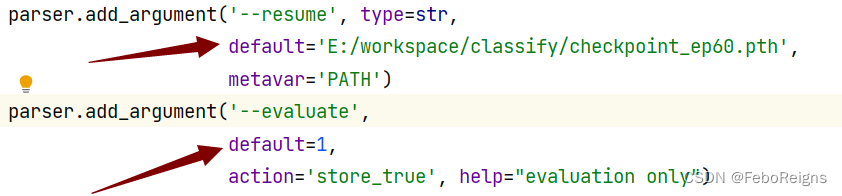
只需改
然后重新运行脚本

前面是文件名,后面是推理结果score, 猫的index是1 (如最后一列所示),可以看到后面那列的数据更大,说明预测的对
我的的代码地址 https://gitee.com/feboreigns/classify边栏推荐
- go 文件路径操作
- 当Steam教育进入个性化信息技术课程
- Informatics Olympiad 1337: [example 3-2] word search tree | Luogu p5755 [noi2000] word search tree
- Analyze the knowledge transfer and sharing spirit of maker Education
- [record of question brushing] 1 Sum of two numbers
- How to choose a good external disk platform, safe and formal?
- Composition of applet code
- 如何形成规范的接口文档
- Abnova DNA marker high quality control test program
- The Chinese Academy of Management Sciences gathered industry experts, and Fu Qiang won the title of "top ten youth" of think tank experts
猜你喜欢
鸿蒙os第四次学习

Practical demonstration: how can the production research team efficiently build the requirements workflow?
Abnova丨DNA 标记高质量控制测试方案

2022北京眼睛健康用品展,护眼产品展,中国眼博会11月举办
如何让化工企业的ERP库存账目更准确

Frequent MySQL operations cause table locking problems

王老吉药业“关爱烈日下最可爱的人”公益活动在南京启动
National Eye Care Education Conference, 2022 the Fourth Beijing International Youth eye health industry exhibition

Duchefa low melting point agarose PPC Chinese and English instructions
AI automatically generates annotation documents from code
随机推荐
Graph embedding learning notes
如何形成规范的接口文档
Use of form text box (II) input filtering (synthetic event)
中国管理科学研究院凝聚行业专家,傅强荣获智库专家“十佳青年”称号
欢迎来战,赢取丰厚奖金:Code Golf 代码高尔夫挑战赛正式启动
渗透创客精神文化转化的创客教育
Propping of resources
Chemical properties and application instructions of prosci Lag3 antibody
ProSci LAG-3 重组蛋白说明书
Mysql频繁操作出现锁表问题
Informatics Olympiad 1338: [example 3-3] hospital setting | Luogu p1364 hospital setting
Interpreting the daily application functions of cooperative robots
Classic implementation of the basic method of intelligent home of Internet of things
Ros2 topic [01]: installing ros2 on win10
19 mongoose modularization
Analyze the knowledge transfer and sharing spirit of maker Education
Welcome to the game and win rich bonuses: Code Golf Challenge officially launched
Station B up builds the world's first pure red stone neural network, pornographic detection based on deep learning action recognition, Chen Tianqi's course progress of machine science compilation MLC,
CVPR 2022 | 常见3D损坏和数据增强
Codeforces Round #804 (Div. 2) - A, B, C