当前位置:网站首页>One question per day - replace spaces
One question per day - replace spaces
2022-07-05 08:28:00 【Protect Xiaozhou】
Hello, everyone , I'm protecting Xiao Zhou ღ, This issue brings you an exercise on Niuke online —— Replace blank space , Bloggers share two ways to solve problems ( A link to this question is attached at the end ), Let's have a look ~

The topic comes from niuke.com

describe
Please implement a function , Put a string s Replace each space in with “%20”.
for example , When the string is We Are Happy. The replaced string is We%20Are%20Happy.
Data range :0 <=strlen(s) <=1000. Ensure that the characters in the string are capitalized English letters 、 One of lowercase letters and spaces .
Example 1
Input :
"We Are Happy"Return value :
"We%20Are%20Happy"
Example 2
Input :
" "Return value :
"%20"
Thinking analysis :
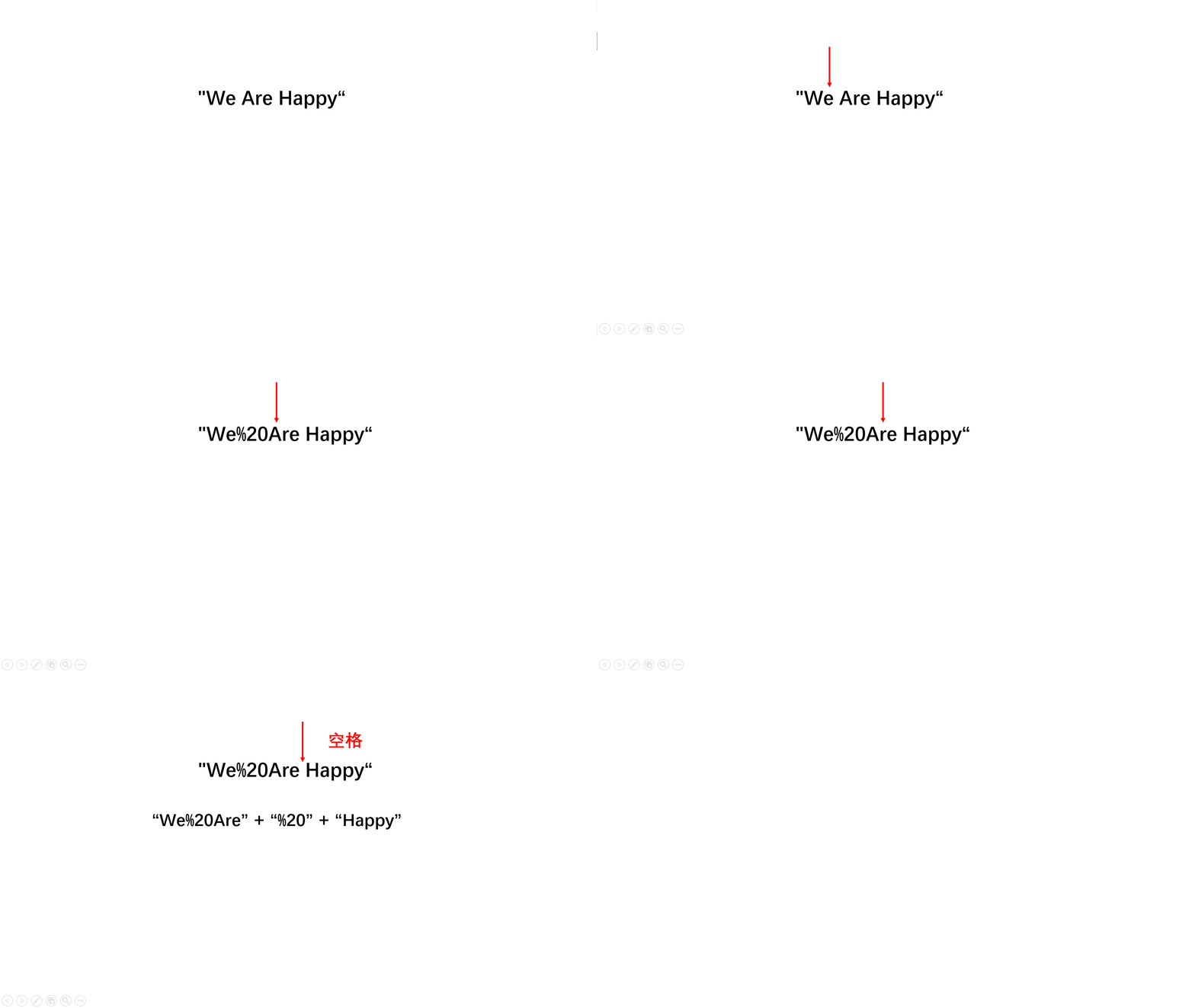
Title main information :
- Put a string s Replace each space in with “%20”;
- Ensure that the characters in the string are capitalized English letters 、 One of lowercase letters and spaces ;
Defines an array of characters ch[N], Or define a dynamically opened character array , We can take traversal strings s To determine the position of the space , Put the character before the space s The value of one to one is given to the character array we define ch, When spaces are encountered , take ch The values of spaces and the next two spaces are replaced by '%','2','0'. until character string s End flag encountered ‘\0’ until .
Program realization :
Array approach :
#include<stdio.h>
#include<string.h>

char* replaceSpace(char* s)
{
    // Because the array is opened on the stack area , Function end stack frame destroy , So want to use static Modify the array , Avoid function end , Array destroy
    static char ch[50] = { 0 };
    for (int i = 0,j = 0; s[i] != '\0'; i++, j++)
    {
        if (s[i] != ' ')
        {
            ch[j] = s[i];
        }
        else if (s[i] == ' ')
        {
            ch[j] = '%';
            ch[j + 1] = '2';
            ch[j + 2] = '0';
            j += 2;//j Follow i Keep in sync
        }
    }
    s = ch;
    // Return the pointer type according to the requirements of the topic
    return s;
}

int main()
{
	char arr[50] = {0};
	gets(arr);
	// Replace blank space
	char *str=replaceSpace(arr);
    printf("%s\n",str);
	return 0;
}
Dynamic development practices :
#include<stdio.h>
#include<string.h>
#include<stdlib.h>

char* replaceSpace(char* s)
{
    // write code here

    int N = strlen(s);// Calculate string length
    char tmp[] = { '%', '2', '0' };// replace content
    int  space = 0;// Calculate the number of spaces
    for(int i=0;i<N;++i)
    {
        if (s[i]==' ')
        {
            ++space;
        }
    }
    int Len = N + space * 2;
    // The function of dynamically opening up space on the heap ends , Will not actively destroy
    char* str =(char*)malloc(Len*sizeof(char));
    if (str == NULL)// If dynamic development fails , End procedure
        return;
    // Traversal string s
    int i = 0;
    while (*s)
    {
        if (*s == ' ')
        {
            int n = 0;
            while (n < 3)
            {
                str[i] = tmp[n];
                ++i;
                ++n;
            }
        }
        else
        {
            str[i] = *s;
            ++i;
        }
        ++s;
    }
    return str;
}

int main()
{
	char arr[50] = {0};
	gets(arr);
	// Replace blank space
	char *str=replaceSpace(arr);
    printf("%s\n",str);
	return 0;
}
Three spaces

Pay attention to :
- The return type of this question is char*
- If you define character array storage , The array is opened on the stack area of memory , Function end stack frame destroy , That is, the space opened up is recycled by the operating system , here , We take this array address as the return value , It will cause illegal access to memory , So we should use static Decorate the array , Let the array become a static global variable , It will not be destroyed because the function ends .
- Can be used to malloc() Open up a space on the heap of memory for storage , In addition to our initiative in the space on the heap free() Release and program end are recycled by the operating system , It will not be destroyed for other reasons .
If you don't know anything about dynamic memory, you can learn another blog of the blogger :C Language —— Dynamic memory
Interested friends can click on the link to try to use the blogger's method , Or do it in your own way .
The title comes from : Cattle from
link : Replace blank space _ Niuke Tiba _ Cattle from
Thank you for watching this article , Please look forward to : Protect Xiao Zhou ღ
If there is infringement, please contact to modify and delete !
边栏推荐
- Summary of SIM card circuit knowledge
- Is the security account given by Yixue school safe? Where can I open an account
- 剑指 Offer 06. 从尾到头打印链表
- Take you to understand the working principle of lithium battery protection board
- My-basic application 2: my-basic installation and operation
- NTC thermistor application - temperature measurement
- MySQL MHA high availability cluster
- STM32 --- configuration of external interrupt
- 第十八章 使用工作队列管理器(一)
- Negative pressure generation of buck-boost circuit
猜你喜欢
Several important parameters of LDO circuit design and type selection
DokuWiki deployment notes
实例008:九九乘法表

如何写Cover Letter?

Tailq of linked list
Semiconductor devices (I) PN junction

List of linked lists
【论文阅读】2022年最新迁移学习综述笔注(Transferability in Deep Learning: A Survey)
FIO测试硬盘性能参数和实例详细总结(附源码)
Bluebridge cup internet of things basic graphic tutorial - GPIO output control LD5 on and off
随机推荐
How to copy formatted notepad++ text?
Void* C is a carrier for realizing polymorphism
MATLAB小技巧(28)模糊综合评价
Wifi-802.11 negotiation rate table
Management and use of DokuWiki (supplementary)
实例006:斐波那契数列
C, Numerical Recipes in C, solution of linear algebraic equations, LU decomposition source program
General makefile (I) single C language compilation template
Naming rules for FreeRTOS
2020-05-21
matlab timeserise
Talk about the function of magnetic beads in circuits
Example 002: the bonus paid by the "individual income tax calculation" enterprise is based on the profit commission. When the profit (I) is less than or equal to 100000 yuan, the bonus can be increase
实例002:“个税计算” 企业发放的奖金根据利润提成。利润(I)低于或等于10万元时,奖金可提10%;利润高于10万元,低于20万元时,低于10万元的部分按10%提成,高于10万元的部分,可提成7.
STM32 single chip microcomputer -- volatile keyword
STM32---ADC
MySQL之MHA高可用集群
Ble encryption details
【云原生 | 从零开始学Kubernetes】三、Kubernetes集群管理工具kubectl
Sword finger offer 05 Replace spaces