当前位置:网站首页>Codeforces Round #804 (Div. 2)(A~D)
Codeforces Round #804 (Div. 2)(A~D)
2022-07-07 22:48:00 【_dawn°】
A. The Third Three Number Problem
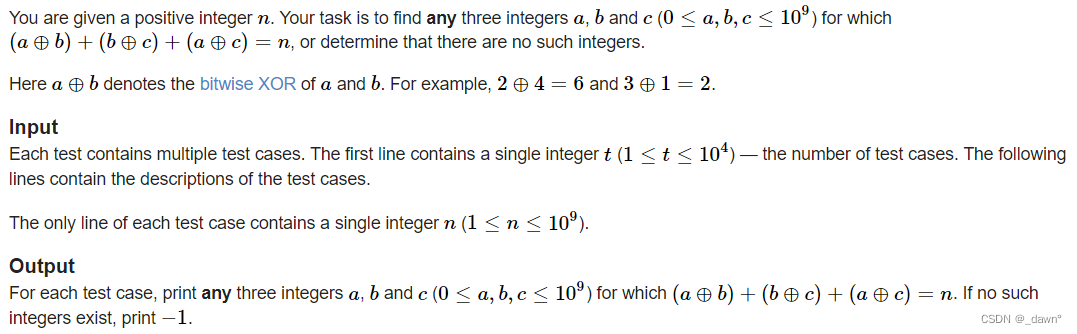
给出一个数n,找到三个数a,b,c,使得这三个数相互异或得到三个数的和等于n。
思路:其实我的思路是看到第一个样例解释来的,,

然后就想到可以是两个数相同,这样三个数的和就可以转化为两个数的和,而对于偶数,直接用n/2和0异或即可;对于奇数,样例中的1不满足,然后我就直接猜测奇数不可以满足条件,事实证明这个是可以证明的:假设二进制最后一位有k个1和3-k个0,那n的二进制最后一位的奇偶性与k*(3-k)相同,那么n的二进制最后一位应该恒为0。
AC Code:
#include <bits/stdc++.h>

#define INF 0x3f3f3f3f
typedef long long ll;
const int mod=1e9+7;
const int N=55;
int t,n;

int main(){
    std::ios::sync_with_stdio(false);
    std::cin.tie(0);
    std::cout.tie(0);
    std::cin>>t;
    while(t--){
    	std::cin>>n;
    	if(n&1){
    		std::cout<<-1<<'\n';
    		continue;
    	}
    	std::cout<<n/2<<' '<<n/2<<' '<<0<<'\n';
    }
    return 0;
}
B. Almost Ternary Matrix
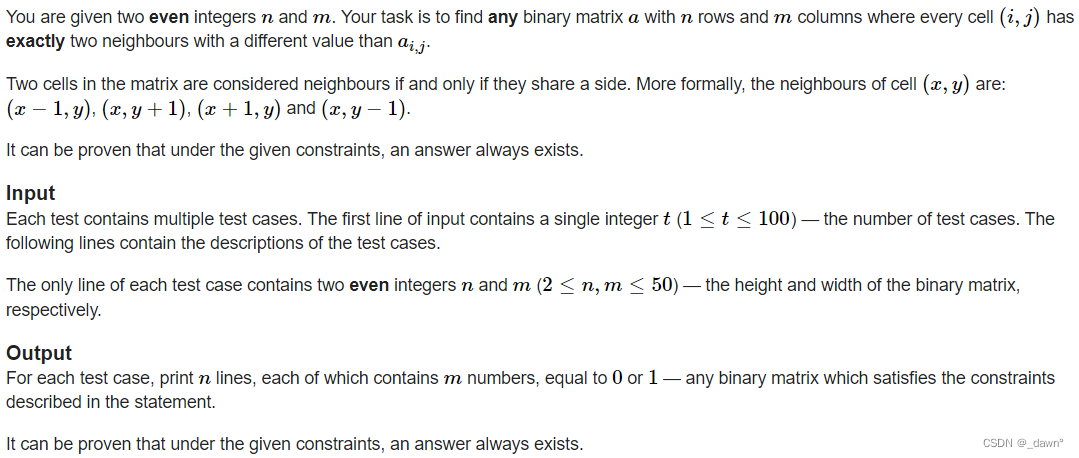
给出两个偶数,构造一个01矩阵,使得每个方块周围与它不同的方块数是2。
思路:自己画一下试试,会发现我们可以找到一个4*4的单元矩阵,根据这个单位矩阵循环输出即可,单位矩阵如下:
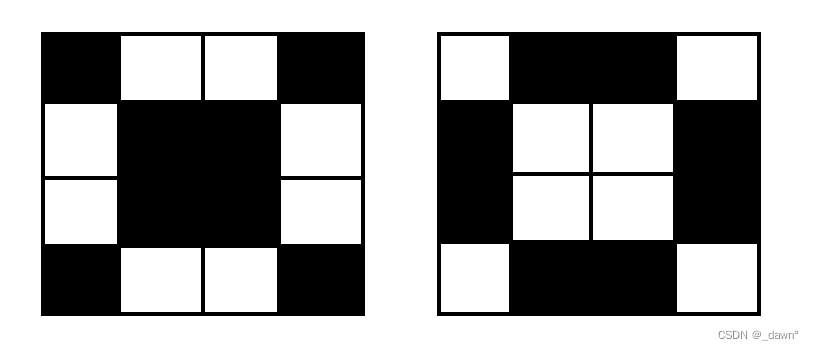
当然,01可以互换,这样代码就很简单了。
AC Code:
#include <bits/stdc++.h>

#define INF 0x3f3f3f3f
typedef long long ll;
const int mod=1e9+7;
const int N=55;
int t,n,m;
int ans[4][4]={1,0,0,1,0,1,1,0,0,1,1,0,1,0,0,1};

int main(){
    std::ios::sync_with_stdio(false);
    std::cin.tie(0);
    std::cout.tie(0);
    std::cin>>t;
    while(t--){
    	std::cin>>n>>m;
    	for(int i=0;i<n;i++){
    		for(int j=0;j<m;j++){
    			std::cout<<ans[i%4][j%4]<<" \n"[j==m-1];
    		}
    	}
    }
    return 0;
}
os:一开始因为怎么写代码想了半天hhhhh
C. The Third Problem
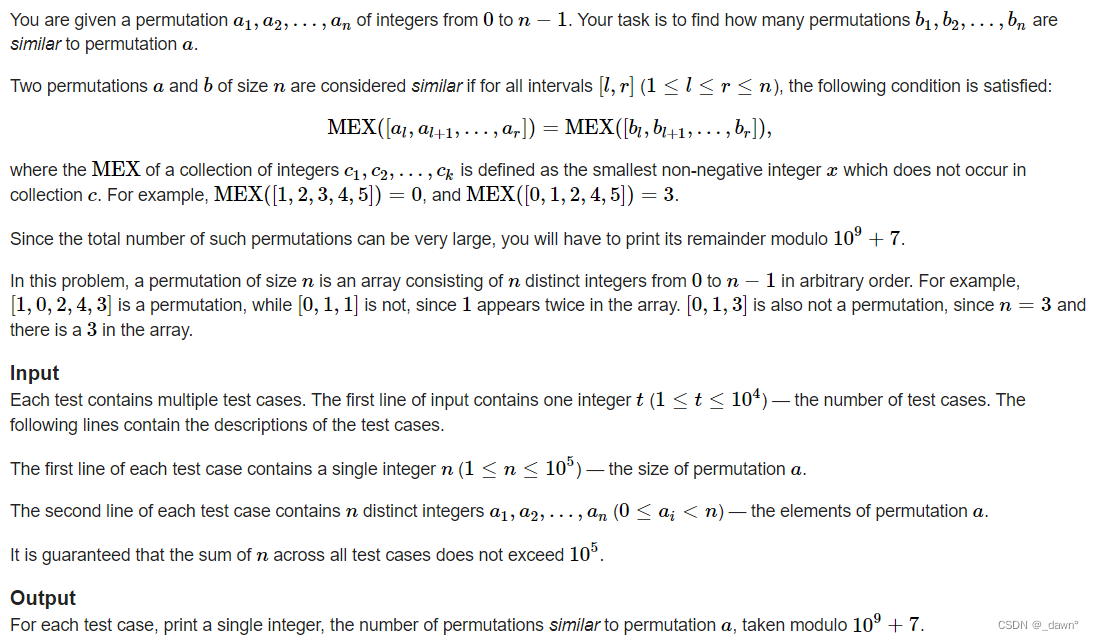
给出一个permutation,不过是从0~n-1,问有多少种重新排列这些数的方法,使得重新排序后的数组对于每个区间的MEX值相等。
思路:看到这个题,大概就是一个排列组合类似的题。根据观察我们可以发现,对于每一个数,只要这个数向前向后都有比该数小的元素存在,那这个数就可以在这个范围内移动,比如样例4:
1 3 7 2 5 0 6 4
比2小的只有0和1,那2就可以在第2到第五个位置移动;3也只能在这个范围内移动,因为比3小的数最向外只能到0和1的位置;而对于在比自己小的数字外围的数字,他们的位置是不能动的,比如4,比它小的0,1,2,3都在前面,很容易理解它的位置如果变化,那一定存在区间的MEX值变化了。根据这个性质,我们可以根据数字大小排序,从小到大枚举,不断更新比当前数小的数的最大范围区间,计算每个数有几种选择位置的方法,相乘即可。当然,0和1作为初始的区间范围,0和1的位置一定不能动。
AC Code:
#include <bits/stdc++.h>

#define INF 0x3f3f3f3f
typedef long long ll;
const int mod=1e9+7;
const int N=1e5+5;
int t,n;
int a[N];

struct node{
	int id,num;
	bool operator<(const node &a) const{
		return num<a.num;
	}
} e[N];

int main(){
    std::ios::sync_with_stdio(false);
    std::cin.tie(0);
    std::cout.tie(0);
    std::cin>>t;
    while(t--){
    	std::cin>>n;
    	for(int i=1;i<=n;i++){
    		std::cin>>a[i];
    		e[i].id=i;
    		e[i].num=a[i];
    	}
    	std::sort(e+1,e+1+n);
    	int r=-1,l=1e9;
    	ll ans=1;
    	for(int i=1;i<=n;i++){
    		r=std::max(r,e[i].id);
    		l=std::min(l,e[i].id);
    		if(i>2&&e[i].id>l&&e[i].id<r){
    			ans*=(r-l-1-i+3);
    			ans%=mod;
    		}
    	}
    	std::cout<<ans<<'\n';
    }
    return 0;
}
os:二十多分钟搞定前两个题,后面一直在想C,最后五分钟交的hhhh
D. Almost Triple Deletions
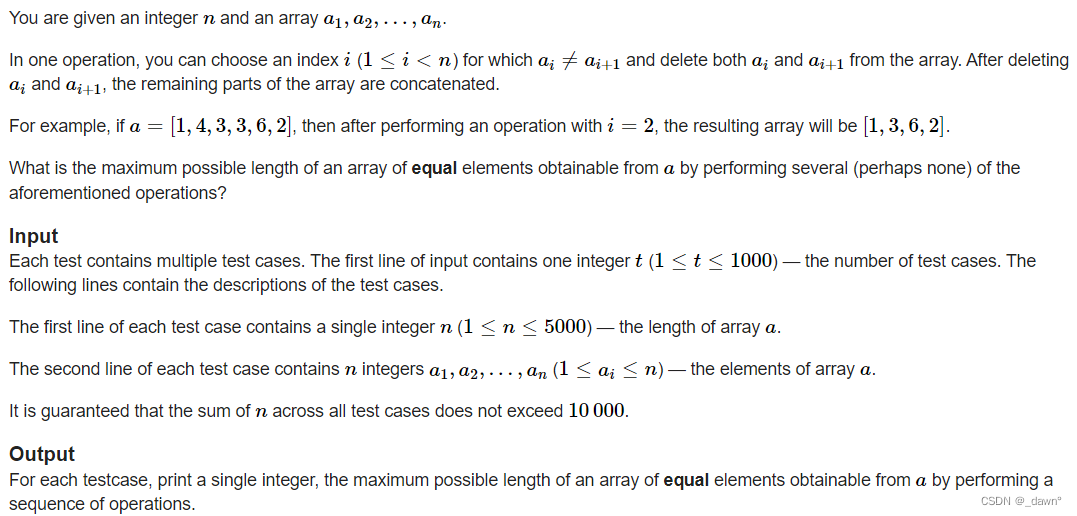
给出一个数组,若相邻两个数不同,那可以删去这两个数。最终操作完成后数组中剩余的数都相等,问最多可以保留几个数。
思路:学习大佬的思路,太顶了
我们可以认为操作的最后结果是删除部分连续区间,而对于一个区间[l,r]来说,当且仅当满足下列条件时,可以删除:区间长是偶数;区间中出现最频繁的元素的个数最大为(r-l+1)/2。
必要性一定,证明充分性:
对于出现最频繁的数,一定可以找到一种方法,删去一个和另外一个数,那么还剩下的出现次数t<=(r-l+1)/2-1;如果删除后,这个数还是出现次数最多的,那它还是满足初始条件,依旧可以删除一个该数和另一个数;如果删除后它不是出现次数最多的数了,那一定有另外一个数满足出现次数最多的初始条件,可以删除一个该数和另外一个数,这样就是这个区间内元素之间的相互转化,最后到达平衡时就是两个元素出现次数相等,都等于l/2,这样一定是可以删去的,使得该区间长为0,证毕。
所以我们可以先处理区间可以删除的子区间,cel[l][r]=1,我们定义DP数组f[i]表示从第一个到第i个数,删去部分数达到所有数都等于a[i]后,剩余的个数最大值,f[i]到f[j]的转化方程可以表示为删除区间[j,i],使得f[i]=f[j]+1。
最后的答案不一定是f[n],因为最后剩下的数不一定都等于a[n],所以需要扫一遍取最大值。
数据范围n<=5000,O(n^2)能过。
AC Code:
#include <bits/stdc++.h>

#define INF 0x3f3f3f3f
typedef long long ll;
const int mod=1e9+7;
const int N=5e3+5;
int t,n;
int a[N];

int main(){
	std::ios::sync_with_stdio(false);
	std::cin.tie(0);
	std::cout.tie(0);
	std::cin>>t;
	while(t--){
		std::cin>>n;
		for(int i=1;i<=n;i++){
			std::cin>>a[i];
		}
		int cel[n+1][n+1]={0};
		for(int l=1;l<=n;l++){
			int cnt[n+1]={0},max=0;
			for(int r=l;r<=n;r++){
				cnt[a[r]]++;
				max=std::max(max,cnt[a[r]]);
				if((r-l+1)%2==0&&max*2<=r-l+1)
					cel[l][r]=1;
			}
		}
		int f[n+1]={0};
		int ans=0;
		for(int i=1;i<n;i++){
			if(cel[1][i])
				f[i+1]=1;
		}
		f[1]=1;
		for(int i=1;i<=n;i++){
			for(int j=1;j<i;j++){
				if((j+1>i-1||cel[j+1][i-1]==1)&&a[j]==a[i]&&f[j]>0)
					f[i]=std::max(f[i],f[j]+1);
			}
			if(i==n||cel[i+1][n]) ans=std::max(ans,f[i]);
		}
		std::cout<<ans<<'\n';
	}
	return 0;
}
os:怪,这个题卡memset
嘿嘿嘿,青啦青啦!
 若有错误请指教,谢谢!
边栏推荐
- What if the testing process is not perfect and the development is not active?
- 丸子官网小程序配置教程来了(附详细步骤)
- 【测试面试题】页面很卡的原因分析及解决方案
- Play sonar
- 商品的设计等整个生命周期,都可以将其纳入到产业互联网的范畴内
- 去了字节跳动,才知道年薪 40w 的测试工程师有这么多?
- [the most detailed in history] statistical description of overdue days in credit
- v-for遍历元素样式失效
- Huawei switch s5735s-l24t4s-qa2 cannot be remotely accessed by telnet
- CoinDesk评波场去中心化进程:让人们看到互联网的未来
猜你喜欢

Fully automated processing of monthly card shortage data and output of card shortage personnel information
![[the most detailed in history] statistical description of overdue days in credit](/img/f7/5c3cbfec5b010171376ac122c704b2.png)
[the most detailed in history] statistical description of overdue days in credit

52歲的周鴻禕,還年輕嗎?
“一个优秀程序员可抵五个普通程序员”,差距就在这7个关键点

80% of the people answered incorrectly. Does the leaf on the apple logo face left or right?
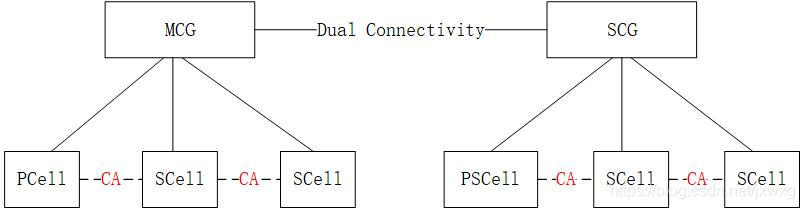
5G NR 系统消息

从服务器到云托管,到底经历了什么?
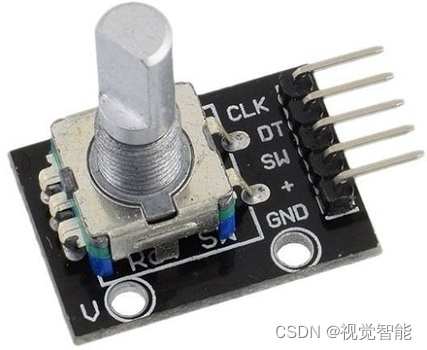
STM32F1与STM32CubeIDE编程实例-旋转编码器驱动
大数据开源项目,一站式全自动化全生命周期运维管家ChengYing(承影)走向何方?

【测试面试题】页面很卡的原因分析及解决方案
随机推荐
52岁的周鸿祎,还年轻吗?
【GO记录】从零开始GO语言——用GO语言做一个示波器(一)GO语言基础
他们齐聚 2022 ECUG Con,只为「中国技术力量」
Flask learning record 000: error summary
22年秋招心得
哪个券商公司开户佣金低又安全,又靠谱
Usage of limit and offset (Reprint)
Which securities company has a low, safe and reliable account opening commission
5g NR system messages
NVIDIA Jetson测试安装yolox过程记录
80% of the people answered incorrectly. Does the leaf on the apple logo face left or right?
Development of a horse tourism website (optimization of servlet)
What is load balancing? How does DNS achieve load balancing?
ABAP ALV LVC模板
[programming problem] [scratch Level 2] 2019.09 make bat Challenge Game
2022-07-07:原本数组中都是大于0、小于等于k的数字,是一个单调不减的数组, 其中可能有相等的数字,总体趋势是递增的。 但是其中有些位置的数被替换成了0,我们需要求出所有的把0替换的方案数量:
C # generics and performance comparison
ABAP ALV LVC template
Two small problems in creating user registration interface
C# 泛型及性能比较