当前位置:网站首页>Leetcode-206. Reverse Linked List
Leetcode-206. Reverse Linked List
2022-07-07 07:30:00 【Eistert】
subject
Given the head of a singly linked list, reverse the list, and return the reversed list.
Example 1:
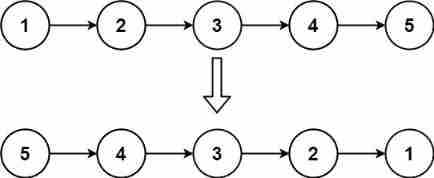
Input: head = [1,2,3,4,5]
Output: [5,4,3,2,1]
Example 2:
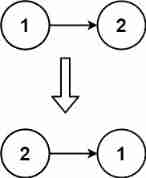
Input: head = [1,2]
Output: [2,1]
Example 3:
Input: head = []
Output: []
Constraints:
The number of nodes in the list is the range [0, 5000].
-5000 <= Node.val <= 5000
solution
Method 1 : iteration
Suppose the linked list is 1→2→3→∅, We want to change it to ∅←1←2←3.
When traversing a linked list , Set the... Of the current node next The pointer changes to point to the previous node . Because the node does not refer to its previous node , So you have to store its previous node in advance . Before changing the reference , You also need to store the latter node . Finally, the new header reference is returned .
Code
class Solution {

    public ListNode reverseList(ListNode head) {

        ListNode prev = null;
        ListNode curr = head;
        while (curr != null) {

            ListNode next = curr.next;
            curr.next = prev;
            prev = curr;
            curr = next;
        }
        return prev;
    }
}
Complexity analysis
Time complexity :O(n), among nn It's the length of the list . You need to traverse the linked list once .
Spatial complexity :O(1).
Method 2 : recursive
Code
/** * Definition for singly-linked list. * public class ListNode { * int val; * ListNode next; * ListNode() {} * ListNode(int val) { this.val = val; } * ListNode(int val, ListNode next) { this.val = val; this.next = next; } * } */
class Solution {

/** *  To list 1->2->3->4->5 give an example  * @param head * @return */
    public ListNode reverseList(ListNode head) {

        if (head == null || head.next == null) {

            /*  Returns the current node until the next node of the current node is empty   because 5 There is no next node , So the node is returned here 5 */
            return head;
        }
        // Recursively pass in the next node , The purpose is to reach the last node
        ListNode newHead = reverseList(head.next);
                /*  The first round of stack ,head by 5,head.next It's empty , return 5  The second round of stack ,head by 4,head.next by 5, perform head.next.next=head That is to say 5.next=4,  Point the child nodes of the child nodes of the current node to the current node   At this time, the linked list is 1->2->3->4<->5, because 4 And 5 Point to each other , So disconnect here 4.next=null  At this time, the linked list is 1->2->3->4<-5  Return to node 5  The third round of stack ,head by 3,head.next by 4, perform head.next.next=head That is to say 4.next=3,  At this time, the linked list is 1->2->3<->4<-5, because 3 And 4 Point to each other , So disconnect here 3.next=null  At this time, the linked list is 1->2->3<-4<-5  Return to node 5  The fourth round of stack ,head by 2,head.next by 3, perform head.next.next=head That is to say 3.next=2,  At this time, the linked list is 1->2<->3<-4<-5, because 2 And 3 Point to each other , So disconnect here 2.next=null  At this time, the linked list is 1->2<-3<-4<-5  Return to node 5  The fifth round comes out of the stack ,head by 1,head.next by 2, perform head.next.next=head That is to say 2.next=1,  At this time, the linked list is 1<->2<-3<-4<-5, because 1 And 2 Point to each other , So disconnect here 1.next=null  At this time, the linked list is 1<-2<-3<-4<-5  Return to node 5  Stack out complete , Final header node 5->4->3->2->1 */
        head.next.next = head;
        head.next = null;
        return newHead;
    }
}
Complexity analysis
Time complexity :O(n), among nn It's the length of the list . You need to reverse each node of the linked list .
Spatial complexity :O(n), among nn It's the length of the list . The space complexity mainly depends on the stack space of recursive calls , At most nn layer .
source
author :LeetCode-Solution
link :https://leetcode-cn.com/problems/reverse-linked-list/solution/fan-zhuan-lian-biao-by-leetcode-solution-d1k2/
source : Power button (LeetCode)
The copyright belongs to the author . Commercial reprint please contact the author for authorization , Non-commercial reprint please indicate the source .
边栏推荐
- OOM(内存溢出)造成原因及解决方案
- RuntimeError: CUDA error: CUBLAS_ STATUS_ ALLOC_ Failed when calling `cublascreate (handle) `problem solving
- Explain Bleu in machine translation task in detail
- Mutual conversion between InputStream, int, shot, long and byte arrays
- Summary of customer value model (RFM) technology for data analysis
- 1090: integer power (multi instance test)
- 3、 High quality programming and performance tuning practical youth training camp notes
- BGP experiment (1)
- 修改Jupyter Notebook文件路径
- Bi she - college student part-time platform system based on SSM
猜你喜欢
Sqlmap tutorial (IV) practical skills three: bypass the firewall

RuntimeError: CUDA error: CUBLAS_ STATUS_ ALLOC_ Failed when calling `cublascreate (handle) `problem solving
Example of Pushlet using handle of Pushlet
Asynchronous components and suspend (in real development)

普通测试年薪15w,测试开发年薪30w+,二者差距在哪?
抽丝剥茧C语言(高阶)指针进阶练习
三、高质量编程与性能调优实战 青训营笔记
抽絲剝繭C語言(高階)指針的進階
外包干了四年,废了...

My ideal software tester development status
随机推荐
身边35岁程序员如何建立起技术护城河?
Abnova membrane protein lipoprotein technology and category display
詳解機器翻譯任務中的BLEU
At the age of 20, I got the ByteDance offer on four sides, and I still can't believe it
【leetcode】1020. Number of enclaves
Sqlmap tutorial (IV) practical skills three: bypass the firewall
LC interview question 02.07 Linked list intersection & lc142 Circular linked list II
二、并发、测试笔记 青训营笔记
Chinese and English instructions prosci LAG-3 recombinant protein
Flexible layout (I)
FPGA course: application scenario of jesd204b (dry goods sharing)
Detailed explanation of neo4j installation process
我理想的软件测试人员发展状态
[semantic segmentation] - multi-scale attention
Blue Bridge Cup Birthday candles (violence)
How to * * labelimg
A concurrent rule verification implementation
leetcode 509. Fibonacci number
[explanation of JDBC and internal classes]
Fullgc problem analysis and solution summary